


Eyeing Migrant Returns, EU Pushes to Revive Syria Ties

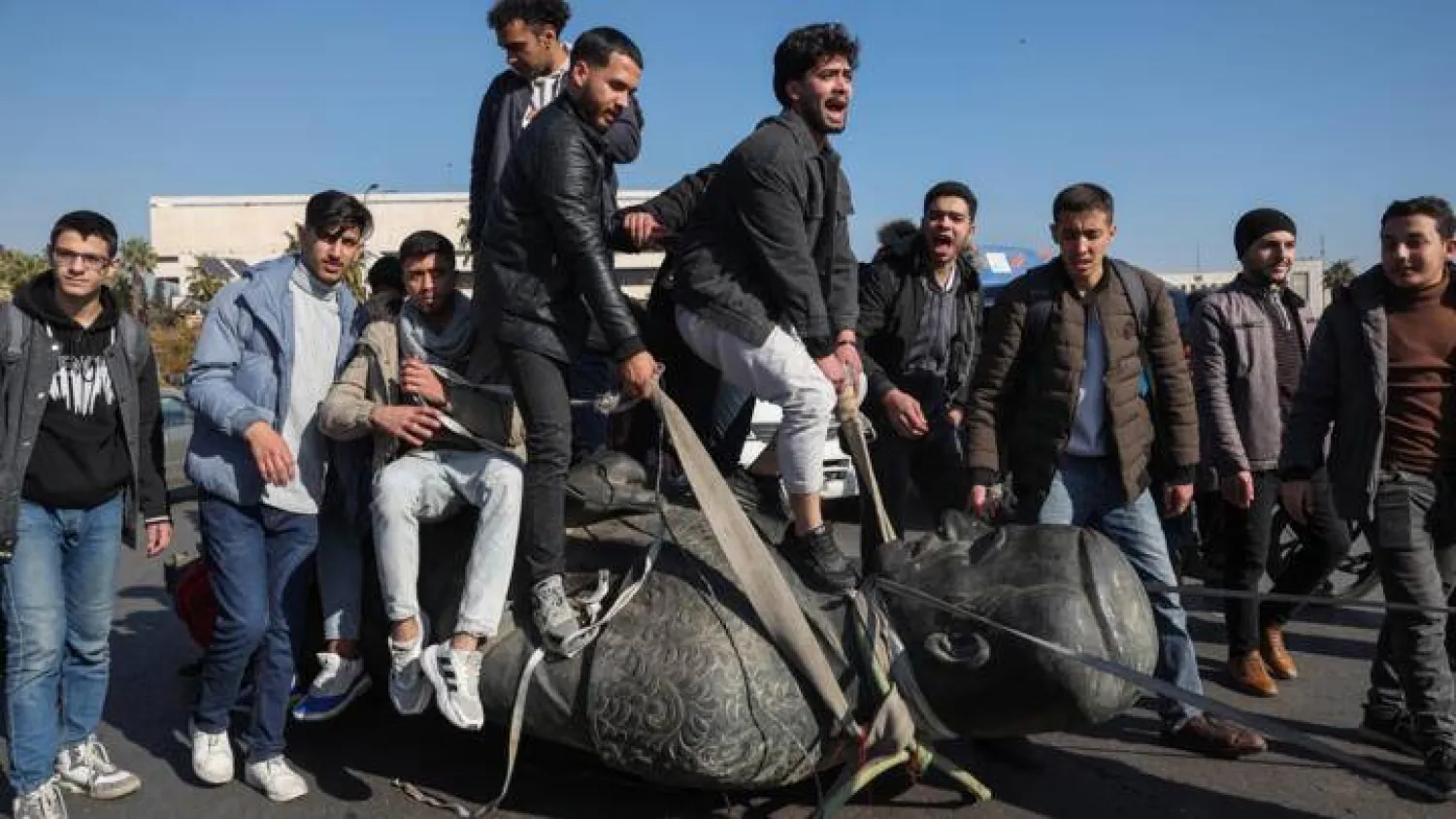
Students stand on the toppled statue of late president Hafez al-Assad during a rally near the campus of the Damascus University in the Syrian capital on December 15, 2024. Omar Haj Kadour, AFP
TT

Eyeing Migrant Returns, EU Pushes to Revive Syria Ties

Students stand on the toppled statue of late president Hafez al-Assad during a rally near the campus of the Damascus University in the Syrian capital on December 15, 2024. Omar Haj Kadour, AFP

The European Union is to push Monday for a revival of ties with Syria as it looks to bolster the war-ravaged country -- with an eye on prospects for Syrian migrants in Europe to one day return home.

The bloc's foreign ministers will meet in Brussels with Syrian top diplomat Asaad al-Shaibani to kick off a high-level "political dialogue" 18 months after the ouster of strongman Bashar al-Assad.

An EU official said the aim was to back reconstruction of the country devastated by more than a decade of civil war that sent millions fleeing abroad, and where "the reality on the ground is still appalling".

Some 13 million Syrians -- nearly half the population -- depend on food assistance, the official said. Needs are enormous, and the EU has already pledged 620 million euros ($730 million) in aid for the 2026-2027 period.

But Syria's stability also interests many EU countries because its nationals have made up the lion's share of asylum-seekers in the bloc over a decade -- and there is a push for large numbers to eventually go back home.

"We need the Syrian transitional government to succeed in bringing stability to the country, because that's in our interest," said one EU diplomat.

- Several deals in cards -

The 27-nation bloc launched a new chapter with Syria after Assad was swept from power in December 2024.

European Commission chief Ursula von der Leyen promised after meeting President Ahmed al-Sharaa in Damascus in January that Europe would "do everything it can" to support Syria's recovery.

Last month, the commission proposed that EU states fully reactivate the bloc's cooperation agreement with Syria -- a step expected to be approved Monday.

The deal -- abolishing duties on imports of most industrial products from Syria -- was partially suspended in 2011 when Assad ruthlessly cracked down on protests at the start of the civil war.

Before, Syria-EU trade had peaked at more than seven billion euros ($9.1 billion at the 2010 exchange rate) in 2010. By 2023, EU imports from the country had dwindled to 103 million euros, while European exports to Syria stood at 265 million euros.

Looking ahead, the EU wants a more ambitious association agreement, similar to those struck with other countries in the region such as Egypt, Israel and Lebanon -- though officials say that goal remains a way off.

In the meantime, the EU wants to facilitate access to financing for Syrians -- crucial to revive the economy -- and to support farmers, for example with irrigation pumps.

It is also on track to sign a deal to rehabilitate a major hospital in the western Homs region.

- Voluntary returns -

On the sensitive matter of Syrian migrant returns, Germany -- home to the EU's largest Syrian diaspora at more than a million -- is on the front line.

Chancellor Friedrich Merz has embraced tougher migration policies as he seeks to counter the far right -- and he triggered a backlash by declaring during a visit by Syria's president last month that he hoped 80 percent of Syrian refugees would return home within three years.

He later clarified this was a figure put forward by Sharaa himself.

Danish authorities have been outspoken in pushing for Syrians to go home.

But at the EU level there is no question of forcing Syrians to leave, a European official said.

There is a consensus that the conditions are not ready for large-scale voluntary returns, said Julien Barnes-Dacey, Middle East and North Africa director at the European Council on Foreign Relations.

"Most Europeans are cognisant of the reality that for the moment conditions on the ground are not improving fast enough, particularly in the economic sphere, to persuade Syrians to pack up their lives in Europe and head home," he said.

An EU official said the focus was "working on stability, on Syria's economic recovery -- because that really is the path for people to be able to go home in sustainable conditions."

But the commission also wants to establish a "straight and regular dialogue" on returns with Damascus, the official added, saying the matter "will obviously feature" in Monday's talks.



Israel Says One Soldier Killed in Lebanon after Vehicle Overturned

Israeli soldiers carrying the coffin of a soldier killed in southern Lebanon during his funeral in Kfar Saba, Israel, on Sunday (dpa)
TT

Israel Says One Soldier Killed in Lebanon after Vehicle Overturned

Israeli soldiers carrying the coffin of a soldier killed in southern Lebanon during his funeral in Kfar Saba, Israel, on Sunday (dpa)

An Israeli military official ‌said ‌on Thursday a ‌soldier ⁠was killed in ⁠southern Lebanon after a vehicle ⁠had ‌overturned.

The official ‌described the ‌incident ‌as an accident, Reuters said.

Earlier, the ‌military said a soldier ⁠had ⁠died during "operational activity".

The pace of violence in Lebanon has eased recently, but Israeli Defense Minister Israel Katz stressed that his forces would remain in southern Lebanon.

“We have stated that, in any case, we will not withdraw, and up to this moment — and this is a diplomatic achievement — there has been no US request for Israel to withdraw from Lebanon,” Katz said in an interview during a conference of local leaders in Tel Aviv.

Israel and Lebanon are currently holding US-mediated talks in Washington aimed at reaching a diplomatic solution to the conflict, including the disarmament of Hezbollah and the withdrawal of Israeli forces.

Since April, Lebanon has engaged in direct talks with Israel under US pressure, with the aim of ending the latest war between Hezbollah and Israel.

Lebanese authorities have stressed their determination to keep Lebanon’s file separate from negotiations involving Iran, Hezbollah’s main backer.

On Wednesday, Lebanese President Joseph Aoun stressed that “the negotiations in Washington are separate from the meetings held in Switzerland last week between the United States and Iran, which were followed by Qatar and Pakistan.”


Iraqi Judiciary Applies ‘Terrorism Provisions’ to Drones

People watch as smoke billows from an oil warehouse in the Kani Qirzhala area on the outskirts of Erbil, the capital of Iraq's autonomous Kurdistan region, following a suspected drone strike, on April 1, 2026. (Photo by AFP)
TT

Iraqi Judiciary Applies ‘Terrorism Provisions’ to Drones

People watch as smoke billows from an oil warehouse in the Kani Qirzhala area on the outskirts of Erbil, the capital of Iraq's autonomous Kurdistan region, following a suspected drone strike, on April 1, 2026. (Photo by AFP)

Iraq’s Supreme Judicial Council has instructed the country’s courts to apply the provisions of the Anti-Terrorism Law to anyone who manufactures, uses, or possesses drones for unlawful purposes, while a security official said the directive is aimed specifically at curbing the activities of armed factions.

In a brief statement on Wednesday, the Council said it had directed the competent courts to enforce Anti-Terrorism Law No. 13 of 2005 against “anyone who manufactures, uses, or possesses drones employed for purposes contrary to the law.”

The law is Iraq’s principal legal framework for prosecuting terrorist crimes that threaten national unity and public safety, carrying penalties of up to the death sentence for perpetrators, instigators, planners, and financiers.

The directive comes amid months of government efforts to bring all weapons under state control and dismantle armed groups operating outside official security institutions.

An Interior Ministry security official told Asharq Al-Awsat that the judicial directive is “exclusively linked to armed factions” and is intended to increase pressure on them. He said the measure places drone-related offenses under terrorism statutes even though Iraqi law permits the use of officially licensed drones, indicating that it is directed at attacks carried out - or potentially to be carried out - by armed factions.

Speaking on condition of anonymity, the official described drones as one of Iraq’s most serious security challenges because they are easy to transport and operate, while the country lacks effective counter-drone capabilities, a weakness exposed during recent attacks.

Since the outbreak of the US-Israeli war against Iran on February 28, armed factions have carried out hundreds of attacks, many involving drones, against civilian and military targets.

Kurdish sources say cities in the Kurdistan Region alone have come under more than 800 attacks by Iran-aligned factions, ostensibly because of the presence of US forces and Iranian Kurdish opposition groups.

The factions have also launched dozens of drone attacks against vital assets in several Gulf states and Jordan, prompting those countries to issue a joint statement on March 25 condemning the attacks and urging Baghdad to take immediate action to halt operations by Iran-backed armed groups.

Iraq has long permitted drones for civilian, commercial, and official security purposes, provided operators obtain prior approval from the Iraqi Civil Aviation Authority and the relevant security agencies.

In early February, the authority introduced new regulations governing licensing, operating requirements, legal obligations, and approved uses, including media production, filmmaking, advertising, tourism, protection of oil and energy pipelines and public utilities, agriculture, environmental monitoring, border security, and official Interior Ministry thermal-drone operations against smugglers.

Drone manufacturing is also “common in Iraq,” according to Ahmed al-Janabi, a software and telecommunications engineer, though primarily for civilian and service-related uses. He said drone components are widely available on Iraqi markets and enter the country through multiple routes, including smuggling networks from Iran via Sulaymaniyah.

Specialized import offices also supply drones, often disguising component shipments. While authorities routinely confiscate unauthorized drones and impose relatively light prison sentences on violators, al-Janabi said the key change is that such offenses are now prosecuted under the Anti-Terrorism Law.


Beirut Transfers 128 Syrian Convicts Home

Lebanese army soldiers secure the area at the entrance of Zawtar al-Gharbiyah village, southern Lebanon, 23 June 2026, amid a ceasefire between Israel and Hezbollah. EPA/WAEL HAMZEH
TT

Beirut Transfers 128 Syrian Convicts Home

Lebanese army soldiers secure the area at the entrance of Zawtar al-Gharbiyah village, southern Lebanon, 23 June 2026, amid a ceasefire between Israel and Hezbollah. EPA/WAEL HAMZEH

Lebanon has transferred 128 Syrian convicts to their home country, a Lebanese security source told AFP on Wednesday, the second batch of handovers under an agreement the two sides signed earlier this year.

Overcrowded Lebanese prisons host around 2,000 Syrian nationals held on various charges.

Many are still awaiting trial, while hundreds have been brought before military courts on charges of "terrorism" or related offences, including attacks on Lebanese forces.

Others are in custody for alleged membership in militant or armed groups that were opposed to now-ousted Syrian president Bashar al-Assad, who was supported by Lebanon's Hezbollah during the Syrian civil war.

The security source, who requested anonymity, said that Beirut "handed over the second batch of Syrian convicts in Lebanon to Damascus, numbering 128 convicts" on Wednesday.

The transfer follows the handover of more than 130 Syrian detainees in March, under an agreement signed between the two countries the previous month, which will cover almost 300 convicts who have served 10 years or more in Lebanese prisons.

Under the agreement, they will be required to complete the remainder of their sentences in Syria.

At least 260 convicts have now been sent to Syria's Adra prison out of 356 in Lebanon's Roumieh, the source added.

The issue of the detainees had been a sticking point in Beirut-Damascus relations following Assad's overthrow in December 2024.

It was discussed by Lebanese Prime Minister Nawaf Salam during his visit to Damascus in May, where he met Syrian President Ahmed al-Sharaa.

Over the past year, both sides have repeatedly expressed their determination to open a new chapter in their relations.