
Lebanon Urges US Ambassador to Push Israel to Halt Bombardments

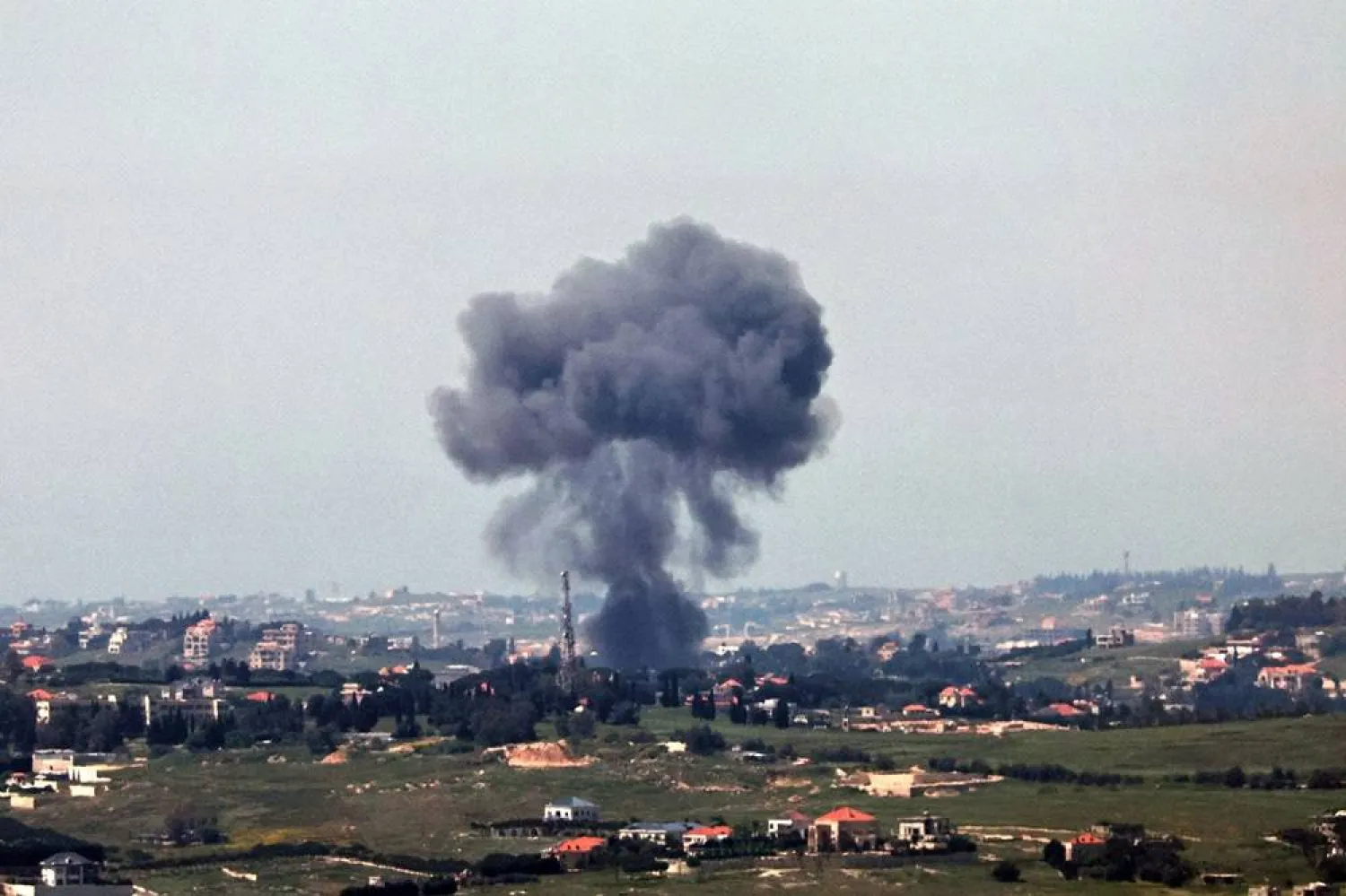
Smoke rises as a result of an Israeli strike on a southern Lebanon village as seen from the Upper Galilee on the Israel-Lebanon border, 11 May 2026. (EPA)
TT

Lebanon Urges US Ambassador to Push Israel to Halt Bombardments

Smoke rises as a result of an Israeli strike on a southern Lebanon village as seen from the Upper Galilee on the Israel-Lebanon border, 11 May 2026. (EPA)

Lebanese leaders urged the US ambassador to Beirut to pressure Israel to halt its attacks as it pounded the country with airstrikes on Monday despite a ceasefire in the Israel-Hezbollah war. 

Lebanese authorities raised the overall death toll from Israeli strikes since March 2 to 2,869 people. That figure includes dozens killed since the truce went into force on April 17. 

Israel's military said one of its soldiers had been killed a day earlier in fighting near the border with Lebanon, bringing its losses to 18 troops and a civilian contractor since the war began. 

Lebanese President Joseph Aoun and Prime Minister Nawaf Salam met separately with US ambassador Michel Issa in preparation for a third meeting between Lebanese and Israeli representatives set to take place in Washington on Thursday and Friday. 

Aoun "stressed ... the necessity of pressure on Israel to halt fire and military operations and the destruction ‌and bulldozing of homes", the presidency said.  

Israel has been demolishing villages in the ‌south, saying it is acting against Hezbollah fighters embedded in civilian areas.  

Aoun and Issa also reviewed "developments related" to a third round of talks due in Washington between Lebanese and Israeli government representatives, the presidency said. 

Salam said he asked Issa to "exert pressure on Israel to stop the ongoing attacks and violations, in order to consolidate the ceasefire". 

Israel has intensified its attacks on Lebanon of late, with weekend strikes reaching as close as around 20 kilometers (12 miles) from the capital Beirut. 

On Monday, Lebanon's official National News Agency (NNA) reported Israeli airstrikes on more than 30 locations in the south and east. 

It reported casualties in several areas, including south Lebanon's Zebdine, where it said an Israeli drone struck two people "while they were distributing bread" in a municipality vehicle to residents who had refused to leave the town. 

Under the terms of the ceasefire published by Washington, Israel reserves the right to act against "planned, imminent or ongoing attacks". 

- Third round of talks - 

Washington last month hosted two rounds of talks between the Israeli and Lebanese ambassadors to Washington, the highest-level ‌contacts between Israel and Lebanon in decades. The US will facilitate the third round on May 14 and 15, the State Department ⁠said.  

Lebanon's delegation will ⁠be headed by former ambassador to Washington Simon Karam. Aoun, who nominated Karam for the role, gave him his directives during a meeting on Saturday, the presidency said.  

Beirut's decision to hold face-to-face contacts with Israel reflects a deep divide in Lebanon over Hezbollah's arsenal and the group's decision to attack Israel.  

Critics accuse the group of unilaterally dragging Lebanon into war. Hezbollah has demanded the government cancel the talks. 

- Displacement - 

Israel's army issued an evacuation warning ahead of strikes on seven south Lebanon towns and two others in the Bekaa region in the country's east. 

The NNA reported a "large wave of displacement" in West Bekaa as hundreds of families fled the threatened towns. 

Lebanese authorities say the war has displaced more than one million people. 

Hezbollah claimed at least 20 attacks on Israeli military targets in south Lebanon, including bulldozing equipment, in what it said was retaliation for ceasefire violations. 

The Israeli army said two Hezbollah drones had damaged "unmanned engineering vehicles" in south Lebanon, and that its troops had "eliminated" a fighter cell there. 

Hezbollah drew Lebanon into the wider Middle East war on March 2 when it launched rockets at Israel to avenge the killing of Iran's supreme leader in US-Israeli strikes. 

Israel responded with airstrikes and a ground invasion. Its troops are operating inside an Israeli-declared "yellow line" that runs around 10 kilometers (six miles) north of Lebanon's border where Lebanese residents have been warned not to return. 

In an interview with Al Arabiya channel on Sunday, Salam said the country was "facing the occupation of 68 Lebanese villages as a result of this war that was imposed on us". 


Iran Reacts with Concern to Reports of Clandestine Israeli Base in Iraq

Iraq's parliamentary security and defense committee meets on Sunday. (Iraqi parliament)
TT

Iran Reacts with Concern to Reports of Clandestine Israeli Base in Iraq

Iraq's parliamentary security and defense committee meets on Sunday. (Iraqi parliament)

Iran has reacted with concern to media reports of a clandestine makeshift Israeli military that was used during the recent war on Iran.

Iranian Foreign Ministry spokesman Esmail Baghaei said on Monday: “We are not ruling out anything related to the Zionist entity in the region.”

“Anything must be taken seriously and this issue is important and will certainly be discussed with Iraq,” he added.

Israeli forces established a makeshift base using an old airstrip in Iraq's desert during the war against Iran, two security officials told AFP on Sunday, confirming a report by The Wall Street Journal.

Early in the war, which was ignited by joint US-Israeli attacks on Iran on February 28, the troops were detected in the Najaf desert in the country's southwest and clashed with Iraqi forces, killing one soldier and wounding two others.

Iraq has scrambled to address the reports. The parliamentary security and defense committee said it will meet with security leaders to probe “foreign military breaches and activities.”

Iraq’s security media cell denied that a new airdrop had taken place in the Karbala desert in what seen as an attempt to avoid directly addressing the reports about the alleged Israeli base.

Commenting on the western reports, head of the cell Saad Maan said they tackled an incident that took place on March 5.

“Iraqi security and military forces engaged in combat with an unlicensed force at a time, leading to the death of a member of the security forces and injury of two others,” he said. WSJ had not spoken about a new military deployment in the area.

Maan continued: “A search of the area last month and this month did not reveal traces of any unlicensed forces or equipment. Our forces will continue to carry out their duties.”

There are no “unlicensed forces” in any other region in Iraq, he added.

Hussein Allawi, advisor to outgoing Prime Minister Mohammed Shia al-Sudani, offered a different account of what happened.

Speaking to Al Arabiya, he said that the airdrop “aimed at collecting something that had fallen from the sky over the Iraqi desert during the US-Israel war on Iran.”

A shepherd who was in the area informed security forces of unusual activity. The forces then headed to the scene, which thwarted the airdrop, he explained.

He denied that Israel had set up a base in Iraq, saying the WSJ report was “inaccurate and aimed to stir up certain issues.”

On Sunday, the parliamentary security and defense committee said it will host security leaders to investigate “foreign military breaches and activities” in the border regions between Karbala and al-Anbar.

It stressed its “categorical” rejection that Iraq become an arena for settling scores or that it be turned into a platform for attacks against neighboring countries.

Committee member Karim Aliwi Al-Muhammadawi told the Iraqi News Agency that he had previously warned of the presence of US forces in the region between Karbala and al-Anbar.

He confirmed the shepherd report of foreign forces in the area.

“Preliminary reports found that efforts had been made to turn the region into a support point for military operations against Iran,” he revealed, saying the drone and rocket attacks would have been launched from there.

The committee will meet with the security leaders to further investigate the issue, he said. The government will take the necessary measures to tackle the violation of Iraq’s sovereignty.


Land Registration in East Jerusalem Israeli ‘Tool’ to Expel Palestinians

Palestinian workers rest during the demolition of shops before the arrival of an Israeli army demolition team in the occupied Palestinian West Bank town of Al-Eizariya adjacent to East Jerusalem on Sunday (AFP) 
TT

Land Registration in East Jerusalem Israeli ‘Tool’ to Expel Palestinians

Palestinian workers rest during the demolition of shops before the arrival of an Israeli army demolition team in the occupied Palestinian West Bank town of Al-Eizariya adjacent to East Jerusalem on Sunday (AFP) 

Initial data from a land registration drive launched in Israeli-annexed east Jerusalem point to a “deeply alarming” trend of land appropriation by the Israeli state, an Israeli rights group said Monday.

Land registration in East Jerusalem began during the British Mandate between 1923 and 1948, and continued under the Jordanian administration starting in 1949.

Israel resumed land registration in east Jerusalem in 2018, reviving a process that had largely been suspended after it occupied and annexed the territory in 1967, said Bimkom, an Israeli rights group focused on urban planning and the protection of Palestinian rights in east Jerusalem.

The rights group examined the first official data covering roughly 2.3 square kilometers, or about 3% of east Jerusalem, where registration procedures have been completed.

It found that 82% of the land surveyed had been registered under the Israeli state or the Jerusalem municipality.

Another 9% was listed under “unknown owners” -- a classification the group described as an initial step toward eventual state takeover -- while 4% was registered to Jewish owners, most of them connected to the settler movement, according to AFP.

According to Bimkom, approximately 4% of the plots were registered to churches, while only 1% were recorded under Palestinian ownership.

Bimkom warned that the registration process is being used by Israeli authorities for “effectively taking land ... from beneath people's feet,” calling it “deeply alarming.”

“This data clearly indicates that the renewed... procedures do not serve -- and were not intended to serve -- the Palestinian residents of the city, but rather to provide a bureaucratic tool for the appropriation of Palestinian land for the benefit of the state,” it said.

The registration process advances plot by plot and lacks transparency, Bimkom architect Sari Kronish told AFP.

“There is no transparency regarding why and how the choices of where to begin are made,” Kronish said.

The areas where registration has already been completed largely correspond to vacant land earmarked for settlement construction, a pattern Bimkom says reinforces concerns that political motivations are driving the process.

The NGO added that a small part of these zones include Palestinian homes, but most of which have been registered under the state or entities linked to settlement groups.

Until Monday noon, Israel's justice ministry, which oversees the registration process, did not respond to requests for comment.

Bimkom denounced what it described as increasingly restrictive measures toward Palestinians, for whom proving land ownership has become nearly impossible.

Jerusalem lies at the core of the Israeli-Palestinian conflict.

Also, the report said that in 2025, Israeli authorities approved only about 640 housing units for Palestinians in East Jerusalem, compared to roughly 9,000 units approved for Jewish residents across the city.


Hamas Nears Final Step in Choosing New Political Chief

A billboard of Hamas' slain leader Yahya Sinwar is displayed at the Palestine square in Tehran, Iran, 19 October 2024. EPA/ABEDIN TAHERKENAREH
TT

Hamas Nears Final Step in Choosing New Political Chief

A billboard of Hamas' slain leader Yahya Sinwar is displayed at the Palestine square in Tehran, Iran, 19 October 2024. EPA/ABEDIN TAHERKENAREH

Hamas is close to electing a new head of its political bureau, who will oversee the movement until the end of this year or early next year, pending broader internal elections in the Palestinian territories and abroad.

Asharq Al-Awsat learned from three Hamas sources outside Gaza that members of the movement’s political bureau — excluding those already in Gaza and the West Bank — along with members of its Shura Council, have been meeting in Istanbul for several days. Participants also attended funeral ceremonies for Azzam Al-Hayya, the son of Khalil Al-Hayya, Hamas’ political leader in Gaza.

According to the sources, Khalil Al-Hayya traveled from Türkiye to Qatar to be with his family after his son Azzam was killed in an Israeli airstrike last Wednesday. The strike also reportedly killed a field commander from the elite forces of the Al-Qassam Brigades, Hamas’ armed wing.

The sources said Al-Hayya is expected to return to Istanbul to resume his duties, including preparations for the final phase of selecting Hamas’ new political bureau chief.

Hamas is facing what observers describe as its most severe crisis since the movement was founded in 1987. Israeli operations launched after the October 7, 2023 attack have targeted multiple branches and leadership levels within the organization, creating significant organizational and financial strains.

Current assessments suggest that Khaled Meshaal, Hamas’ external political chief, and Khalil Al-Hayya are the leading contenders for the top position.

The movement is waiting for what sources described as “appropriate security and political conditions” before holding comprehensive elections across Palestinian territories and Hamas’ overseas branches to choose a new Shura Council, political bureau, executive body, and regional leadership structures.

For roughly the past year and a half, Hamas affairs have been managed by a temporary “leadership council.” Earlier this year, the movement began efforts to select a leader to complete the remainder of the current political bureau’s term, which was originally due to end in 2025 but was extended by one year until broader elections can be held late this year or early next year.

Momentum Builds Around Al-Hayya

Sources outside Gaza said Hamas could announce the identity of its new political bureau chief within days, possibly by the end of this week or early next week.

A fourth Hamas source in Gaza told Asharq Al-Awsat that some within the movement are pushing for Al-Hayya’s election, particularly after the killing of his fourth son.

With Azzam Al-Hayya’s death last week, Khalil Al-Hayya has now lost four sons in Israeli strikes. Earlier, Azzam’s twin brother, Hammam Al-Hayya, was killed in a strike targeting Hamas leaders in Doha in September 2025.

New Mediation Proposal Expected

A Palestinian faction source said mediators, particularly Egypt, are expected to present a revised proposal aimed at narrowing gaps between Hamas and Israel. The source said Israel’s response to the latest framework remained negative, citing disputes over weapons, withdrawal terms, and reconstruction conditions.

Meanwhile, Israel intensified accusations that Hamas is rebuilding military infrastructure, manufacturing weapons, and exploiting humanitarian aid through taxation. Hamas spokesman Hazem Qasim rejected the claims, saying they were intended to justify continued Israeli military escalation and tighter restrictions on Gaza.

Qasim also said Hamas remains committed to the Sharm El-Sheikh ceasefire agreement signed in October 2025, despite what he described as thousands of Israeli violations since the truce took effect. According to the report, more than 856 Palestinians have been killed since the ceasefire began.