
War Worsens Lebanon's Economic Crisis with Job Losses, Price Gouging and Slow Business

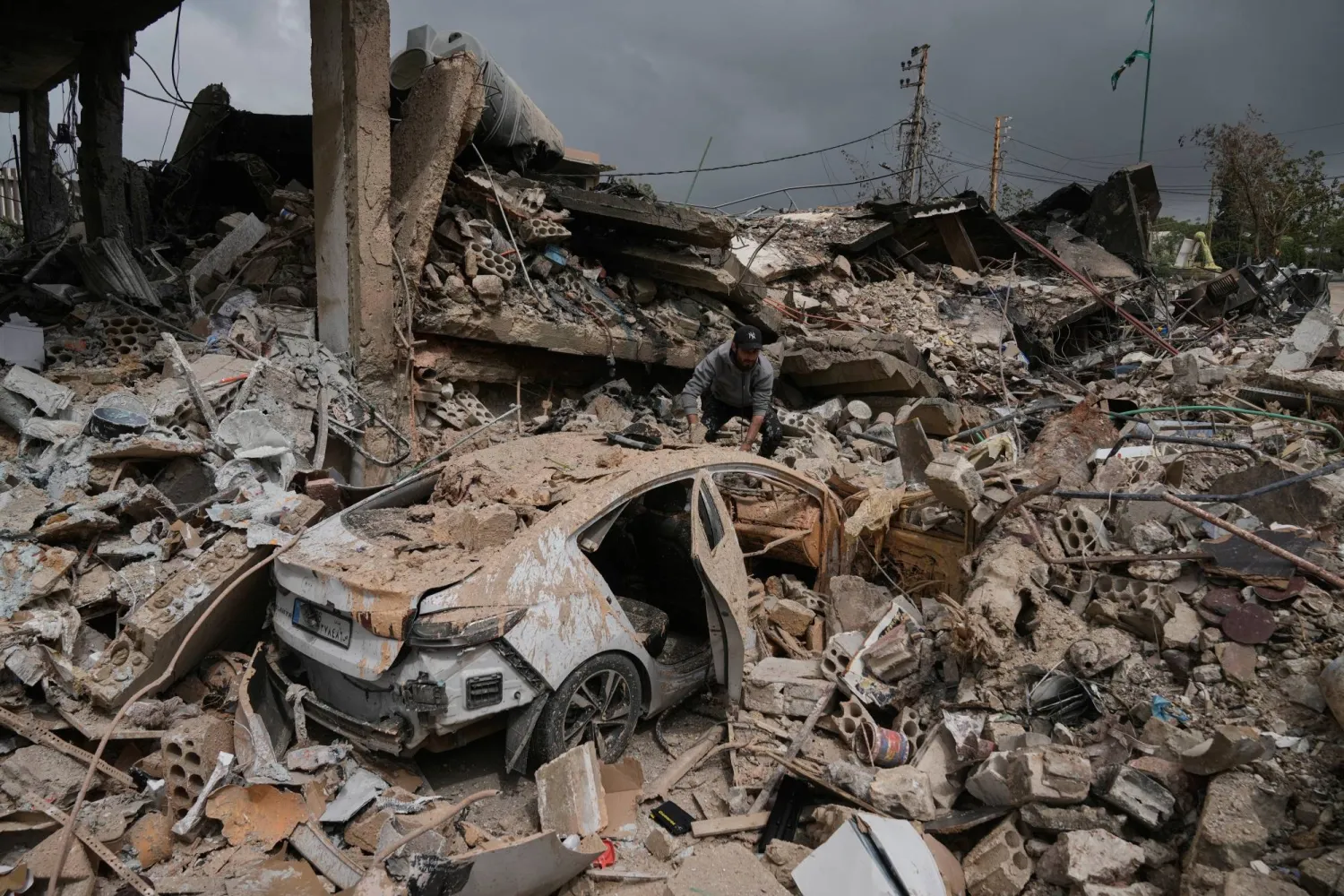
A man inspects his damaged car amid the rubble of shops destroyed in previous Israeli airstrikes in the Hosh neighborhood of Tyre, southern Lebanon, April 19, 2026. (AP Photo/Bilal Hussein)
TT

War Worsens Lebanon's Economic Crisis with Job Losses, Price Gouging and Slow Business

A man inspects his damaged car amid the rubble of shops destroyed in previous Israeli airstrikes in the Hosh neighborhood of Tyre, southern Lebanon, April 19, 2026. (AP Photo/Bilal Hussein)

Ayman al-Zain watched on a recent afternoon as a bulldozer cleared the rubble of what used to be his sports clothing store, which was one of dozens of buildings destroyed in Israeli strikes against the Hezbollah militant group.

With a nominal truce in place that has reduced but not halted the fighting, Al-Zain tried to assess whether to rebuild the shop in Beirut’s southern suburbs that he once hoped to pass down to his kids. But it's unlikely he will be able to do so anytime soon, and not only because of the fear of more airstrikes.

“Everything is expensive,” he told The Associated Press. “If I want to open a new store and get mannequins, hangers and some accessories, the prices are very different than before.”

The US-Israeli war with Iran, and the closure of the Strait of Hormuz, have sent economic shock waves across the Mideast. In Lebanon, those woes have been compounded by the country's existing economic problems and by largely unregulated markets that are vulnerable to price gouging.

“This continues to be a major economic shock, one of honestly an existential nature,” said Economy Minister Amer Bisat, who is part of the Lebanese Cabinet that came into office over a year ago on a reformist agenda.

Problems have piled up for years

Since 2019, the tiny Mediterranean country has been in the throes of an economic crisis that pulverized the value of its local currency and its banking system.

That's when Lebanese banks collapsed, which evaporated depositors’ savings and plunged about half of the population of 6.5 million into poverty, after decades of rampant corruption, waste and mismanagement. The country suffered some $70 billion in losses in its financial sector, further compounded by about $11 billion in the 2024 war between Israel and Hezbollah, according to the World Bank. The Lebanese pound has since lost over 90% of its value against the US dollar.

The cash-strapped state electricity company provides only a few hours of power a day, and most Lebanese rely on diesel generators to make up the difference. That makes the economy particularly vulnerable to fuel price increases.

Lebanon was already “grappling with multiple rounds of crises,” said Mohamad Faour, professor of finance at the American University of Beirut. "So this round of war only made an already fragile situation more fragile.”

With this new war, 1.2 million Lebanese have been displaced, largely from southern Lebanon and Beirut's southern suburbs. Many are sheltering in schools with no work or draining whatever money they have renting out apartments or hotel rooms.

Economy suffers job losses and crippling inflation

In an interview with the AP from his office, Bisat estimated that the country faces an economic loss of around 7% of its gross domestic product due to the war because “companies are closing, people are losing their jobs, tourists are not showing up.”

Evidence of inflation abounds.

In the usually bustling produce market in Sabra, south of Beirut, vendor Ahmad al-Farra looked dejected as an elderly woman shopping for watermelon, tomatoes and potatoes walked away without buying anything after checking the price tags.

Prices have spiked since the US and Israel launched a war against Iran on Feb. 28, followed quickly by a resurgence of war between Israel and Hezbollah.

“We're keeping our prices low so we can sell, and even then we're not selling,” al-Farra said as the sound of an Israeli drone whizzed overhead.

Even consumers who can afford to spend are anxious and cutting back on nonessential purchases, leaving many businesses empty.

Riad Aboulteif, who runs several restaurants and bars in the capital, said his revenue has dropped by some 90% since the war began, as Lebanon’s shrinking middle class cuts costs.

People are saving more money for their survival and not making plans to celebrate birthdays or other special occasions, he said at one of his bars in the bustling Hamra district of Beirut, where the loud chatter of customers once overpowered the jazz music coming through the sound system.

That night, only a few tables were occupied. He's had to downsize his staff and restructure his menus to offer more affordable items.

War fuels price gouging

Meanwhile, the country’s bankrupt government has struggled to crack down on unfair and illicit profiteering and the hoarding of fuel and other essential items.

Many agricultural areas in southern and eastern Lebanon are no longer accessible because of airstrikes and clashes, but al-Faraa believes suppliers have raised prices beyond what is necessary to cover cost increases.

Some of the starkest increases have been in generator bills.

Families and businesses for years have paid multiple utility bills to cover privately supplied electricity and water in the absence of government services. Neighborhood generator owners charge a monthly fee, and some landlords have their own generators and charge the cost to tenants.

Frustrated business owners have said that generator bills have doubled at times, forcing them to shorten their hours of operation or even close on some days to cut costs.

“If we didn’t take these measures, we cannot continue,” Aboulteif said.

Bisat said his ministry has conducted over 4,000 inspections of private generators, gas stations and shops across the country since the start of the war in March and lodged dozens of complaints to the courts. But the issue will not be quickly resolved.

In the meantime, the government has little ability to crack down on the handful of companies that import and distribute fuel and other goods.

No sign of relief on the horizon

With no end to the war in sight, the economic situation shows no sign of easing.

A tenuous ceasefire is in place between the US and Iran, but talks between Washington and Tehran are gridlocked. A nominal truce between Israel and Hezbollah has reduced but not stopped the fighting in Lebanon.

For now, Lebanese families and business owners are confronting the challenges day by day and hoping for the best.

“Only God knows how we’ve been trying to manage ourselves," al-Farra said.


Iraq PM Vows Monopoly on Arms as Parliament Approves Government

 Iraqi lawmakers attend the session to approve the new government in Baghdad, Iraq, Thursday, May 14, 2026. (Iraqi Presidency Office via AP)
Iraqi lawmakers attend the session to approve the new government in Baghdad, Iraq, Thursday, May 14, 2026. (Iraqi Presidency Office via AP)
TT

Iraq PM Vows Monopoly on Arms as Parliament Approves Government

 Iraqi lawmakers attend the session to approve the new government in Baghdad, Iraq, Thursday, May 14, 2026. (Iraqi Presidency Office via AP)
Iraqi lawmakers attend the session to approve the new government in Baghdad, Iraq, Thursday, May 14, 2026. (Iraqi Presidency Office via AP)

Iraqi lawmakers approved a new government on Thursday led by Prime Minister Ali al-Zaidi, who vowed to ensure a state monopoly on weapons amid growing US pressure to dismantle Tehran-backed groups.

Iraq has long walked a tightrope between the competing influences of its allies, neighboring Iran and the United States.

Iraq's parliament voted in favor of Zaidi's government and program, just a few weeks after he was designated following months of political deadlock.

Zaidi's program includes "reforming the security apparatus by restricting weapons to state control and strengthening the capabilities of the security forces", state news agency INA quoted the parliament media office as saying.

In Iraq, a government wins a confidence vote when parliament approves half plus one of its ministries.

Only 14 ministerial nominations out of 23 posts were approved on Thursday, as key political parties continue to negotiate several portfolios.

Zaidi, Iraq's youngest prime minister at the age of 40, was chosen to form the new government late last month.

His nomination followed months of political wrangling after the United States vetoed the previous frontrunner, former premier Nouri al-Maliki.

He is backed by the Coordination Framework, a ruling alliance of Shiite groups with varying ties to Iran.

Iraq's Prime Minister-designate Ali al-Zaidi, front left, arrives at the Iraqi parliament to attend the voting of his government in Baghdad, Iraq, Thursday, May 14, 2026. (AP)

- Divisions? -

Senior US diplomat Tom Barrack meanwhile said his government was ready to work with Zaidi "to advance our shared goals of prosperity for the Iraqi people and the elimination of terrorism, which is always an impediment to the people's progress".

Iran's Foreign Minister Abbas Araghchi congratulated Iraq's new government following the approval from parliament.

"Strengthening the friendly and brotherly relations between Tehran and Baghdad has always been at the top of the priorities of our foreign policy," he wrote on X.

The US has recently piled pressure on Baghdad to disarm Iran-backed groups, which it designates as terrorist organizations.

After the United States and Israel attacked Iran on February 28, those groups intervened in support of Tehran and hit US facilities in Iraq more than 600 times before a ceasefire was announced, according to a US official.

Washington also struck their positions and bases, killing dozens of fighters.

Iraqi lawmakers attend the session to approve the new government in Baghdad, Iraq, Thursday, May 14, 2026. (Iraqi Presidency Office via AP)

- Challenges -

Recently, several powerful Iraqi politicians have also called for a state monopoly on weapons, revealing divisions over the sensitive issue.

While some armed groups showed readiness to cooperate, others remain adamant that the issue should not be discussed under US pressure.

Hussein Mounes, the head of a parliamentary bloc close to the Kataib Hezbollah group, criticized the "clear and direct American interference in shaping the political scene".

He told journalists that the question of the state's monopoly on arms cannot be achieved through "pressure".

The new premier faces other daunting tasks.

His government will also need to repair Iraq's relations with Gulf countries, which have protested attacks by Tehran-backed groups on their territory during the war.

His program has also set economic reforms as a main priority, with an emphasis on diversification and investment, in a country where almost the entire economy relies on oil.

Iraq has lost significant income due to the disruption in the Strait of Hormuz, given that oil exports make up about 90 percent of the country's budget revenues.


Israel Refuses to Withdraw from Lebanon before ‘Disabling’ Hezbollah

Lebanese army soldiers man a checkpoint in Beirut, Lebanon, 14 May 2026. EPA/WAEL HAMZEH
TT

Israel Refuses to Withdraw from Lebanon before ‘Disabling’ Hezbollah

Lebanese army soldiers man a checkpoint in Beirut, Lebanon, 14 May 2026. EPA/WAEL HAMZEH

Israel refused to withdraw from Lebanese territories it occupied during its recent war with Hezbollah before eliminating the military capabilities of the Iran-backed group and securing its northern borders.

Israel’s position came during the third round of direct negotiations with Lebanon held in Washington, D.C. on Thursday and hosted by the US State Department represented by senior adviser Mike Needham and the US ambassadors to Lebanon, Michel Issa, and to Israel, Mike Huckabee.

Secretary of State Marco Rubio did not participate because he was accompanying President Donald Trump in China.

The Lebanese delegation is led by Presidential Special Envoy Simon Karam accompanied by Lebanon’s ambassador to the United States Nada Hamadeh Moawad, deputy ambassador Wissam Boutros, and military attaché in Washington, Brig. Gen. Oliver Hakmeh.

The participants from Israel included Deputy National Security Adviser Yossi Draznin, National Security Council Deputy Director for Foreign Policy Uri Resnick, and ambassador to Washington Yechiel Leiter.

Ceasefire extension

Negotiators in Washington discussed extending the current Israel-Lebanon ceasefire beyond next Sunday’s deadline.

Lebanese officials emphasized the need for full compliance by both Israel and Hezbollah, while Israel argued its military actions are necessary to counter threats from the Iran-backed group.

US mediators continue to support Israel’s right to self-defense under the November 2024 ceasefire agreement and are expected to decide soon on extending the truce.

The Israeli ambassador

Leiter said in remarks to the press from the Israeli embassy in Washington that Israel’s presence in Lebanon is tied to the continued existence of Hezbollah. He said the party is heavily armed with intent on attacking Israeli communities with rockets. He stressed that Israel would no longer allow such threats.

He explained that the current focus is on reaching a peace treaty as if “there were no Hezbollah” and fighting the group as if there were no peace treaty. “I believe we will achieve both”, he stated

Lebanese silence

Leiter said ahead of the latest negotiations that no diplomatic progress or peace agreement with Lebanon would be possible unless Hezbollah is dismantled militarily. He added that a shared interest in freeing Lebanon from Hezbollah would ultimately prevail.

The Israeli ambassador said that Israel has no territorial ambitions in Lebanon, but it also has no immediate plan to withdraw from its territories. He expressed cautious optimism about peace prospects, claiming shifting Lebanese public opinion ,including among Shiites, against Hezbollah.

However, he acknowledged that achieving progress would be difficult due to decades of entrenched dynamics and Lebanese hesitation despite alleged shared interest in reducing Hezbollah’s influence.


Yemen Govt Agrees Largest Prisoner Exchange with Houthis

Hans Grundberg, UN Special Envoy for Yemen, poses for a photo as members of the Supervisory Committee on the Detainees Release Agreement attend the closing ceremony of a meeting between the legitimate Yemeni government and the Houthis, in Amman, Jordan, May 14, 2026. (Reuters)
TT

Yemen Govt Agrees Largest Prisoner Exchange with Houthis

Hans Grundberg, UN Special Envoy for Yemen, poses for a photo as members of the Supervisory Committee on the Detainees Release Agreement attend the closing ceremony of a meeting between the legitimate Yemeni government and the Houthis, in Amman, Jordan, May 14, 2026. (Reuters)

Yemen's legitimate government and the Iran-backed Houthi militants agreed Thursday to free more than 1,600 detainees in the largest swap during Yemen's 11-year war.

The deal was signed in Amman, Jordan, after 14 weeks of negotiations observed by UN officials and the International Committee of the Red Cross. The swap built on previous understandings that started from Muscat in late 2025 and included indirect negotiations rounds in Riyadh, before culminating in an agreement in Jordan.

UN Secretary-General António Guterres welcomed the deal and called on the parties to move swiftly toward implementing it so families could soon be reunited, a UN spokesperson said.

UN Special Envoy for Yemen Hans Grundberg said the deal covered the largest release of “conflict-related detainees.” An ICRC in a statement said both sides agreed on the identities of the detainees to be released, and added that the Geneva-based organization is ready to facilitate their repatriation.

The head of the government delegation, Yahya Kazman, said in a post on X that a “number of politicians and media professionals" held by the Houthis will also be released. He did not give details.

It was not immediately clear when the release would start.

Guterres also called on the government and the Houthis to build on the positive momentum generated by the deal and to engage constructively toward an inclusive political process for a just and lasting peace in Yemen, Guterres’ deputy spokesperson Farhan Haq said.

“The Secretary-General further urges the Houthis to immediately and unconditionally release all arbitrarily detained personnel from the United Nations, NGOs, civil society and diplomatic missions,” Haq said.

Sustained diplomacy

“These negotiations have been extraordinarily complex,” Grundberg told reporters. “They required persistence, flexibility, and willingness by all sides.”

He said the agreement demonstrated that sustained diplomacy could still produce results despite years of conflict and mistrust.

“This outcome is a clear demonstration of what sustained and determined negotiations can produce,” he added. “It proves that when the parties choose to engage in dialogue, they can deliver on the priorities that weigh most heavily on Yemeni families and build confidence for the wider peace process.”

Grundberg also renewed calls for the release of UN personnel and others arbitrarily detained in Yemen.

“I hope that today’s momentum can help advance the release of UN and other colleagues who remain in arbitrary detention,” he said.

Some 1,100 of the almost 1,700 detainees are Houthi-affiliated, while seven Saudis and 20 Sudanese are among the 580 detainees that will be released by the other side.

'Major breakthrough'

The government delegation said the deal calls for the release of 1,750 detainees, including 27 members of the Arab Coalition forces. It said the development was a “real changing point in this complex humanitarian file.”

A government statement said the negotiations faced major hurdles and complications but a “national and humanitarian approach” ensured their success.

It hailed the role played by Saudi Arabia, Jordan and the ICRC in the file.

The swap agreement includes mutual prisoner and detention center visits after the exchange is complete in what was seen as an efforts to build trust between the two the government and Houthis.

In Houthi-held Sanaa, head of the Houthis’ Supreme Political Council Mahdi al-Mashat welcomed the agreement, saying the militants have offered “all facilitations” to ensure its success, reported Houthi media.

He claimed that the prisoner file had always been a top priority for the Houthis, vowing to pursue the release of remaining detainees by all possible means.

Observers said the swap was a new test for the Yemeni parties to translate humanitarian understandings into tangible steps on the ground, given the failure of previous swaps due to various differences.

International mediators are hoping the implementation of the latest swap will generate a positive conditions that would push forward the stalled political process.