


Iraq’s Coordination Framework on Verge of Collapse after Zaidi’s Govt Approved by Parliament

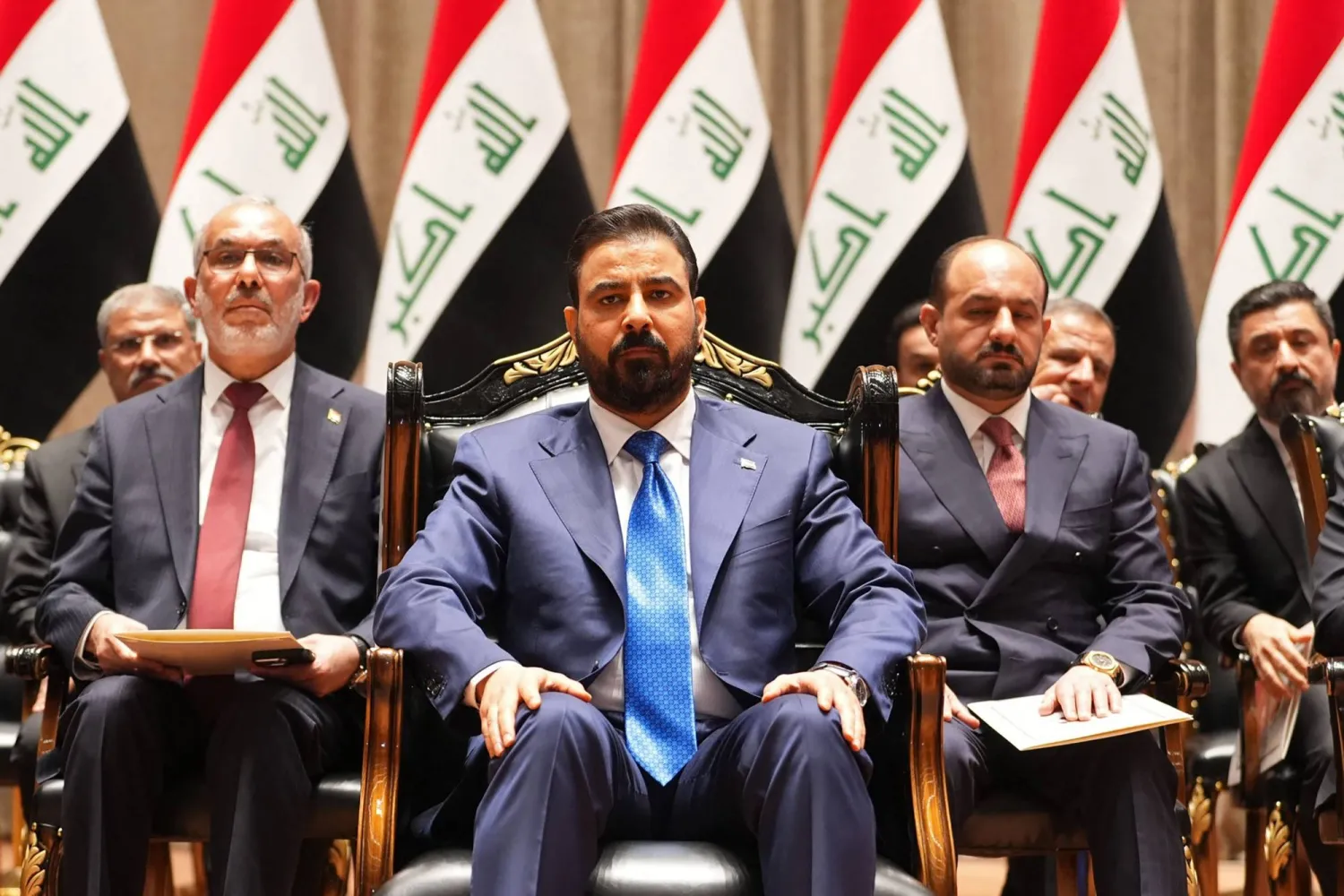
This handout picture released by the Iraqi Prime Minister's Press Office shows new prime minister-designate Ali al-Zaidi (C) sitting ahead of presenting his government to the parliament in Baghdad on May 14, 2026. (Iraqi Prime Minister’s Press Office / AFP)
TT

Iraq’s Coordination Framework on Verge of Collapse after Zaidi’s Govt Approved by Parliament

This handout picture released by the Iraqi Prime Minister's Press Office shows new prime minister-designate Ali al-Zaidi (C) sitting ahead of presenting his government to the parliament in Baghdad on May 14, 2026. (Iraqi Prime Minister’s Press Office / AFP)

Iraq’s ruling pro-Iran Coordination Framework appears to be on the verge of collapse after Prime Minister Ali al-Zaidi's government was approved by parliament on Thursday.

The PM submitted an incomplete lineup, but it still earned the vote of confidence. The parliament approved 14 ministers out of 23. Discussions on the remaining vacant portfolios, including notable ones such as interior and defense, have been postponed due to political disputes between Shiite, Sunni and Kurdish forces.

Thursday’s vote exposed evident differences in the Framework, which includes major parties, such as former PM Nouri al-Maliki's State of Law coalition, with other influential Shiite blocs over sovereign portfolios, especially the interior and higher education ministries, said lawmakers and political sources.

State of Law MP Ibtissam al-Hilali told the media that failure to include a candidate from her bloc in the lineup was an act of "deceit" against political agreements reached before the session.

Meanwhile, the National Contract bloc and the Sumerian Movement announced on Friday that they were quitting former PM Mohammed Shia al-Sudani's Construction and Development bloc, accusing the political leadership inside the alliance of violating agreements and seeking to marginalize members.

In a joint statement, they said the proceedings at parliament reflected "a violation of political agreements whereby individual interests were placed above national ones."

They said they would form a new parliamentary bloc in a move that would reshape alliances in the legislature.

Later on Friday, MP Ammar Youssef also announced he was leaving Sudani’s bloc but that he would remain in Faleh al-Fayyad's National Contract bloc.

These developments are seen as a realignment of Shiite political forces that are coming under mounting internal and foreign pressure.

Sudani, Zaidi’s predecessor, has slammed his allies in the Framework, saying: "No other government has come under such false accusations and misinformation." He accused "failed leaderships" of mounting these campaigns.
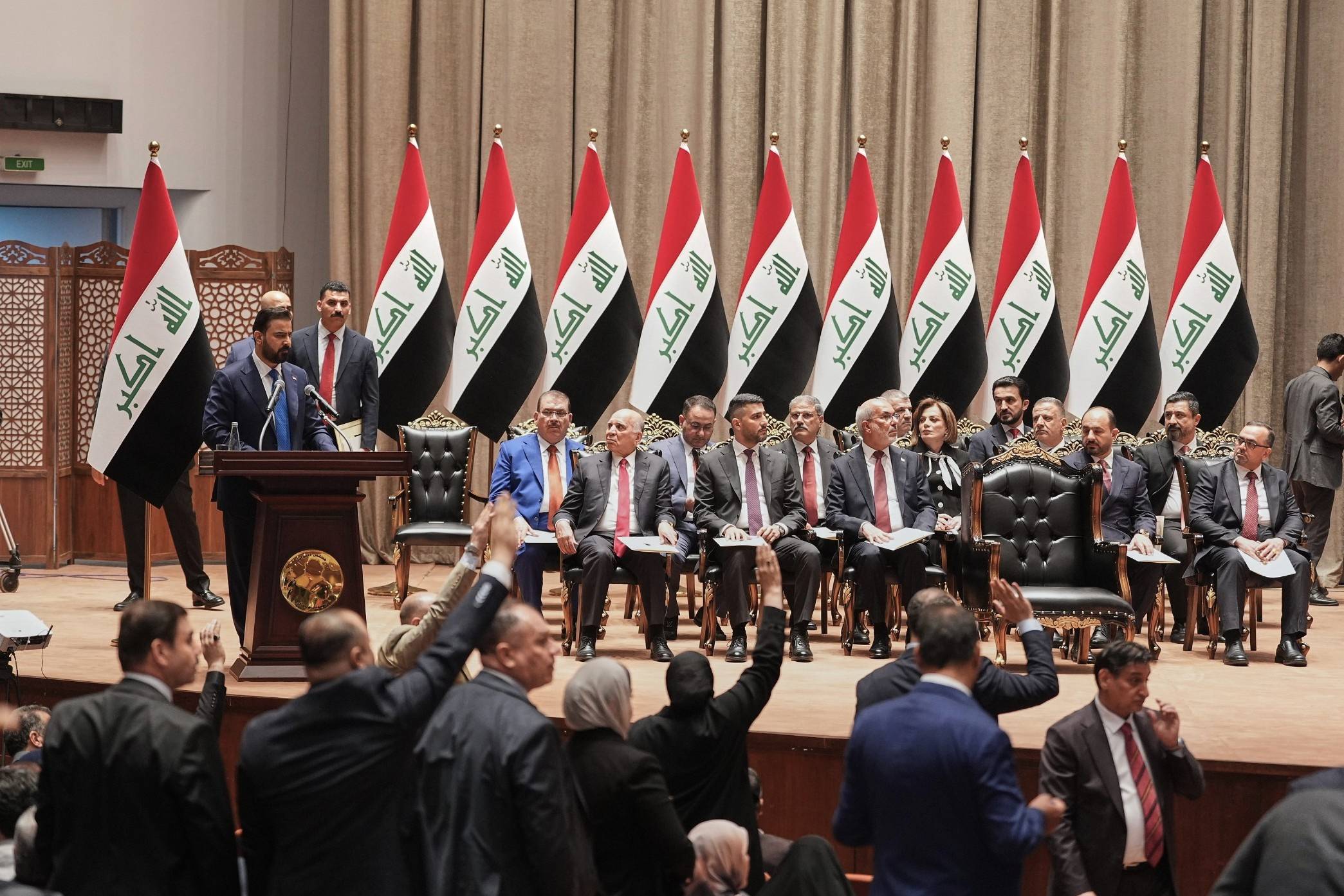
Iraqi lawmakers attend the session to approve the new government in Baghdad, Iraq, Thursday, May 14, 2026. (Iraqi Presidency Office via AP)

Zaidi, who is backed by the Framework, is Iraq's youngest prime minister at the age of 40. He was chosen to form the new government late last month.

His program includes "reforming the security apparatus by restricting weapons to state control and strengthening the capabilities of the security forces", state news agency INA quoted the parliament media office as saying.

He also vowed to ensure a state monopoly on weapons amid growing US pressure to dismantle Tehran-backed groups.

His nomination followed months of political wrangling after the United States vetoed the previous frontrunner, former premier Maliki.

Senior US diplomat Tom Barrack said his government was ready to work with Zaidi "to advance our shared goals of prosperity for the Iraqi people and the elimination of terrorism, which is always an impediment to the people's progress".

Iran's Foreign Minister Abbas Araghchi congratulated Iraq's new government following the approval from parliament. "Strengthening the friendly and brotherly relations between Tehran and Baghdad has always been at the top of the priorities of our foreign policy," he wrote on X.

The US has recently piled pressure on Baghdad to disarm Iran-backed groups, which it designates as terrorist organizations.

After the United States and Israel attacked Iran on February 28, those groups intervened in support of Tehran and hit US facilities in Iraq more than 600 times before a ceasefire was announced, according to a US official.

Recently, several powerful Iraqi politicians have also called for a state monopoly on weapons, revealing divisions over the sensitive issue.

While some armed groups showed readiness to cooperate, others remain adamant that the issue should not be discussed under US pressure.

Hussein Mounes, the head of a parliamentary bloc close to the Kataib Hezbollah group, criticized the "clear and direct American interference in shaping the political scene".

The new premier faces other daunting tasks.

His government will also need to repair Iraq's relations with Gulf countries, which have protested attacks by Tehran-backed groups on their territory during the war.

His program has also set economic reforms as a main priority, with an emphasis on diversification and investment, in a country where almost the entire economy relies on oil.

Iraq has lost significant income due to the disruption in the Strait of Hormuz, given that oil exports make up about 90 percent of the country's budget revenues.



Palestinian President's Son Elected to Top Fatah Leadership Body

Palestinian President Mahmoud Abbas with his son Yasser in Ramallah, West Bank, on May 28, 2018 (Reuters file photo)
TT

Palestinian President's Son Elected to Top Fatah Leadership Body

Palestinian President Mahmoud Abbas with his son Yasser in Ramallah, West Bank, on May 28, 2018 (Reuters file photo)

The son of Palestinian President Mahmoud Abbas won a seat on Fatah's top decision-making body on Sunday, as initial results emerged from the Palestinian movement's first congress in years.

Yasser Abbas, 64, a businessman who spends most of his time in Canada, secured a place on the central committee after being appointed around five years ago as his father's "special representative" - a role that marked his gradual emergence on the political scene.

Jailed Fatah leader Marwan Barghouti topped the preliminary results, retaining his seat on the committee with the highest number of votes, according to figures seen by AFP.

Jibril Rajoub was reelected as the secretary-general of the committee, retaining the seat he has held since 2017.

Palestinian vice president Hussein Al-Sheikh, Fatah deputy leader Mahmoud Al-Aloul and ex-Palestinian intelligence chief Tawfiq Tirawi also held their seats on the body.

Among the newcomers was Zakaria Zubeidi, 50, a former commander of the Al-Aqsa Martyrs Brigades -- Fatah's armed wing in the Jenin refugee camp -- who was freed from Israeli prison last year under a prisoner exchange deal with Hamas.

Two women also won seats, including Ramallah governor Laila Ghannam.

The three-day congress, held simultaneously across Ramallah, Gaza, Cairo and Beirut, drew 2,507 voters -- a turnout of 94.64 percent, organisers said.

Fifty-nine candidates competed for 18 seats on the central committee, while 450 vied for 80 seats on the revolutionary council, the party's parliament.

Counting for the council was still under way.

The congress opened Thursday, with Abbas being reelected as head of the movement.
In his opening address, he vowed to pursue reforms and hold long-delayed presidential and parliamentary elections.


Gaza Talks Face Fallout from Haddad Killing

Palestinians walk amid the rubble of destroyed buildings in Jabalia refugee camp in the northern Gaza Strip (AFP)
TT

Gaza Talks Face Fallout from Haddad Killing

Palestinians walk amid the rubble of destroyed buildings in Jabalia refugee camp in the northern Gaza Strip (AFP)

An Egyptian source told Asharq Al-Awsat on Saturday that mediators were continuing their efforts to implement the ceasefire agreement in Gaza, and that contacts had not stopped in order to prevent any deliberate disruption of negotiations by Israel after its latest “unacceptable” escalation in the enclave.

Sources from Hamas had earlier told Asharq Al-Awsat on Saturday that Izz al-Din al-Haddad, the commander-in-chief of the Qassam Brigades, the movement’s armed wing, had been killed in an Israeli strike that targeted him in Gaza City on Friday evening.

They said the attack on a residential apartment in the Rimal neighborhood of Gaza City had targeted Haddad.

Experts who spoke to Asharq Al-Awsat said this “escalation” by Israel places mediators before a difficult task and limited scenarios.

They said the “Gaza agreement” faces possible outcomes linked to a temporary halt in negotiations aimed at breaking the deadlock, or a complete obstruction of talks if Israel expands its escalation, intensifies assassinations and seizes more land in the enclave, potentially leading to a return to war, especially as the US position has not yet moved to deter Israel.

New operation

The assassination of Haddad came as Hamas was completing the election of its new political bureau chief.

The operation also followed rounds of talks hosted by Cairo over several weeks, with the participation of the High Representative of the Board of Peace in the enclave, Nickolay Mladenov, who had asked the movement days before the operation to hand over its weapons after visiting Tel Aviv and meeting Prime Minister Benjamin Netanyahu.

Dr. Tarek Fahmy, a professor of political science specializing in Palestinian and Israeli affairs, said the assassination confirms Israel’s lack of commitment to agreements.

He said Israel seeks to confuse Hamas’s internal scene as the movement prepares to carry out internal and external changes, and that the strike carries a message from Netanyahu to a politically troubled Israeli public, aimed at boosting his popularity and achieving electoral and political goals, before directly affecting the negotiations and their credibility.

Palestinian political analyst Dr. Ayman al-Raqab said Netanyahu had carried out the operation to save himself electorally amid domestic setbacks, and to try to impose heavy pressure on Hamas amid US distraction and silence over what is happening in the enclave.

Widening violations

The targeting is not the only step Israel is pursuing amid US silence.

The Israeli newspaper Israel Hayom reported on Wednesday that “the security zones in Gaza have been expanded by an additional 34 square kilometers, with the approval of the Board of Peace, after Hamas failed to implement commitments related to disarmament, and Israel now controls about 64 percent of the enclave’s area.”

Fahmy said the latest operation leaves mediators facing limited scenarios. The first is continued Israeli escalation and further assassinations that could include members of Hamas’s political bureau abroad, or an expansion of control inside the enclave, along with the continuation of military action and the occupation of the entire Gaza Strip.

He said the escalation would obstruct negotiations amid US silence, or lead to a temporary pause in talks without mediators halting their contacts, especially as the operation opens the way for the rise of more hardline leaders within Hamas.

Raqab expected Hamas to show reservations about returning to negotiations for now, though he said this would be temporary, especially as the movement has no alternatives or ability to engage in a military confrontation.

He said mediators face an extremely difficult task, but will continue trying to salvage what can be salvaged to return quickly to negotiations, with intensive contacts with Washington to intervene and curb Israel’s possible escalation.


Lebanon Seeks Real Ceasefire from Early Monday

A bulldozer clears debris from outside a damaged building after an overnight Israeli strike on the southern Lebanese city of Tyre (AFP)
TT

Lebanon Seeks Real Ceasefire from Early Monday

A bulldozer clears debris from outside a damaged building after an overnight Israeli strike on the southern Lebanese city of Tyre (AFP)

Lebanon will test before dawn on Monday whether Israel will honor a ceasefire and halt attacks on civilians and civilian facilities, and whether Hezbollah will match that commitment, in a push to turn a fragile pause into real calm on the ground.

The expected de-escalation would pave the way for the security track to begin smoothly at the end of this month and for the political track to resume early next month.

But Hezbollah said direct negotiations with Israel would “strengthen Israeli gains at Lebanon’s expense,” warning the Lebanese authorities “not to go too far in deviant choices with the enemy” and blaming the talks for continued Israeli pressure and attacks.

A Lebanese official source told Asharq Al-Awsat that contacts Lebanon has made after the first round of direct negotiations with Israel in Washington have focused on securing those principles before moving to the next steps in the security and political tracks.

The source said Lebanon had stressed in talks with the US sponsor of the negotiations that the ceasefire must hold and that attacks on infrastructure and civilian facilities must stop. The source said the initial Israeli response showed readiness to comply if the other side, Hezbollah, did the same.

“We have informed the concerned parties inside Lebanon, the party, of these details,” the source said.

“The Lebanese presidency was informed by Parliament Speaker Nabih Berri that the party is ready to halt fire if Israel commits to doing so. Things are now being put to the test, especially since the Israeli side’s pledges cannot be trusted, as experience has shown so far,” the source added.

The source said Berri had informed the presidency that Hezbollah was ready to issue a public pledge before the extended ceasefire deadline expires at midnight Sunday into Monday.

Hezbollah warned against “attempts to reproduce something more dangerous than the May 17 Agreement” by pushing for a “full and comprehensive peace agreement” between Lebanon and Israel. It said any such path would be a “deviation” from national principles and a breach of the Lebanese constitution, Lebanon’s history and the sacrifices of its people.

The party issued its statement on the 43rd anniversary of the May 17, 1983 agreement, reaffirming its commitment to “resistance” and rejecting any peace agreement with Israel.

Hezbollah said the Lebanese authorities were “dealing with the enemy as if it were a peaceful, recognized entity,” despite the continued “Israeli occupation and attacks.” It warned that such a course could threaten domestic stability and rejected “any foreign dictates or pressure, whether American or otherwise,” which it said aimed to impose political choices on Lebanon.

It said direct negotiations with Israel serve to “strengthen Israeli gains at Lebanon’s expense,” urged the Lebanese authorities “not to go too far in deviant choices with the enemy,” and blamed the negotiation track for continued Israeli pressure and attacks.

As Israeli escalation continued in the south, Lebanon’s internal political debate over Hezbollah’s weapons and its role in the next phase intensified. The US-sponsored negotiation track in Washington has again placed the issue of restricting arms to the Lebanese state at the top of the political and security agenda.

MP Fouad Makhzoumi hardened his position on the weapons issue, saying “the era of weapons outside the state is over” and that any coming settlement must reinforce the authority of the Lebanese state and its sole right to decide on war and peace.

In a post on X, Makhzoumi said extending the ceasefire and launching the political and security tracks under US sponsorship offer a chance to rebuild the state and strengthen the Lebanese army as the only authority responsible for protecting the borders, the land and the people. He said all weapons outside Lebanese legitimacy must end.

MP Ali Khreis, a member of the Development and Liberation bloc, condemned the Israeli raids on Tyre during a tour of the city, saying “the resistance cannot kneel or bow to pressure.”

“What was said yesterday about extending the ceasefire is a false extension, as the Israeli enemy bombed residential buildings, neighborhoods and infrastructure and destroyed them completely. This shows the enemy’s premeditated intentions toward our people in Tyre and the south,” he said.

Other political positions, meanwhile, stressed the need to restore the Lebanese state’s authority and its sole power over decisions of war and peace.

MP Ghayath Yazbeck, a member of the Lebanese Forces bloc, urged the Lebanese state to “seize the opportunity on the table to save the country from the repercussions of Hezbollah’s policies.”

He said the proposed political and security tracks could lead to long-term understandings, provided Lebanon fulfills its pledges to place weapons exclusively under state control.

Yazbeck said Lebanon’s decisions should be driven by “the interests of the Lebanese people, not Iran’s calculations or Hezbollah’s choices.” He said Hezbollah is demanding a ceasefire while rejecting the steps that could make it hold.