


Is Anger at Iran Beginning to Spread Among Lebanon’s Shiites?

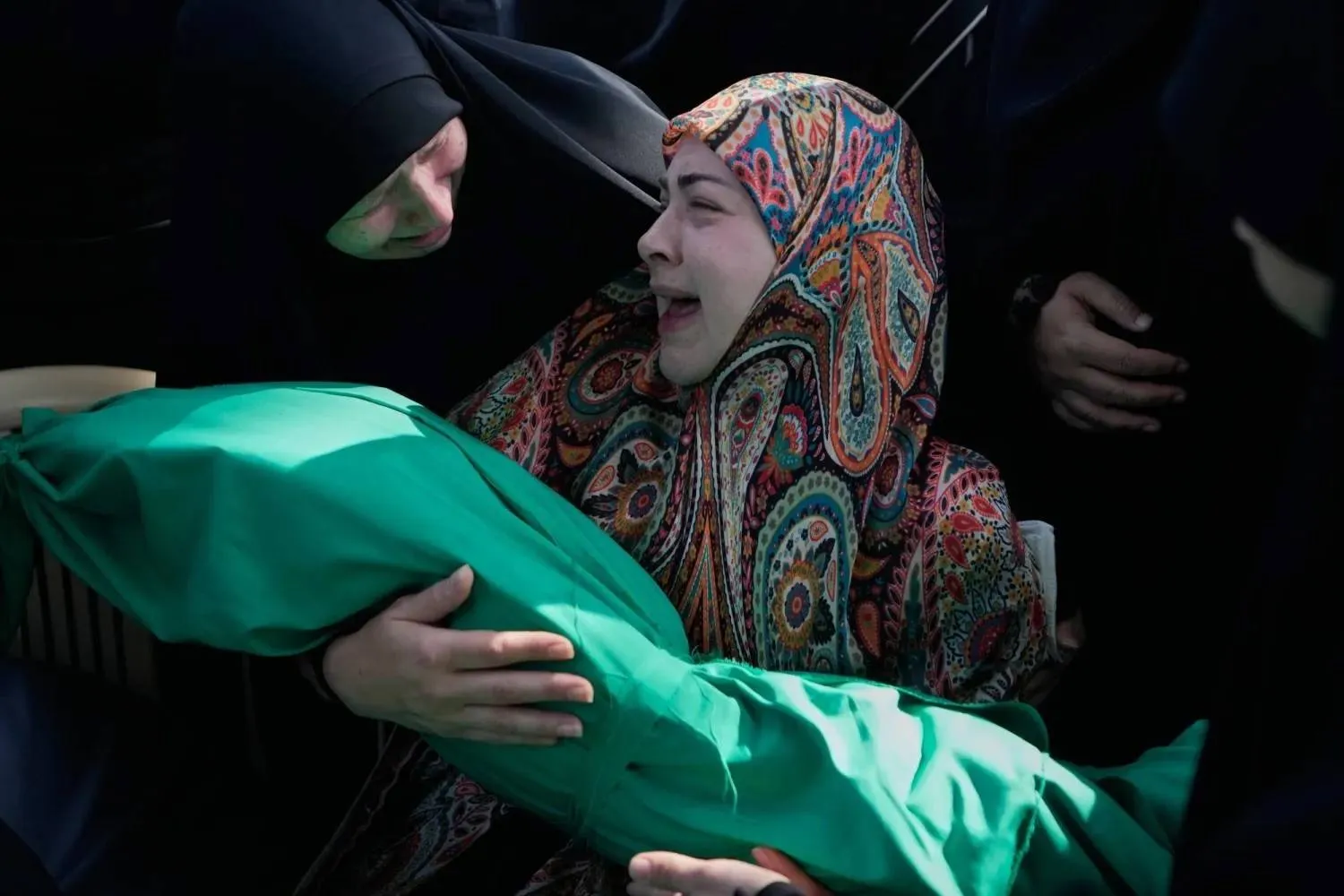
A woman carries the body of six-month-old Mariam Fahs during her funeral after she was killed in an Israeli strike on the town of Saksakiyeh (AP) 
TT

Is Anger at Iran Beginning to Spread Among Lebanon’s Shiites?

A woman carries the body of six-month-old Mariam Fahs during her funeral after she was killed in an Israeli strike on the town of Saksakiyeh (AP) 

Growing frustration is emerging within Lebanon’s Shiite community, extending beyond the traditional political discourse of Hezbollah and the Amal Movement to target Iran directly, as many residents feel the war launched in support of Tehran ended in the destruction of their villages, the displacement of their families and the loss of their loved ones.

The discontent has become increasingly visible on social media, particularly among supporters of the Amal Movement led by Parliament Speaker Nabih Berri, as well as among Hezbollah supporters, with ideological and political slogans no longer able to contain the scale of anger and despair.

The growing resentment comes despite continued statements by Hezbollah officials thanking Iran and emphasizing its role in supporting the “resistance,” while also relying on Tehran to pressure for a ceasefire.

But a large segment of the Shiite community now sees a contradiction between that rhetoric and daily reality, as tens of thousands of displaced people endure harsh humanitarian conditions with no clear prospect of return or reconstruction.

Ideological rhetoric meets southern anger

In that context, remarks by Hezbollah-affiliated cleric Sheikh Assad Qasir sparked widespread debate after he said that “preserving the Islamic Republic in Iran is a religious duty that takes precedence over preserving individuals because it constitutes a guarantee for preserving Islam itself.”

Qasir based his remarks on ideas attributed to Iran’s late supreme leader Khomeini and on the concept of sacrifice embodied in the battle of Karbala. But the rhetoric prompted angry reactions from many residents who increasingly view the war through the lens of their human and material losses.

Zeinab, a displaced woman from southern Lebanon, said: “The war was launched under the slogan of supporting Iran, but today we feel we were left alone. Even Hezbollah and Amal MPs do not ask about the people living in displacement centers.”

She added: “I feel dying under the roof of our home would be easier than the life of displacement we are living today. We can no longer endure this psychological and economic suffering, and nobody feels what we are going through.”

‘The south matters more than all conflicts’

Mona, a mother of two renting a home in Mount Lebanon, said the experience of recent months had changed the convictions of many within the pro-resistance environment.

“The war started under major slogans, but the result was the destruction of our villages, the loss of our young men and the displacement of our families. Today people feel anguish for the south more than anything else,” she remarked.

She added bitterly: “Many have reached the conclusion that the south and its people matter more than all regional conflicts. People in the south are now saying: let Iran and the whole world burn, as long as the south survives.”

Collapse of the ‘single axis’ slogan

Umm Mohammed also expressed deep disappointment with the idea of the “single axis.”

“For years they told us we were one axis and that we had to support every battle fought by this axis. But when war came upon us, we felt we were alone,” she said.

She continued: “Tehran said it would not enter negotiations before a ceasefire in Lebanon, then later said the ceasefire agreement was reached through negotiations with America, while Israeli bombardment and occupation continue expanding every day.”

The state option

Like many Lebanese, Leila called for supporting the Lebanese state in pursuing direct negotiations with Israel to end the war.

“Iran works for its own interests, and that is its right, but why don’t we also think about the interests of our people and our country?” she asked. “We are tired of waiting and of tying the fate of the south to the calculations of other countries.”

She stressed that many people now demand that the Lebanese state alone manage negotiations and the war file because the current situation means “more destruction and losses without any clear horizon.”

Anger over declining Iranian support

Political analyst Ali al-Amin spoke of “a clear shift” within the Shiite community in its perception of Iran and growing feelings of anger and disappointment among Hezbollah supporters over developments in southern Lebanon.

Al-Amin told Asharq Al-Awsat that Iranian influence was not based solely on sectarian or political ties, but also on the network of support and services provided by Hezbollah with Iranian backing, which for years represented a source of security for many families.

He said that feeling had weakened amid scenes of destroyed southern villages, displaced residents and mounting casualties, while many people no longer saw Iranian support commensurate with the scale of the losses.

According to Al-Amin, a large part of Hezbollah’s support base is now questioning why Iran has not responded directly or exerted real military pressure on Israel despite repeated talk of the “unity of fronts” and Iran’s missile capabilities.

“This reality has generated a feeling among some that Iran uses Hezbollah and the Shiite community within its regional calculations without being prepared to pay a real price to protect Lebanon or curb the ongoing war and destruction,” he remarked.

He added that the disappointment had opened the door to unprecedented criticism within the Shiite community of Iran’s role and policies, which some believe serve the interests of the Iranian regime more than those of Lebanese in the south.

“Iran said the ceasefire in Lebanon came as a result of an agreement with America in Islamabad,” Al-Amin said. “So if Israel violated the ceasefire, Iran should also abandon the ceasefire and pressure Israel at least to stop its attacks and expansion and reduce the displacement of residents from dozens of southern villages.”



MSF Warns Aid Used for 'Military Objectives' in S.Sudan

FILE PHOTO: Sudanese women from community kitchens run by local volunteers prepare meals for people who are affected by conflict and extreme hunger and are out of reach of international aid efforts, in Omdurman, Sudan, June 22, 2024. REUTERS/Mazin Alrasheed/File Photo
TT

MSF Warns Aid Used for 'Military Objectives' in S.Sudan

FILE PHOTO: Sudanese women from community kitchens run by local volunteers prepare meals for people who are affected by conflict and extreme hunger and are out of reach of international aid efforts, in Omdurman, Sudan, June 22, 2024. REUTERS/Mazin Alrasheed/File Photo

Medical charity Doctors Without Borders warned Tuesday that aid in South Sudan was being "instrumentalized" for military and political objectives, despite the country's dire humanitarian needs.

After gaining independence in 2011, South Sudan descended into civil war and remains mired in extreme poverty, corruption and insecurity, said AFP.

Government troops under President Salva Kiir have again been clashing with militias allied to his longtime rival Riek Machar over the past 18 months, with conflict reported in 73 of 79 counties, according to the ACLED monitoring group.

Doctors Without Borders, known by its French initials MSF, warned of a "concerning trend" to block humanitarian and civilian access to contested or opposition-controlled areas and said all sides were using aid for "military and political objectives".

In a report, it said the government had prevented MSF from accessing Akobo town, a hotspot of recent fighting in Jonglei state, where the charity supported one of the few hospitals.

It condemned targeted attacks on other MSF facilities around the country between January 2025 and April 2026, saying an estimated 762,000 people had lost access to healthcare as a result.

MSF's warning comes as some global partners withdraw due to humanitarian cuts and others become increasingly outspoken about the country's dire governance.

Nick Checker, a senior US State Department official for Africa, said recently that the government had issued "insincere promises of reform" to elicit donor funds, "while simultaneously obstructing the delivery of lifesaving assistance".

The US embassy said in April the crisis was worsening despite billions of dollars in oil revenue and foreign assistance, while the United Nations says roughly two-thirds of the population faces acute hunger.


Report: ‘Abu Lulu’, RSF Commander Who Was Filmed Killing Civilians in Sudan, Is Back in Combat

RSF Brigadier General al-Fateh Abdullah Idris, known as Abu Lulu, was reportedly seen on the battlefield in Kordofan in March. (AFP file)
TT

Report: ‘Abu Lulu’, RSF Commander Who Was Filmed Killing Civilians in Sudan, Is Back in Combat

RSF Brigadier General al-Fateh Abdullah Idris, known as Abu Lulu, was reportedly seen on the battlefield in Kordofan in March. (AFP file)

A Sudanese paramilitary commander who was arrested late last year following global outrage over videos of him executing unarmed people in al-Fashir has been released from prison and returned to active duty on the battlefield, nine sources told Reuters.

Two of the sources – a Sudanese intelligence official and a commander with the paramilitary Rapid Support Forces – said they personally saw RSF Brigadier General al-Fateh Abdullah Idris, known as Abu Lulu, on the battlefield in Kordofan in March.

RSF officers had pleaded for Abu Lulu to be returned to the field to boost the morale of forces engulfed in heavy fighting there, a Chadian military officer told Reuters.

In total, Reuters spoke with 13 sources who said they knew of Abu Lulu’s release. They include three RSF commanders, an RSF officer, a relative of Abu Lulu, a Chadian military officer close to RSF command and seven other sources with contacts in RSF leadership or access to intelligence on RSF field operations.

The RSF-led coalition government, in response to questions from Reuters, issued a statement on Monday denying the group had released Abu Lulu. A special court will try him and others accused of violations during the al-Fashir offensive, according to the statement from Ahmed Tugud Lisan, spokesman for the RSF-led Tasis government.

“The talk about Abu Lulu being released is untrue, malicious, and completely false,” the statement said. “Abu Lulu and the others accused of violations during the liberation of al-Fashir have been in detention since their arrest and have never left prison.”

Reuters was unable to reach Abu Lulu.

SANCTIONS CITE WAR CRIMES

The RSF imprisoned Abu Lulu in late October 2025, a few days after its bloody takeover of al-Fashir, a large city in North Darfur. Multiple videos had surfaced of him executing unarmed people during the offensive. His actions earned him the nickname “the butcher of al-Fashir,” a moniker noted by the UN Security Council when sanctioning him on February 24 for human rights abuses.

The three-year civil war between the Sudanese army and the RSF is a brutal power struggle to control the country and its financial resources. It has created what aid groups say is the world's largest humanitarian ‌crisis.

Earlier this year, an independent ‌UN probe found that the mass killings in al-Fashir bear the hallmarks of genocide. A separate UN probe found more than 6,000 people were killed by RSF fighters from ‌October 25 ⁠to 27.

Four videos verified ⁠by Reuters show Abu Lulu shooting at least 15 unarmed captives in al-Fashir on October 27, after the RSF seized the city. All were wearing civilian clothing. It is considered a war crime under international law to kill anyone, even a former fighter, who is unarmed and not posing a threat.

After international outcry by UN leaders, US politicians and others, RSF leader Mohamed Hamdan Dagalo, known as Hemedti, publicly acknowledged violations by his fighters in al-Fashir and said an accountability committee would be set up to investigate any abuses.

On October 30, the RSF released a video of Abu Lulu being driven to Shala prison, in southwestern al-Fashir. In the video, a handcuffed Abu Lulu is escorted from a vehicle flanked by armed men and placed behind bars. An unidentified RSF spokesperson standing in front of the prison says Abu Lulu “will be presented to a just trial in accordance with the law.”

In November, Al Jazeera published a story saying Abu Lulu had been released, citing unspecified online videos. But on December 2, the head of the RSF-appointed accountability committee told Reuters that it had Abu Lulu in custody and was investigating him and several other RSF soldiers in connection with violations committed in al-Fashir. Al Jazeera did not respond to questions from Reuters about its November report.

Four sources told Reuters Abu Lulu was released in December. Reuters was unable to confirm when he was freed.

The relative said that before Abu Lulu ⁠was authorized to return to duty in Kordofan, he appeared in November before a disciplinary board made up of six senior officers. The hearing was about videos he appeared in that ‌damaged the RSF’s reputation.

Reuters was unable to confirm the hearing took place or determine its outcome.

Abu Lulu is from the same clan as Hemedti, the RSF leader. Hemedti’s ‌brother, Abdelrahim Dagalo, the deputy commander of the RSF, personally ordered Abu Lulu’s release from prison, according to three sources – an RSF commander and an RSF officer both close to RSF leadership and a researcher with contacts in the committee tasked with investigating Abu Lulu.

The RSF officer said ‌that the disciplinary committee had not officially released Abu Lulu but that the deputy commander had ordered his release via radio message.

COMMAND RESPONSIBILITY

The videos of Abu Lulu are among nearly 300 videos posted online around the time of the offensive and ‌analyzed by Reuters and the Sudan Witness project at the Center for Information Resilience.

Abu Lulu was the only commander Reuters identified in video shooting unarmed people. But the Reuters-Sudan Witness investigation also found that three other senior RSF commanders were in the same area when the mass killings took place.

One video verified by Reuters shows Gedo Hamdan Abu Nashuk, the highest ranking RSF commander for the region of North Darfur, walking alongside Abu Lulu on the morning of October 27. Reuters geolocated videos from this area and found that Nashuk was recorded within 40 meters of two other videos that showed Abu Lulu executing unarmed men. By measuring shadows in the three videos, Reuters found that the videos were filmed within the same two-hour window.

Under international law, these leaders may be held criminally liable for crimes committed by their fighters during the conflict, said Jehanne Henry, a human rights lawyer and Sudan ‌director at The Reckoning Project, a US non-profit that documents war crimes.

The RSF did not respond to questions about the specific actions of any commanders present during the al-Fashir offensive. On October 29, Hemedti said that any soldier or officer who committed a crime would be arrested and investigated, with the results publicized.

The RSF government has been delayed in ⁠trying those accused of violations, spokesman Lisan said, because it is “establishing state structures ⁠under difficult circumstances.”

“We are committed to achieving justice and holding all those who commit violations accountable,” Lisan said. “Any talk to the contrary is deliberate misinformation.”

WITNESS ACCOUNTS

Reuters spoke with six survivors in refugee camps in Chad who said they witnessed Abu Lulu killing civilians in al-Fashir before they fled in October 2025.

Manazil Mousa, 25, recognized Abu Lulu from videos shown to her by a Reuters reporter and said she met him on the road out of al-Fashir as she and her family were fleeing. There, she said, he took their phones and all of their belongings, beat them severely and shot and killed her brother, Mubarak.

“Abu Lulu is the one who abused us,” she said. “He was the one who killed Mubarak. He is the one who killed our families and killed our husbands.”

Madina Adam, 38, said Abu Lulu entered Al-Fashir University on October 27, where she was sheltering with other civilians, and started to kill women and children. She described one moment when Abu Lulu asked a pregnant woman how many months along she was, and when she responded “seven months,” he shot her seven times in her stomach with his gun. The same scene was described by two witnesses in a UN report published in February.

Adam said Abu Lulu then asked a group of 10 children to sit on the ground and forced them to chant RSF slogans while he filmed. The children asked not to be killed, she said, but he shot all 10 of them.

SECRECY ORDERED

An RSF commander said leadership ordered other officers to keep quiet about Abu Lulu’s return to combat. A different RSF commander and the relative said Abu Lulu was released on the condition that he not film or be filmed on the battlefield. Reuters has not found any images of him in action since his release.

“He has been free for about three or four months and is on the battlefield with his troops,” said one RSF commander, who declined to be named. Abu Lulu’s relative said the RSF needed the commander’s services because its forces are struggling. After cementing control of al-Fashir, the RSF shifted its offensive eastward into the Kordofan region, between its territory and army-held areas. It has faced intense fighting there.

“He is very popular with the troops and that’s good for their morale,” the relative said.

In several videos verified by Reuters and Sudan Witness, other RSF fighters praise Abu Lulu and his killings. In one, filmed and posted online on November 1, 2025, by Salah Abdeen Mohamed Azala, an RSF fighter, Azala says many fighters are ready to take Abu Lulu’s place.

“If Abu Lulu disappeared, or you arrested him or tried him, we are all 1,000 Abu Lulus,” he says, speaking to the camera. “I too am Abu Lulu.”


Gaza Aid Flotilla Says Israeli Forces Intercepted 41 Vessels, 10 Still Sailing

Boats taking part in the Global Sumud Flotilla, which aims to reach Gaza and break Israel’s naval blockade, set sail from a port in the southern Turkish resort of Marmaris, Türkiye, May 14, 2026. (Reuters)
TT

Gaza Aid Flotilla Says Israeli Forces Intercepted 41 Vessels, 10 Still Sailing

Boats taking part in the Global Sumud Flotilla, which aims to reach Gaza and break Israel’s naval blockade, set sail from a port in the southern Turkish resort of Marmaris, Türkiye, May 14, 2026. (Reuters)

The organizers of an aid flotilla bound for Gaza said on Tuesday Israeli forces had intercepted 41 of their boats in the eastern Mediterranean, with 10 vessels still sailing toward the enclave.

The closest vessel to Gaza, Sirius, was 145 ‌nautical miles away, ‌the group said.

Israel's ‌foreign ⁠ministry had said ⁠on X on Monday that it "will not allow any breach of the lawful naval blockade on Gaza".

Speaking in Ankara late on Monday, ⁠Turkish President Recep Tayyip Erdogan condemned ‌the intervention ‌against the "voyagers of hope" in the ‌flotilla and called on the ‌international community to act against Israel's actions.

Ships from the Global Sumud Flotilla had set sail for ‌a third time on Thursday from southern Türkiye, after ⁠earlier attempts ⁠to deliver aid to Gaza were intercepted by Israel in international waters.

The group said there were 426 people taking part in the 54-vessel flotilla from 39 countries.

Israel's foreign ministry has called on "all participants in this provocation to change course and turn back immediately".
