


Govt's ‘Wheat Pricing’ Fuels Farmer Protests across Syrian Provinces

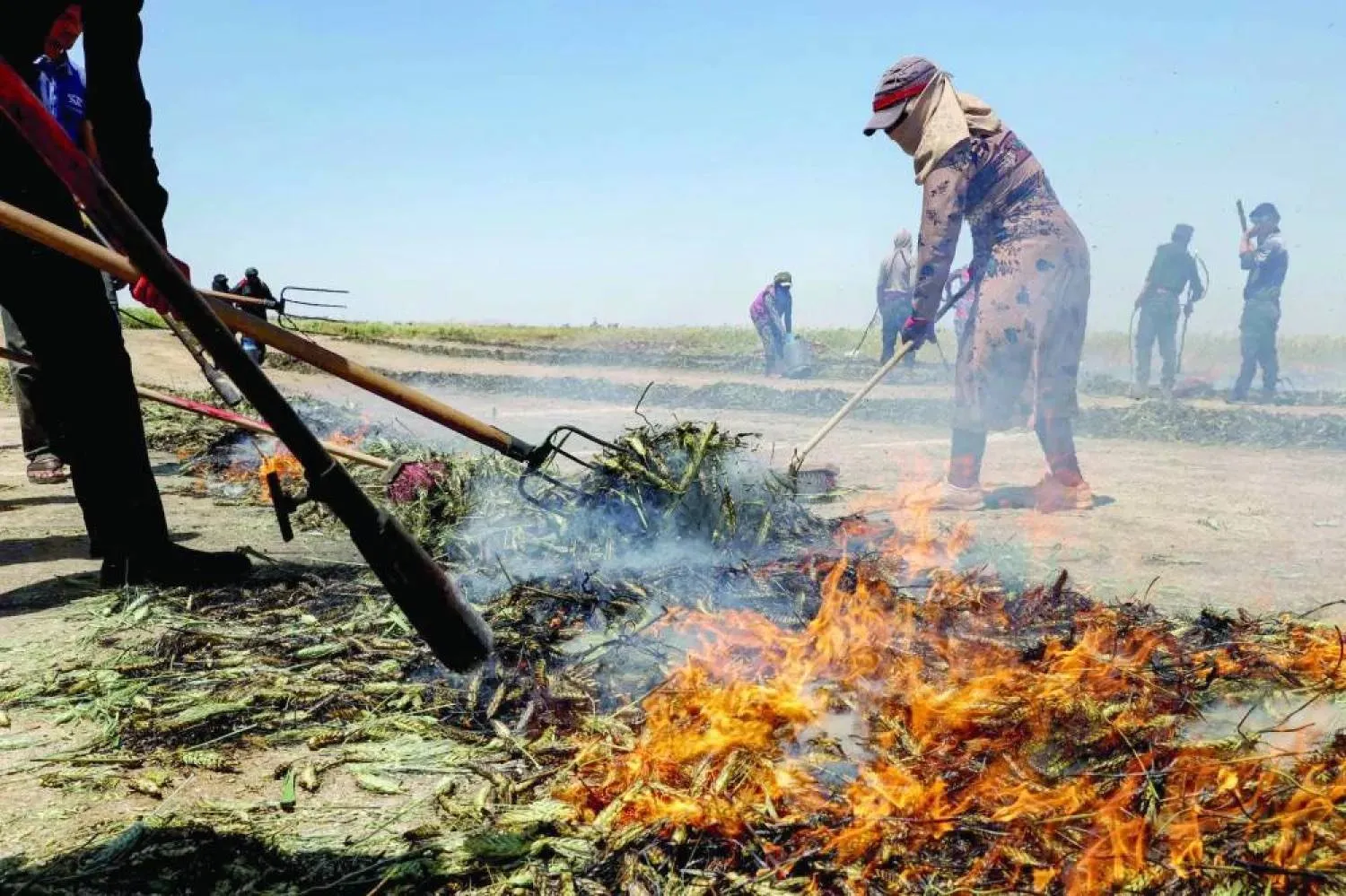
Syrians roast wheat in the town of Binnish, in the countryside of Idlib province in northwestern Syria (file photo - AFP) 
TT

Govt's ‘Wheat Pricing’ Fuels Farmer Protests across Syrian Provinces

Syrians roast wheat in the town of Binnish, in the countryside of Idlib province in northwestern Syria (file photo - AFP) 

Hundreds of farmers staged protests for a second consecutive day across several Syrian provinces over the government’s wheat purchase price for the current harvest season, denouncing it as unfair and insufficient to cover production costs.

Demonstrators warned the pricing policy would discourage wheat cultivation and called for the dismissal of the economy minister, saying the decision threatened farmers’ livelihoods at a time when Syria is already grappling with deep economic hardship.

The Ministry of Economy and Industry recently set the purchase price for first-grade durum wheat for the 2026 season at 46,000 Syrian pounds per ton in the country’s new currency — about $330 at the exchange rate on the day of the announcement, based on the parallel market rate of 138 pounds to the dollar.

The decision sparked anger among farmers, particularly in eastern and northern Syria — the country’s main wheat-producing region.

Khalil al-Nuaimi, an agricultural engineer and farmer, told Asharq Al-Awsat that growers had pinned high hopes on this year’s harvest following heavy rainfall, after years of drought, war and destruction.

“Farmers were hoping to repay debts and improve their living conditions, but the pricing decision crushed those hopes,” he said.

Al-Nuaimi, who lives in Raqqa province, said most farmers borrow money to finance cultivation and repay loans after the harvest. He added that many rural families postpone major life decisions until the wheat season ends, including engagements, weddings, medical treatment, home repairs and vehicle purchases.

“A decision like this has serious social consequences,” he underlined.

He accused the government of failing to consider the impact of the measure, particularly in eastern and northern Syria, where many residents already feel economically and politically marginalized.

Al-Nuaimi also pointed to what he described as a major discrepancy between production costs and the new pricing policy. He noted that the government had earlier set the price of wheat seed for the 2025-2026 season at $500 per ton, while the official purchase price for harvested wheat was lower.

“This is a gap farmers cannot absorb,” he said, adding that even raising the purchase price to $500 per ton would not fully offset losses because of exchange-rate volatility and grading-based pricing.

He continued that while the government faced a severe economic crisis, “supporting farmers is an essential part of supporting rural development and a cornerstone of the economy in an agricultural country like Syria.”

State media said the government defended the new pricing by arguing it was aligned with global wheat prices and exceeded them by around 10 percent to support local farmers and offset transportation and labor costs.

Following the announcement, hundreds of farmers protested on Sunday and Monday in the provinces of Raqqa, Deir Ezzor, Hasakeh, Daraa, Hama and Idlib, as well as other wheat-growing areas.

Protesters rejected comparisons with international prices, arguing that production conditions in Syria — devastated by years of war and drought — were not comparable to those in other countries.

The conflict and prolonged drought have severely damaged Syria’s agricultural sector, transforming the country from a wheat exporter into a wheat importer.

Eight Kurdish political parties in Hasakeh province also rejected the new pricing, describing it as “unrealistic” and warning of “negative repercussions for food security and economic and social stability.”

Syria needs around 2.55 million tons of wheat annually to meet basic consumption needs and maintain bread supplies.

During the 18-month transitional period, Syria imported around 1.3 million tons of wheat, mainly from Russia and Ukraine. The government is counting on this year’s harvest to fully meet domestic demand.


Egypt’s Greece, Cyprus Partnerships Do Not Hinder Ties With Türkiye

Egyptian President Abdel Fattah al-Sisi stands between Cypriot President Nikos Christodoulides and Greek Prime Minister Kyriakos Mitsotakis (Egyptian Presidency)
TT

Egypt’s Greece, Cyprus Partnerships Do Not Hinder Ties With Türkiye

Egyptian President Abdel Fattah al-Sisi stands between Cypriot President Nikos Christodoulides and Greek Prime Minister Kyriakos Mitsotakis (Egyptian Presidency)

Growing cooperation between Cairo and Ankara, which has expanded into defense and military coordination, is raising questions about its impact on the strategic partnership linking Egypt with Greece and Cyprus since 2014.

The development comes as Türkiye’s relations with Athens and Nicosia remain constrained by long-standing disputes over maritime boundary demarcation and energy issues in the Eastern Mediterranean.

Egyptian experts who spoke to Asharq Al-Awsat acknowledged that balancing Cairo’s regional relationships was no easy task. They stressed, however, that the Egyptian-Turkish rapprochement was not directed against Cyprus or Greece and could also serve their interests.

They said Egypt could play a role in bringing the sides closer together, given its determination to maintain balanced relations with all three countries.

Established partnership

Egypt, Greece and Cyprus have maintained a strategic partnership since the first presidential-level meeting of their trilateral cooperation mechanism in 2014.

At the time, relations between Cairo and Ankara were deeply strained following the fall of Muslim Brotherhood rule after the June 30 uprising. Some analyses suggested that Egypt had turned to partnerships with Cyprus and Greece to balance Türkiye.

Egypt, Cyprus and Greece launched a summit-level trilateral cooperation mechanism, holding its first meeting in Cairo in November 2014.

The three countries have since taken turns hosting their meetings annually, with the 10th round held in Cairo in January 2025.

Earlier this year, Cairo hosted political consultations among the foreign ministers of Egypt, Greece and Cyprus.

Egyptian Foreign Minister Badr Abdelatty highlighted “the special nature of the relations linking Cairo with Athens and Nicosia, which contributed to a convergence of views on establishing the trilateral summit mechanism.”

He described the mechanism as “a model for cooperation and regional integration.”

The latest step in the growing relationship between Egypt and Türkiye was the signing of a letter of intent on defense cooperation during Egyptian Defense Minister Ashraf Salem Zaher's visit to Ankara last Sunday.

It was the first visit of its kind since President Abdel Fattah al-Sisi traveled to Ankara on May 8, 2013, when he was serving as defense minister.

Greek caution

Greek newspaper eKathimerini examined the growing Egyptian-Turkish rapprochement in a report published on July 15.

It said that while the rapprochement did not directly threaten Greek interests so far, it was increasing concerns amid broader regional geopolitical shifts.

Rakha Ahmed Hassan, a member of the Egyptian Council for Foreign Affairs and a former ambassador, said Egypt stressed on all occasions and in its meetings with Türkiye, Greece and Cyprus that there was no way to resolve their disputes except through dialogue and negotiation.

“Egypt seeks to maintain a balance in its relations with the three countries,” Hassan told Asharq Al-Awsat.

“Egypt’s task in achieving this balance is not easy because of the difficulty of the situation itself,” he said.

“Türkiye does not recognize the international law of the high seas concerning the division of maritime boundaries and the economic maritime zone in the Eastern Mediterranean, while Greece and Cyprus insist on its application. Egypt is also a signatory to this 1982 law.”

The main disputes between Türkiye, on one side, and Greece and Cyprus, on the other, center on complex geopolitical and economic issues.

Chief among them is the Cyprus conflict, the oldest of these disputes. It dates back to 1974, when Turkish forces intervened in the northern part of the island following a coup backed by the military council then ruling Greece.

Ankara says its intervention was intended to protect Turkish Cypriots, while Cyprus and Greece consider it an occupation of the northern part of the island.

The disputes also include disagreements over maritime boundary demarcation, airspace, the continental shelf and exclusive economic zones in the Aegean Sea and the Eastern Mediterranean.

These disputes intensified with natural gas discoveries and competition over the exploitation of energy resources in the Eastern Mediterranean.

Egypt as a bridge

Bashir Abdel Fattah, an Egyptian academic and international relations researcher, said Egypt had begun paying greater attention to the Mediterranean dimension of its foreign relations a decade or more ago, focusing on Cyprus and Greece.

“Egypt demarcated its maritime borders with them and entered into security arrangements, regular military exercises and high-level security and strategic coordination,” Abdel Fattah told Asharq Al-Awsat.

“The two countries also play an important role in strengthening Egypt’s relations with the European Union. At the same time, Egypt restored momentum to its relationship with Türkiye after a period of political disagreements.”

Abdel Fattah said there was no contradiction between Egypt’s rapprochement with Türkiye and its close relations with Greece and Cyprus.

“Cairo is keen to diversify its relationships, and this is its sovereign right,” he said.

“Contrary to any concerns, Egypt could serve as a bridge for rapprochement between Türkiye, Greece and Cyprus and help resolve disputes over maritime boundary demarcation and the sharing of Eastern Mediterranean resources.”

Relations between Egypt and Türkiye have grown rapidly since 2023, as ties between the two countries returned to normal and Sisi and Turkish President Recep Tayyip Erdogan exchanged visits.

This was reflected in military cooperation, particularly in training and cooperation in the defense industries.

Amr el-Shobaki, an adviser at the Al-Ahram Center for Political and Strategic Studies, said the Egyptian-Turkish rapprochement, particularly in the military field, could understandably concern Israel.

“But it will never be directed against Greece and Cyprus,” Shobaki said.

“On the contrary, through this rapprochement with Türkiye, Egypt could play a major role in easing tensions between Türkiye, Greece and Cyprus because of its strong and distinguished relations with all three countries.”

Shobaki told Asharq Al-Awsat that it was natural for Greece and Cyprus to monitor developments in the rapprochement between Egypt and Türkiye, given the sensitivity of their position toward Türkiye.

“But they undoubtedly have strong confidence in Egypt because of the strength of their relations with it,” he said.


Komala: A Frequent Target of Iranian Attacks in Iraqi Kurdistan

A drone is intercepted in the sky over Erbil, Iraq, July 15, 2026, in this screengrab obtained from a social media video. (Dlawer/X/via Reuters)
TT

Komala: A Frequent Target of Iranian Attacks in Iraqi Kurdistan

A drone is intercepted in the sky over Erbil, Iraq, July 15, 2026, in this screengrab obtained from a social media video. (Dlawer/X/via Reuters)

At least nine people were killed and others wounded on Friday in a missile and drone attack suspected of having been carried out by Iran against an Iranian Kurdish opposition group in the Iraqi Kurdistan Region, a group official said.

The attack targeted positions belonging to the Komala Party of Iranian Kurdistan in the Zargwezela area near Sulaymaniyah, the official said, requesting anonymity for security reasons.

The group said Iran was behind the strike, the official added. Tehran did not immediately claim responsibility.

Iran has previously attacked Iranian Kurdish opposition groups based in the Kurdistan Region.

Abdullah Azarbar, a member of the Politburo of the Komala Party, said the attack began at around 6 a.m. and involved eight large bunker-busting missiles.

Nine members of the group’s Peshmerga forces were killed and three others seriously wounded, he added. Three missiles struck the headquarters where the casualties occurred.

A security source had earlier said a party headquarters in the Surdas subdistrict of Sulaymaniyah province had been hit by missiles. Authorities opened an investigation to determine the circumstances of the attack and identify those responsible, the source said.

The Kurdistan Region Security Agency said seven missiles struck three areas in Sulaymaniyah province early on Friday.

Four landed in Zargwezela, one in Qasardi village and two near Tal Kobani in the Qaradagh area, the agency said. Its teams were still assessing casualties and material damage.

The Kurdistan Region Counter-Terrorism Service had earlier said coalition forces intercepted and destroyed eight explosive-laden drones over Erbil early on Friday. No casualties were reported.

Residents of Sulaymaniyah and Halabja provinces said they heard loud explosions in the early hours of the morning.

The Kurdistan Region Presidency condemned the missile and drone attacks on Sulaymaniyah and Erbil provinces, calling them a “dangerous development and a flagrant violation” of Iraqi sovereignty.

It warned that continued attacks could threaten Iraq’s stability and undermine efforts to strengthen security and peace in the region.

Komala repeatedly targeted

The Komala Party of Iranian Kurdistan is one of Iran’s oldest opposition groups. Founded in the late 1960s as a leftist Kurdish movement, it rose to prominence during the unrest that followed Iran’s 1979 revolution.

The group later entered into armed conflict with the new authorities over Kurdish autonomy and political freedoms.

After years of fighting inside Iran, Komala moved much of its operations and many of its bases to Iraq’s Kurdistan Region, where it established political and military headquarters and camps.

It has since faced repeated Iranian attacks, particularly by Iran’s Revolutionary Guards, which accuses Iranian Kurdish opposition parties of seeking to destabilize the country.

Komala combines political opposition to Tehran with advocacy for Kurdish rights in Iran. Tehran says such groups pose a security threat.

The 2022 “Woman, Life, Freedom” protests renewed attention on Iranian Kurdish opposition parties, although most remained based outside Iran.

Since the war between Iran and the United States began in February, no independent tally has established a final figure for the number of attacks on Komala bases.

Available reports, however, indicate that Iranian Kurdish opposition headquarters in Iraq’s Kurdistan Region were hit by a wave of missile and drone strikes during the conflict.

According to statements by the party and its allies, sites belonging to Iranian Kurdish opposition groups were repeatedly attacked, including bases linked to Komala and other parties in Erbil and Sulaymaniyah provinces.

The Coalition of Political Forces of Iranian Kurdistan also said missile strikes had targeted Peshmerga positions.

Human rights reports and Kurdish sources said bases belonging to Iranian Kurdish opposition parties, including Komala, were among the targets of dozens of missile and drone attacks during the war.


Delay of Lebanon-Israel Technical Meeting Stalls Implementation of Pilot Zones Plan

An Israeli flag hangs from a building in an area occupied by Israeli troops in southern Lebanon, Thursday, July 9, 2026. (AP)
TT

Delay of Lebanon-Israel Technical Meeting Stalls Implementation of Pilot Zones Plan

An Israeli flag hangs from a building in an area occupied by Israeli troops in southern Lebanon, Thursday, July 9, 2026. (AP)

The United States has postponed a virtual meeting between Lebanese, Israeli and US military delegations that had been expected on Friday to discuss the first phase of the “pilot zones” plan.

The delay puts the practical rollout of the framework agreement between Lebanon and Israel on hold, particularly the pilot zone arrangements, and renews questions over an implementation process that still has no clear timetable.

The technical meeting was agreed during the latest round of negotiations in Rome at the start of the week. It was intended to finalize the first phase mechanism: Israeli forces would withdraw from several pilot zones, allowing the Lebanese army to deploy there under the supervision of the monitoring committee. The plan would then expand in later stages.

Sources familiar with the negotiations told Asharq Al-Awsat that Washington requested the postponement, saying more time was needed to complete technical files, operational plans and implementation procedures.

No new date was set.

The sources said the meeting could instead take place during a visit by US Central Command chief Admiral Brad Cooper, who is due in Beirut on July 23. Cooper met President Joseph Aoun and Lebanese army commander General Rodolphe Haykal late last month.

Military sources, however, linked the delay to Israeli actions on the ground in Lebanon.

“Israel is continuing its systematic destruction of border villages in what appears to be an attempt to complete its objectives on the ground before committing to any implementation agreement,” the sources said.

They said Israel, which still refuses to withdraw from Lebanese territory, was trying to limit the pilot zone plan to locations it does not occupy. Washington, meanwhile, is pressing Israel to begin implementing the agreement by withdrawing from areas under its control.

The sources said the disagreement explained Israel’s attempts to buy time and delay the start of actual implementation.

The sixth round of direct Lebanese-Israeli negotiations, held in Rome under US sponsorship, ended with an agreement to finalize the pilot zone structure and begin implementation within days.

The plan forms part of the framework agreement aimed at consolidating the ceasefire and preparing for a gradual Israeli withdrawal in return for the deployment of the Lebanese army. But the agreement sets no binding deadline for a full Israeli withdrawal.

Israel says it will not leave the security zone it seeks to retain, stretching about 10 km from the border, until Hezbollah has been disarmed in those areas.

That condition is widely seen as highly difficult under Lebanon’s current circumstances.

Israeli soldiers walk at the entrance to Beaufort Castle in southern Lebanon, Thursday, July 9, 2026. (AP)

Violations and destruction continue

On the ground, Israeli violations continued across southern Lebanon as the Lebanese army expanded its deployment.

The army deployed in the town of Froun in the Bint Jbeil district and began intensive patrols. Froun is one of six villages being considered for the pilot phase.

Israeli forces continued demolishing homes, most recently in Bint Jbeil.

Israeli drones also struck Mayfadoun and Choukine, carried out three strikes on the Naqoura road and hit Mansouri. Another strike on Naqoura wounded a Syrian worker.

Israeli forces also carried out a large explosion on Friday morning in Hadatha, near the outskirts of Aita al-Jabal, and continued combing operations in several border areas.

Rescue teams recovered the bodies of victims of the strike on Mansouri late on Thursday.

Residents of Haris appealed to the Lebanese army to evacuate civilians trapped during an Israeli combing operation, the state-run National News Agency reported.

This handout photograph released by the Lebanese army press office on July 15, 2026 shows Lebanese army vehicles patrolling in southern Lebanon. (Lebanese Army Press Office / AFP)

Hezbollah steps up criticism, warns of internal instability

Hezbollah, meanwhile, continued to attack the framework agreement and the Lebanese authorities’ handling of the negotiations.

Hezbollah lawmaker Ali Fayyad said the Rome talks had exposed the weakness of Lebanon’s official position.

He accused the authorities of pursuing negotiations despite continuing Israeli military operations and following policies aimed at satisfying the United States and Israel.

Fayyad warned that the approach threatened domestic stability.

“These authorities are determined to take the country to an extremely dangerous place,” he said.

He said the process would neither restore Lebanese territory nor protect sovereignty, but would instead cost the country its internal stability and national unity.

Fayyad said the “resistance [Hezbollah] is ready for all possibilities and options” and remained committed to what he described as its principles of defending Lebanon, liberating occupied territory and securing the return of residents to their villages.
