

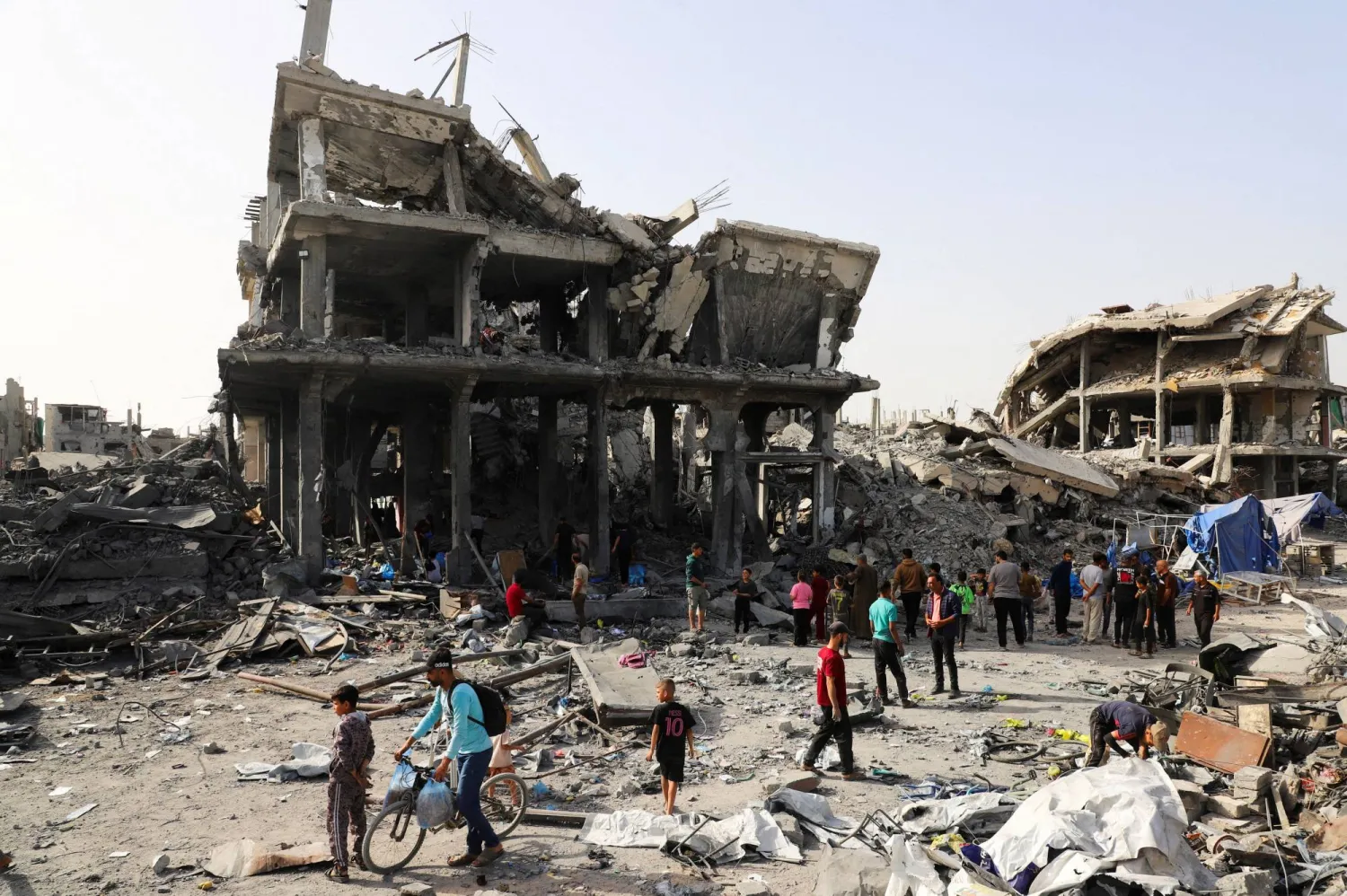

Palestinians in Gaza Mark Anniversary of Nakba, Say Today’s Catastrophe Is Worse

Palestinians inspect the site of an Israeli strike on a house that was pre-warned by the Israeli military to evacuate before the strike was carried out late on Monday, in Jabalia refugee camp in the northern Gaza Strip May 19, 2026. (Reuters)
TT

Palestinians in Gaza Mark Anniversary of Nakba, Say Today’s Catastrophe Is Worse

Palestinians inspect the site of an Israeli strike on a house that was pre-warned by the Israeli military to evacuate before the strike was carried out late on Monday, in Jabalia refugee camp in the northern Gaza Strip May 19, 2026. (Reuters)

Blink and you might miss the few stone walls that are all that’s left of the village that Yusuf Abu Hamam’s family was forced to flee when he was an infant in 1948.

The village, al-Joura, was demolished by the Israeli military at the time. It has since vanished under neighborhoods of the southern Israeli city of Ashkelon and the grounds of a national park.

The neighborhood where Abu Hamam’s family ended up — and where he spent most of his life — now lies also largely in ruins. Buildings in the Shati Camp in the northern Gaza Strip have been razed and wrecked by Israeli bombardment and demolitions during the past 2½ years of war.

On Friday, Abu Hamam and millions of Palestinians mark the 78th anniversary of the Nakba, Arabic for “catastrophe,” referring to the mass expulsion and flight of some 750,000 Palestinians from what is now Israel during the 1948 war surrounding Israel’s creation. It’s the third commemoration of the Nakba since the war in Gaza began.

The 78-year-old Abu Hamam, one of a dwindling number of Nakba survivors, says the current war is an even greater catastrophe.

Israel’s military has pushed deep into Gaza, now controlling 60% of the territory, Israeli Prime Minister Benjamin Netanyahu said on Friday, during a Jerusalem Day celebration.

"Today it is 60%, tomorrow we will see, tomorrow we will see,” he told a cheering crowd in Jerusalem.

More than six months after an October ceasefire, Gaza’s more than 2 million people are now crammed into less than half of the 25-mile-long strip along the Mediterranean coast, surrounded by the Israeli-controlled zone.

“There is no country left,” Abu Hamam said, speaking next to his home, which was heavily damaged by Israeli shelling earlier in the war. “A square kilometer and a half extending from the sea, this is what we are living in ... It’s indescribable, unbearable.”

For Palestinians, the Nakba meant the loss of most of their homeland. Some 80% of the Palestinians who lived in the area that became Israel were driven from their homes by forces of the nascent state before and during the war. The fighting began when Arab armies attacked following Israel’s establishment as a home for Jews in the wake of the Holocaust. Palestinians who remained behind hold Israeli citizenship.

After the war, Israel refused to allow Palestinian refugees to return to ensure a Jewish majority within its borders. Palestinians became a seemingly permanent refugee community that now numbers some 6 million, with most living in refugee camps in the Israeli-occupied West Bank, Lebanon, Syria, Jordan and Gaza.

Around 530 Palestinian villages in what became Israel were destroyed, according to the Palestinian Bureau of Statistics.

Abu Hamam’s birth village was one of them. Al-Joura was seized by the Israeli military as it advanced against Egyptian forces in November 1948. Soldiers were ordered to destroy every home in al-Joura and neighboring villages to ensure their Palestinian populations couldn’t come back, according to military archives cited by Israeli historian Benny Morris.

Refugees swelled the population of the tiny patch of territory along the southern coast that became the Gaza Strip. They stayed in tent camps, run by a newly created UN agency for Palestinians, UNRWA, which provided aid and schooling. Those camps, like Abu Hamam’s Shati Camp, grew into dense urban neighborhoods over the decades, before many were flattened during the latest Gaza war by Israeli bombardment.

In Gaza, Palestinians say they live a new Nakba

The ancestors of Ne’man Abu Jarad and his wife, Majida, were already living in what would become the Gaza Strip in 1948. They both recall stories from their families about refugees streaming in by foot from areas further north, like the village Abu Hamam came from.

Though they avoided the original Nakba, there was no escaping from what Majida now calls “our Nakba.”

Their hometown has been wiped off the map. Over the past year, Israeli bulldozers and controlled detonations have razed nearly every building in the northern Gaza towns of Beit Lahiya and Beit Hanoun. A new Israeli military base stands about 700 meters (765 yards) from where the Abu Jarads’ house once stood, according to satellite photos.

Also gone is the southern Gaza city of Rafah, once home to a quarter million people, and other villages and neighborhoods located in the Israeli-held half of the Gaza Strip. The military says it is destroying positions used by Hamas and preparing the area for reconstruction. Satellite photos show nearly every structure reduced to rubble.

Over the last 31 months of war, the Abu Jarads and their six daughters have been displaced more than a dozen times as they fled Israeli bombardment and offensives. They currently live in a camp in the southern city of Khan Younis. Their tent offers little shelter from biting winter winds or summer heat, Majida said.

Their daughters have been out of school for over two years now.

“The Nakba of ’48, I don’t think it can be compared to our Nakba,” Majida said. “In ’48, they say people were displaced once and settled in one place, and they are still there until now. But our Nakba, honestly, is more severe because our displacement has happened multiple times. There is no stability.”

Around 90% of Gaza’s more than 2 million people have lost their homes, according to UN estimates, with most of them now sheltering in huge tent camps with rat infestations and pools of sewage. They are dependent on aid to survive.

Israel’s offensive has killed over 72,700 Palestinians, according to local health officials. It was triggered by Hamas’ Oct. 7, 2023, attack on southern Israel that killed some 1,200 people. Militants also abducted 251 hostages.

In the northern West Bank, tens of thousands of Palestinians are entering their 15th month of displacement, after the Israeli military ordered them out of their refugee camps as it launched an operation it said was targeting militant groups.

Since then, troops have demolished or heavily damaged at least 850 structures across the refugee camps of Nur Shams, Jenin and Tulkarem, according to an analysis of satellite imagery by Human Rights Watch released in December.

Saving what was lost, again and again

The 1948 Nakba also brought the loss of Palestinians’ history, as those fleeing struggled to keep hold of the documents and possessions tying them to their homes.

One of the largest archives of Palestinian documents dating back to the Nakba belongs to UNRWA.

UNRWA staff members, who fled their offices in Gaza after Israel ordered the north evacuated, had to leave behind the agency’s extensive archive.

The staff then launched a mission to rescue the most crucial documents — birth, death and marriage certificates and refugee registration cards, according to Juliette Touma, a former senior UNRWA official.

Without those documents, Palestinians could lose their rights and refugee status. Staffers crammed their personal suitcases full of papers and carried them through checkpoints and out of the territory, Touma said.

The current war has cost Palestinians in Gaza what little remained of their personal histories. Majida’s parents’ home in Beit Hanoun was destroyed, and with it family photos.

“There is nothing left,” she said.

Abu Hamam, too, says everything has been lost.

“When this war came, it devoured trees, stones and people,” he said. “Entire families were erased from the civil registry. Hundreds of families are still buried under the rubble.”



UN Considers Response to Israeli Move to Build a Military Compound on Site of Relief Agency

The front gate of the east Jerusalem compound of UNRWA is seen in east Jerusalem, May 10, 2024. (AP)
TT

UN Considers Response to Israeli Move to Build a Military Compound on Site of Relief Agency

The front gate of the east Jerusalem compound of UNRWA is seen in east Jerusalem, May 10, 2024. (AP)

The United Nations is considering how to respond to Israel's announcement that it will build a military complex on the former headquarters of the UN relief agency for Palestinians in east Jerusalem, an official said Tuesday.

Israel at the weekend announced the government's approval for a defense ministry complex at the United Nations Relief and Works Agency ’s compound in Sheikh Jarrah, including a museum and enlistment office.

“The matter is currently under consideration at the level of the legal council, the highest legal authority of the United Nations in New York,” UNRWA Deputy Commissioner General Natalie Boucly told The Associated Press during a visit to Syria.

“These are UN premises and, at a minimum, this is a breach of the 1946 UN Convention on privileges and immunities,” she said.

Israel bulldozed part of the UNRWA compound in January, capping off a decades-long campaign against the agency, which became acute following the Hamas-led attacks on Oct. 7, 2023.

Israel has accused the UN agency of harboring staff members affiliated with Hamas, accusing some of taking part in the attacks. UNRWA leaders have said they took swift action against the employees accused of taking part in the 2023 attacks, and have denied allegations that the agency tolerates or collaborates with Hamas.

Israel's Defense Minister Israel Katz said the plan to build a defense complex on the former UNRWA headquarters was “a decision of sovereignty, Zionism and security.”

“In a place where an organization that became part of the terror and incitement mechanism against Israel operated, institutions will be established that will strengthen Jerusalem, the (Israeli army), and the State of Israel,” Katz said in a statement on Sunday.

The decision came on Jerusalem Day, which marks Israel’s capture of east Jerusalem, including the Old City and its holy sites sacred to Jews, Christians and Muslims, in the 1967 Mideast war. Israel considers the entire city of Jerusalem its capital, while the Palestinians seek east Jerusalem as the capital of their future independent state.

The UNRWA compound was shut down in May 2025 after far-right protesters, including at least one member of parliament, overran its gate in view of the police.

UNRWA’s mandate is to provide aid and services to some 2.5 million Palestinian refugees in Gaza, the occupied West Bank and east Jerusalem, as well as 3 million refugees in Syria, Jordan and Lebanon. Its operations were curtailed last year when Israel’s Knesset passed legislation severing ties and banning it from functioning in what it defines as Israel — including east Jerusalem.

Boucly said the humanitarian situation in Gaza “remains absolutely dire.” While UNRWA international staff have been barred by Israel from entering Gaza, about 10,000 local staff continue to work in the enclave, including teachers, health workers and sanitation workers, she said.

Despite a tenuous ceasefire, “there are issues with insufficient aid coming in,” she said. “It is not coming in at scale and reconstruction is not starting fast enough for the people to see a real change on the ground.”

Boucly spoke to the AP from Syria's Yarmouk Palestinian refugee camp, where the situation is somewhat more hopeful as former residents who fled during the country's 14-year civil war have been gradually returning.

Taken over by a series of armed groups then bombarded by the military of then President Bashar al-Assad, the camp was all but abandoned after 2018. The buildings that were not destroyed by bombs were demolished by the government or stripped by thieves.

After Assad's ouster in 2024, former residents began to trickle back and repair their damaged homes. As of April, some 60,000 people had returned to the camp, of which 80% are Palestinian refugees, Boucly said.

Assistance to those returning to the camp has been limited, she acknowledged. UNRWA has received donor aid to rehabilitate schools and health centers, but has been unable to provide more than minor assistance to people needing to repair their damaged homes, she said.

Despite anxieties about shrinking funding, she said, “I think there is a situation of hope for Palestine refugees” in Syria.


Sudan's RSF Denies Reports of Abu Lulu's Release

This handout picture released by the Sudanese Rapid Support Forces (RSF) on October 30, 2025, shows RSF members reportedly detaining a fighter known as Abu Lulu (L) in al-Fashir in war-torn Sudan's western Darfur region. (RSF / AFP)
TT

Sudan's RSF Denies Reports of Abu Lulu's Release

This handout picture released by the Sudanese Rapid Support Forces (RSF) on October 30, 2025, shows RSF members reportedly detaining a fighter known as Abu Lulu (L) in al-Fashir in war-torn Sudan's western Darfur region. (RSF / AFP)

Sudan’s paramilitary Rapid Support Forces (RSF) denied on Tuesday reports about the release of RSF Brigadier General al-Fateh Abdullah Idris, known as Abu Lulu, who was arrested late last year following global outrage over videos of him executing unarmed people in al-Fashir.

In a statement, the RSF “categorically” denied the reports, slamming them as “baseless” and being part of a “campaigns of incitement.”

Two sources – a Sudanese intelligence official and a commander with the RSF – said they personally saw Abu Lulu on the battlefield in Kordofan in March, said a Reuters report on Monday.

The RSF stressed that Abu Lulu and a number of individuals, accused of violations against civilians in al-Fashir, have been detained since their arrest in October.

“They remain in prison and have never left,” it added.

RSF officers had pleaded for Abu Lulu to be returned to the field to boost the morale of forces engulfed in heavy fighting there, a Chadian military officer told Reuters.

Reuters spoke with 13 sources who said they knew of Abu Lulu’s release. They include three RSF commanders, an RSF officer, a relative of Abu Lulu, a Chadian military officer close to RSF command and seven other sources with contacts in RSF leadership or access to intelligence on RSF field operations.

The RSF-led coalition government, in response to questions from Reuters, issued a statement on Monday denying the group had released Abu Lulu.

A special court will try him and others accused of violations during the al-Fashir offensive, according to the statement from Ahmed Tugud Lisan, spokesman for the RSF-led Tasis government.

The RSF imprisoned Abu Lulu in late October 2025, a few days after its bloody takeover of al-Fashir, a large city in North Darfur.

Multiple videos had surfaced of him executing unarmed people during the offensive. His actions earned him the nickname “the butcher of al-Fashir,” a moniker noted by the UN Security Council when sanctioning him on February 24 for human rights abuses.

The three-year civil war between the Sudanese army and the RSF is a brutal power struggle to control the country and its financial resources. It has created what aid groups say is the world's largest humanitarian ‌crisis.


Blank Ballots Impede Vote for New Hamas Leader

Hamas leaders, from right: Rawhi Mushtaha, Saleh al-Arouri and Ismail Haniyeh, all of whom were assassinated, Khaled Meshaal and Khalil al-Hayya. Hamas media)
TT

Blank Ballots Impede Vote for New Hamas Leader

Hamas leaders, from right: Rawhi Mushtaha, Saleh al-Arouri and Ismail Haniyeh, all of whom were assassinated, Khaled Meshaal and Khalil al-Hayya. Hamas media)

While many were waiting to learn who would become the new head of Hamas’s political bureau, the movement issued a rare and surprising statement last Saturday saying the result could not be decided in the first round and that a second would be held.

Asharq Al-Awsat asked Hamas sources inside and outside Gaza why the process of electing a new leader had stalled.

Speaking separately, they cited several factors, including “blank ballots” cast by some voters to show they were not backing either of the two contenders, Khalil al-Hayya, head of Hamas’s office in Gaza, and Khaled Meshaal, his counterpart abroad.

Hamas is facing its worst crisis since it was founded in 1987. Israeli strikes that began after the October 7, 2023, attack have hit its various wings and leaderships.

Israel assassinated its political bureau chief Ismail Haniyeh in Tehran in July 2024. He was succeeded by Yahya al-Sinwar in Gaza in October of the same year.

For about a year and a half, a “leadership council” has been running Hamas’s affairs. At the start of this year, a new push began to elect a chief to lead the movement for the remaining period of the current political bureau’s term. The term had been due to end in 2025 but was extended by one year, pending general elections at the end of this year or the beginning of next year.

Two options

Three Hamas sources, including two outside Gaza, told Asharq Al-Awsat that since the result was not decided in favor of either al-Hayya or Meshaal, the movement’s internal regulations offer “two options: either the candidate with fewer votes withdraws in favor of the one with more, or a second round is held within 20 days of the first.”

The vote to elect the head of the political bureau is conducted through the 71-member Shura Council.

The two sources outside Gaza said many voters submitted blank votes, meaning they did not name any candidate. This prevented either contender from winning the first round.

Both sources, who are senior leaders in the movement, said this was “the first time” they had seen such a situation in a vote for the head of the bureau.

One source said the situation suggested “dissatisfaction with the two competing figures, and perhaps a protest against the movement’s policies and an attempt to push toward a younger leadership.”

The other source said: “This is not necessarily a protest against the contenders, as much as it indicates that there is real rejection of some policies on several files, or a desire to postpone the idea of electing an interim chief, wait until comprehensive elections are held, and keep the current leadership council in place.”

Hard-fought contest

Assessments inside and outside Hamas suggest that the competition between al-Hayya and Meshaal reflects diverging trends between two camps within the movement.

Al-Hayya is believed to be closer to support from the Qassam Brigades, Hamas’s military wing, and to advocates of closer ties with Iran.

Meshaal is seen as representing a current that is more independent from tying the movement’s path to Tehran, as reflected in his dispute over the events of the Syrian revolution and in distancing the movement from involvement in it.

One source outside Gaza described the election as a very tight contest between Meshaal and al-Hayya, saying Hamas’s leadership in Gaza had controlled the movement’s most important files over the past two election cycles.

The source inside Gaza said only that “decisions within the movement are made by consensus, regardless of the standing or historical role of whoever leads Hamas.”

Previous elections

In previous years, elections for the head of Hamas’s political bureau were held as part of broader elections for the entire bureau and its various bodies.

In the last comprehensive elections, held in 2021, Haniyeh secured the leadership of the political bureau for a second term. His closest rivals were Saleh al-Arouri and Mohammed Nazzal, respectively.

In his first term as head of the movement in 2017, Haniyeh ran for the leadership with relative ease after Meshaal, who led Hamas’s political bureau between 2013 and 2017, was unable to run.

In the last election, held in Gaza, there was a fierce contest between Sinwar and Nizar Awadallah. It was heading for a second round before Awadallah withdrew in favor of Sinwar.