


Strikes Hit South Lebanon City as Israel Expands Ground Operations

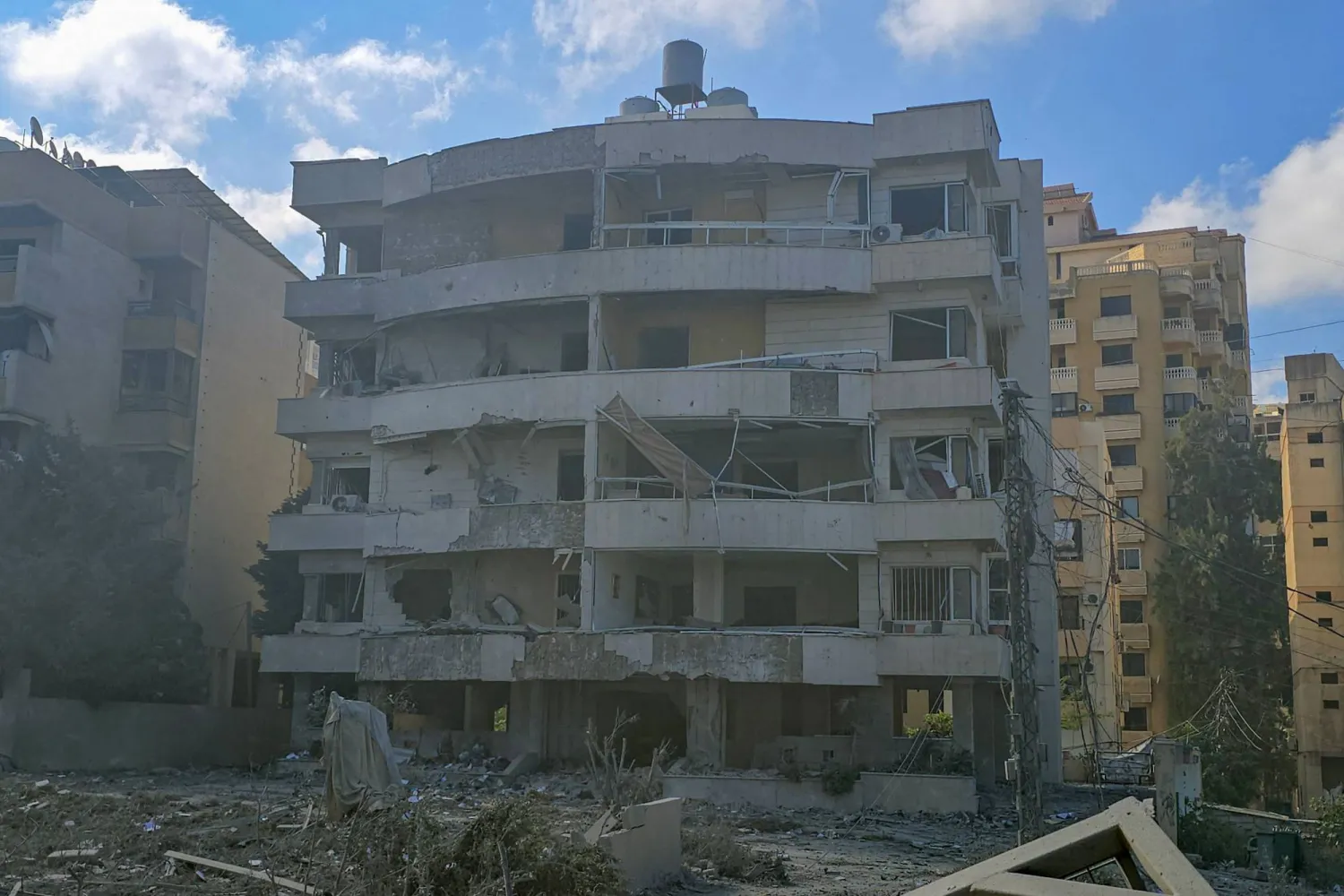
The aftermath of an Israeli airstrike is seen in the southern Lebanese area of al-Hosh, near the coastal city of Tyre on May 26, 2026.  (Photo by AFP)
The aftermath of an Israeli airstrike is seen in the southern Lebanese area of al-Hosh, near the coastal city of Tyre on May 26, 2026. (Photo by AFP)
TT

Strikes Hit South Lebanon City as Israel Expands Ground Operations

The aftermath of an Israeli airstrike is seen in the southern Lebanese area of al-Hosh, near the coastal city of Tyre on May 26, 2026.  (Photo by AFP)
The aftermath of an Israeli airstrike is seen in the southern Lebanese area of al-Hosh, near the coastal city of Tyre on May 26, 2026. (Photo by AFP)

Several strikes hit the southern Lebanese city of Nabatieh on Tuesday after an Israeli evacuation warning, an AFP correspondent said, as an Israeli military official confirmed ground operations had expanded deeper into the country. 

The latest strikes came after Israeli Prime Minister Benjamin Netanyahu on Monday ordered his military to intensify attacks on Hezbollah to "crush" the Iran-backed group, the same day at least 11 people were killed in a strike in eastern Lebanon. 

An AFP correspondent in Nabatieh reported airstrikes following the warning on Tuesday and saw plumes of smoke rising from various locations within the city. 

An Israeli military official told AFP that troops had begun operating beyond the Israel-announced "Yellow Line" in south Lebanon, which runs around 10 kilometers (six miles) deep inside Lebanese territory. 

As Israel's operations moved deeper into south Lebanon, Hezbollah said its fighters confronted Israeli troops trying to advance into a town that overlooks Nabatieh city on Tuesday. 

Hezbollah said in a statement that its fighters repelled an Israeli force early Tuesday that had advanced toward Zawtar al-Sharqiyah following airstrikes and heavy artillery fire. 

The group said it used drones and was fighting with Israeli soldiers in the town. 

Largely deserted since the start of the latest Israel-Hezbollah war on March 2, Nabatieh has faced relentless strikes despite an April 17 truce. 

Avichay Adraee, the Israeli military's Arabic-language spokesman said on X on Tuesday that residents of the entire city "must evacuate your homes immediately and move north of the Zahrani River". 

In eastern Lebanon, the health ministry said "yesterday's Israeli enemy airstrike on the town of Mashghara in West Bekaa resulted in a preliminary toll of 11 martyrs, including two girls and a woman, and 15 wounded, including a child". 

Rescuers were still clearing the rubble in the eastern town, the ministry added. 

The Israeli military in a statement said it launched "several strikes... in the area of Mashghara" on "Hezbollah infrastructure sites where terrorists' activity was identified". 

Later on Tuesday, it issued an evacuation warning for the town as well as Sohmor near it. 

Lebanon's state-run National News Agency (NNA) also reported several Israeli strikes across the south and east. 

A strike on Srifa in the south killed a rescuer and wounded two others from the Risala Scouts association, linked to the Hezbollah-allied Amal movement, according to the health ministry, raising the rescuer death toll in the war to 120. 

- Drone attacks - 

Several strikes also hit near a dam in the Litani river's Qaraoun lake, eastern Lebanon. 

The Litani River Authority issued a statement warning that "any direct or indirect targeting of the Qaraoun Dam or its facilities could lead to catastrophic risks for residents, infrastructure, and vital installations in the areas downstream". 

It called on the president, prime minister and government to "make the necessary contacts and take the necessary actions at the international and diplomatic levels to protect the Qaraoun Dam... from any attacks". 

Evacuation warnings near the southern city of Tyre on Monday caused mass panic and an exodus of residents of the historic city, according to an AFP correspondent. 

The Israeli military said on Tuesday it had bombed more than 100 Hezbollah targets across Lebanon overnight. 

The Iran-backed movement also claimed drone attacks on an Israeli army barracks in northern Israel on Tuesday. 

The Israeli army on Tuesday said it "intercepted several explosive drones launched by the Hezbollah terrorist organization toward Israeli territory". 

"Several additional explosive drones fell within Israeli territory, adjacent to the Israel-Lebanon border," it added, saying no injuries were reported. 

Netanyahu had ordered "an even greater acceleration of our operations" against Hezbollah on Monday evening. 

"It is true that they are attacking us with drones, including fiber-optic drones, but we have teams working on countermeasures and we will solve this issue... We will intensify our blows, increase our firepower, and we will crush them." 

Israel has repeatedly bombed Lebanon despite a truce in its war with Hezbollah, saying it is targeting the group, while the latter has claimed several attacks on Israeli positions in southern Lebanon and northern Israel. 

Lebanese authorities say more than 3,100 people have been killed by Israeli strikes since March 2, when Hezbollah drew Lebanon into the Middle East war by attacking Israel in support of its backer Iran. 


Sudan’s Omar al-Bashir Seeks Treatment Abroad

Former Sudanese President Omar Hassan al-Bashir inside a cage in a Khartoum court during his corruption trial on August 31, 2019 (Reuters)
TT

Sudan’s Omar al-Bashir Seeks Treatment Abroad

Former Sudanese President Omar Hassan al-Bashir inside a cage in a Khartoum court during his corruption trial on August 31, 2019 (Reuters)

Sudan's former president Omar al-Bashir is seeking permission to travel abroad for medical treatment, his lawyer told AFP on Friday, saying the jailed ex-ruler requires tests unavailable in war-ravaged Sudan.

Bashir, 82, was recently transferred from a hospital in the northern city of Merowe to Aliaa Specialist Military Hospital in Omdurman, across the Nile from the capital Khartoum, after suffering health complications, his lawyer Mohamed El-Hassan El-Amin said.

El-Amin added that Bashir's condition "requires medical tests and cardiac imaging that are not currently available in Sudanese hospitals".

"There is no specific country being sought for treatment. He could travel to any country able to provide the required care," he told AFP.

In a statement on Wednesday, Bashir's family said his health had deteriorated to the point that treatment abroad had become "urgent", without disclosing details of his condition.

Bashir seized power in 1989 and ruled Sudan for three decades before being ousted in April 2019 following months of mass protests.

The International Criminal Court has accused him of genocide, war crimes and crimes against humanity over the Darfur conflict that erupted in 2003.


Hezbollah Seeks to Ease Supporters’ Anger With Pledge to Cover Displaced Families’ Rent

Hezbollah supporters hold a portrait of former Secretary-General Hassan Nasrallah on the second anniversary of his assassination in Beirut’s southern suburbs (Reuters). 
TT

Hezbollah Seeks to Ease Supporters’ Anger With Pledge to Cover Displaced Families’ Rent

Hezbollah supporters hold a portrait of former Secretary-General Hassan Nasrallah on the second anniversary of his assassination in Beirut’s southern suburbs (Reuters). 

Hezbollah is seeking to ease growing anger among its supporters by pledging to contribute to housing costs for families who lost their homes in the war, nearly six months after a devastating escalation that began on March 2, during which Israel occupied more than 65 villages and towns in South Lebanon.

Hezbollah Secretary-General Naim Qassem’s announcement of plans to contribute to a housing project, alongside a commitment to provide accommodation, repairs and reconstruction using the group’s resources and donations, comes amid mounting frustration over its failure to deliver promised housing allowances for nearly two years.

The delays have worsened conditions for thousands of families, particularly those displaced from border communities.

Hezbollah has yet to disclose details of the initiative, leaving prospective beneficiaries hoping that long-promised payments will soon materialize.

No Full Rent Coverage

Residents of Beirut’s southern suburbs understand the announcement to mean that Hezbollah will cover only part of displaced families’ rent rather than the full amount.

Local sources told Asharq Al-Awsat that the pledge had dashed hopes of full coverage, as provided in 2006 and following the 2024 war.

“We are waiting for the details to be announced to understand the nature of this support,” they added.

The issue has become increasingly pressing for Hezbollah, which faces a financial crisis that Qassem has attributed to a financial “siege” preventing the transfer of funds from Iran to Lebanon.

Researcher Mohammad Shamseddine estimated that around 35,000 families currently require housing assistance.

He told Asharq Al-Awsat that the last payment, made after the March 2026 war, consisted of monthly allowances of up to $400 for households in Beirut and $300 in the south.

No final decision has been reached on the amount to be allocated, its distribution or whether payments would cover specific months or an entire year, he noted.

Following the first round of fighting in 2024, Hezbollah paid up to $10,000 per property for minor repairs, spending an estimated $300 million. It also disbursed $800 million in housing assistance, covering furniture and one year’s rent for those whose homes were completely destroyed.

In 2025, Qassem announced that the group had provided housing allowances to 50,755 people and repaired homes for 332,000 others.

Growing Discontent Among Supporters

Hezbollah opponent Ali Murad linked the announcement to rising dissatisfaction within the group’s support base, ranging from limited objections to occasional public criticism of its decisions and the course it has charted for South Lebanon.

He questioned what options remained available to residents after everything they had endured and whether Hezbollah had a clear vision for the next phase.

Murad told Asharq Al-Awsat that the party was under pressure to offer at least partial accommodation solutions while continuing to blame the state for shortcomings, despite recognizing the severity of its crisis.

He maintained that rental assistance alone could not compensate residents for their losses.

While the government has clear obligations toward its citizens, displaced families primarily need a viable plan allowing them to return to their villages and homes, something currently unavailable, he explained.

Murad urged the state to assume responsibility for the south, not merely by paying compensation or countering Hezbollah, but by becoming the residents’ principal authority and point of reference.

Three Objectives Behind the Pledge

Paris-based professor of law and foreign policy Mohieddine Al-Shuhaimi identified three objectives behind Hezbollah’s announcement.

First, he argued, Hezbollah wants to preempt the state by portraying itself as capable of delivering aid where public institutions appear absent or unable to fulfill their responsibilities.

Second, it seeks to demonstrate that it can still secure funding despite substantial losses, restrictions and sanctions.

Third, the initiative aims to bolster morale among supporters amid emerging, albeit limited and largely unspoken, discontent.

According to Al-Shuhaimi, Hezbollah fears even minor dissent within its ranks and wants to reaffirm its position as the community’s protector rather than leaving that role to the state.

On financing, he observed that although the party has lost substantial revenue sources and parts of its financial network, it retains diminished resources and continues receiving assistance through informal channels despite tighter oversight.

Al-Shuhaimi called on Lebanese authorities to avoid merely reacting to Hezbollah’s initiatives and instead develop a comprehensive financial strategy aligned with a political process.

The state, he concluded, must reclaim its role and work toward ending the exceptional situation created by Hezbollah’s weapons through a coordinated political and financial approach.


Lebanon PM Says Scale of War Recovery beyond State's Capacity

Lebanese Prime Minister Nawaf Salam during a visit to the Lebanese army in southern Lebanon, Aug. 21, 2026. (National News Agency)
TT

Lebanon PM Says Scale of War Recovery beyond State's Capacity

Lebanese Prime Minister Nawaf Salam during a visit to the Lebanese army in southern Lebanon, Aug. 21, 2026. (National News Agency)

Lebanese Prime Minister Nawaf Salam said Friday that rebuilding regions destroyed in the latest Israel-Hezbollah war was beyond the state's capacity, calling for funding as he visited the heavily damaged south.

"I am aware of the magnitude of the crisis" including the destruction, displacement and loss of livelihoods, Salam said in Nabatieh, a major southern city hit hard by Israeli airstrikes.

"But the scale of the needs exceeds the capacities of the Lebanese state and its ability to bear these burdens alone," Salam added. "We still need significant funding" for reconstruction, the prime minister said.

Lebanese militant group Hezbollah drew the country into the broader Middle East war in March by attacking Israel, which responded with massive airstrikes and a ground invasion.

The fighting followed another conflict that erupted in 2023 that led to an all-out war the next year. Lebanon has put the overall death toll from these conflicts at more than 8,900.

Hundreds of thousands of people remain displaced, mainly from the south, while Israel maintains troops in a self-declared "security zone" running around 10 kilometers (six miles) inside Lebanon along the border.

Last month, Salam said the estimated total cost of the two wars could exceed $27 billion.

"I am here today to affirm the return to work of state institutions," he said during Friday's visit.

Violence has decreased since a ceasefire following a US-Iran memorandum of understanding in June, while Lebanon and Israel concluded a US-sponsored framework agreement later that month.

But Nabatieh and surrounding areas in particular have seen continued Israeli attacks.

The Israel-Lebanon deal involves the disarmament of Hezbollah, a gradual withdrawal of Israeli forces from Lebanon's south and the deployment of the Lebanese army to the region, starting in test areas known as "pilot zones".

Salam said it was important to rally "all the capabilities and support we can to achieve a full Israeli withdrawal" and build a state that is the sole decision maker on war and peace.

"This is the path to avoid finding ourselves once again facing a new war or new pretexts to attack Lebanon, or a new expansion of the (Israeli) occupation," he added.

Hezbollah has rejected disarming.
