


Palestinians Mourn 10 Killed in Eid Strikes as Netanyahu Vows Wider Control of the Strip

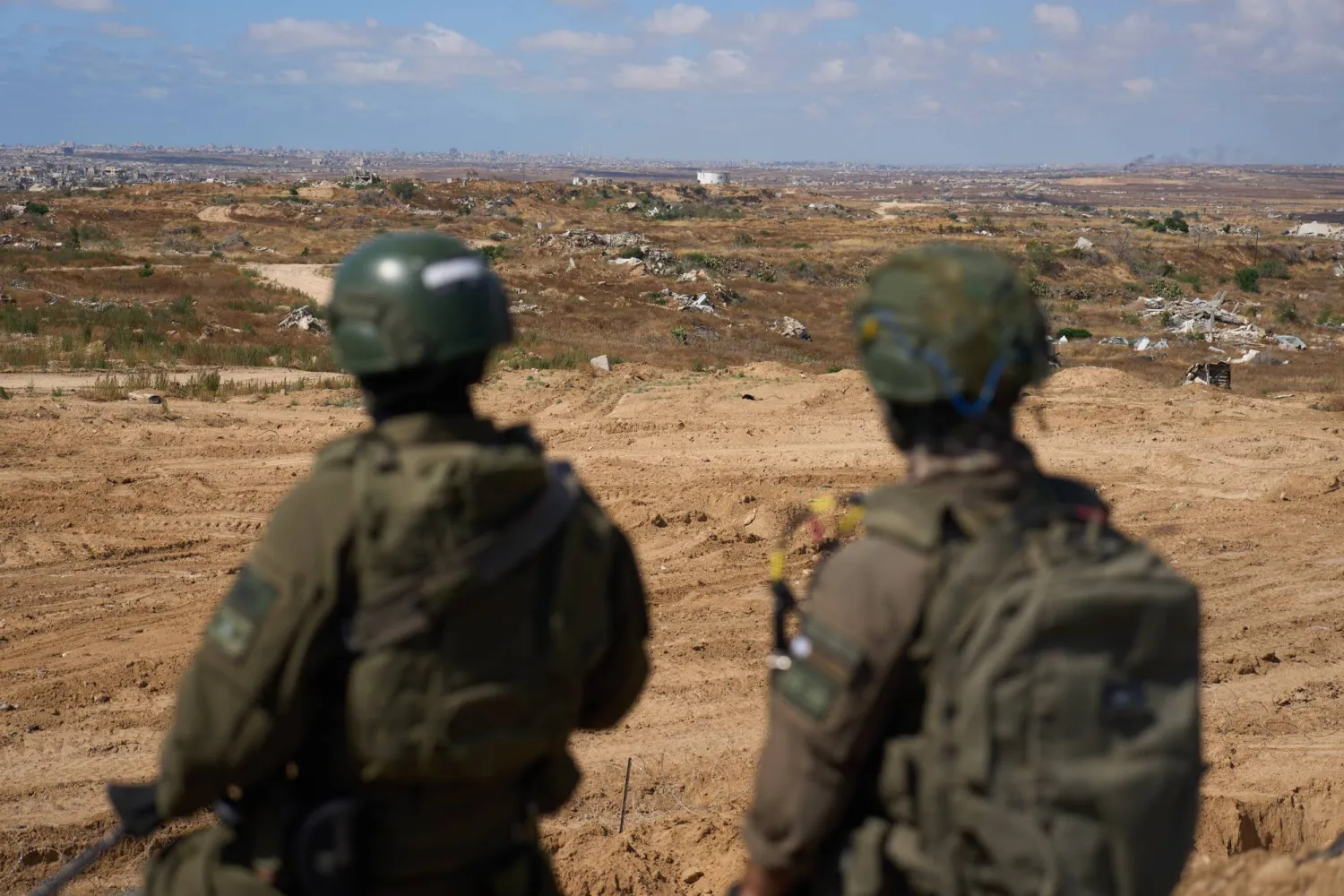
Israeli soldiers occupy a military position overlooking the so-called Yellow Line in the central Gaza Strip, Tuesday, May 26, 2026. (AP Photo/Ariel Schalit)
TT

Palestinians Mourn 10 Killed in Eid Strikes as Netanyahu Vows Wider Control of the Strip

Israeli soldiers occupy a military position overlooking the so-called Yellow Line in the central Gaza Strip, Tuesday, May 26, 2026. (AP Photo/Ariel Schalit)

Dozens of Palestinians in Gaza City gathered on Thursday for funeral prayers for 10 people killed in Israeli strikes the night before, including five children and an elderly person, as well as a Hamas militant.

More than 20 people were injured in the strikes, according to Shifa Hospital. Video from the scene showed flames pouring from an upper-floor window of a building, while bystanders rushed to carry wounded people, including children, to ambulances, said AFP.

Mohammed Shawish, who was wounded and lost his wife in the strikes, broke down in tears as he held her body at the hospital morgue, saying, “I married my wife for love. For God’s sake, I chose her because of love.”

The strikes took place on the first day of Eid al-Adha, an Islamic holiday celebrated by millions of Muslims worldwide. The Israeli military said Wednesday evening it had launched strikes in the northern Gaza Strip targeting two Hamas militants.

Among those killed was Hamas fighter Imad Isleim. On Thursday, mourners carried his body wrapped in a white shroud with a Hamas flag draped over it. His death came as a “shock” to the family, even though they knew it could happen at any time, his cousin Nidal Isleim said.

The strikes came as Israeli Prime Minister Benjamin Netanyahu said Israel was expanding its control in Gaza.

“Right now we are tightening the grip on Hamas," Netanyahu said Thursday at the Jordan Valley Conference in the occupied West Bank. “We are now in 60% of the territory of the Gaza Strip. You know that? We were at 50%, we moved to 60%."

He said the next step was to move to 70% control, with Israel “tightening the grip" on Hamas "from every direction.”

“We will deal with the remnants,” Netanyahu said. "But the most important thing is to continue leveraging our power, to increase it.”

The conference was part of a broader discussion on the war, Iran, Hezbollah, Gaza and regional strategy.

"There is still more work. What is happening right now is truly a global change. There is no doubt about that,” Netanyahu added.

Earlier this week, an Israeli strike killed Mohammed Odeh, the newly appointed leader of Hamas’ military wing, the Qassam Brigades, less than two weeks after his predecessor was also killed.

Across the Gaza Strip, 16 people were killed and 39 others wounded over the past 48 hours, Gaza’s health ministry said in an update on Thursday. The ministry is part of Gaza’s Hamas-run government but is staffed by medical professionals who maintain and publish detailed records viewed as generally reliable by the international community.

Since a fragile ceasefire came into effect last October, 922 people have been killed in Gaza and 2,786 others injured, according to the ministry.



Israel Army Chief Vows in Syria to Deter Threats to Border

Eyal Zamir and Israeli troops during a visit to an Israeli-occupied security zone in southern Syria. (Israeli army)
TT

Israel Army Chief Vows in Syria to Deter Threats to Border

Eyal Zamir and Israeli troops during a visit to an Israeli-occupied security zone in southern Syria. (Israeli army)

Israel's army chief said Wednesday during a visit to an Israeli-occupied security zone in southern Syria that the military would not allow threats to "establish themselves" on the border.

"We are monitoring the changes on the Syrian front. We will not allow hostile forces to establish themselves on our borders, and we will know how to use our operational capabilities precisely where and when needed," Lieutenant General Eyal Zamir told troops.

Israeli forces have been stationed in a security zone in southern Syria since the fall of the Assad regime in December 2024, occupying what was previously a buffer zone patrolled by the United Nations that had separated Israeli and Syrian forces in the Israeli-occupied Golan since 1974.

The top general said the army cannot afford to let down its guard on any of Israel's active war fronts, including Syria.

"We are still in a multi-front war, alert and operating in all arenas -- escalation can develop in any one of them, and we must remain in constant readiness."

Zamir's visit came one day after Israel bombed the Abu al-Duhur air base in Idlib province in northwestern Syria, accusing Damascus of violating an agreement by accepting Turkish troops on it.

"Israel repeatedly warned Syria that such a deployment would pose a threat to Israel's security. Syria chose to ignore these warnings," said a statement by the Office of Prime Minister Benjamin Netanyahu, which stopped short of acknowledging Israeli responsibility.

Türkiye, which has had tense relations with Israel in recent years, rejected the allegations, while the US ambassador to Türkiye Tom Barrack condemned the strikes, saying they constituted an "unnecessary escalation."

Syria's foreign ministry condemned "in the strongest terms the Israeli airstrikes" targeting the base, calling them "an unjustified act of aggression" and urging action by the UN Security Council.

The attacks come as Syria "has exercised restraint and worked to consolidate stability and avoid escalation", it added.

Despite tensions between the neighbors, Israel and Syria's new authorities have held several rounds of direct talks and have agreed to establish an intelligence-sharing mechanism.

But last week Israeli Defense Minister Israel Katz said that his country planned to keep troops in Syria.

Israel captured most of the Golan from Syria in the 1967 Arab-Israeli War and later annexed the areas under its control, in a move not recognized by the international community except for the United States and Colombia.


Germany, France Condemn Far-Right Israeli Minister’s ‘Inhumane’ Gaza Remarks

10 November 2022, Israel, Jerusalem: Israeli Minister of National Security Itamar Ben-Gvir speaks during a memorial ceremony for late Rabbi Meir Kahane. (dpa)
TT

Germany, France Condemn Far-Right Israeli Minister’s ‘Inhumane’ Gaza Remarks

10 November 2022, Israel, Jerusalem: Israeli Minister of National Security Itamar Ben-Gvir speaks during a memorial ceremony for late Rabbi Meir Kahane. (dpa)

Germany and France on Wednesday condemned remarks by Israel's far-right national security minister, who declared that Israel should kill "30 or 40" people every night in the Palestinian territory of Gaza.

German Chancellor Friedrich Merz "strongly condemns the inhumane appeals made by Minister (Itamar) Ben-Gvir, which violate international law," German government spokesman Sebastian Hille said. "They are unacceptable."

French Foreign Minister Jean-Noel Barrot also slammed the remarks, calling them "intolerable and inhumane" in an interview with the La Montagne regional newspaper.

Israel launched a military campaign on Hamas-ruled Gaza after the October 7, 2023 attack by the Palestinian group Hamas against Israel.

Ben-Gvir, who is already facing calls from several European countries for bloc-wide sanctions, made the call for mass killings during a podcast with a former Gaza hostage who had been held by Hamas.

"I think targeted eliminations should be carried out in Gaza every night. Take out 30 or 40," he said.

"Not only those who endanger you right now. These are people who shouldn't be alive," Ben-Gvir said. "I'm paying them a compliment by calling them humans."

Lars Klingbeil, German vice chancellor and finance minister, said in a TV interview Tuesday that Ben-Gvir's comments "must have consequences", adding that sanctions were being discussed at the European level.

Several European countries have called for EU-wide sanctions against the far-right minister, but the proposal has failed to win the required unanimity.

Calls to blacklist Ben-Gvir grew after he published a video in May of himself mocking bound activists seized by Israeli soldiers on a Gaza-bound aid flotilla.

France in response banned Ben-Gvir from entering the country and called for the EU to impose bloc-wide sanctions.

But EU sanctions have to be signed off by all 27 member states and staunch supporters of Israel refused to go along with the push.

- 'No further steps' -

Germany also condemned Israeli plans for settlement expansion in the so-called E1 area of the occupied West Bank, saying it jeopardizes the prospect for a two-state solution.

"Our message is clear: there must be no further steps toward annexation in the West Bank," said Hille.

"No formal ones, but also no political, structural, or other measures whose impact is increasingly and obviously leading toward annexation. They run counter to a two-state solution."

France's Barrot did not rule out further sanctions on Israeli settlers in the West Bank, who have increasingly been harassing and assaulting Palestinian residents in recent months, often with the aim to take their property.

"We imposed European sanctions against these settlers for the third time on May 28," he said.

"Further sanctions could be imposed and all options are on the table," Barrot added.

Israel has occupied the West Bank since 1967 and since then settlement expansion has been a policy under successive Israeli governments.

But it has accelerated significantly under the current coalition government of Prime Minister Benjamin Netanyahu.

Excluding east Jerusalem, more than 500,000 Israelis now live in the West Bank in settlements that are illegal under international law, among some three million Palestinians.


Lebanon Says Received French Invitation to Meeting on Army Support

13 August 2026, Lebanon, Zawatar al-Gahrbiyeh: Lebanese army soldiers secure the premises of "Our Lady of the Annunciation" Monastery in Zawatar al-Gahrbiyeh. (dpa)
TT

Lebanon Says Received French Invitation to Meeting on Army Support

13 August 2026, Lebanon, Zawatar al-Gahrbiyeh: Lebanese army soldiers secure the premises of "Our Lady of the Annunciation" Monastery in Zawatar al-Gahrbiyeh. (dpa)

Lebanon said Wednesday it had received an invitation from France for a meeting to prepare for an international conference on support for the Lebanese army, an event postponed by the Middle East war.

The conference in Paris was supposed to take place in March but was delayed after the Hezbollah group drew Lebanon into the regional war by attacking Israel in support of its backer Iran.

Lebanon said in a statement Wednesday that President Joseph Aoun had "received from the French charge d'affaires in Lebanon, Bruno Da Silva, a letter from French President Emmanuel Macron that included an invitation for Lebanon to participate in a preparatory meeting to be held in Paris on September 17".

Aoun thanked Macron for the invitation, praising "the constant interest he shows towards Lebanon and its national institutions, foremost among them the army and the Internal Security Forces".

He said the invitation highlighted the importance of "supporting the Lebanese army with the aim of enabling it to possess the capabilities and resources necessary to carry out its responsibilities effectively".

The army "requires international support and a collective effort to meet its operational needs, logistical equipment, training and capacity building", the statement by the Lebanese presidency added.

Army chiefs from several countries, as well as representatives from governmental and international organizations, along with experts, are expected to attend the meeting, according to the presidency.

France did not announce anything on Wednesday related to the conference.

In February, French Foreign Minister Jean-Noel Barrot visited Lebanon to prepare for the event.

Beirut received pledges of international support for its troops after Lebanon's government committed to disarming Hezbollah last year and tasked the army with the process.

Hezbollah has been weakened by over a year of hostilities with Israel, which a November 2024 ceasefire sought to end, although the fighting has not been completely halted.

Lebanon and Israel have since entered US-sponsored direct talks in an effort to end hostilities. In June they signed a framework agreement that calls for the disarmament of Hezbollah, a gradual withdrawal of Israeli forces from south Lebanon and the deployment of the Lebanese army to the region, starting in "pilot zones".

But the Lebanese military faces major challenges amid a shortage of equipment, personnel, and technical capabilities necessary to carry out its mission.
