
Lebanon Announces Partial Ceasefire between Israel, Hezbollah but Attacks Continue

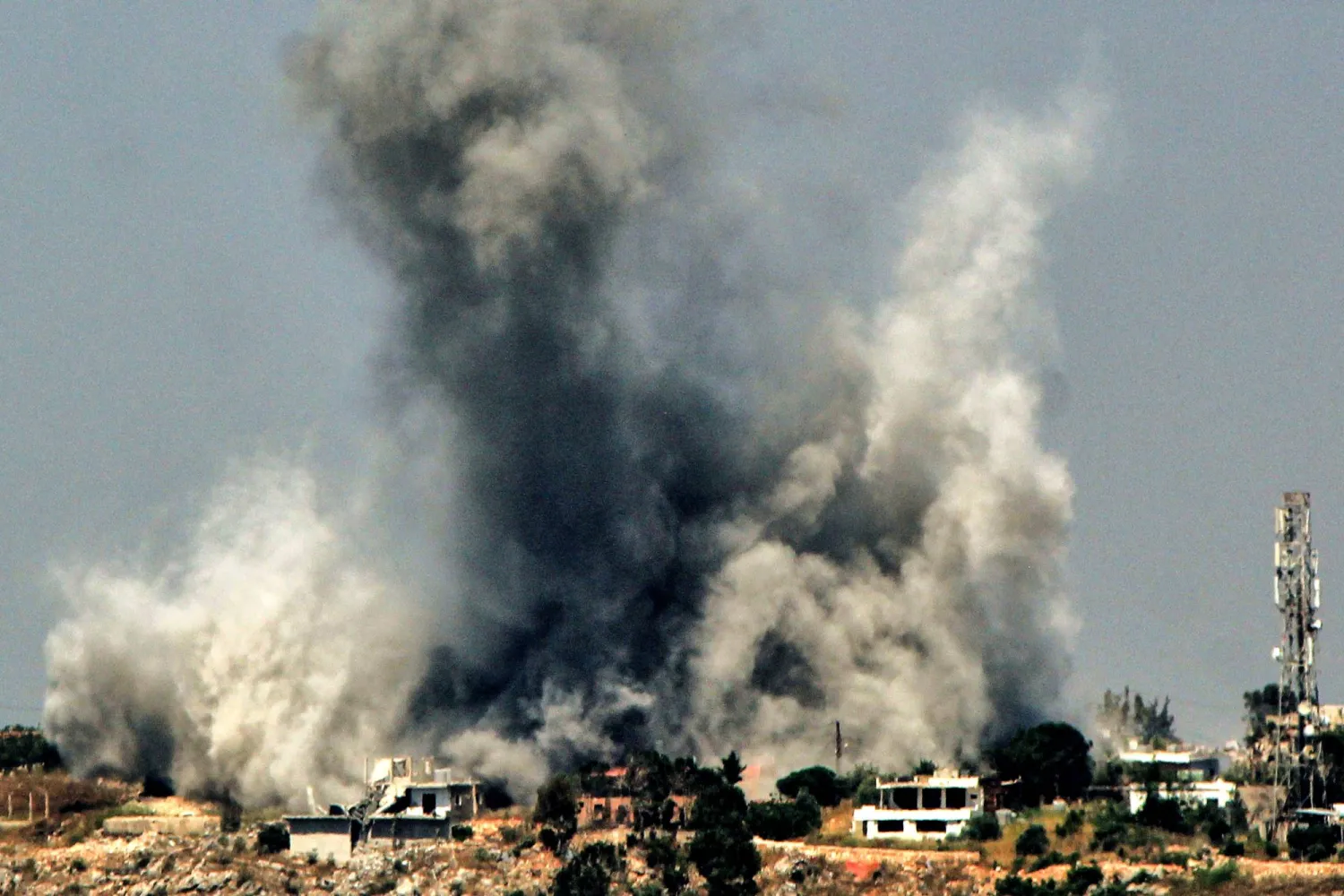
01 June 2026, Lebanon, Arnoun: Smoke billows from an Israeli airstrike on the southern Lebanese village of Arnoun. Photo: Stringer/dpa
TT

Lebanon Announces Partial Ceasefire between Israel, Hezbollah but Attacks Continue

01 June 2026, Lebanon, Arnoun: Smoke billows from an Israeli airstrike on the southern Lebanese village of Arnoun. Photo: Stringer/dpa

Lebanon announced a partial ceasefire between Hezbollah and Israel on Monday in what would amount to a limited de-escalation of a conflict that has killed thousands of people and inflamed the broader US-Israeli war with Iran. According to Lebanon's embassy in Washington, the agreement would not end the conflict in that country. But it calls for Israel to refrain from strikes on Beirut and its suburbs controlled by Hezbollah, while the Iran-aligned group would halt its attacks on Israel.

Hostilities in southern Lebanon, which Israel invaded in March, continued on Monday evening. Early on Tuesday, the Israeli military said that it intercepted two projectiles that crossed from Lebanon into northern Israel, and that no injuries were reported, Reuters said.

US President Donald Trump, who first announced the agreement, ‌said Hezbollah, through ‌intermediaries, had pledged not to attack Israel. No US president has ever spoken ‌with Hezbollah, ⁠with or without ⁠intermediaries. The US has designated the group as a terrorist organization.

Trump also said Israeli Prime Minister Benjamin Netanyahu agreed to pull back any troops preparing to attack Beirut.

After Trump's announcement, Netanyahu said Israel would continue military operations in southern Lebanon, where ground forces are pushing toward the Zaharani River, their deepest incursion in Lebanon in 25 years.

Hezbollah lawmaker Hassan Fadlallah said the militia would support a full ceasefire across all Lebanon as a precursor to the withdrawal of Israeli troops. He did not say whether the group would stop its strikes on Israeli territory.

Lebanon said it would seek to expand ⁠the ceasefire in talks with Israel in Washington on Wednesday. That could clear the ‌path for renewed efforts to end the three-month-old war that began with ‌US and Israeli attacks on Iran. The process has been stuck in limbo for weeks under a fragile ceasefire as negotiators ‌have been unable to agree on an initial framework for peace talks.

The Israel-Hezbollah war erupted on March 2 ‌as an offshoot of the broader conflict and has been entangled with it ever since.

Iran has insisted on a halt to Israeli attacks in Lebanon as a condition of any deal to end the war, while the US has said the two conflicts are separate.

"The ceasefire between Iran and the US is unequivocally a ceasefire on all fronts, including in Lebanon," Iranian Foreign Minister ‌Abbas Araghchi said in a statement.

IRAN THREATENS TO BREAK OFF TALKS Iranian state media said earlier on Monday that Tehran was halting indirect peace negotiations with ⁠the US and might end a ⁠ceasefire that has largely held since early April, citing the war in Lebanon.

There was no direct confirmation of the reports from Iranian officials, and Trump told an NBC reporter that he had not heard from Iran. He said in a CNBC interview on Monday that the peace talks had "started to get very boring" and that he did not care if they were over.

"I really don't care, I couldn't care less," Trump said.

Since mid-March, Trump has repeatedly said he is close to signing a peace agreement but has yet to do so. Despite the ceasefire, Iran and the US have exchanged strikes several times over the past week.

Meanwhile, the head of Iran's Revolutionary Guards Quds Force, Esmaeil Qaani, threatened to expand its blockade of the Strait of Hormuz to the Bab El Mandeb Strait, another chokepoint at the mouth of the Red Sea. Iran has already bottled up maritime traffic in the Gulf that before the war provided one-fifth of the world's oil and liquefied natural gas, sending prices sharply higher.

Oil prices rose 4% on Monday on the heightened tensions.


A US Soldier and a British Soldier Die during Training in Iraq

US Army soldiers from the 5-20 Infantry Division take up positions to provide cover for fellow soldiers as part of the launch of Operation Arrowhead Strike Six in the Shaab neighborhood of northern Baghdad, 06 February 2007. (AFP)
TT

A US Soldier and a British Soldier Die during Training in Iraq

US Army soldiers from the 5-20 Infantry Division take up positions to provide cover for fellow soldiers as part of the launch of Operation Arrowhead Strike Six in the Shaab neighborhood of northern Baghdad, 06 February 2007. (AFP)

One American soldier and one British soldier died during a training exercise in Iraq, US and UK officials said Monday without releasing further details.

The deaths occurred Sunday at an air base in Irbil in the semi-autonomous Kurdish region of northern Iraq, where the US has retained a presence, the US Army said in a post on X. The statement said the soldier’s identity is being withheld until 24 hours after his or her family has been notified.

The UK’s Ministry of Defense said in a separate post that the family of the British soldier has been notified and requested a “period of grace” before more details are released, The Associated Press reported.

The US has been reducing the number of troops countering the ISIS militant group in Iraq. But American forces have retained a presence in the Kurdish region as the US seeks to strengthen ties with the Kurds.

The US inaugurated a large new consulate compound in December in Irbil, the capital of the Kurdish region, highlighting Washington’s diplomatic and strategic engagement in the area.

The deaths occurred nearly a month after two American soldiers fell off a cliff and died during an off-duty recreational hike in Morocco. They were reported missing May 2 after participating in African Lion, an annual multinational military exercise.


Israel Imposes 'Undeclared Buffer Zone' in Southern Syria

UNDOF soldiers in Saidah village in the southern Quneitra countryside. (SANA)
TT

Israel Imposes 'Undeclared Buffer Zone' in Southern Syria

UNDOF soldiers in Saidah village in the southern Quneitra countryside. (SANA)

Israeli forces continued their nearly daily violations of Syria territory on Monday when an Israeli artillery shell landed near the village of al-Musayritiyah in the western Daraa countryside, sparking a fire in a wheat field before residents managed to extinguish it, reported Syria’s state news agency SANA.

The village is located in the Yarmouk Basin area close to the border with the occupied Syrian Golan. It has witnessed repeated Israeli incursions, including home and farm searches and the detention of young men.

On Sunday, four Israeli military vehicles reached the entrance of the town of Maariya in the Yarmouk Basin, while two others seized the road connecting the village of Saidah in the Golan to al-Basali in the eastern Quneitra countryside.

SANA reported the Israeli forces set up two checkpoints and searched pedestrians and vehicles before withdrawing from the area.

All the measures are seen as efforts to impose an unofficial buffer zone, said sources in Damascus.

Israel continues to violate the 1974 Disengagement Agreement through shelling, ground incursions, attacks on civilians, raids, detentions and land leveling.

Syria consistently demands the end of the Israeli occupation of its territory, stating that all Israeli measures in southern Syria are null and void under international law. Damascus also calls on the international community to assume its responsibilities, deter the Israeli practices and compel a full withdrawal from southern Syria.

Since the ouster of Bashar al-Assad's regime in December 2024, Israeli forces have seized 665 kilometers of Syrian territory, set up nine military positions and continue to carry out land incursions into Syria, notably in the eastern and northern Quneitra countryside and Yarmouk Basin.

Syrian and international reports said Israel has set up a security zone, similar to the “yellow line” in Gaza, to bar military activity in the area and strip the Quneitra and Daraa regions of heavy weapons. It aims to control areas leading to southern Damascus with the aim of creating “strategic depth” to protect Galilee and the Golan.

Researcher at the Jusoor Center for Studies Rashid Hourani said Israel wants to create the buffer zone through razing agricultural areas in Quneitra, western Daraa countryside, and Yarmouk Basin especially.

It wants to destroy infrastructure and military positions by repeatedly targeting them, thereby preventing citizens from accessing their agricultural lands, he told Asharq Al-Awsat.

It also wants to impose restrictions on their movement as Israeli forces have carried out frequent interrogations of the locals and set up temporary checkpoints in the areas, he added.

Israeli forces have destroyed civilian facilities and historic sites, including 15 houses in the village of al-Hamidiye. They blew up a historic mosque, a museum building, and other heritage sites.

Israel has increased its incursions into Syria as it escalated its operations in Lebanon and as Lebanese and Israeli official prepare to hold a third round of negotiations in Washington to end the war.

The Syrian-Israeli negotiations have meanwhile stalled after a series of intense talks last year that “have yet to reach tangible results on the ground,” said Foreign Minister Asaad al-Shaibani in previous remarks.

Hourani told Asharq Al-Awsat Israel’s failure to achieve its objectives in the war on Iran has reflected in the stalling of negotiations with Syria, which he said is because of Israel’s “erratic position on how to handle the Syrian file.”

He also noted the pressure it is coming under due to its involvement in Lebanon and Gaza.

Observers have speculated that Israel will impose military and security measures in southern Syrian similar to the ones it has in place in Gaza and southern Lebanon where it is expanding its field control and weakening the local authorities by imposing long-term changes on the ground.

At the same time, Israel is expanding its settlement projects in the Golan.


Euphrates Flood Deprives East Syria Farmers from Crops

People walk across and stand on a bridge damaged by overflowing waters from the Euphrates River near Deir Ezzor, Syria, Thursday, May 28, 2026. (AP Photo/Omar Albam)
TT

Euphrates Flood Deprives East Syria Farmers from Crops

People walk across and stand on a bridge damaged by overflowing waters from the Euphrates River near Deir Ezzor, Syria, Thursday, May 28, 2026. (AP Photo/Omar Albam)

Farmer Issa al-Moussa walks among his damaged wheat crop in eastern Syria after the nearby Euphrates River flooded in recent days due to heavy rainfall and increased flows from Türkiye.

Syrian authorities have said the country was experiencing an "exceptional" rise in water levels along the Euphrates River, which originates in Türkiye and flows through the Raqa and Deir Ezzor provinces before reaching neighboring Iraq.

The water flooded fields and homes, took bridges and crossings out of service, and disrupted the operation of pumping stations for drinking water and irrigation.

"I ploughed my land, which is six dunams (6,000 square meters) in size, and each dunam cost me one million liras ($75)... This land is lost," Moussa told AFP from his farmland, part of which was still submerged in water.

With his wheat crop destroyed, Moussa has no other source of income to feed his family.

The energy ministry said the floods were caused by "the significant and unprecedented increase in water flows from the Turkish side".

In Moussa's town, where many residents rely on agriculture as a source of income, water covered vast areas of farmland, while farmers stood in their fields assessing their losses.

It also surrounded some houses and small buildings.

Authorities estimated about 5,000 dunams (five square kilometers) of land in Deir Ezzor flooded, as well as about 1,500 dunams in the village of Al-Mahoukiya in Raqa.

"No one knows when this water will dry up," Moussa said, demanding that the government "compensate us, assist the farmers, raise the prices of wheat and cotton for us, and support us with fertilizer, medicines and fuel".

- 'Our lands are gone' -

Farmers in the area said they were not warned early enough to avoid losses to equipment and crops.

"We were not informed that dams would open... our lands are gone," Moussa added.

Syrian Energy Minister Mohammad al-Bashir said " Türkiye’s warning to us about the rising water levels of the Euphrates River came too late".

Syria said last week it had to open the Euphrates Dam floodgates for the first time in decades.

No official Turkish position has been issued regarding coordination with Damascus on the rising water level of the Euphrates.

Turkish media however quoted official sources as saying that water authorities carried out "controlled water releases" from the Ataturk Dam after water levels rose due to heavy rainfall in recent months.

The four-meter rise in water levels also caused around 60 water pumping stations to go out of service, water company chief Ahmad al-Moussa told AFP.

On the riverbank, local resident Ahmad Saadoun pointed at a temporary earthen bridge that collapsed.

"We now struggle to cross from one bank to another... People are now crossing by boat, but it is also dangerous as long as the water has not calmed down," he told AFP.

- No harvests -

In response to the floods, the worst in 30 years, authorities were on the alert, reinforcing earthen barriers and preparing to evacuate if needed.

The energy ministry also said it closed one of the spillways from the Euphrates Dam which it had previously opened in to help reduce the flows.

On Sunday, Raqa water authorities said the Euphrates River water level had dropped by about 60 centimeters in 24 hours -- but the gradual decrease has not yet resolved the crisis.

In other parts of Kharita, the water crept suddenly at night, reaching farmers' homes.

"We were asleep when we saw the water rushing in," Mohammed Khodr al-Hussein, 27, said.

"We ran out... with only clothes on our backs. We left our cars, our livelihoods, our homes, and our farms behind. We have nothing left," he added.

"We farmers live season by season. We borrow at the beginning of each season and wait for the harvest to pay off our debts. Today, our losses are twofold: our money is gone, our crops are gone, and the wheat is no longer fit for harvesting."