


Euphrates Flood Deprives East Syria Farmers from Crops

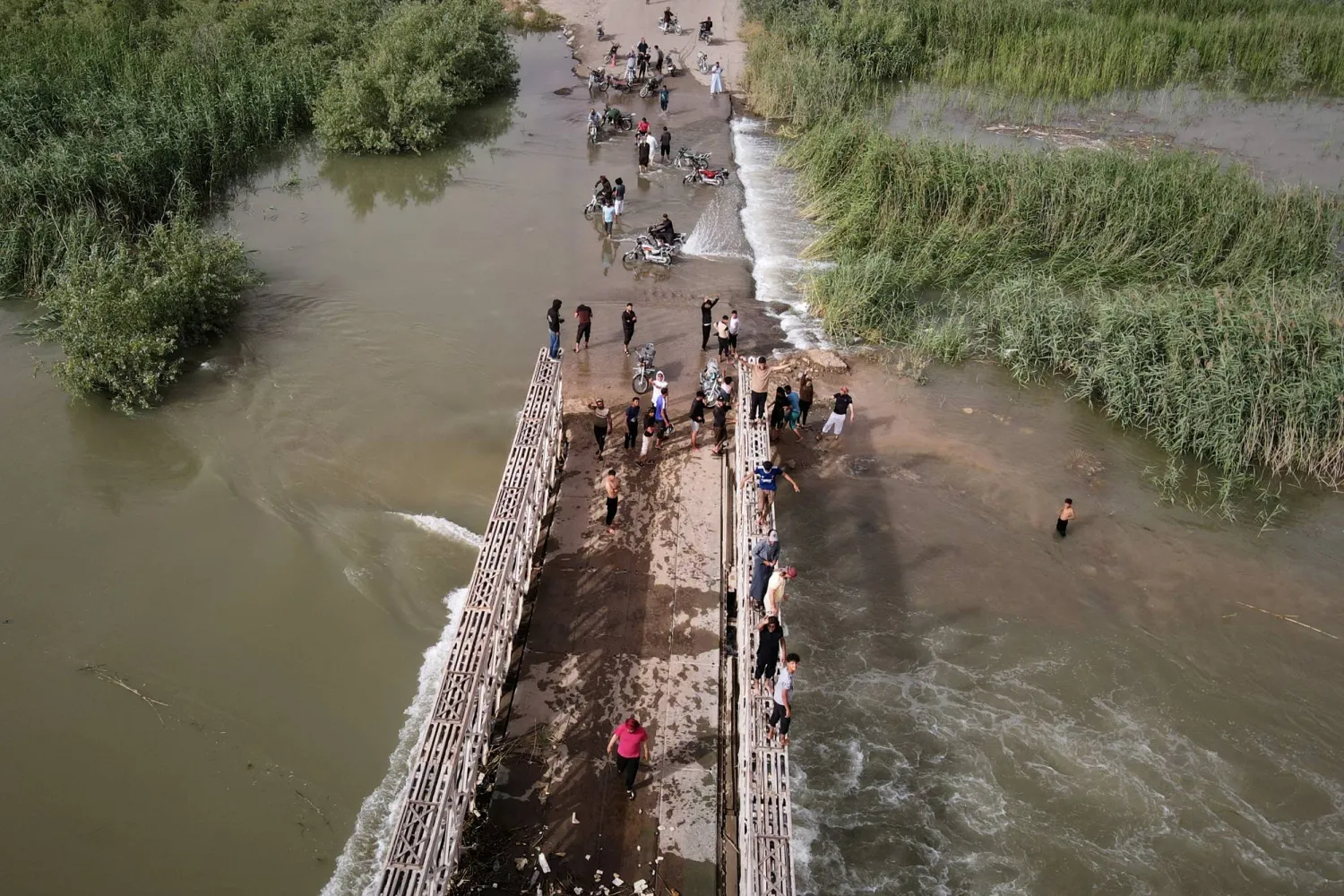
People walk across and stand on a bridge damaged by overflowing waters from the Euphrates River near Deir Ezzor, Syria, Thursday, May 28, 2026. (AP Photo/Omar Albam)
TT

Euphrates Flood Deprives East Syria Farmers from Crops

People walk across and stand on a bridge damaged by overflowing waters from the Euphrates River near Deir Ezzor, Syria, Thursday, May 28, 2026. (AP Photo/Omar Albam)

Farmer Issa al-Moussa walks among his damaged wheat crop in eastern Syria after the nearby Euphrates River flooded in recent days due to heavy rainfall and increased flows from Türkiye.

Syrian authorities have said the country was experiencing an "exceptional" rise in water levels along the Euphrates River, which originates in Türkiye and flows through the Raqa and Deir Ezzor provinces before reaching neighboring Iraq.

The water flooded fields and homes, took bridges and crossings out of service, and disrupted the operation of pumping stations for drinking water and irrigation.

"I ploughed my land, which is six dunams (6,000 square meters) in size, and each dunam cost me one million liras ($75)... This land is lost," Moussa told AFP from his farmland, part of which was still submerged in water.

With his wheat crop destroyed, Moussa has no other source of income to feed his family.

The energy ministry said the floods were caused by "the significant and unprecedented increase in water flows from the Turkish side".

In Moussa's town, where many residents rely on agriculture as a source of income, water covered vast areas of farmland, while farmers stood in their fields assessing their losses.

It also surrounded some houses and small buildings.

Authorities estimated about 5,000 dunams (five square kilometers) of land in Deir Ezzor flooded, as well as about 1,500 dunams in the village of Al-Mahoukiya in Raqa.

"No one knows when this water will dry up," Moussa said, demanding that the government "compensate us, assist the farmers, raise the prices of wheat and cotton for us, and support us with fertilizer, medicines and fuel".

- 'Our lands are gone' -

Farmers in the area said they were not warned early enough to avoid losses to equipment and crops.

"We were not informed that dams would open... our lands are gone," Moussa added.

Syrian Energy Minister Mohammad al-Bashir said " Türkiye’s warning to us about the rising water levels of the Euphrates River came too late".

Syria said last week it had to open the Euphrates Dam floodgates for the first time in decades.

No official Turkish position has been issued regarding coordination with Damascus on the rising water level of the Euphrates.

Turkish media however quoted official sources as saying that water authorities carried out "controlled water releases" from the Ataturk Dam after water levels rose due to heavy rainfall in recent months.

The four-meter rise in water levels also caused around 60 water pumping stations to go out of service, water company chief Ahmad al-Moussa told AFP.

On the riverbank, local resident Ahmad Saadoun pointed at a temporary earthen bridge that collapsed.

"We now struggle to cross from one bank to another... People are now crossing by boat, but it is also dangerous as long as the water has not calmed down," he told AFP.

- No harvests -

In response to the floods, the worst in 30 years, authorities were on the alert, reinforcing earthen barriers and preparing to evacuate if needed.

The energy ministry also said it closed one of the spillways from the Euphrates Dam which it had previously opened in to help reduce the flows.

On Sunday, Raqa water authorities said the Euphrates River water level had dropped by about 60 centimeters in 24 hours -- but the gradual decrease has not yet resolved the crisis.

In other parts of Kharita, the water crept suddenly at night, reaching farmers' homes.

"We were asleep when we saw the water rushing in," Mohammed Khodr al-Hussein, 27, said.

"We ran out... with only clothes on our backs. We left our cars, our livelihoods, our homes, and our farms behind. We have nothing left," he added.

"We farmers live season by season. We borrow at the beginning of each season and wait for the harvest to pay off our debts. Today, our losses are twofold: our money is gone, our crops are gone, and the wheat is no longer fit for harvesting."



Egypt Banks on Domestic Defense Manufacturing to Curb Military Spending

A military vehicle manufactured in Egypt. (Egyptian Ministry of Military Production)
TT

Egypt Banks on Domestic Defense Manufacturing to Curb Military Spending

A military vehicle manufactured in Egypt. (Egyptian Ministry of Military Production)

Egypt is increasingly relying on domestic defense manufacturing to curb military spending, expanding local production of armored vehicles, drones and air defense systems while continuing to diversify its foreign arms suppliers and pursue joint-production partnerships with other countries.

The strategy comes as the country posted the lowest military spending among Arab states last year, with defense expenditure accounting for 0.61% of gross domestic product, according to figures released by the Stockholm International Peace Research Institute (SIPRI).

Military experts told Asharq Al-Awsat that local arms production helps ease pressure on foreign-currency reserves required for imports while ensuring a more secure supply chain. They explained that modern warfare is characterized by the heavy consumption of weapons and ammunition, making uninterrupted access to military supplies a strategic necessity.

Egypt’s armed forces have pursued a comprehensive modernization program in recent years, including diversifying sources of weaponry and forging partnerships with major defense-producing countries, according to Egypt’s State Information Service.

The government is also pushing to expand reliance on locally manufactured defense products.

Minister of State for Military Production Salah Mostafa Gomblat said the current phase focuses on localizing advanced industrial technologies to improve production efficiency and enhance the competitiveness of Egyptian-made products.

He added that the strategy includes forging new partnerships with the private sector to reduce import costs and support the national economy.

According to SIPRI, Egypt recorded the lowest military spending among Arab countries in 2025 even as global military expenditure rose 2.9% from the previous year to $2.887 trillion. Algeria recorded the highest military-spending among Arab countries, at 8.83% of GDP.

Egypt has recently showcased a range of domestically produced defense systems, including armored vehicles, drones and air defense platforms displayed at the EDEX 2025 defense exhibition held in Cairo last December.

Among the systems highlighted were the Raad 300, a multiple-caliber guided rocket launcher capable of striking targets at ranges of up to 300 kilometers, and the Jabbar 150 unmanned aerial vehicle, which Egyptian officials describe as possessing advanced offensive capabilities.

The unveiling of the Jabbar 150 attracted attention in Israel. In a report published on June 8, Israeli website Natziv.net said Israeli security agencies were monitoring advances in Egyptian military technology and assessing their strategic implications.

Major General Nasr Salem, a military analyst, noted that Egypt’s drive to deepen domestic weapons production is intended both to secure military supply lines and reduce the cost of importing arms.

“Part of Egypt’s strategy to diversify its sources of armaments is based on localizing military industries,” Salem told Asharq Al-Awsat.

He stressed that the prolonged nature of modern conflicts requires armies to maintain a continuous flow of weapons and ammunition, adding that some military estimates suggest the cost of a single day of combat can equal a year’s defense procurement budget for some armed forces.

“For that reason, the best option for countries is to manufacture their own weapons,” he said.

Salem cautioned, however, that building a domestic defense industry is itself costly and requires access to advanced technologies capable of competing with foreign systems.

He added that local production offers another advantage: the ability to design weapons tailored to a country’s operational environment and the needs of its armed forces.

Major General Samir Ragab said expanding local defense production also helps reduce pressure on foreign-currency resources.

“No country in the world can achieve complete self-sufficiency in armaments,” Ragab told Asharq Al-Awsat, noting that certain categories of advanced weapons will continue to be imported from countries with more sophisticated defense-industrial capabilities.

Nevertheless, he said, a strong domestic defense-industrial base enhances the Egyptian military’s capabilities and provides Cairo with greater flexibility to develop weapons systems suited to its own requirements.


Israeli Military Warns of Imminent Strikes on South Lebanon

 Smoke billows from southern Lebanon following an Israeli strike, as seen from Marjeyoun, Lebanon, June 12, 2026. (Reuters)
Smoke billows from southern Lebanon following an Israeli strike, as seen from Marjeyoun, Lebanon, June 12, 2026. (Reuters)
TT

Israeli Military Warns of Imminent Strikes on South Lebanon

 Smoke billows from southern Lebanon following an Israeli strike, as seen from Marjeyoun, Lebanon, June 12, 2026. (Reuters)
Smoke billows from southern Lebanon following an Israeli strike, as seen from Marjeyoun, Lebanon, June 12, 2026. (Reuters)

The Israeli military on Saturday warned of imminent strikes on south Lebanon, telling residents of 20 towns and villages including many near Nabatieh city to evacuate despite a ceasefire in its war with Lebanese militant group Hezbollah, according to AFP.

"For your safety, you should evacuate your homes immediately and move to the north of the Zahrani River," the military's Arabic-language spokesman Avichay Adraee said in a post on X.

"Anyone who is in the vicinity of Hezbollah installations or means of warfare is endangering their lives," he added, accusing the movement of violating the truce.


Sharaa: Syria Seeks to Stop Lebanon War, Not Join It

Syrian President Ahmed al-Sharaa (SANA)
TT

Sharaa: Syria Seeks to Stop Lebanon War, Not Join It

Syrian President Ahmed al-Sharaa (SANA)

Syrian President Ahmed al-Sharaa has moved to quell renewed speculation that Syria could become involved in the war in Lebanon, saying reports that Damascus intends to intervene militarily are “mere rumors.”

Sharaa said Syria’s position at this stage was based on “seeking to stop the war in Lebanon, not becoming involved in it.”

His remarks came during a meeting with a delegation from the Damascus countryside. He said demarcating the Syrian-Lebanese border was “not currently a priority” given more urgent files, foremost among them the case of about 1.4 million displaced Syrians in Lebanon and efforts to find a suitable mechanism to ensure their return.

US President Donald Trump had recently reaffirmed Washington’s goal of delivering a strong blow to Hezbollah. According to him, Israel has done what is necessary in the south, but there is still much left to eliminate Hezbollah. He then hinted at possibly having to ask Syria’s involvement.

Trump’s remarks prompted a wave of interpretations, amid reports of a possible visit by Sharaa to Washington. The Syrian presidency denied those reports.

Sources in Damascus told Asharq Al-Awsat that the US remarks were “a form of reshuffling the cards” and fell within “the framework of negotiating statements and sending messages to Iran.”

The sources said, “So far, there has been no official US request to Damascus related to any form of Syrian military intervention in Lebanon.” They said Tom Barrack, Trump’s envoy to Syria and Iraq and Washington’s ambassador in Ankara, had previously asked Damascus “to take a clear, explicit and serious position against Hezbollah.”

The sources said Damascus believes it already has such a position, reflected in border control, cutting smuggling routes and high-level coordination with the Lebanese government.

They added that “entering the quagmire of war and sending military forces unilaterally is completely ruled out,” and that it was “very, very early” to discuss the possibility of Syrian forces entering Lebanon in support of the Lebanese army.

Brigadier General Hassan Abdul Ghani, commander of the Border Guard Forces in the Syrian Arab Army, met last Thursday with a Lebanese army delegation headed by liaison official Brigadier General Michel Boutros, in the presence of several officers.

The talks focused on issues of mutual concern, mainly “enhancing cooperation and coordination between the two sides in border control and combating smuggling activities, in a way that contributes to strengthening border security between the two countries.”

At the same time, Syria’s Interior Ministry said “Lebanon is a sovereign state and not a backyard, as the former regime viewed it,” stressing that “coordination with Lebanon is the basic pillar for any assistance Syria provides to Lebanon.”

Sharaa had expressed Syria’s readiness to provide Lebanon with whatever support and assistance it can, within available capabilities and circumstances, when he received former Lebanese Prime Minister Najib Mikati in Damascus on the ninth of this month.

Media reports said Sharaa told Mikati that “Lebanon’s stability and security constitute a direct Syrian interest,” and that Damascus was keen to build the best relations with the Lebanese state on the basis of mutual respect, good neighborliness and non-interference in internal affairs.

The meeting between Sharaa and Mikati, which lasted for hours, discussed the state of bilateral relations between Damascus and Beirut and prospects for developing them in the next stage, along with several economic and investment files of mutual interest, in light of the transformations taking place in the region.