A US Soldier and a British Soldier Die during Training in Iraq

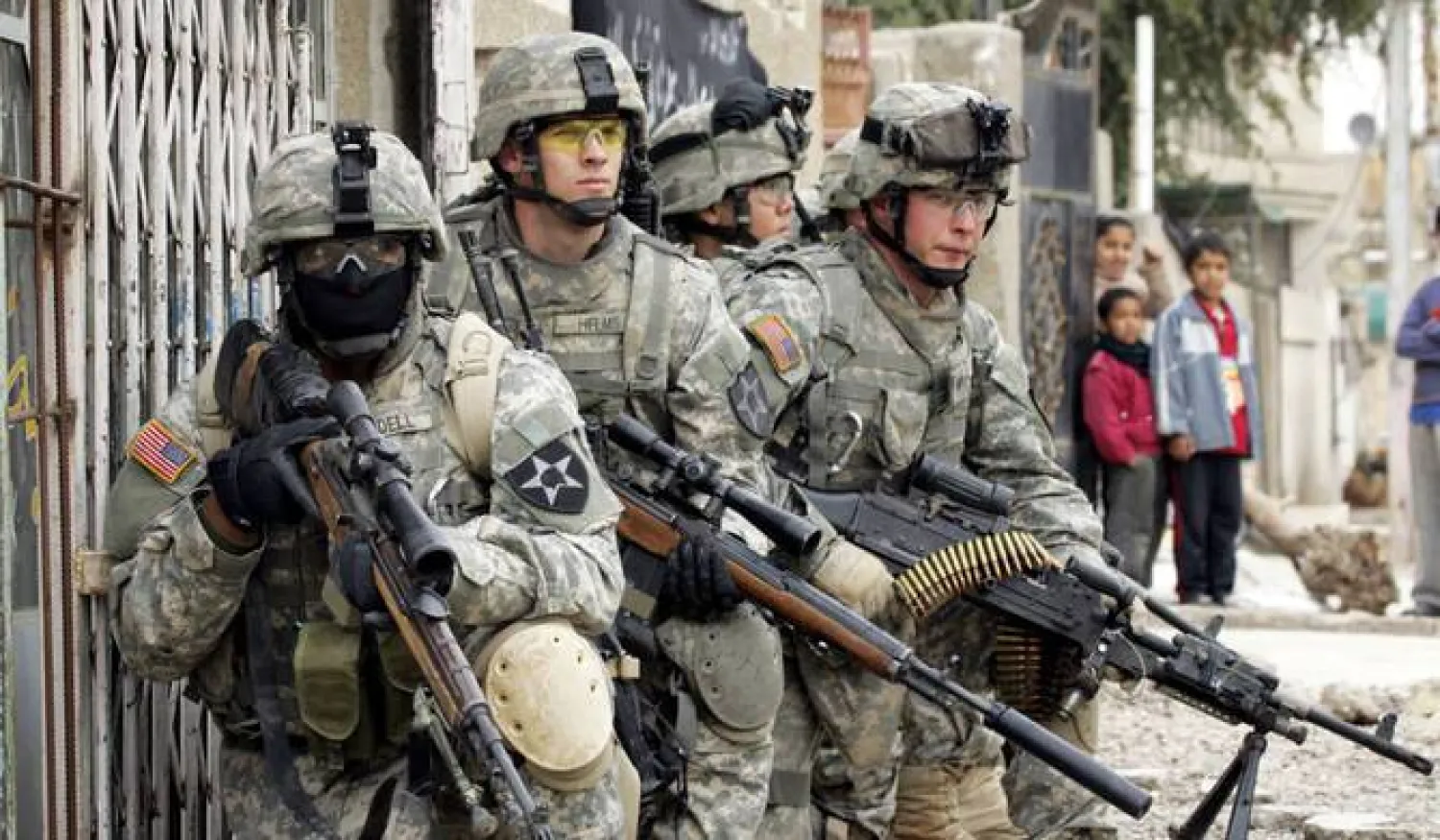
US Army soldiers from the 5-20 Infantry Division take up positions to provide cover for fellow soldiers as part of the launch of Operation Arrowhead Strike Six in the Shaab neighborhood of northern Baghdad, 06 February 2007. (AFP)
TT

A US Soldier and a British Soldier Die during Training in Iraq

US Army soldiers from the 5-20 Infantry Division take up positions to provide cover for fellow soldiers as part of the launch of Operation Arrowhead Strike Six in the Shaab neighborhood of northern Baghdad, 06 February 2007. (AFP)

One American soldier and one British soldier died during a training exercise in Iraq, US and UK officials said Monday without releasing further details.

The deaths occurred Sunday at an air base in Irbil in the semi-autonomous Kurdish region of northern Iraq, where the US has retained a presence, the US Army said in a post on X. The statement said the soldier’s identity is being withheld until 24 hours after his or her family has been notified.

The UK’s Ministry of Defense said in a separate post that the family of the British soldier has been notified and requested a “period of grace” before more details are released, The Associated Press reported.

The US has been reducing the number of troops countering the ISIS militant group in Iraq. But American forces have retained a presence in the Kurdish region as the US seeks to strengthen ties with the Kurds.

The US inaugurated a large new consulate compound in December in Irbil, the capital of the Kurdish region, highlighting Washington’s diplomatic and strategic engagement in the area.

The deaths occurred nearly a month after two American soldiers fell off a cliff and died during an off-duty recreational hike in Morocco. They were reported missing May 2 after participating in African Lion, an annual multinational military exercise.


Barrack’s Appointment May Intensify US Pressure on Iraq to Disarm Factions

Iraqi Prime Minister Ali al-Zaidi meets with US Embassy Chargé d'Affaires Joshua Harris on Sunday. (Prime Minister's press office)
TT

Barrack’s Appointment May Intensify US Pressure on Iraq to Disarm Factions

Iraqi Prime Minister Ali al-Zaidi meets with US Embassy Chargé d'Affaires Joshua Harris on Sunday. (Prime Minister's press office)

The appointment of Tom Barrack as US presidential envoy to Iraq may lead to greater American pressure on Baghdad to meet its demand for the disarmament of factions allied to Iran in an effort to stem its influence in Iraq.

Iraqi Prime Minister Ali al-Zaidi has repeatedly spoken about the disarmament. So far, influential cleric Moqtada al-Sadr was the only figure to comply, announcing that the Saraya al-Salam armed wing will become part of state institutions and come under the direct command of the armed forces.

The move was described as “encouraging”. Sadr, however, had distanced himself from Iran years ago, so it remains to be seen if any of the Tehran-aligned parties will also make a similar move.

Zaidi had declared on Saturday that he was “determined to end all armed presence outside the authority of the state” despite the pressure he is facing from powerful political forces.

He explained that the disarmament of factions will take place in phases and it began with Sadr’s announcement.

The Asaib Ahl al-Haq headed Qais al-Khazali, Badr Organization headed by Hadi al-Ameri, Kataib Sayyid al-Shuhada, Kataib al-Imam Ali, Thar-Allah movement all spoke about the possibility of their disarmament, but they remained vague over how.

In contrast, the Kataib Hezbollah and Nujaba movement refuse to lay down their weapons.

Hussein al-Sheihani, member of the Sadiqoon movement’s politburo, the Asaib Ahl al-Haq's political wing, said the ruling pro-Iran Coordination Framework “is preparing a draft decision that organizes the process to limit possession of weapons.”

It also tackles “how to handle foreign forces in Iraq and discusses how to empower the security forces and air defense system.”

Meanwhile, a prominent Framework member said Barrack’s appointment will increase pressure on Zaidi and his backers in the coalition to address the issue of the possession of weapons outside state control.

Speaking to Asharq Al-Awsat on condition of anonymity, he said: “The Framework is really interested in reaching a solution to this problem. It wants the process to be simple and away from sharp clashes with the government and factions.”

The official spoke of “possible scenarios” about resolving the issue, including “assuring the factions that they will not be persecuted legally and that they may be merged” with government bodies.

Reports have said that the US will not agree to their integration into government agencies until they lay down their weapons.

The official said that the “complete elimination of the factions from the scene is not possible given their military role and the political weight enjoyed by the factions inside the Framework,” which brought Zaidi to power.

Analyst and former diplomat Ghazi Faisal said that Barrack may have a role to play in pressuring the government to disarm the factions.

The process will be based on the constitution and laws that bar the formation of armed groups outside state control, he told Asharq Al-Awsat.

He noted the strategic agreement signed between Iraq and the US in 2008, adding that Barrack may offer support requested by the government, especially the interior and defense ministries, in line with the agreement.

Faisal said that with some factions saying they were ready to lay down their arms, the US wanting to confront Iran’s influence and the Iraqi government’s determination to impose state monopoly over weapons, all parties involved may resolve this file in the coming months.


Guterres: Vital to Keep a UN Force in Lebanon after Current Peacekeepers Depart

UN Secretary-General Antonio Guterres speaks during a press conference at Japan National Press Club in Tokyo, Japan, 20 May 2026. EPA/FRANCK ROBICHON
TT

Guterres: Vital to Keep a UN Force in Lebanon after Current Peacekeepers Depart

UN Secretary-General Antonio Guterres speaks during a press conference at Japan National Press Club in Tokyo, Japan, 20 May 2026. EPA/FRANCK ROBICHON

UN chief Antonio Guterres said Monday that peacekeepers will be needed in Lebanon after the mandate of the current mission expires at year-end -- an option likely to face opposition from the United States and Israel.

Last August, the UN Security Council, under US pressure, decided to end the mandate of the United Nations Interim Force in Lebanon (UNIFIL) on December 31, 2026.

However, it asked Guterres to propose options by June 1 to allow UN peacekeepers to remain in Lebanon, particularly to monitor the Blue Line, which stretches for 120 kilometers (75 miles), marking the de facto border between Lebanon and Israel -- now the middle of the Israel-Hezbollah war.

In a report to the Security Council seen by AFP on Monday, Guterres proposes three options ranging from nearly 2,000 to more than 5,500 UN personnel to monitor the ceasefire and support the Lebanese armed forces.

"Under all proposed options, a uniformed United Nations presence working to facilitate de-escalation, dialogue, liaison and coordination, and support for the Lebanese Armed Forces, would be necessary... towards the overarching objective of a long-term solution to the conflict," the report says.

Concerns over the exit of the UNIFIL come with Israeli troops occupying south Lebanon's border areas, and as Israel and Lebanon hold direct negotiations seeking to end decades of hostilities.

UNIFIL currently counts some 7,500 peacekeepers from nearly 50 countries. They are deployed in south Lebanon near the Blue Line.

The force has been a buffer between Lebanon and Israel since 1978 although its presence has not prevented repeated outbreaks of conflict.

Several Lebanese sources told AFP that Beirut, which has pledged to disarm Hezbollah, supports maintaining a UN presence after the departure of UNIFIL.

"Recent developments have only heightened Lebanon's urgent need for continued UN and international assistance, specifically to facilitate an Israeli withdrawal on the one hand, and to enable the state to extend its authority over its entire territory on the other," said Lebanon's ambassador to the UN, Ahmad Arafa, thanking Guterres for his report.

Several members of the Security Council also support replacing UNIFIL, particularly China and Russia.

"As UNIFIL’s mandate is about to expire, the Security Council must make a responsible decision to ensure the continued UN presence in Lebanon, and to prevent a security vacuum," said Fu Cong, China's UN envoy.

But the US and close ally Israel welcomed the vote in August that ended UNIFIL.

The Trump administration has questioned the effectiveness of UN peacekeeping missions and has withheld part of the US financial contribution to support them, forcing the UN to reduce its troops worldwide.


Israel Imposes 'Undeclared Buffer Zone' in Southern Syria

UNDOF soldiers in Saidah village in the southern Quneitra countryside. (SANA)
TT

Israel Imposes 'Undeclared Buffer Zone' in Southern Syria

UNDOF soldiers in Saidah village in the southern Quneitra countryside. (SANA)

Israeli forces continued their nearly daily violations of Syria territory on Monday when an Israeli artillery shell landed near the village of al-Musayritiyah in the western Daraa countryside, sparking a fire in a wheat field before residents managed to extinguish it, reported Syria’s state news agency SANA.

The village is located in the Yarmouk Basin area close to the border with the occupied Syrian Golan. It has witnessed repeated Israeli incursions, including home and farm searches and the detention of young men.

On Sunday, four Israeli military vehicles reached the entrance of the town of Maariya in the Yarmouk Basin, while two others seized the road connecting the village of Saidah in the Golan to al-Basali in the eastern Quneitra countryside.

SANA reported the Israeli forces set up two checkpoints and searched pedestrians and vehicles before withdrawing from the area.

All the measures are seen as efforts to impose an unofficial buffer zone, said sources in Damascus.

Israel continues to violate the 1974 Disengagement Agreement through shelling, ground incursions, attacks on civilians, raids, detentions and land leveling.

Syria consistently demands the end of the Israeli occupation of its territory, stating that all Israeli measures in southern Syria are null and void under international law. Damascus also calls on the international community to assume its responsibilities, deter the Israeli practices and compel a full withdrawal from southern Syria.

Since the ouster of Bashar al-Assad's regime in December 2024, Israeli forces have seized 665 kilometers of Syrian territory, set up nine military positions and continue to carry out land incursions into Syria, notably in the eastern and northern Quneitra countryside and Yarmouk Basin.

Syrian and international reports said Israel has set up a security zone, similar to the “yellow line” in Gaza, to bar military activity in the area and strip the Quneitra and Daraa regions of heavy weapons. It aims to control areas leading to southern Damascus with the aim of creating “strategic depth” to protect Galilee and the Golan.

Researcher at the Jusoor Center for Studies Rashid Hourani said Israel wants to create the buffer zone through razing agricultural areas in Quneitra, western Daraa countryside, and Yarmouk Basin especially.

It wants to destroy infrastructure and military positions by repeatedly targeting them, thereby preventing citizens from accessing their agricultural lands, he told Asharq Al-Awsat.

It also wants to impose restrictions on their movement as Israeli forces have carried out frequent interrogations of the locals and set up temporary checkpoints in the areas, he added.

Israeli forces have destroyed civilian facilities and historic sites, including 15 houses in the village of al-Hamidiye. They blew up a historic mosque, a museum building, and other heritage sites.

Israel has increased its incursions into Syria as it escalated its operations in Lebanon and as Lebanese and Israeli official prepare to hold a third round of negotiations in Washington to end the war.

The Syrian-Israeli negotiations have meanwhile stalled after a series of intense talks last year that “have yet to reach tangible results on the ground,” said Foreign Minister Asaad al-Shaibani in previous remarks.

Hourani told Asharq Al-Awsat Israel’s failure to achieve its objectives in the war on Iran has reflected in the stalling of negotiations with Syria, which he said is because of Israel’s “erratic position on how to handle the Syrian file.”

He also noted the pressure it is coming under due to its involvement in Lebanon and Gaza.

Observers have speculated that Israel will impose military and security measures in southern Syrian similar to the ones it has in place in Gaza and southern Lebanon where it is expanding its field control and weakening the local authorities by imposing long-term changes on the ground.

At the same time, Israel is expanding its settlement projects in the Golan.