Guterres: Vital to Keep a UN Force in Lebanon after Current Peacekeepers Depart

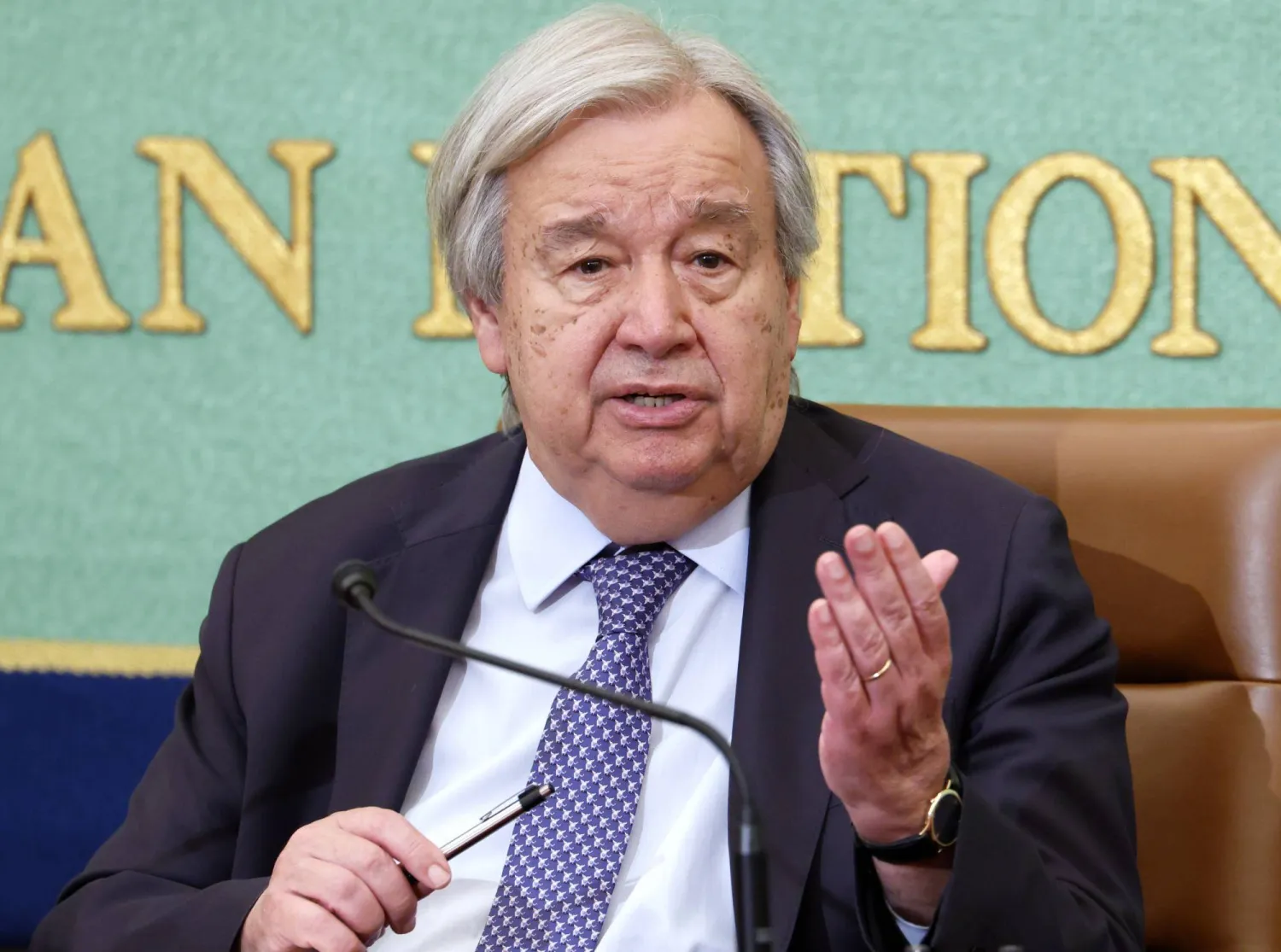
UN Secretary-General Antonio Guterres speaks during a press conference at Japan National Press Club in Tokyo, Japan, 20 May 2026. EPA/FRANCK ROBICHON
TT

Guterres: Vital to Keep a UN Force in Lebanon after Current Peacekeepers Depart

UN Secretary-General Antonio Guterres speaks during a press conference at Japan National Press Club in Tokyo, Japan, 20 May 2026. EPA/FRANCK ROBICHON

UN chief Antonio Guterres said Monday that peacekeepers will be needed in Lebanon after the mandate of the current mission expires at year-end -- an option likely to face opposition from the United States and Israel.

Last August, the UN Security Council, under US pressure, decided to end the mandate of the United Nations Interim Force in Lebanon (UNIFIL) on December 31, 2026.

However, it asked Guterres to propose options by June 1 to allow UN peacekeepers to remain in Lebanon, particularly to monitor the Blue Line, which stretches for 120 kilometers (75 miles), marking the de facto border between Lebanon and Israel -- now the middle of the Israel-Hezbollah war.

In a report to the Security Council seen by AFP on Monday, Guterres proposes three options ranging from nearly 2,000 to more than 5,500 UN personnel to monitor the ceasefire and support the Lebanese armed forces.

"Under all proposed options, a uniformed United Nations presence working to facilitate de-escalation, dialogue, liaison and coordination, and support for the Lebanese Armed Forces, would be necessary... towards the overarching objective of a long-term solution to the conflict," the report says.

Concerns over the exit of the UNIFIL come with Israeli troops occupying south Lebanon's border areas, and as Israel and Lebanon hold direct negotiations seeking to end decades of hostilities.

UNIFIL currently counts some 7,500 peacekeepers from nearly 50 countries. They are deployed in south Lebanon near the Blue Line.

The force has been a buffer between Lebanon and Israel since 1978 although its presence has not prevented repeated outbreaks of conflict.

Several Lebanese sources told AFP that Beirut, which has pledged to disarm Hezbollah, supports maintaining a UN presence after the departure of UNIFIL.

"Recent developments have only heightened Lebanon's urgent need for continued UN and international assistance, specifically to facilitate an Israeli withdrawal on the one hand, and to enable the state to extend its authority over its entire territory on the other," said Lebanon's ambassador to the UN, Ahmad Arafa, thanking Guterres for his report.

Several members of the Security Council also support replacing UNIFIL, particularly China and Russia.

"As UNIFIL’s mandate is about to expire, the Security Council must make a responsible decision to ensure the continued UN presence in Lebanon, and to prevent a security vacuum," said Fu Cong, China's UN envoy.

But the US and close ally Israel welcomed the vote in August that ended UNIFIL.

The Trump administration has questioned the effectiveness of UN peacekeeping missions and has withheld part of the US financial contribution to support them, forcing the UN to reduce its troops worldwide.


‘A Temporary Tactical Gain’… Israelis Underestimate the Occupation of Beaufort Castle

Israeli soldiers near Beaufort Castle inside Lebanese territory (Reuters).
TT

‘A Temporary Tactical Gain’… Israelis Underestimate the Occupation of Beaufort Castle

Israeli soldiers near Beaufort Castle inside Lebanese territory (Reuters).

Israeli Prime Minister Benjamin Netanyahu on Sunday saw the occupation of the Beaufort castle (Qalaat al-Shaqif), near the city of Nabatiyeh in South Lebanon, as a symbol of a heroic battle and a “dramatic shift” in Israel’s policy against Hezbollah.

However, analysts in Israel argued that the occupation of the castle is not enough to eliminate Hezbollah's threat or achieve a strategic shift in the war despite Israel's expanding offensive.

The severe criticisms, unprecedented since the October 7, 2023 attacks, came as the Israeli government and military officials have reportedly asked the US to approve an expansion of strikes in Beirut in line with the resumption of talks with the Lebanese cabinet.

They also came as the Israeli street accuse the government and the military of severe security failures, particularly with Hezbollah's daily use of explosive drones—reaching cities like Tiberias and Acre and towns in the lower Galilee region.

Maariv’s military correspondent Avi Ashkenazi described the occupation of the Beaufort castle as “nothing more than a tactical event” and warned that Israel was being dragged into a war of attrition in Lebanon without a clear political strategy.

Objectives of Bombing Beirut’s Southern Suburbs

On Monday, Netanyahu issued a joint statement with Defense Minister Israel Katz threatening to strike Hezbollah targets in Beirut’s southern suburbs “following repeated violations of the ceasefire.”

Right-wing paper Maariv said the military leadership intends to designate a variety of objectives for the attack, which fall into three main categories.

The first category includes the assassination of senior Hezbollah officials, most notably the party's Secretary-General, Naim Qassem. The second category aims to target command and control centers, where the Israeli army intends to destroy headquarters in the southern suburbs of Beirut from where Hezbollah relay instructions to forward headquarters in Tyre and Sidon.

The third category aims to attack weapons depots and apartments where Hezbollah stores various types of missiles, as well as drone depots, and even laboratories and technological systems used by the party to operate against Israeli forces.

On Sunday, Channel 12 said Netanyahu held a high-level security consultation, the second in 24 hours, amid Israeli efforts to get Washington to back strikes against Hezbollah in Beirut.

Netanyahu held a similar discussion on Saturday, as Jerusalem aims to shift from a strategy focused on holding territory in southern Lebanon to broader aerial operations, including in Beirut, according to the report.

But the channel said some top Israeli security officials strongly oppose a major, destructive attack on Beirut, arguing that such an operation would be another failed counterproductive move.

Killings and Destructions Don’t Bother Naim Qassem

Professor Eyal Zisser wrote at the Israel Hayom newspaper that Israel has been foolishly dragged into a war of attrition in southern Lebanon. “We are operating just slightly beyond the confrontation line and the border, and are losing soldiers.”

He also noted that Israel is paying a heavy price in losses. While warning against endless military quagmires that lack decisive endgame strategies, he said decisive military action remains necessary to protect Israel’s security interests.

“Needless to say, the killing of a few dozen of its operatives or the destruction of Shiite villages in southern Lebanon does not disturb Naim Qassem,” he wrote.

Nightmare of Beaufort Castle

Meanwhile, Ron Ben-Yishai wrote in the Yedioth Ahronoth that the capture of the Beaufort castle improves security and makes it more difficult for Hezbollah to operate. But it also places Israel and the military in a dilemma.

“If Israeli forces remain there, the history of a war of attrition may repeat itself. Unlike the years when Israel maintained a security zone in southern Lebanon, however, there is no South Lebanon Army today to shoulder the burden with Israeli troops,” he noted, adding that the military is already operating on at least three active fronts and faces a shortage of more than 10,000 combat soldiers.

This came as Israeli broadcast networks, including Channel 12, Channel 13, and Kan 11, interviewed soldiers returning from the southern Lebanon front, who described their experiences around Beaufort Castle as a “nightmare.”

A former general told Channel 12 that the capture of the castle is an important blow to Hezbollah, as it was carried out quickly compared to the time of Fatah and the PLO.

Israel previously occupied the site during its 1982 invasion of Lebanon and maintained a military presence there until withdrawing from southern Lebanon in 2000.

“But this will not constitute the devastating blow portrayed by Netanyahu. Hezbollah's main power centers in Beirut and the Bekaa had not been decisively hit while the Israeli army is not yet moving towards controlling Nabatieh,” he said.


France FM: 'Nothing Can Justify' Prolonged Israeli Occupation in Lebanon

French Foreign Minister Jean-Noël Barrot (Reuters)
TT

France FM: 'Nothing Can Justify' Prolonged Israeli Occupation in Lebanon

French Foreign Minister Jean-Noël Barrot (Reuters)

France's foreign minister said Tuesday that nothing could justify Israeli troops remaining deep inside Lebanon, after Israel and Hezbollah clashed overnight despite a US announcement that both sides had agreed to halt fighting.

"Nothing can justify the continuation of military operations and Israel's prolonged occupation deep inside Lebanese territory," Jean-Noel Barrot told France TV.


Barrack’s Appointment May Intensify US Pressure on Iraq to Disarm Factions

Iraqi Prime Minister Ali al-Zaidi meets with US Embassy Chargé d'Affaires Joshua Harris on Sunday. (Prime Minister's press office)
TT

Barrack’s Appointment May Intensify US Pressure on Iraq to Disarm Factions

Iraqi Prime Minister Ali al-Zaidi meets with US Embassy Chargé d'Affaires Joshua Harris on Sunday. (Prime Minister's press office)

The appointment of Tom Barrack as US presidential envoy to Iraq may lead to greater American pressure on Baghdad to meet its demand for the disarmament of factions allied to Iran in an effort to stem its influence in Iraq.

Iraqi Prime Minister Ali al-Zaidi has repeatedly spoken about the disarmament. So far, influential cleric Moqtada al-Sadr was the only figure to comply, announcing that the Saraya al-Salam armed wing will become part of state institutions and come under the direct command of the armed forces.

The move was described as “encouraging”. Sadr, however, had distanced himself from Iran years ago, so it remains to be seen if any of the Tehran-aligned parties will also make a similar move.

Zaidi had declared on Saturday that he was “determined to end all armed presence outside the authority of the state” despite the pressure he is facing from powerful political forces.

He explained that the disarmament of factions will take place in phases and it began with Sadr’s announcement.

The Asaib Ahl al-Haq headed Qais al-Khazali, Badr Organization headed by Hadi al-Ameri, Kataib Sayyid al-Shuhada, Kataib al-Imam Ali, Thar-Allah movement all spoke about the possibility of their disarmament, but they remained vague over how.

In contrast, the Kataib Hezbollah and Nujaba movement refuse to lay down their weapons.

Hussein al-Sheihani, member of the Sadiqoon movement’s politburo, the Asaib Ahl al-Haq's political wing, said the ruling pro-Iran Coordination Framework “is preparing a draft decision that organizes the process to limit possession of weapons.”

It also tackles “how to handle foreign forces in Iraq and discusses how to empower the security forces and air defense system.”

Meanwhile, a prominent Framework member said Barrack’s appointment will increase pressure on Zaidi and his backers in the coalition to address the issue of the possession of weapons outside state control.

Speaking to Asharq Al-Awsat on condition of anonymity, he said: “The Framework is really interested in reaching a solution to this problem. It wants the process to be simple and away from sharp clashes with the government and factions.”

The official spoke of “possible scenarios” about resolving the issue, including “assuring the factions that they will not be persecuted legally and that they may be merged” with government bodies.

Reports have said that the US will not agree to their integration into government agencies until they lay down their weapons.

The official said that the “complete elimination of the factions from the scene is not possible given their military role and the political weight enjoyed by the factions inside the Framework,” which brought Zaidi to power.

Analyst and former diplomat Ghazi Faisal said that Barrack may have a role to play in pressuring the government to disarm the factions.

The process will be based on the constitution and laws that bar the formation of armed groups outside state control, he told Asharq Al-Awsat.

He noted the strategic agreement signed between Iraq and the US in 2008, adding that Barrack may offer support requested by the government, especially the interior and defense ministries, in line with the agreement.

Faisal said that with some factions saying they were ready to lay down their arms, the US wanting to confront Iran’s influence and the Iraqi government’s determination to impose state monopoly over weapons, all parties involved may resolve this file in the coming months.