

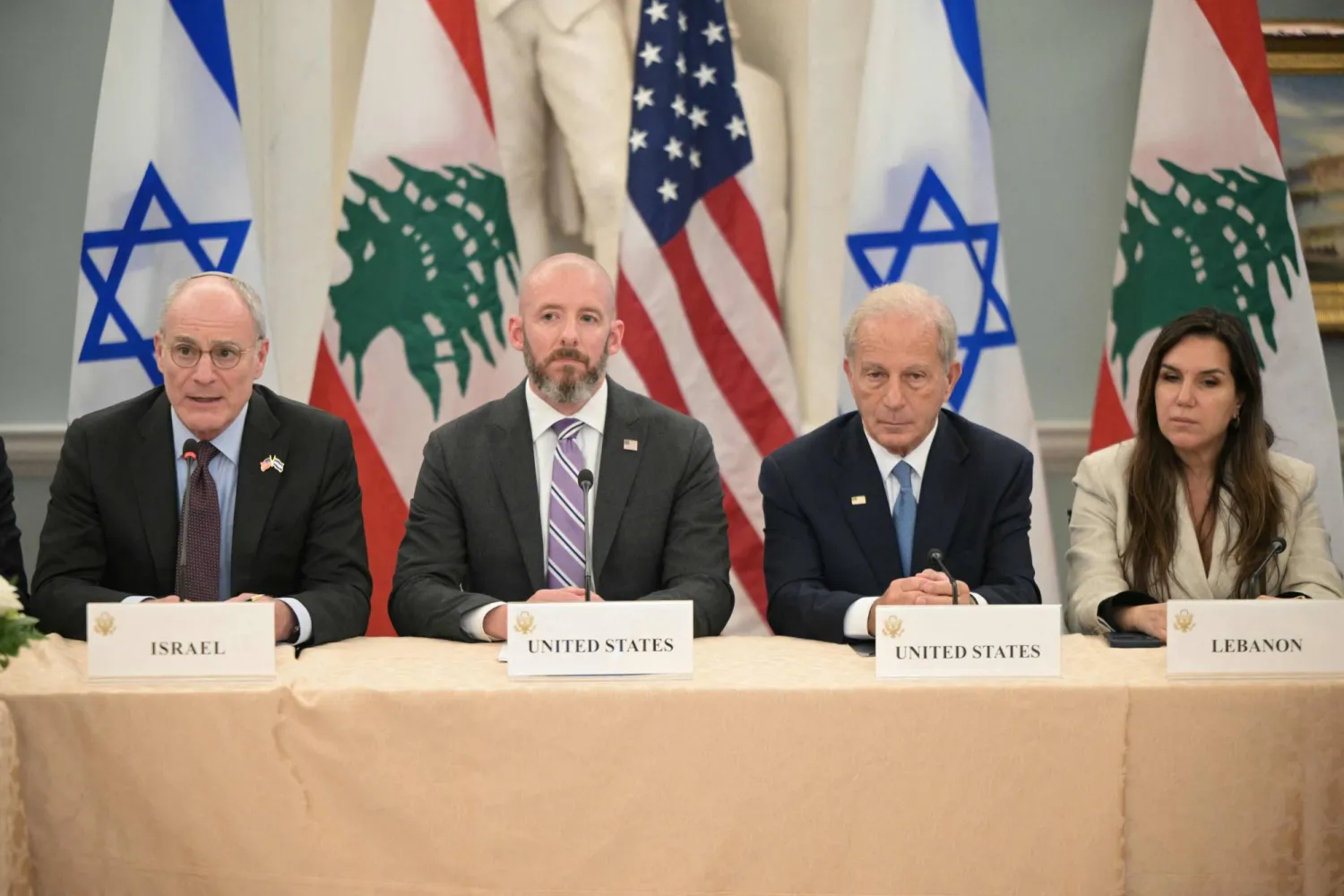

Lebanon-Israel Ceasefire Deal: Complete Cessation of Hezbollah Attacks, Creation of Pilot Zones

(L/R) Israel's Ambassador to the US Yechiel Leiter, State Department Chief of Staff Daniel Holler, US Ambassador to Lebanon Michel Issa and Lebanese Ambassador to the US Nada Hamadeh attend a meeting between Israeli and Lebanese delegations hosted by the United States at the State Department in Washington, DC, on June 3, 2026. (Photo by Oliver Contreras / AFP)
TT

Lebanon-Israel Ceasefire Deal: Complete Cessation of Hezbollah Attacks, Creation of Pilot Zones

(L/R) Israel's Ambassador to the US Yechiel Leiter, State Department Chief of Staff Daniel Holler, US Ambassador to Lebanon Michel Issa and Lebanese Ambassador to the US Nada Hamadeh attend a meeting between Israeli and Lebanese delegations hosted by the United States at the State Department in Washington, DC, on June 3, 2026. (Photo by Oliver Contreras / AFP)

Israel and Lebanon on Wednesday agreed to a new ceasefire following talks mediated by the United States. Under the agreement, Hezbollah is to stop all attacks on Israel and withdraw its fighters from the area south of the Litani River in southern Lebanon.

In a joint statement, the US, Israel and Lebanon said “the ceasefire is contingent on a complete cessation of Hezbollah fire and the evacuation of all Hezbollah operatives from the South Litani Sector.”

Israel and Lebanon agreed with US guidance “to swiftly advance the creation of pilot zones” in which the Lebanese army “will take exclusive control of the territory to the exclusion of all non-state actors.”

“These steps will enable progress towards a comprehensive peace and security agreement,” the statement said, adding that both sides “rejected any attempt, by any state or non-state actor, to hold Lebanon’s future hostage.”

Hezbollah has yet to comment on the ceasefire. Before it was announced, the group said it had conducted two drone and rocket attacks on Israeli troops inside Lebanon that it said took place just after midnight local time on Wednesday.

In their statement, “Israel and Lebanon reaffirmed that they have no hostile intent toward one another and committed to continuing direct negotiations to build confidence, resolve all outstanding issues, and work toward a comprehensive agreement between the two countries.”

The US reaffirmed that any agreement to cease hostilities must be reached directly between the two governments, brokered by Washington, and not through any separate track.

As for Israel, it said that its security and respect for its territorial integrity can only be achieved through Hezbollah’s disarmament and the dismantlement of its infrastructure across Lebanon.

In the statement, “Lebanon reaffirmed the necessity for mutual respect of internationally recognized borders, the urgent need for full implementation of the cessation of hostilities, underscoring the principles of territorial integrity and full state sovereignty.”

It stressed commitment to enhancing the capacity of the Lebanese army, with US support, to assert effective control across the country. 


Crisis Looms in Southern Iraq over Water, Electricity Shortages

People protest in Dhi Qar over frequent power outages. (Social media)
TT

Crisis Looms in Southern Iraq over Water, Electricity Shortages

People protest in Dhi Qar over frequent power outages. (Social media)

The worsening electricity crisis in Iraq continues to burden most of the population, amid rising temperatures that have surpassed 50 degrees Celsius in some southern governorates.

There are fears that the crisis could lead to local conflicts between some governorates, given that some receive up to 20 hours of power, while others receive only about 10 at best.

In Dhi Qar, a number of residents threatened to cut off water from the Al-Bidaa canal and prevent it from reaching the Basra Governorate in the far south if they do not receive more hours of electricity. A video showed dozens of citizens holding signs that read: "Water for electricity."

The canal is a main channel for drinking water to Basra, flowing from the Tigris River through Dhi Qar. Cutting it off may lead to a humanitarian and service crisis for millions of Basra residents, who already suffer from water salinity and irregular supply to their homes.

An official source in Dhi Qar dismissed the citizens' ability to cut off the water supply. The source told Asharq Al-Awsat that the protests reflect anger over deteriorating electricity services in the governorate, but it will not reach the stage of cutting off water or bartering it for electricity.

The source said the problem relates to the Al-Fuhoud and Al-Chibayish areas bordering Basra.

Al-Chibayish receives enough electricity from Basra, unlike the Al-Fuhoud, which receives around two hours for every four-hour cut from Dhi Qar, making the residents’ anger justified, added the source.

The official source said the crisis is not limited to Dhi Qar, but affects most of Iraq, especially the south.

Citizens in six governorates, including Baghdad, demonstrated a few days ago to protest the shortage of electricity.

In Wasit, which borders Dhi Qar, hundreds took to the streets over the past two days in protest against the power cuts.

The demonstrations led to clashes with police and anti-riot forces, who were forced to use water cannons and tear gas to disperse the protesters, prompting criticism from MPs who demanded a probe into the unrest.

Energy officials and experts warned that the crisis will likely continue for years due to the stark disparity between demand and production capacity. The country's needs are estimated at around 60,000 megawatts, while current production does not exceed 25,000 megawatts.


Iraq PM Aiming for Legislation that Limits Possession of Weapons to the State

Iraqi Prime Minister Ali al-Zaidi. (AFP)
TT

Iraq PM Aiming for Legislation that Limits Possession of Weapons to the State

Iraqi Prime Minister Ali al-Zaidi. (AFP)

Iraqi Prime Minister Ali al-Zaidi stressed that October 1 will be a new chapter for the state after the withdrawal of all foreign military forces from the country.

By then, it would have achieved national sovereingty over its territories as it continues to build its military and security capabilities to allow it to protect its security and stability by itself, he added.

September 30 is the deadline for both the withdrawal of the US-led anti-ISIS coalition forces from Iraq and pro-Iran armed factions to lay down their weapons.

The PM made his remarks during a meeting with Commander of the US Central Command Brad Cooper in Baghdad.

Al-Zaidi underscored the deadline for the troop withdrawal, adding that imposing state monopoly over weapons “according to the law, protects everyone and bolsters the authority and sovereignty of the state.”

“It is a condition for Iraq to move to a new phase of development,” he stressed.

The PM said he was aiming for a draft-law on limiting the possession of weapons to the state.

Sources said that this may lead to a potential confrontation with the armed factions that refuse to lay down their weapons.

Meeting with members of the parliamentary security and defense committee, al-Zaidi said that the “greatest threat to the state” was the possession of weapons outside state control because it undermines the rule of law and state institutions.

He called for preparing the draft-law, stressing the need to “bolster the standing of the state and its sovereignty and institutions.”

Legal expert Ali al-Tamimi told Asharq Al-Awsat that the Iraqi constitution stipulates that military and security forces should be under the command of civilian authority. It bars the formation of militias outside state frameworks.

He noted that the law that established the Popular Mobilization Forces in 2016 says that they are a state formation, but it demands that its members quit any parties they are members of.

The greatest challenge with the state imposing state monopoly over arms is “defining the concept of weapons.” He explained that the armed factions believe their weapons are part of a “resistance” and in line with the PMF law.

The state, on the other hand, views these weapons as outside its authority and they need to come under its control, he added.


Syria Forms Committee to Seek Interpol Handover of Assad-Era Figures

Syrians celebrate outside the Omari Mosque in Daraa, where the Syrian uprising began in 2011, after a Syrian court sentenced Atef Najib, the official responsible for the crackdown in the city, to death (dpa)
TT

Syria Forms Committee to Seek Interpol Handover of Assad-Era Figures

Syrians celebrate outside the Omari Mosque in Daraa, where the Syrian uprising began in 2011, after a Syrian court sentenced Atef Najib, the official responsible for the crackdown in the city, to death (dpa)

Syria has formed a committee to seek the extradition of criminals sentenced to death in absentia, Deputy Justice Minister Mustafa al-Qassem said on Wednesday, as the government defended the rulings against criticism from Amnesty International.

Al-Qassem said the committee would coordinate with Interpol to secure the handover of those convicted to Syria.

A Syrian court on Tuesday sentenced ousted President Bashar al-Assad and several senior figures from his rule to death, including former security official Atef Najib, in the first rulings of their kind since the former government was overthrown in late 2024.

Cheers and chants erupted inside the courtroom, through the corridors of the Palace of Justice and outside the building as the verdicts were announced.

“We have established offices to receive complaints related to transitional justice crimes, and we are seeking to recover Syrians’ stolen funds and pursue those who invested them abroad,” al-Qassem told Syria’s Al-Ikhbariya television.

He said international cooperation, particularly in the handover of fugitives, would help accelerate Syria’s transitional justice process.

Al-Qassem said the Justice Ministry was also seeking the closest possible alignment between Syrian judicial procedures and international trial standards, while stressing Syria’s national sovereignty in matters of transitional justice.

The Justice Ministry, meanwhile, pushed back against Amnesty International’s criticism of Tuesday’s rulings, saying the group’s statement “does not accurately reflect the nature of the judicial procedures followed in these cases or the safeguards guaranteed to litigants under Syrian law.”

Amnesty said the government, if it wanted to “truly turn the page on the horrors of the past,” should end trials in absentia and the death penalty, criminalize core crimes under international law in domestic legislation and undertake comprehensive judicial reform.

It said prosecutions should take place before ordinary civilian courts, with victims participating and without resorting to capital punishment, as part of a nationwide, victim-centered strategy aimed at establishing truth, delivering justice and providing reparations.

The ministry said the cases were heard before a competent civilian criminal court by qualified judges, with victims and their representatives taking part in accordance with legal procedures.

It said constitutional and legal safeguards were observed, along with relevant principles of international humanitarian law and international human rights law.

The trials, it added, were based on facts, evidence and judicial case files, with defendants guaranteed rights of defense, appeal and objection under applicable procedures.

The ministry said Syria’s current circumstances, after years of crimes and violations, placed a legal and moral duty on the state to deliver justice and hold those responsible to account.

That responsibility, it said, did not justify bypassing constitutional or legal safeguards or diminishing the rights of any party to a case.

Justice was being pursued through state institutions and within their jurisdiction, the ministry said, “in a manner that preserves victims’ right to redress and defendants’ right to a trial under the law, away from revenge or politicization.”

On capital punishment, the ministry said the death penalty remained part of Syrian law and could only be imposed by a court ruling based on law, evidence and facts.

Any execution, it said, would be subject to prescribed legal safeguards and could take place only after all stages and procedures required by law and the competent authorities had been completed.

The ministry also defended trials in absentia, saying that when permitted by law and conducted under the required conditions, they did not, in themselves, undermine fair-trial guarantees or the legality of the proceedings.

It reiterated its willingness to engage with international rights groups and consider observations that could help improve Syria’s justice system.

But it said evaluating judicial procedures, ruling on cases and determining responsibility and punishment remained the jurisdiction of the Syrian judiciary, operating under the constitution and the law while safeguarding the rights of all parties and victims’ right to justice.

Justice Minister Mazhar al-Wais told Al-Ikhbariya on Tuesday that the ruling against Atef Najib had been issued in the name of the entire Syrian people.

He said the verdict showed that no one was above the law, regardless of status or position, and that rights would ultimately be restored to those entitled to them, however long it took.
