


OPCW Analyzing 34 Sealed Boxes of Documents Handed Over from Syria

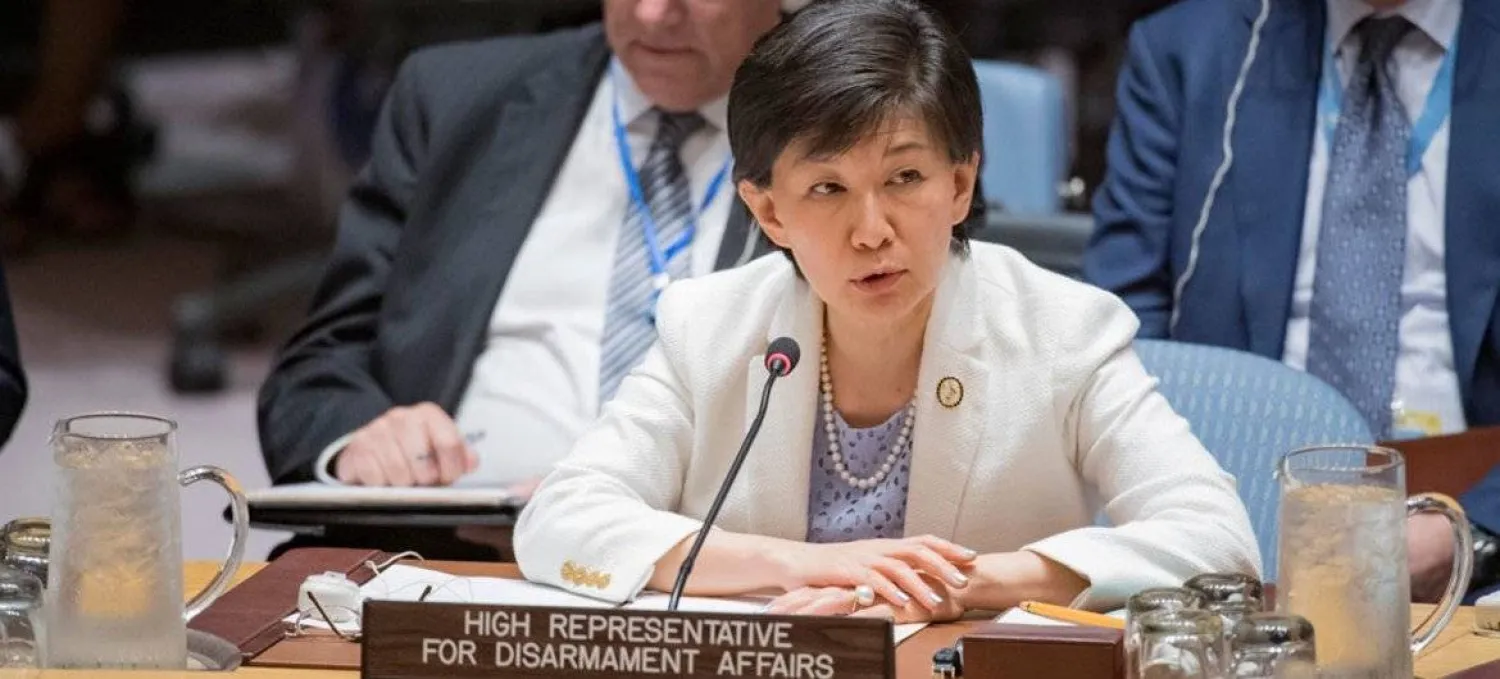
Under-Secretary-General and High Representative for Disarmament Affairs Izumi Nakamitsu (File photo)
TT

OPCW Analyzing 34 Sealed Boxes of Documents Handed Over from Syria

Under-Secretary-General and High Representative for Disarmament Affairs Izumi Nakamitsu (File photo)

The Organization for the Prohibition of Chemical Weapons (OPCW) said the Syrian authorities handed over to the Secretariat team in Damascus 34 sealed cardboard boxes of documents that are being processed and further analyzed.

Briefing the UN Security Council on the implementation of Resolution 2118 on the elimination of Syria’s chemical weapons program, UN Under-Secretary-General and High Representative for Disarmament Affairs Izumi Nakamitsu welcomed on Thursday the Syrian government’s continued cooperation with OPCW, which has led to significant progress.

In early May, a team from the Organization went to Syria.

Nakamitsu stressed that the Syrian government has done courageous work to facilitate the OPCW’s work, and “we commend its continued cooperation.”

She said, the team is now ready to report that a “significant amount” of undeclared chemical weapons, related materials, and documentation – including evidence of previously undeclared chemical munitions –were already discovered.

Rockets were also found, of the same type as those that were used in the chemical weapons attack in the Syrian city of Ghouta in August 2013.

“These findings are a momentous discovery – not just for Syria, but for international security and the global disarmament regime,” Nakamitsu said, attributing their discovery to the OPCW’s unflagging efforts, the new Syrian government’s compliance with international law and the Council’s continued advocacy.

“This cooperation will remain critical going forward, as the newly discovered elements now need to be declared and destroyed, under the OPCW Technical Secretariat’s verification,” she said.

For her part, Deputy US Representative to the UN, Ambassador Tammy Bruce, welcomed the return of OPCW teams to Syria and the significant progress made by the Syrian government and the OPCW, including the discovery of previously undeclared chemical materials.

Bruce said affirmed that Syria has showed flexibility and determination to close this file and turn the page on the past, and we call for continued assistance in this step.

Several Council members also praised the progress.

Jennifer MacNaughtan, UK Minister Counsellor at the Security Council said Syria’s significant operational support to the Organization’s deployment in early May allowed access to priority sites, enabling the identification of dozens of chemical munitions such as aerial bombs and rockets.

She said the Assad regime claimed repeatedly that it had no active chemical weapons program after 2014, while this discovery demonstrates unequivocally that this claim was false.

Syria’s Permanent Representative to the UN, Ibrahim Olabi said the achievements of the Syrian teams constituted a decisive turning point in the efforts to uncover the Assad’s chemical weapons program and a major step forward in the path to accountability, thus providing an invaluable service to the region and the world by addressing the risks of proliferation and enhancing its security and stability.

While that work is critical and praiseworthy, Olabi nevertheless said the recent progress is bittersweet as it brings back terrible memories of the previous government. “Syria suffered from chemical weapons for more than 12 years,” he said, adding: “Today, it is committed to rid itself of its legacy.”

Also, China’s Deputy Permanent Representative to the UN affirmed that the chemical weapons file in Syria must be closed in order to direct resources towards reconstruction and development.

France’s Permanent Representative to the UN, Jerome Bonnafont, said that the Assad regime has used chemical weapons against its own people in at least nine confirmed cases, and hoped that the remaining chemical stockpiles will be secured and destroyed as quickly as possible.

“We welcome the Syrian government’s cooperation with the Organization for the Prohibition of Chemical Weapons, and this cooperation opens a new chapter in the country’s history,” Bonnafont added.

Greece’s Permanent Representative to the UN, Ioannis Ghikas, said that his country reiterates its full support for the sovereignty, unity, and territorial integrity of Syria. The Syrian people deserve to turn the page on chemical weapons in their modern history, he added.

In a separate development, Syria's permanent delegation to the UN participated on Wednesday in the election of five non-permanent members of the UN Security Council for the 2027–2028 term.

“We extend our warm congratulations to Kyrgyzstan, Austria, Portugal, Zimbabwe and Trinidad and Tobago on their election,” the delegation said in a post on its X account.

“We look forward to working with you in the coming period in support of international peace and security and in furtherance of multilateral cooperation,” it added.



Houthis Escalate Attacks Across Taiz, Yemen’s Western Coast

 The navigation bridge of a sunken vessel is all that is seen at the surface of the water in the Port of Mokha the day after an attack by the Houthis on the city Mokha, held by Yemen's legitimate government on August 10, 2026. (AFP)
The navigation bridge of a sunken vessel is all that is seen at the surface of the water in the Port of Mokha the day after an attack by the Houthis on the city Mokha, held by Yemen's legitimate government on August 10, 2026. (AFP)
TT

Houthis Escalate Attacks Across Taiz, Yemen’s Western Coast

 The navigation bridge of a sunken vessel is all that is seen at the surface of the water in the Port of Mokha the day after an attack by the Houthis on the city Mokha, held by Yemen's legitimate government on August 10, 2026. (AFP)
The navigation bridge of a sunken vessel is all that is seen at the surface of the water in the Port of Mokha the day after an attack by the Houthis on the city Mokha, held by Yemen's legitimate government on August 10, 2026. (AFP)

The Iran-backed Houthi group stepped up military operations on several fronts west of Yemen’s Taiz governorate and along the Red Sea coast on Thursday.

Houthis fired more than 12 ballistic missiles at rural areas in Taiz and Hodeidah governorates as fierce clashes erupted with government forces and the National Resistance in Maqbanah, al-Kadha, al-Tuwair and Ghabari.

Military sources said the fighting began in the early hours of Thursday when the Houthis launched a broad assault on government and National Resistance positions across several sectors. The attack developed into direct clashes and artillery exchanges that lasted for hours.

The group fired hundreds of artillery and mortar rounds during the assault and deployed drones in combat operations, the sources said. The fighting spread to hills overlooking the al-Aqma area in Mawza district, where brigades affiliated with the National Resistance are stationed.

The Houthis seized several positions during the opening hours of the attack before government forces, fighters from Taiz and the National Resistance launched a counterattack and recaptured a number of them, according to military sources.

The sources said the ballistic missiles had no effect on government forces’ battlefield operations. Most of the Houthi missile strikes targeted areas around vital facilities and civilian and military supply routes, causing panic among residents.

Government forces suffered deaths and injuries, while the Houthis also sustained casualties, the sources said, without providing figures for either side. Four Houthi fighters were reportedly captured.

Reports from the Joint Operations Room said air-defense systems and military formations on the Red Sea coast were “maintaining a high level of vigilance in confronting these repeated missile threats, which have become the group’s most prominent means of trying to offset its successive battlefield losses.”

The reports said the attacks were also intended to send a message linked to regional developments around the Red Sea shipping corridor and strategic Bab al-Mandeb Strait.

The missile attacks coincided with an attempted infiltration and ground assault by Houthi fighters against government positions in al-Kadha, west of Taiz.

Three drones downed

Government forces said they shot down three Houthi drones flying over subdistricts in Jabal Habashi district as fighting continued on fronts west of Taiz.

Military sources said the drones were intercepted as the group continued using unmanned aircraft to attack government and National Resistance positions. Clashes persisted in several sectors as forces deployed reinforcements to combat positions.

The ground escalation coincided with a new wave of Houthi missile strikes on the Red Sea coast. The group fired more than 12 ballistic missiles toward several areas east and north of the city of Mokha, as well as areas in Hodeidah’s Khokha district.

Local sources said the missiles were launched from Houthi-held positions in Ibb governorate and from al-Hawban and Sharab, east and north of Taiz. One missile caused a fire on the northern outskirts of Mokha.

The National Resistance’s military media office said the Houthis fired eight ballistic missiles toward rural areas around Mokha, while a ninth landed south of Khokha district. Local sources said three more missiles were launched shortly afterward.

Red Sea coast targeted

The missile strikes coincided with fighting on the Maqbanah and al-Kadha fronts west of Taiz, while air defenses operated by the “Taiz Military Axis” responded to drones launched by the group during the assault.

The escalation came hours after the Houthis targeted residential areas, the vicinity of camps for displaced people and front-line positions in Taiz, where fighting has intensified steadily since August.

Government forces and the National Resistance have continued to repel Houthi attacks across western Taiz and the Red Sea coast as the group persists in using ballistic missiles, drones and artillery.

The simultaneous broad ground assault and missile strikes point to an expansion of the Houthi escalation in the region, which has seen repeated attacks on military positions and areas near residential communities and civilian facilities.

Government forces in Marib and al-Dhale governorates carried out strikes on Wednesday targeting Houthi positions, gatherings and vehicles, and released footage of the operations.


Syria Says Begun Destroying Assad-Era Chemical Weapon Materials

Syrian Ambassador to the United Nations Ibrahim Olabi addresses the Security Council during the meeting on the situation in the Middle East, at UN headquarters in New York City, US, February 18, 2026. (Reuters)
TT

Syria Says Begun Destroying Assad-Era Chemical Weapon Materials

Syrian Ambassador to the United Nations Ibrahim Olabi addresses the Security Council during the meeting on the situation in the Middle East, at UN headquarters in New York City, US, February 18, 2026. (Reuters)

Syria has begun the process of destroying chemical weapon materials identified by an international watchdog, the country's UN envoy said Thursday, signaling a major step forward since the 2024 ouster of autocratic leader Bashar al-Assad.

"This is the very first destruction process since we have been liberated from the previous regime," Ibrahim Olabi told the Security Council. "It's also the first of its kind to destroy chemical materials on Syrian territory for over a decade."

In 2021, the Organization for the Prohibition of Chemical Weapons (OPCW) took the unprecedented step of stripping Syria of its voting rights after finding its air force had used nerve agent sarin and chlorine gas on its own people.

But since Assad's overthrow, the new authorities in Damascus have vowed to cooperate with the OPCW to destroy the chemical weapons the former president was repeatedly accused of using during Syria's 13-year civil war.

"We aim at protecting the Syrian people so that such weapons will not fall into the wrong hands," Olabi said Thursday.

He added that his country was "also protecting the world and the region through such work. Every site that is secured, every ammunition that is identified, does not merely remove a danger to Syria, but the entire world."


Israeli Minister Presents Plan to Remove Gaza Population

Israel's far-right National Security Minister Itamar Ben Gvir - File photo
TT

Israeli Minister Presents Plan to Remove Gaza Population

Israel's far-right National Security Minister Itamar Ben Gvir - File photo

Israel's far-right National Security Minister Itamar Ben Gvir set out a plan on Thursday to remove Palestinians from the Gaza Strip and send them abroad.

Speaking in the run-up to close-fought Israeli elections, he said the plan aimed to see the departure of 250,000 Palestinians from Gaza in the first year, followed by the rest of the roughly two million residents over the following six years.

"It's realistic," said Ben Gvir, claiming that there were countries who were "ready" to take in Gazans, without naming which ones.

Forced displacement of civilians in occupied territory is considered a war crime under the Geneva Conventions.