


Lebanese Leaders Rebuke Iran as Israel, Hezbollah Trade Attacks

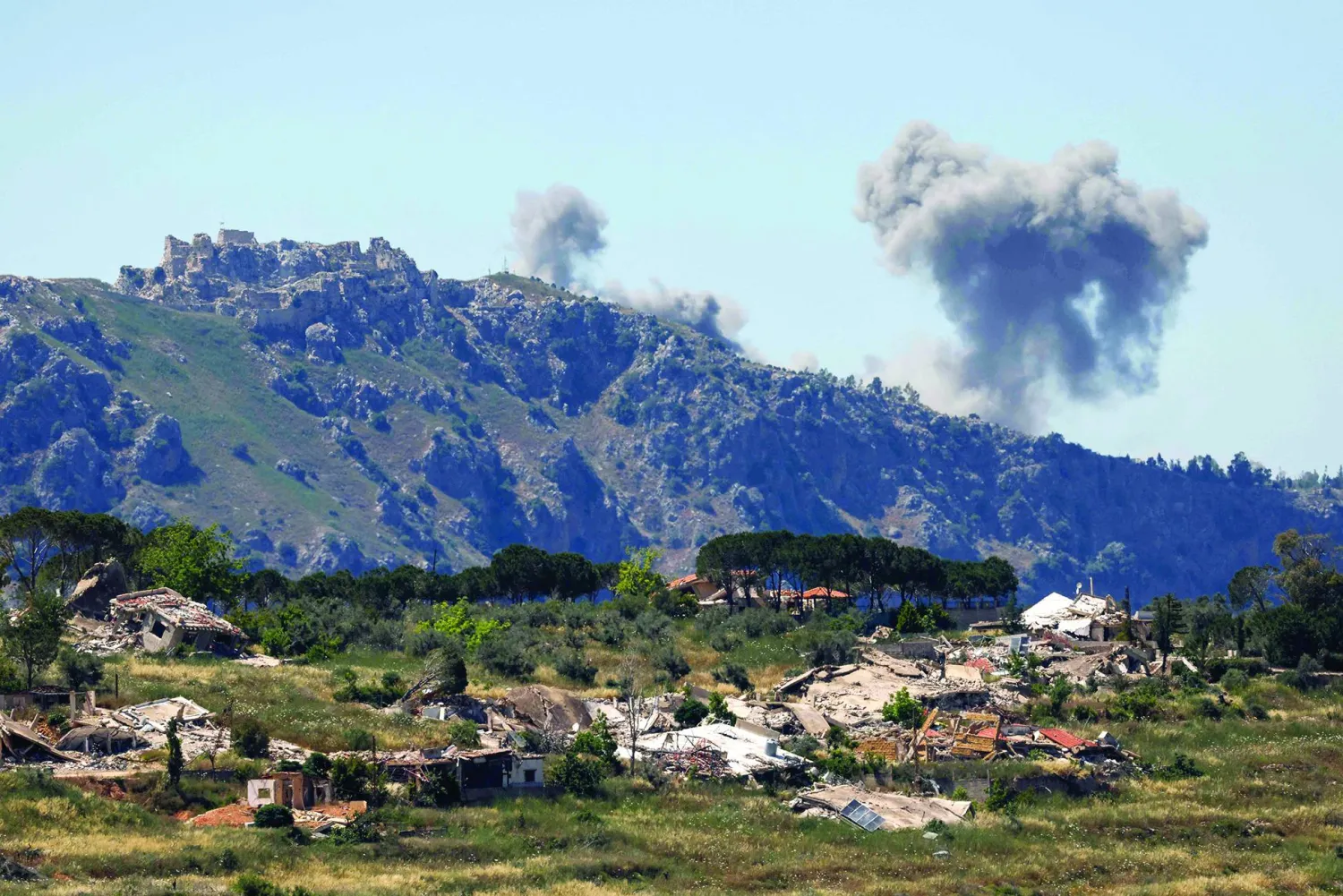
Smoke rises following Israeli bombardment in southern Lebanon close to the Beaufort Castle as seen from a position across the border in the Upper Galilee, in northern Israel on June 4, 2026. (Photo by Jalaa MAREY / AFP)
TT

Lebanese Leaders Rebuke Iran as Israel, Hezbollah Trade Attacks

Smoke rises following Israeli bombardment in southern Lebanon close to the Beaufort Castle as seen from a position across the border in the Upper Galilee, in northern Israel on June 4, 2026. (Photo by Jalaa MAREY / AFP)

Lebanon's leaders issued pointed calls for Iran to stop interfering in their country's affairs on Friday, as Israel and the Tehran-backed Hezbollah traded attacks after a new truce deal collapsed before it even began. 

Lebanese state media reported fresh Israeli strikes on around 40 locations in southern Lebanon on Friday, with some causing casualties, while Hezbollah claimed new attacks on Israeli troops who have invaded the south, including with drones and rockets. 

Lebanon was drawn into the wider Middle East war when Hezbollah attacked Israel on March 2 to avenge the February 28 killing of Iran's supreme leader. 

Iran, in its peace negotiations with Washington, has repeatedly insisted that the fighting in Lebanon and the war in the Gulf are inextricably linked. 

Lebanese Prime Minister Nawaf Salam addressed Iran's leaders in frank terms during a press conference on Friday, telling them: "Have mercy on our south, stop treating it and its people as merely a bargaining chip to improve the terms of your negotiations." 

"We are the people of a sovereign nation that refuses to serve as a mailbox for the messages of others or as an open battlefield for their wars," he added. "The south is not anyone's reserve front." 

Lebanese President Joseph Aoun, echoing Salam's "bargaining chip" remark, offered a similar message for Iran in an interview with CNN. 

"It's not your country, it's our country," he said. "It's not your job to interfere into our country." 

Lebanese and Israeli envoys in Washington agreed to a truce this week that according to a statement is conditional on a "complete cessation" of Hezbollah fire, without mentioning a halt to Israeli attacks. 

Hezbollah flatly rejected the deal on Thursday, demanding instead a comprehensive ceasefire and full Israeli withdrawal from south Lebanon. 

Lebanese parliament speaker and Hezbollah ally Nabih Berri said Friday that the group would withdraw from the area south of Lebanon's Litani River if these conditions were met. 

Hezbollah had vehemently opposed the government's direct engagement with Israel, with its leader Naim Qassem describing the talks as a "farce and humiliation" -- a stance Aoun took issue with on Friday. 

"Hezbollah must understand that (there is) no other way but to sit and talk, no other way to solve this problem and to save what's left except through negotiation and diplomacy," he told CNN. 

- 'How long will this go on?' - 

Israel has staged its deepest incursion in two decades into Lebanon, and on Friday it warned residents of nine towns and villages, including Sarafand on the coastal road between Tyre and Sidon, to immediately evacuate. 

Lebanon's official National News Agency reported mass displacement from some of the villages, and subsequently reported strikes there. 

An overnight Israeli strike near the city of Tyre's Jabal Amel hospital killed four people, wounded seven and lightly damaged the facility, while another in a residential area killed three and wounded five, including two children, according to a civil defence source. 

An AFP correspondent saw a heavily damaged bank near the hopsital, one of only three in the city. 

"I was in my mother's hospital room when a powerful strike hit near the hospital," Marwan Ghorayeb told AFP, adding that his mother had also survived a Monday strike near the facility that killed four people and wounded 127, including 39 hospital personnel. 

"My house in my hometown was destroyed, and my house in Tyre was destroyed. How long will this go on?" 

Lebanon's health ministry said Israeli attacks have killed at least 3,558 people since March 2. 

- 'Not a life' - 

In rejecting the new truce deal on Thursday, Hezbollah chief Qassem demanded that any "ceasefire must be comprehensive... without the Israeli enemy having the freedom to kill". 

Israeli Defense Minister Israel Katz had said after the deal's announcement that the army would "at this stage, continue its fire and ground operations", while retaining the "freedom" to strike Beirut if Hezbollah attacked Israeli communities. 

Hezbollah is Lebanon's only armed group that refused to hand over its arsenal after the 1975-1990 civil war, arguing that it was fighting Israel's occupation of south Lebanon. 

After Israeli troops withdrew in 2000, calls on Hezbollah to disarm multiplied, with the leadership under Aoun taking the firmest stance yet. 

The Lebanese government has declared Hezbollah's military activities illegal, and the army was working to disarm the group in areas near the border before the latest war erupted. 

The war launched by the US and Israel on Iran saw Hezbollah return to the battlefield, launching attacks into Israel while fighting Israeli troops inside Lebanon. 

As the exchanges of fire continued, Israelis in northern villages expressed fatigue at the situation. 

"We can't keep doing this," 60-year-old Sigalit Levin told AFP on Thursday from her home in Shlomi, a small town in Israel's far north. 



EU Chief Salutes Lebanon-Israel Deal

European Commission President Ursula von der Leyen speaks at the opening session of the Ukraine Recovery Conference 2026 at the European Solidarity Center in Gdansk, Poland, 25 June 2026. (EPA)
TT

EU Chief Salutes Lebanon-Israel Deal

European Commission President Ursula von der Leyen speaks at the opening session of the Ukraine Recovery Conference 2026 at the European Solidarity Center in Gdansk, Poland, 25 June 2026. (EPA)

EU chief Ursula von der Leyen on Saturday welcomed the US-Lebanon-Israel framework agreement as a "critical step" away from conflict in the Middle East.

"I welcome the agreement between Israel and Lebanon. This is a critical step away from escalation. Because there can be no peace in the Middle East with Lebanon in flames," she said in a statement posted on X, thanking Washington for its mediation role.

"Key next steps are the disarmament of non-state groups and preserving Lebanese sovereignty and territorial integrity," she stressed.

Von der Leyen added that "the EU stands ready to support this path to lasting regional stability, also with the continued delivery of much needed humanitarian aid with EUR100 million mobilized for the displaced."


Israeli Drone Strike Kills Palestinian Siblings in a Gaza Tent Camp

Palestinians inspect their destroyed tents on Al-Jalaa Street following an Israeli airstrike in Gaza City, Gaza Strip, 27 June 2026. (EPA)
TT

Israeli Drone Strike Kills Palestinian Siblings in a Gaza Tent Camp

Palestinians inspect their destroyed tents on Al-Jalaa Street following an Israeli airstrike in Gaza City, Gaza Strip, 27 June 2026. (EPA)

An Israeli drone strike on Saturday killed two Palestinian siblings, including a 15-year-old girl, in southern Gaza and wounded at least seven others, according to Nasser hospital, where the casualties were taken.

The strike targeted tents sheltering displaced Palestinians in the sprawling camp of Muwasi, killing 15-year-old Islam Moussa and her 30-year-old brother, Abdullah Moussa.

The Israeli military acknowledged it had struck the area of Muwasi, saying it had targeted a Hamas fighter but did not immediately provide more information.

In the hospital's courtyard, relatives wept over the bodies covered in white burial shrouds.

Also on Saturday, Palestinians reported hearing a loud boom in Gaza City.

The Israeli military struck a tent sheltering displaced Palestinians in western Gaza City, wounding at least 12 people, according to Shifa hospital. The ambulance service of the Palestinian Red Crescent Society said two people were critically wounded and the majority of those hurt were women.

The Israeli military did not immediately respond to a request for comment on the strike, and it was not immediately clear what the target was.

Despite a fragile ceasefire reached in October that paused the heaviest fighting between Israel and the Hamas group, Israel continues to carry out near-daily strikes and shelling across the coastal enclave. Israel and Hamas continue to trade accusations of violating the ceasefire. Israel says it is targeting Hamas and other fighters who pose a threat and in response to ceasefire violations.

Since the ceasefire went into effect, Israel has killed more than 1,030 people in Gaza, according to Gaza’s Health Ministry, part of the Hamas-led government. The ministry maintains detailed casualty records that are seen as generally reliable by United Nations agencies and independent experts. But it does not give a breakdown of civilians and fighters.

The ministry last week said Israel has killed over 250 children in Gaza since the ceasefire took effect.

A team of independent experts commissioned by the United Nations has accused Israel of deliberately shooting children in Gaza, and repeated an accusation that Israel has committed genocide in the territory. Israel denies the claim that it committed genocide in Gaza during the two-year war.

The Israel-Hamas war broke out on Oct. 7, 2023, with a Hamas-led attack on southern Israel that killed some 1,200 people and saw 251 taken hostage. Israel’s retaliatory offensive in Gaza has killed more than 73,050 Palestinians, including those killed since the ceasefire, Gaza’s Health Ministry said.


What Challenges Lie Ahead for the US-Lebanon-Israel Agreement?

 Israeli tanks maneuver in Lebanon, after Lebanon and Israel signed a framework agreement following US-mediated talks, as seen from northern Israel, June 27, 2026. (Reuters)
Israeli tanks maneuver in Lebanon, after Lebanon and Israel signed a framework agreement following US-mediated talks, as seen from northern Israel, June 27, 2026. (Reuters)
TT

What Challenges Lie Ahead for the US-Lebanon-Israel Agreement?

 Israeli tanks maneuver in Lebanon, after Lebanon and Israel signed a framework agreement following US-mediated talks, as seen from northern Israel, June 27, 2026. (Reuters)
Israeli tanks maneuver in Lebanon, after Lebanon and Israel signed a framework agreement following US-mediated talks, as seen from northern Israel, June 27, 2026. (Reuters)

Lebanon and Israel, under US sponsorship, signed an agreement on Friday hoping to end hostilities between them, but experts say it does not guarantee Israeli withdrawal from Lebanon and its implementation depends on Hezbollah and its backer Iran.

Lebanon took the historic step of negotiating directly with Israel despite them having no diplomatic relations, as a reaction to Tehran-backed Hezbollah drawing the country into the Middle East war on March 2.

But with Israel saying it will not leave occupied Lebanese territory unless the group is disarmed, what traps and challenges lie ahead for the agreement?

- Will Israel withdraw? -

Although the framework agreement officially mentions Israeli "redeployment" from Lebanon, where its troops occupy swathes of the south, Israeli Prime Minister Benjamin Netanyahu immediately set the tone on Friday, saying his soldiers will remain in the self-declared "security zone" stretching 10 kilometers from the border, "as long as Hezbollah has not disarmed".

Imad Salamey, head of the Political and International Studies Department at the Lebanese American University, told AFP that one of the agreement's shortcomings was that it made "no guarantee that Israel will fully withdraw from occupied areas or significantly restrict its military operations in southern Lebanon".

"Without firm Israeli commitments, many residents of the south may continue to face insecurity, delayed reconstruction."

Netanyahu said Friday that displaced Lebanese civilians will not be allowed to return home to occupied areas.

The agreement merely mentions "pilot zones", where the Lebanese military will take control after an Israeli "redeployment".

An initial two zones have been agreed to by the two sides, and future pilot zones are supposed to be determined by mutual consent.

However, the Lebanese army would only assume full security responsibility for these zones upon external "confirmation" that non-state armed groups, most notably Hezbollah, are disarmed there.

- Where does Hezbollah stand? -

From the moment Lebanese authorities announced direct talks with Israel in April, Hezbollah branded the move a "sin".

The group's leader Naim Qassem on Saturday called the framework agreement a "grave blunder" that is "legitimizing" Israeli occupation, urging the government to withdraw from it.

Hezbollah lawmaker Hassan Fadlallah said that the government will not be able to implement it "unless they go, with American support, to civil war" inside Lebanon.

Supporters of the group took to the streets of Beirut on Friday night to protest the framework.

Lebanese Parliament Speaker and Hezbollah ally Nabih Berri warned on Saturday against internal "strife".

In the capital's Hamra street, Ahmad Shamas, a 48-year-old taxi driver, told AFP the agreement was "an agreement of humiliation and shame"

"Never in the history of the Lebanese Republic has anyone made an agreement like this one."

Husam al-Beiruti, 43, was "neutral".

"What is the other solution? Is there any solution? Give us a solution we can follow."

Salamey said that while Hezbollah's rejection of the agreement was expected, "the real question is whether opposition remains political or evolves into direct confrontation with the Lebanese army, particularly if the state receives expanded military and financial support from the United States and its partners".

In the agreement, Lebanon requested international and Arab support to achieve "the complete and verified disarmament of all non-state armed groups," hinting at Hezbollah.

- What about Iran? -

According to experts, the implementation of the agreement will depend in large part on Hezbollah's backer, Iran.

Iran has used Lebanon as a key bargaining chip in its negotiations with the US, sometimes closing the Strait of Hormuz and threatening to walk away from talks over continued Israeli attacks on the country.

Heiko Wimmen, researcher at the International Crisis Group told AFP that while the government may be able to "take control of the process" after the latest agreement, "Iranian influence in Lebanon is still alive and kicking".

According to Salamey, the implementation "will depend primarily on Iran's strategic calculations".

"Tehran must decide whether the benefits of continued engagement with Washington and sanctions relief outweigh the costs of preserving its military leverage in Lebanon, which has become increasingly expensive".
