
Iraq’s PMF Declares ‘Complete Split’ from Parties, Factions

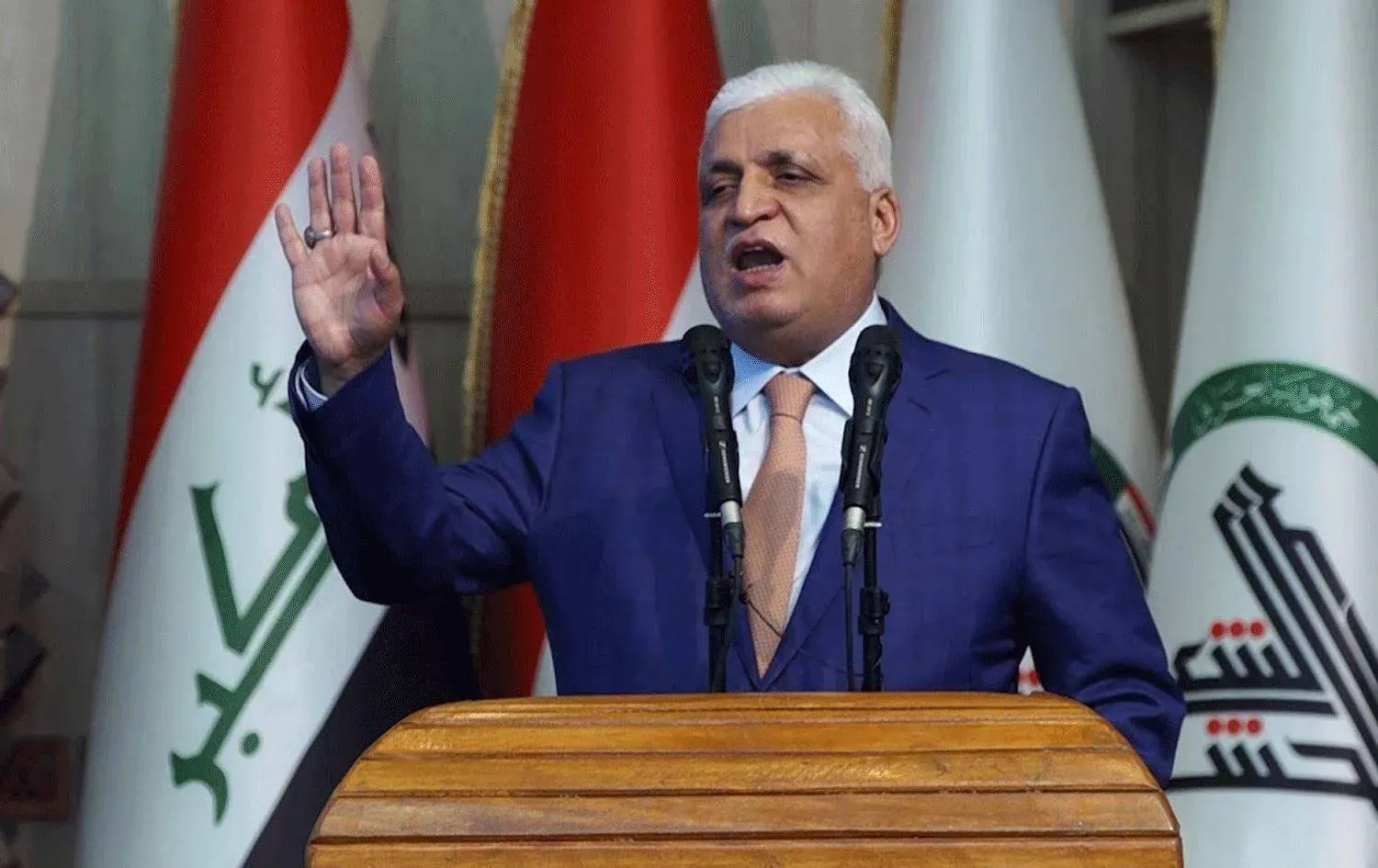
PMF chief Faleh al-Fayyadh. (INA)
TT

Iraq’s PMF Declares ‘Complete Split’ from Parties, Factions

PMF chief Faleh al-Fayyadh. (INA)

The head of Iraq’s Popular Mobilization Forces announced the start of implementation of a government order by Prime Minister Ali al-Zaidi, who is also commander-in-chief of the armed forces, to form a committee tasked with reorganizing the relationship with armed factions.

The move is officially being presented as part of a broader effort to place all weapons under state control.

PMF chief Faleh al-Fayyadh said in a television interview that the new committee had begun work on mechanisms for the “complete disengagement” of the PMF from any political, factional, or partisan frameworks.

The aim was to turn the PMF into an institution governed by a unified system and linked to the commander-in-chief of the armed forces, he added.

Fayyadh said the effort was based on the 2016 law governing the PMF and on successive government orders. But he said the war against ISIS had prevented full implementation over the past years.

In a related development, Sabah al-Numan, spokesman for the commander-in-chief of the armed forces, confirmed that a government order had been issued to form a “sovereign” committee that would set binding mechanisms to end the possession of weapons outside state control.

He warned against what he described as the continued “politicization of the military institution,” saying national security required control over weapons.

Fayyadh rejects calls to dissolve PMF

At the same time, Fayyadh rejected local and diplomatic calls to dissolve the PMF after the end of “major battles”, describing such demands as “unrealistic.”

He said the need for security forces, including the PMF, was “permanent” as long as security threats continued.

Fayyadh said those who believed the PMF’s role had ended had a “superficial view,” referring to criticism he sees as driven by political opposition to his forces.

In a more sensitive file, Fayyadh revealed special arrangements involving brigades affiliated with Saraya al-Salam, which is linked to the Sadrist movement, in Samarra.

He said the brigades would be integrated into the PMF structure under new professional arrangements.

The Saraya al-Salam had handed over their security responsibilities to the Iraqi army in Samarra city on Thursday.

Fayyadh said these formations would be “received as individuals and restructured or redeployed in the field as needed.”

He said the objective was to end the idea of “areas belonging to certain factions” in favor of unified military administration.

In a notable statement, he added that some sites would be placed under temporary transitional arrangements supervised by the Iraqi army before being finally redistributed within the PMF.

The developments come as the head of the Security Media Cell, Lieutenant General Saad Maan, announced the start of steps to implement the decision to place weapons under state control.

He said a number of factions, including Asaib Ahl al-Haq and Kataib al-Imam Ali, had begun legal procedures to hand over heavy and medium weapons ahead of integration into official institutions.

Other factions, including Kataib Hezbollah, the Nujaba movement, and Kataib Sayyid al-Shuhada, continue to reject handing over their weapons.

They said disarmament depends on achieving the “goals for which they were formed,” particularly those linked to the presence of foreign forces in Iraq.

The security spokesman for Kataib Hezbollah, Abu Mujahid al-Assaf, said some current initiatives “do not represent the factions of the Islamic Resistance.” The Nujaba said in a statement that weapons were a “red line.”

‘Unified standards’

Fayyadh said the current stage represented a “starting point” for applying unified standards to all formations.

He warned against any political or partisan links within the military structure and said implementation would include all brigades without exception.

Local press reports said leaders of the Coordination Framework have received signals that Washington will not accept symbolic disarmament.

The reports said Washington is instead pushing for the “dissolution of the PMF” and firmly rejects its integration into other security institutions.

Separately, Numan denied on Friday reports of changes in senior leadership positions in the military and security institutions.

He said current commanders were continuing to perform their duties and national responsibilities normally.

Drone Strikes Continue to Claim Civilian Lives in Sudan

Two damaged tanks outside the central bank building in Khartoum during fighting. File photo: Reuters
TT

Drone Strikes Continue to Claim Civilian Lives in Sudan

Two damaged tanks outside the central bank building in Khartoum during fighting. File photo: Reuters

Two civilians were killed, and several others were wounded, when a drone struck a fuel station in Rabak, the capital of White Nile state in southern Sudan, as drones continued to hit El-Obeid in North Kordofan on Thursday morning, part of a growing wave of drone attacks across the country.

Local sources said drones hit a fuel station inside Rabak on Thursday morning, killing two civilians and wounding others. The injured were taken to health facilities, while authorities sealed off the area, began assessing the damage and opened an investigation into the attack.

Witnesses said the strike spread panic among residents. Ambulance teams and relevant authorities rushed to the site to deal with the aftermath and secure the area.

At the same time, El-Obeid, the capital of North Kordofan, remained under repeated drone attacks believed to have been carried out by the Rapid Support Forces (RSF). Witnesses said drones launched a fresh raid on the city on Thursday morning. Authorities have not yet announced an official casualty toll.

Several cities in central and western Sudan have seen drone attacks rise since the start of the war. The strikes have expanded and intensified in recent months and weeks, during the fourth year of fighting between the army and the RSF.

El-Obeid has been a frequent target in recent weeks of attacks attributed to the RSF. Rabak and Kosti in White Nile state, as well as Kadugli and Dilling in South Kordofan, have also been hit by similar attacks from time to time.

The Sudanese army, meanwhile, continues to carry out drone strikes on sites in areas held by the RSF. The two sides rarely announce the results or targets of drone raids they launch.

The latest strikes came two days after a drone attack on Tuesday hit the market in the town of al-Siyah in North Darfur. Local reports said the attack killed one person, wounded several civilians and sparked fires that destroyed part of the market, damaging crops and foodstuffs worth millions of Sudanese pounds.

The al-Siyah market serves more than 70 villages. It lies about 60 km north of Mellit, near the border with Libya, and about 100 km northeast of El-Fasher. Witnesses said the attack coincided with the presence of RSF combat vehicles around the market, suggesting the drone may have belonged to the Sudanese army, which has not commented on the incident.

Drones have become a key weapon in the war between the army and the RSF in recent months. Their use has expanded to attacks on military sites and vital facilities in areas controlled by both sides, after fighting had previously centered on direct front lines.

The strikes usually target military bases and headquarters, weapons and ammunition depots, combat vehicles, infrastructure facilities, fuel stations and forces from both sides.

With many military sites located inside cities, and forces from both sides deployed in populated areas, civilians have borne the highest cost. The strikes often kill and wound civilians and damage homes, civilian facilities and basic services.

Since the war erupted in Sudan in April 2023, both sides have widened their use of drones, reaching cities far from the front lines. That has increased civilian losses and deepened humanitarian suffering in targeted areas.

The Associated Press reported on June 15, citing UN High Commissioner for Human Rights Volker Türk, that more than 1,000 civilians were killed in drone attacks in Sudan during the first five months of 2026.

According to the report, Türk said his office had recorded more than 1,000 civilian deaths from drone strikes between January and May this year.

There are no official figures for the number of civilians killed in the war. But the Armed Conflict Location & Event Data Project, known as ACLED, said in its latest reports that at least 59,000 people have been killed during the conflict, and that the true toll is likely far higher because of the difficulty of documenting victims in several combat zones.


Palestinian Health Ministry: Israeli Forces Kill Man in West Bank

A Palestinian kicks away a teargas cyclinder fired by Israeli security forces guarding bulldozers demolishing the home and shops belonging to the al-Atrash family just south of the Israeli-occupied West Bank city of Hebron on June 23, 2026. (Photo by HAZEM BADER / AFP)
TT

Palestinian Health Ministry: Israeli Forces Kill Man in West Bank

A Palestinian kicks away a teargas cyclinder fired by Israeli security forces guarding bulldozers demolishing the home and shops belonging to the al-Atrash family just south of the Israeli-occupied West Bank city of Hebron on June 23, 2026. (Photo by HAZEM BADER / AFP)

Israeli forces fatally shot a Palestinian man in the occupied West Bank on Thursday, the Palestinian health ministry said, with the Israeli military confirming troops had fired at someone "throwing objects" at soldiers.

The shooting is the latest fatal incident to occur as violence surges in the occupied Palestinian territory.

In a statement, the Palestinian health ministry announced the death of 32-year-old Mustafa Taha Mustafa Al-Khatib "at dawn today after being shot by Israeli occupation forces in Salfit.”

It added that his death brought the number of Palestinians killed since the beginning of the year to 72, including 17 children, five women, and two elderly people.

When asked by AFP about the incident, the Israeli military said that "during IDF soldiers' operational activity in the area of Sarta, a terrorist threw objects at the soldiers."

"The soldiers initiated standard suspect apprehension procedures, which included warning shots into the air. After the terrorist continued attacking the soldiers and throwing objects in a manner that posed a threat to them, they responded with fire toward him," the military said, adding that "hits were identified."

A day earlier, Israeli forces killed a Palestinian man during a house raid in a town in the northern West Bank who the military described as a "terrorist.”


Israel Says will Only Withdraw Troops from Lebanon after Hezbollah Disarmed

A man with a Hezbollah flag drives past a damaged building following a ceasefire between Israel and Hezbollah in the town of Nabatiyeh, southern Lebanon, Monday, June 22, 2026. (AP Photo/Mohammed Zaatari)
TT

Israel Says will Only Withdraw Troops from Lebanon after Hezbollah Disarmed

A man with a Hezbollah flag drives past a damaged building following a ceasefire between Israel and Hezbollah in the town of Nabatiyeh, southern Lebanon, Monday, June 22, 2026. (AP Photo/Mohammed Zaatari)

Israel said Thursday that it would only withdraw its forces from southern Lebanon after Hezbollah was disarmed, as the two countries engaged in US-mediated talks in Washington.

"We will not withdraw our forces from southern Lebanon as long as Hezbollah remains a threat, are not disarmed and are not demilitarised," David Mencer, a government spokesman, said in a briefing to journalists.

Under US pressure, Lebanese officials began direct talks in April with Israel in Washington. The latest three-day round of talks is due to wrap up on Thursday, Reuters reported.

Commenting on the negotiations, US Secretary of State Marco Rubio said the two neighbors were close to making a "commitment of intent".

Asked about the talks, Mencer said: "We are making extremely clear that our responsibility is to our northern citizens and to the whole of Israel, and we will not allow any terrorist force anywhere near our border -- which means that any redeployment of - Israeli - forces comes after, not before, but after the demilitarisation of southern Lebanon and the disarming of Hezbollah."

"We've already been in this situation in 2024," he added. "Hezbollah were supposed to be disarmed. They weren't."

Meanwhile, Senior Israeli and Lebanese officials denied on Thursday that there had been any Israeli withdrawal from occupied southern Lebanon, after a US official said Israel had pulled some troops back in a good faith gesture toward Lebanon's government.

A US State Department official said that "Israel has already taken a concrete step by pulling back from a part of its buffer zone". The so-called buffer zone is a vast area of southern Lebanon that Israeli forces are occupying north of the Israeli border.

The official described the move as "a significant demonstration of good faith toward Lebanon's legitimate government."

"The (Lebanese Armed Forces) should now move in and verifiably clear out terrorist weapons and infrastructure. This model will be repeated across South Lebanon, enabling the safe return of displaced families, reconstruction of the south, and the restoration of full Lebanese sovereignty," the official added.

A senior Israeli defense official denied there had been any kind of pullback or withdrawal by Israeli forces, and said Israel would not be withdrawing from its buffer zone.

Another Israeli military official told Reuters on Wednesday that the military had not received orders to hand over any position to the Lebanese army and that, for now, it would not permit the Lebanese army or civilians to cross into the buffer zone.

"We will not allow the Lebanese army to go south from the security line," the official said.