Pakistan, Lebanon Army Chiefs Meet as Middle East Mediation Drags On

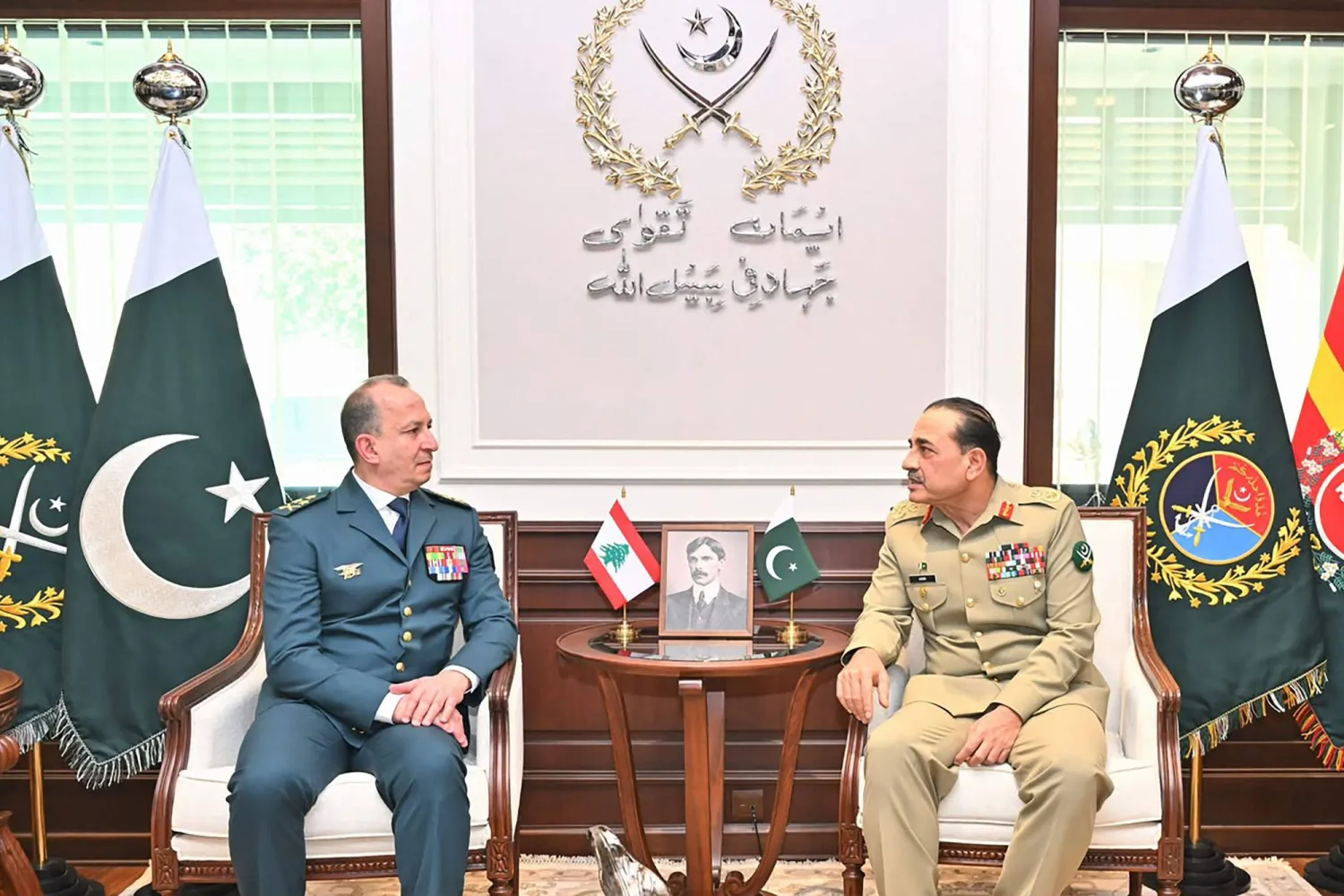
This handout photograph taken and released on June 9, 2026 by Pakistan's Inter-Services Public Relations (ISPR) shows Pakistan's Army Chief and Field Marshal Syed Asim Munir (R) speaking with General Rodolphe Haykal, Commander-in-Chief of the Lebanese Armed Forces during their meeting in Rawalpindi. (Photo by Handout / Pakistan's Inter-Services Public Relations (ISPR) / AFP)
TT

Pakistan, Lebanon Army Chiefs Meet as Middle East Mediation Drags On

This handout photograph taken and released on June 9, 2026 by Pakistan's Inter-Services Public Relations (ISPR) shows Pakistan's Army Chief and Field Marshal Syed Asim Munir (R) speaking with General Rodolphe Haykal, Commander-in-Chief of the Lebanese Armed Forces during their meeting in Rawalpindi. (Photo by Handout / Pakistan's Inter-Services Public Relations (ISPR) / AFP)

The heads of the Pakistani and Lebanese armed forces agreed to boost cooperation on Tuesday as they met in Pakistan with peace talks over the Middle East war dragging on.

Pakistan has been mediating between the United States and Iran to end the months-long conflict, with Tehran insisting that any deal should include Lebanon, where Israel has been fighting Iran-backed Hezbollah, reported AFP.

Lebanese army chief Rodolphe Haykal left on Saturday to meet his powerful Pakistani counterpart Asim Munir, with a Lebanon-based source telling AFP the visit was linked to the broader peace talks.

The two military commanders discussed "matters of mutual interest, (the) evolving regional security environment, defense cooperation and prospects for enhancing bilateral military relations", a statement from the media wing of the Pakistani military said on Tuesday.

Munir "underscored (the) Pakistan Army's commitment to expanding defense collaboration with the Lebanese Armed Forces," it said, after Haykal received a guard of honor ahead of the meeting in the city of Rawalpindi.

Conflict in Lebanon has become a centerpiece of weeks of stop-start efforts to bring a formal end to the war.

Armed hostilities flared further during Haykal's visit, though both Iran and Israel indicated on Monday that they had halted the fighting.

US President Donald Trump, who has expressed frustration at the slow progress of peace talks, said on Tuesday that negotiators were in the "final throes" of reaching a deal.

Lebanon was drawn into the war when Hezbollah militants fired rockets at Israel on March 2 to avenge the US-Israeli killing of Iran's supreme leader.

Israel responded with an extensive campaign of airstrikes and a ground invasion that have killed nearly 3,600 people. Exchanges of fire with Hezbollah have not stopped despite an ongoing truce.

Pakistan's Prime Minister Shehbaz Sharif has said a US-Iranian agreement to end the war was "about to be achieved" when fresh fighting between Iran and Israel erupted on Sunday.

Even after an April 17 ceasefire agreement began, the Israeli military announced a so-called Yellow Line inside Lebanese territory about a dozen kilometers from its northern border where its ground troops are fighting with Hezbollah, who have fired rockets at Israel.


Assad-era Officer Convicted in Austria Reportedly Returns to Syria a Free Man

A man cycles past heavily-damaged and destroyed buildings in the Jobar suburb northeast of Damascus on August 12, 2026. (Photo by LOUAI BESHARA / AFP)
TT

Assad-era Officer Convicted in Austria Reportedly Returns to Syria a Free Man

A man cycles past heavily-damaged and destroyed buildings in the Jobar suburb northeast of Damascus on August 12, 2026. (Photo by LOUAI BESHARA / AFP)

A former Syrian security officer sentenced to prison in Austria for abusing detainees during Bashar al-Assad’s rule left the country while appealing against his sentence and returned to Syria earlier this month, according to four sources and messages reviewed by Reuters.

Lieutenant Colonel Musab Abu Rukba was handed an eight-year prison sentence last month by a Vienna court that found him guilty of bodily harm, aggravated coercion and sexual assault against detained opponents of Assad while he headed the police's criminal investigations department in the city of Raqqa more than a decade ago.

The Syria Justice and Accountability ⁠Center, a Syrian ⁠human rights organisation, said the case exposed shortcomings in the Austrian judicial system after authorities allowed Abu Rukba to remain at liberty throughout proceedings and while challenging his prison sentence on appeal.

Abu Rukba had pleaded not guilty. In early August, he arrived in his hometown of Nawa in southern Daraa province, where his family held a reception to celebrate his return, the four sources familiar with the case said.

The invitation ⁠said he had been granted "release from prison," according to a message sent to local dignitaries and seen by Reuters.

A spokesperson for the Austrian court that convicted him told Reuters on Friday that ahead of the trial, he was found not to pose a flight risk because he had been living in Austria since 2014 and was seeking asylum there along with his family.

He was not remanded in custody during the trial and was also not subject to other restrictions. Until the appeals process is included, his departure from Austria does not constitute a breach of any ⁠Austrian laws or ⁠rulings, the spokesperson said.

“The escape of a lieutenant colonel accused of torture, sexual coercion and serious bodily harm demonstrates a failure by the Austrian authorities to assess the danger posed by this defendant and their failure to place him in pre-trial detention,” Mohammad al-Abdallah, executive director of the Syria Justice and Accountability Center.

Syria’s new authorities have pledged to hold former Assad officials accountable for abuses committed during his rule. A Syrian court on Tuesday sentenced Assad to death in absentia for killings, torture, arbitrary arrest and crimes against humanity. The ousted leader fled to Russia in December 2024.


How Will Hamas Handle the Requirements of the Legislative Elections?

A member of the Fatah movement attends the 8th General Conference of Fatah, at Al-Azhar University in Gaza City, May 14, 2026. REUTERS/Dawoud Abu Alkas
TT

How Will Hamas Handle the Requirements of the Legislative Elections?

A member of the Fatah movement attends the 8th General Conference of Fatah, at Al-Azhar University in Gaza City, May 14, 2026. REUTERS/Dawoud Abu Alkas

With Hamas announcing its intention to contest the legislative elections, scheduled for November 28, as stipulated in a Palestinian presidential decree, the movement faces a host of questions over its ability to navigate the political requirements of the post-war phase in the Gaza Strip.

This will be Hamas's second participation in legislative elections following the last vote in 2006. The war has fundamentally altered the reality of Palestinians and triggered further conflicts in several countries across the region.

Perhaps the most pressing question in recent days is how Hamas will deal with the amendments introduced by Palestinian President Mahmoud Abbas to the election law, particularly the requirement that electoral lists commit to the political program of the Palestine Liberation Organization (PLO), which is recognized as the sole legitimate representative of the Palestinian people.

That program includes recognition of relevant international legitimacy resolutions, including recognition of Israel and the renunciation of violence, along with other conditions the movement had previously rejected.

A Hamas political source told Asharq Al-Awsat that the movement is in contact with all factions to reach a comprehensive consensus on the elections and ensure the participation of all parties without imposing unilateral policies in determining the political objectives of the national framework.

Asked about Hamas's plans for overcoming the dispute over the PLO's political program, the source said there are legal and political options, alongside national dialogue, for reaching agreement on a course of action that could circumvent such a requirement. The source added that Hamas is committed to reforming the PLO and the Palestinian National Council before joining them, so that their programs are brought into line with national requirements under the current circumstances.

He noted that messages are being exchanged with Fatah, both directly and indirectly, on a range of national issues, expressing hope that an understanding can be reached that brings Palestinians closer together and steers them toward safety.

The source stressed that the developments in Gaza had increased the popularity of Hamas and the armed factions that share its approach of "resisting the occupation." As a result, the movement is not afraid of electoral competition, even if it loses or remains in opposition. He stressed that Hamas has no intention of returning to power, but wants to be part of the Palestinian political system and put an end to unilateral decision-making on issues of national consequence.

Hossam Badran, a member of Hamas's political bureau, told Asharq Al-Awsat that the principle of imposing political conditions on electoral participation is unacceptable regardless of the wording or substance, because it contradicts the very essence of elections, which is competition among different political programs.

Badran said Hamas is holding consultations and dialogue with various factions as well as emerging electoral lists to agree on a collective mechanism for addressing the issue. He said some parties had already begun, in coordination with Hamas, sending messages to the Palestinian Central Elections Commission, while others are considering turning to the Palestinian judiciary.

"We will follow the matter and reach what is appropriate, but on the basis of participating in the elections," he said.

Fatah in Gaza

A senior Fatah source in the Gaza Strip told Asharq Al-Awsat that President Abbas's decisions regarding the latest amendments would not be reversed, and that they enjoy full support as part of the reform plan adopted by the Palestinian Authority with full Arab and international backing.

According to the source, who requested anonymity, Hamas and any Palestinian faction or entity participating in the forthcoming elections, in which the Gaza Strip will take part under arrangements established by the Central Elections Commission, must comply with the amended laws. He said the decisions were not intended to restrict the participation of any faction, whether affiliated with the PLO or outside it. Rather, their primary objective was to ensure that every future parliamentary force has a clear political program.

Abdel Fattah Doleh, the Fatah spokesman in Ramallah, said any party has the right to participate in the forthcoming elections, a right guaranteed by Palestinian law, which must be observed by every party taking part in the electoral process.

In remarks to Asharq Al-Awsat, Doleh said there have been no genuine direct contacts with Hamas regarding the elections. He noted that Hamas had previously participated in elections and became part of the political system before turning against it and monopolizing power.

He added that Fatah had repeatedly sought, during previous rounds of dialogue, to integrate Hamas into the PLO, but that the movement had raised objections each time.

Doleh stressed that the political system has room for everyone, but said it is essential that anyone participating in it adhere to the PLO's political program, given its status as the sole legitimate representative of the Palestinians. He emphasized that Hamas must align itself with that framework.


US Wants Netanyahu to Condemn Settler Siege in Palestinian Village

Soldiers evacuate Israeli settlers before dismantling their tent in front of one of the three homes belonging to Palestinian families besieged by settlers for six days in Qusra (AP)
TT

US Wants Netanyahu to Condemn Settler Siege in Palestinian Village

Soldiers evacuate Israeli settlers before dismantling their tent in front of one of the three homes belonging to Palestinian families besieged by settlers for six days in Qusra (AP)

The United States wants Israeli Prime Minister Benjamin Netanyahu to publicly condemn a siege imposed by Jewish settlers in a Palestinian village, US and Israeli officials said on Friday, as settlers pressured residents by pitching a new tent before Israeli soldiers arrived and it was taken down.

Settlers have been besieging homes in Qusra in the occupied West Bank for almost a week, trapping Palestinians in an area where rights groups say settlers are mounting a concerted effort to seize more land, further eating into territory where Palestinians aim to establish a state.

The siege has drawn public US criticism: the US Ambassador to Israel, Mike Huckabee — a strong supporter of Jewish settlement in the West Bank — on Thursday condemned settlers besieging a Palestinian home as "Israeli terrorists".

A US official and an Israeli official said on Friday White House officials are pressing Netanyahu to publicly condemn the siege.

Washington began to protest after learning that the home of a Palestinian-American was among those under siege, said the two officials, who spoke on condition of anonymity to describe sensitive discussions, of which they had knowledge.

Netanyahu has not commented on the siege in Qusra. Neither his office nor the White House immediately responded to requests for comment.

Settler violence in the West Bank has risen during the three years since the Hamas-led October 7 attacks on Israel.

Condemning settlers could be politically risky for Netanyahu some two months before an election, potentially upsetting settler voters upon whom parts of his right-wing coalition rely. Opinion polls show Netanyahu could lose power, his security credentials still shaken by the 2023 Hamas attacks.

"We are very afraid," said Aysha Hassan, a Palestinian woman who lives in one of three besieged homes in the village, speaking to Reuters by phone.

"There is nothing new. It's been like this for six days...the settlers are still here."

Hassan said she had seen settlers below the house in the early hours of the morning and shared videos with Reuters showing groups of settlers wandering underneath her home that she said she had taken from her window.

The United Nations has said some 15 Palestinians, including two children, were trapped inside their homes with no water or electricity.

Footage shot by a Palestinian resident trapped in another of the besieged homes and obtained by Reuters showed seven settlers outside, standing near a blue tent. One is seen throwing stones toward the nearby village, as another arrives with chairs.

Israeli army vehicles and soldiers later arrive and the tent is seen collapsed on the ground.

"Israeli civilians erected a tent in the Qusra area, and army soldiers operated to remove it while protecting the local residents," the Israeli military said in a statement, a day after dozens of troops were sent into Qusra and occupied several village homes.

Netanyahu's government, the most right-wing in Israeli history, has spearheaded a rapid expansion of settlements in the West Bank, territory captured by Israel in a 1967 war. Israel has established dozens of new settlements and settler outposts in the area.

Rights groups say that settlers have been trying to seize properties on the outskirts of Qusra and neighbouring Jalud as part of a strategy to seize the land between them and join it up with settler outposts to the south and larger settlements to the west.