Israel to Allocate $338 Million for West Bank Settlement Expansion, Rights Group Says

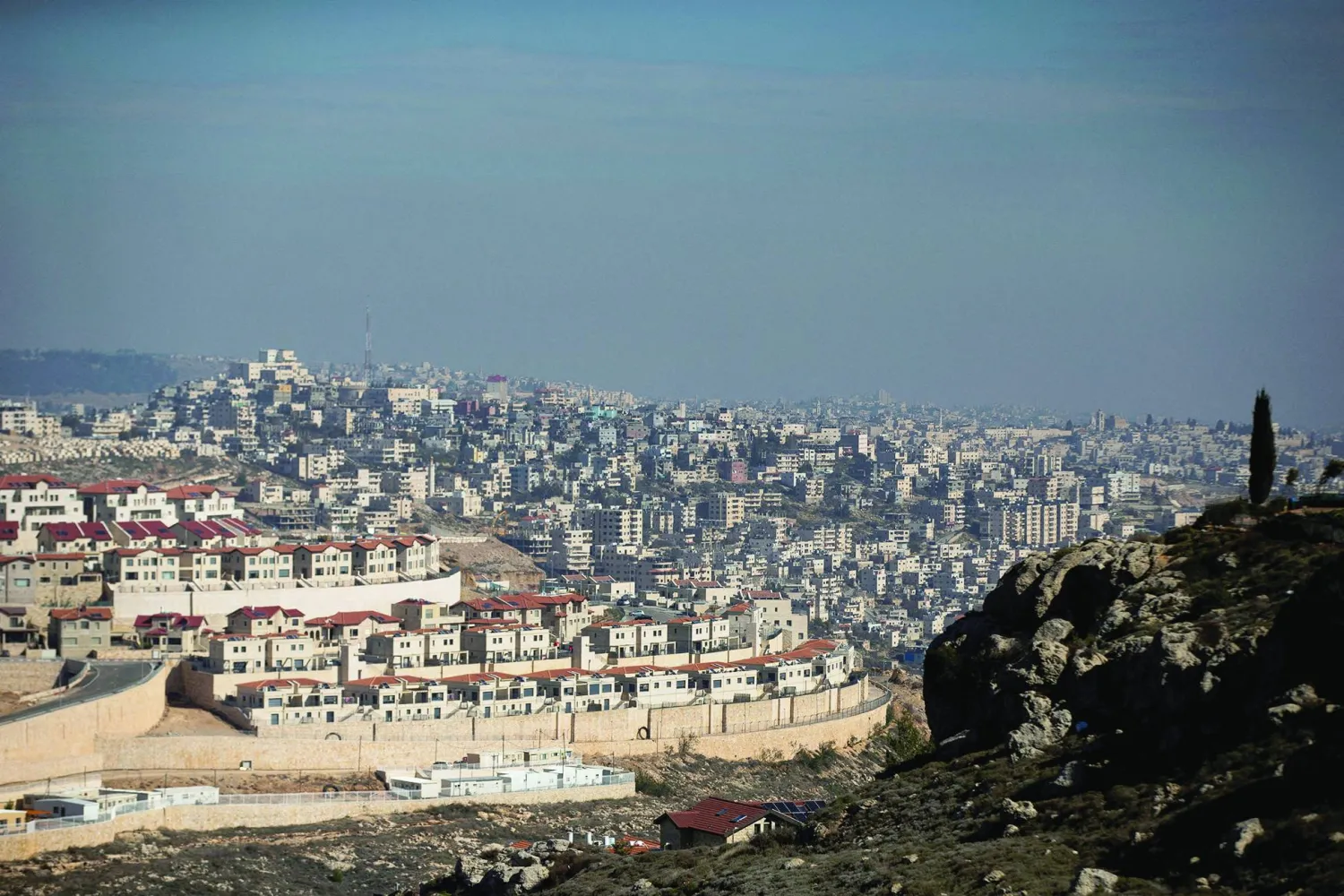
FILE PHOTO: A general view picture shows the Israeli settlement of Efrat in the Gush Etzion settlement block as Bethlehem is seen in the background, in the Israeli-occupied West Bank January 28, 2020. REUTERS/Ronen Zvulun/File Photo
TT

Israel to Allocate $338 Million for West Bank Settlement Expansion, Rights Group Says

FILE PHOTO: A general view picture shows the Israeli settlement of Efrat in the Gush Etzion settlement block as Bethlehem is seen in the background, in the Israeli-occupied West Bank January 28, 2020. REUTERS/Ronen Zvulun/File Photo

Israel is expected to approve on ‌Thursday the allocation of 1 billion shekels ($337.8 million) to build new settlements and connect them to infrastructure in the occupied West Bank, Israeli anti-settlement group Peace Now said.

The plan is being promoted by Israel's far-right finance minister Bezalel Smotrich, a proponent of Israeli settlement expansion who has said he wants to bury the idea of Palestinian statehood, reported Reuters.

According to Israeli Prime Minister Benjamin Netanyahu's cabinet schedule, ministers are expected to discuss the establishment of temporary sites that have already been approved in the West Bank.

The schedule did not say whether ‌the ministers would ‌approve new funding. Netanyahu's office did not immediately ‌respond ⁠to a request for ⁠comment.

FUNDING FOR ROADS, WATER, RIGHTS GROUP SAYS

About 700,000 Israeli settlers live among 2.7 million Palestinians in the West Bank and East Jerusalem. Israel annexed East Jerusalem in 1980, a move not recognized by most countries, but has not formally extended sovereignty over the West Bank.

UN bodies and most countries view the West Bank settlements as ⁠illegal, citing international conventions. Israel disputes this, saying ‌a Jewish presence has existed ‌in the West Bank for thousands of years.

In a statement, Peace Now said ‌the cabinet vote would bypass the standard settlement planning process. ‌It said the settlements in question had been approved by Netanyahu's government over the past three years.

Both Peace Now and the news website Axios, citing a draft resolution, said the allocation of funds would include construction of ‌infrastructure such as access roads, land preparation, sewage systems, water connections and related works, as well as ⁠temporary residential ⁠compounds.

A spokesperson for Smotrich, the finance minister, did not provide specifics but said the cabinet vote would strengthen Israeli settlements and that these are not new settlements, but rather existing sites. Smotrich last week announced a major expansion by more than 2,000 homes of three Jewish settlements in the West Bank.

Palestinians and many countries view the settlements as a primary obstacle to peace, saying they eat into West Bank land that could make up a potential State of Palestine. The expansion of settlements and smaller settler outposts has been accompanied in recent years by a rise in Israeli settler violence, with settlers staging sometimes deadly attacks on Palestinians.


Iraqis Queue for Fuel as Regional War Disrupts Imports

An Iraq's traffic police officer controls the queues at a petrol station in the Iraqi capital Baghdad on September 5, 2026. (AFP)
TT

Iraqis Queue for Fuel as Regional War Disrupts Imports

An Iraq's traffic police officer controls the queues at a petrol station in the Iraqi capital Baghdad on September 5, 2026. (AFP)

Drivers formed long lines outside fuel stations in Baghdad on Saturday as gasoline supplies dropped in oil-rich Iraq due to import disruptions caused by the Middle East war.

Despite being OPEC's second largest oil producer, Iraq imports oil derivatives because its refineries do not produce enough gasoline to meet domestic demand.

In recent weeks, as regional hostilities drag on, long queues have been reappearing every few days, mostly outside government-run fuel stations in Baghdad and other provinces.

Baghdad resident Ibrahim Hashem waited for two hours outside a fuel station on Friday without any luck, only to return early the next day hoping to fill his car.

"It is unreasonable that we produce so many barrels of oil a day, yet still do not have enough gasoline to meet our daily needs," Hashem told AFP outside a fuel station in central Baghdad.

"We already suffer from traffic congestion because of the roads and lack of services. Now, it has become worse due to the gasoline shortage," he added.

Iraq's average daily consumption of gasoline is 33 million liters, but demand rises to 38 million when people panic over shortages, according to authorities.

The oil ministry said Friday that "regional events and the ongoing conflict are causing logistical challenges to tanker traffic, delaying their arrival at Iraqi ports."

It urged citizens to buy only the quantities they need and avoid crowding fuel stations for small amounts of gasoline.

Oil Minister Bassem Mohammed Khudair said on Friday that his ministry was addressing the "temporary shortage of gasoline" and that new shipments will arrive soon to help stabilize supplies.

Like other oil producers, Iraq has been greatly affected by the US-Iran conflict, which has choked off the strategic Strait of Hormuz.

Iraq is hugely dependent on oil exports, which make up about 90 percent of its budget revenues.

Before the war erupted in February, Iraq produced around four million barrels per day, and exported an average of 3.4 million bpd, mostly via Hormuz.

After a significant drop, Iraqi oil exports recovered to more than 2.2 million bpd in August, according to the oil ministry.

Last month, Iran's state news agency IRNA said that over the past six months, Tehran has granted permission to "a number of Iraqi oil tankers" to pass through Hormuz.


US Ambassador Calls for ‘Severe Consequences’ to Stop Israeli Settler West Bank Violence

US Ambassador to Israel, Mike Huckabee (C-L) meets residents as he visits the West Bank village of Turmus Ayya, near Ramallah, West Bank, 05 September 2026. (EPA)
TT

US Ambassador Calls for ‘Severe Consequences’ to Stop Israeli Settler West Bank Violence

US Ambassador to Israel, Mike Huckabee (C-L) meets residents as he visits the West Bank village of Turmus Ayya, near Ramallah, West Bank, 05 September 2026. (EPA)

The US ambassador to Israel on Saturday called for "severe consequences" to stop violence in the occupied West Bank as he met Palestinian-Americans who have reported attacks from Israeli settlers.

"Our clear message is that crime is crime, terror is terror. When people do it they should have an expectation that they will have severe consequences," Mike Huckabee told reporters as he visited the West Bank town of Turmus Ayya, which has a high number of US citizens, but he declined to criticize Israel.

Settler violence in the West Bank has risen sharply since Prime Minister Benjamin Netanyahu's coalition government, the most right-wing in Israel's history, took office in late 2022.

Several settlements have been ‌established around Turmus Ayya, ‌the Palestinian town near Ramallah that Huckabee was visiting ‌on ⁠Saturday. Its residents ⁠say that harassment by militant Israeli settlers is common and that they are unable to stop them from entering the town and damaging their homes.

"We have many issues that we will address," Nawwaf Zaghoul, the town's mayor, told reporters ahead of the meeting, describing what he said were constant attacks by settlers.

He said that the town's residents would be asking the ambassador to help secure ⁠their safety and security. About 80% of the town's roughly ‌3,000 residents were Palestinian Americans, he said.

Huckabee, ‌a Baptist minister and longtime supporter of Israeli settlements, has called for violent settlers ‌to be prosecuted, while saying he believes their actions represent a minority of the ‌wider settler community, which numbers around 750,000. Israeli settlers accused of carrying out attacks in the West Bank targeting Palestinians are rarely prosecuted.

"We are hoping that (the ambassador) will do something for us regarding these lawless settlers," Turmus Ayya resident Sameer Hazama said ‌ahead of the meeting with the ambassador.

Huckabee visited Taybeh, one of the only Christian villages remaining in the West ⁠Bank, in ⁠June 2025 after a church there was vandalized. Huckabee said at the time that the desecration of a place of worship was an act of terror and a crime.

Netanyahu's government has also overseen an expansion of settlements across the West Bank, further entrenching Israeli control over territory that Palestinians seek for a future state.

Israeli settlements in the West Bank are illegal under international law, with the United Nations and most countries deeming the territory to be occupied. Israel's government says that the land is disputed, not occupied.

Huckabee refers to the West Bank by its biblical name, Judea and Samaria, a term used by the Israeli government but not adopted by the US government. He has visited Shiloh, a settlement near Turmus Ayya, at least twice since 2025.


Could Sudan’s Conflict Become a Regional War?

Members of the Sudanese army take part in a military parade in Gedaref in August. (AFP)
TT

Could Sudan’s Conflict Become a Regional War?

Members of the Sudanese army take part in a military parade in Gedaref in August. (AFP)

Fears that Sudan’s war could turn into a regional conflict are no longer merely assessments raised by observers following cross-border strikes and mutual accusations between Sudan and Chad, alongside troubling military movements near the border with Ethiopia.

Massad Boulos, senior adviser to the US president for Arab and African affairs, conveyed those concerns to the UN Security Council, warning that the repercussions could fuel the conflict and threaten to draw neighboring countries more deeply into the war.

The US warnings do not appear to have emerged in a vacuum. They are difficult to separate from Washington’s extensive intelligence capabilities, which allow it to monitor military movements, weapons and drone routes, and cross-border networks.

Raising the level of concern to the Security Council therefore reflects a US assessment that the risks are real and growing, even if the administration has not publicly disclosed all the information on which that assessment is based.

The warning was reinforced by a call Boulos held with Chadian President Mahamat Idriss Deby following reports of a military strike inside Chadian territory.

Boulos said the two expressed “deep concern about the war in Sudan spilling across its borders, fueling further escalation and threatening regional peace and stability,” while calling for an end to external support for the warring parties.

More than three years after the war began, it is no longer simply an internal confrontation between the Sudanese army and the paramilitary Rapid Support Forces. As fighting has moved into areas bordering Chad and Ethiopia and the use of sophisticated weapons has expanded, Sudan has become the center of a conflict in which the calculations of neighboring countries intersect with the interests of regional and international powers.

Growing internationalization

Evidence of the war’s internationalization can be seen in the UN Fact-Finding Mission’s finding that weapons, military technology, fighters and external supply networks are helping prolong the conflict and strengthen the capabilities of both sides.

The mission described a cross-border network linked to individuals, entities and countries that it said had provided the RSF with weapons, equipment, logistical support and foreign personnel. The countries concerned have denied the accusations, saying they remain neutral and support peace efforts.

The mission, meanwhile, said its investigations into sources of external support for the army were still at a preliminary stage.

Sudanese researcher Kholood Khair, director of Confluence Advisory, told the Financial Times in April that the war had “spread across the Red Sea, the Horn of Africa and the Sahel,” and that none of Sudan’s seven neighbors was entirely removed from its effects.

Alan Boswell, director of the Horn of Africa project at the International Crisis Group, has similarly argued that the war is dividing the region and increasing polarization among surrounding countries over the two sides.

He considers Chad and South Sudan the most exposed to its repercussions, while also pointing to the need to watch Ethiopia and tensions in Somalia.

A prolonged conflict, he has warned, could drag the region into a “spiral of violence.”

Amin Ismail Majzoub, an expert on crisis management and negotiation at the Center for Research and Strategic Studies, ruled out the conflict developing into a direct military confrontation between Sudan and neighboring countries.

He said the more likely scenario was an escalation of “proxy warfare,” through continued financial and military support and the use of mercenaries and armed groups, which would prolong the war.

Majzoub told Asharq Al-Awsat that Khartoum’s accusations against Chad and Ethiopia were, according to Sudanese authorities, based on evidence submitted to the African Union, IGAD and the Security Council, in addition to reports that bases and airports had been used in support of the RSF.

He added that if those parties moved from indirect support to declared military intervention, Sudan’s regional allies could step in to back it, at which point the conflict could expand to include the Horn of Africa and sub-Saharan Africa.

Majzoub nevertheless dismissed that scenario, saying: “This will not happen,” because a comprehensive regional war would not be welcomed by the countries of the region.

At the same time, he noted that the conflict’s repercussions were already becoming visible inside neighboring countries, citing increasingly vocal opposition groups in Chad that reject what they say is support being provided to Arab groups aligned with the RSF.

Retired Sudanese army Maj. Gen. Kamal Ismail, for his part, warned that the intersection of regional interests was gradually pushing the conflict beyond Sudan’s borders.

“We have repeatedly warned that the conflict could move from inside Sudan into the region, and the indicators point to that direction,” Ismail told Asharq Al-Awsat.

He added that the widening scope of the fighting could lead to a broader civil war and further complicate the situation.

Ismail said intensifying competition over regional interests could push some actors toward direct intervention under the pretext of protecting their interests, warning that “the longer the war continues, the more its parties lose the ability to control its course or stop it.”

He urged Sudanese to unite to halt the fighting and preserve what remains of the country.

Ethiopia and Chad

The movement of military operations into Blue Nile state near the Ethiopian border is among the most worrying developments.

Yale University’s Humanitarian Research Lab has published reports based on satellite imagery and open-source analysis pointing to the assembly of brigade-size military support inside an Ethiopian National Defense Force base in Asosa and linking it to RSF activity.

Asosa is significant because of its proximity to Blue Nile and the town of Kurmuk. Any military presence in the area connected to the war, if confirmed, could therefore lay the groundwork for a new border front.

To the west, Chad stands at the center of the storm because of its long border with Darfur and the tribal ties spanning both sides.

Tensions escalated after Sovereignty Council Chairman and army commander Gen. Abdel Fattah al-Burhan accused N’Djamena of facilitating support to the RSF, while Chad denies that its territory or airports are being used to transfer weapons.

Cameron Hudson, a former US official and Sudan expert, says the repercussions of strikes inside Chad are no longer confined to the battlefield but have developed into a diplomatic confrontation.

Countries affected by the war

South Sudan may be the country most exposed to the consequences of the war. Its economy depends on exporting oil through Sudanese facilities and ports, while it has received more than 1 million Sudanese and returning South Sudanese since the fighting began.

A halt in oil exports or the spread of fighting to the border could threaten Juba’s fragile stability.

Kenya, although it does not share a border with Sudan, is exposed to the spillover of political polarization, financing and fighter networks, as well as trade disruption and damage to the role of IGAD, of which Nairobi is a key pillar.

Uganda faces similar risks through South Sudan. Any renewed eruption of instability in Juba could trigger a new refugee influx into Uganda, which already hosts more than 1 million South Sudanese refugees. In this way, the effects of the war could spread from Sudan to South Sudan and then to Uganda and Kenya without regular armies ever crossing borders.

Egypt, for its part, faces repercussions related to refugees, security along its southern border, Nile waters and the balance with Ethiopia. Eritrea fears instability spreading into eastern Sudan and the Red Sea coast.

IGAD Executive Secretary Workneh Gebeyehu has said that peace and security challenges have become too interconnected for any single country or institution to confront alone, describing Sudan as one of the clearest examples of the convergence of military confrontation, humanitarian catastrophe, institutional fragmentation, regional spillover and geopolitical rivalry.

Sudan’s war has not yet become a full-fledged regional confrontation, but it long ago moved beyond the confines of an internal conflict. As the different strands become increasingly intertwined, the question in the future may no longer be: Will the war spread into the region? But rather has it already begun?