Cairo to Host Fourth Quadrilateral Meeting on Iran War

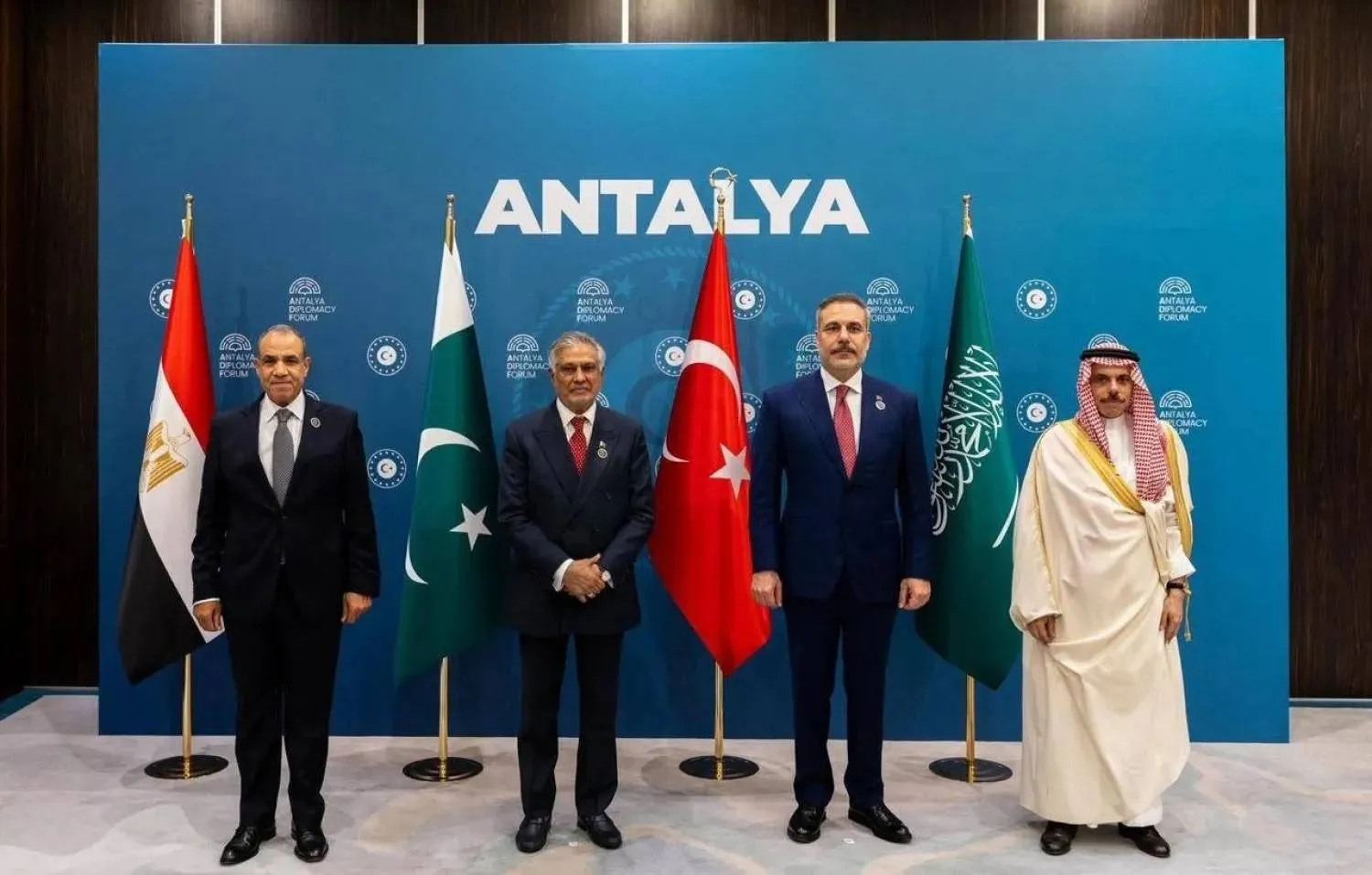
The foreign ministers of Saudi Arabia, Egypt, Türkiye and Pakistan during a meeting to discuss the progress of US-Iran negotiations (Egyptian Foreign Ministry handout). 
TT

Cairo to Host Fourth Quadrilateral Meeting on Iran War

The foreign ministers of Saudi Arabia, Egypt, Türkiye and Pakistan during a meeting to discuss the progress of US-Iran negotiations (Egyptian Foreign Ministry handout). 

Egypt is preparing to host the fourth meeting of the Quadrilateral Mechanism comprising Saudi Arabia, Egypt, Türkiye and Pakistan, as the four countries continue consultations aimed at easing tensions stemming from the conflict involving Iran.

Egyptian Foreign Minister Badr Abdelatty and Pakistan’s Deputy Prime Minister and Foreign Minister Mohammad Ishaq Dar discussed arrangements for the meeting during a phone call, according to a statement issued by Egypt’s Foreign Ministry on Thursday.

The ministers agreed on the importance of maintaining close coordination among the four countries amid what the statement described as dangerous developments in the region. They also discussed efforts to support the US-Iran negotiating track.

The first meeting of the mechanism was held in Riyadh on March 20, followed by a second meeting in Pakistan on March 29. The third meeting took place in the Turkish city of Antalya on April 17 on the sidelines of the Antalya Diplomacy Forum.

According to Egypt’s Foreign Ministry, participants at the latest meeting discussed ways to strengthen coordination in response to fast-moving regional developments, follow the course of US-Iran negotiations, and continue efforts to de-escalate tensions and contain the conflict.

They also discussed prospects for restoring regional security and stability and the future of the regional order after the current conflict.

The meeting brought together Abdelatty, Saudi Foreign Minister Prince Faisal bin Farhan Al Saud, Turkish Foreign Minister Hakan Fidan and Pakistan’s Ishaq Dar.

The ministers exchanged assessments of the conflict’s impact on the global economy and discussed ways to mitigate disruptions to international shipping, supply chains, food security, energy security, and oil prices.

Egyptian Foreign Ministry spokesman Tamim Khallaf said Abdelatty and Dar also exchanged views during their latest call on regional developments and stressed the importance of continued political and diplomatic efforts to contain the current escalation.

The two ministers also emphasized the importance of prioritizing diplomatic solutions to prevent the conflict from widening and to contain the current escalation, citing the serious security, economic and geopolitical consequences of the conflict for the region and the wider world, according to the ministry.


After 1,000 Days, Israel Shifts ‘Yellow Line’ to Expand Control in Gaza

A general view of a concrete block (back) marking the "yellow line" drawn by the Israeli military in Bureij, central Gaza Strip, on November 4, 2025. (AFP)
TT

After 1,000 Days, Israel Shifts ‘Yellow Line’ to Expand Control in Gaza

A general view of a concrete block (back) marking the "yellow line" drawn by the Israeli military in Bureij, central Gaza Strip, on November 4, 2025. (AFP)

Recent remarks by Israeli Prime Minister Benjamin Netanyahu that his forces intended to expand their control inside Gaza to 70% of the territory, in a bid to tighten pressure on Hamas and force it to disarm, were not merely media threats.

In recent days, they have become a clear reality on the ground.

A field review by Asharq Al-Awsat of the situation before and after Netanyahu’s remarks showed that Israel has significantly expanded its control over new areas inside the enclave by pushing the “yellow line” deeper into Gaza.

As the war marked 1,000 days since Oct. 7, 2023, Israeli Defense Minister Israel Katz said 83% of tunnels behind the “yellow line” had been destroyed so far. He stressed that Israeli forces would not withdraw from the security zone in Gaza.

Wide control

Four field sources, speaking separately to Asharq Al-Awsat, said Israeli ground control operations had reached almost every part of Gaza, with most extending to Salah al-Din Street, the main road running from the south to the north of the enclave.

The sources said the operations hit Khan Younis in southern Gaza from several directions, as well as Deir al-Balah, the village of al-Masdar, al-Maghazi, Wadi Gaza in central Gaza, Kuwait Roundabout, Dawla, the Shujaiyya and Tuffah neighborhoods of Gaza City, Jabalia camp, and al-Atatra in northern Gaza.

Displaced Palestinian people walk near the area marked as "yellow line" by the Israeli military, in east of Gaza City, January 16, 2026. (Reuters)

The operations have centered on expanding the “yellow line,” which was set as the first withdrawal line under the maps agreed in the October 2025 ceasefire agreement.

They have been carried out amid artillery shelling and fire from military vehicles and drones, intended to keep any threat away from advancing forces as they widen Israel’s security control.

With this advance, Israel has effectively secured full control from Salah al-Din Street to the border areas it held before October 7, 2023, covering at least 4 to 6 kilometers, depending on the area.

Palestinian movement along Salah al-Din Street has stopped completely, especially near areas where the “yellow line” has been pushed forward. The same applies to other areas where new military positions have been established.

Their number has reached 40, leaving the coastal al-Rashid Street as the only road linking northern Gaza with the center and south of the enclave.

Central Gaza

The latest Israeli ground control operation came on Monday in central Gaza, where the “yellow line” was expanded again. Yellow blocks marking the line were moved to just 3 meters east of Salah al-Din Street, at the entrance to Gaza’s only power plant, which has been out of service since the start of the war, one field source said.

The operation was carried out amid artillery shelling and major demolitions throughout the night and into early Monday. Drone fire continued without pause, providing cover for ground forces by widening the range of fire to areas on the outskirts of Bureij and Nuseirat camps.

A yellow block demarcating the "yellow line," which has separated the Gaza Strip's Israeli-held and Palestinian zones since the October ceasefire, is visible in Jabalia, northern Gaza Strip. where Hamas militants are searching for the remains of hostages, Monday, Dec. 1, 2025. (AP)

Days earlier, Israeli forces expanded security control east of Deir al-Balah and the village of al-Masdar. Israeli vehicles advanced into an area known as the factories zone, about 400 meters from the main Salah al-Din Street, carrying out wide-scale bulldozing and demolitions in several areas.

A field source said Israeli forces carried out major demolitions because they believed tunnels were located in the area.

In recent days, Israel flooded tunnels in al-Masdar and around al-Maghazi camp with cement, it added

“There are fears this could extend to entire residential areas, raising concerns that these areas may later be destroyed all the way to Salah al-Din Street, as Israeli forces have done in other parts of Gaza, such as Khan Younis, Gaza City and elsewhere.”

Northern Gaza

The operations in central Gaza coincided with those in the neighboring towns of al-Atatra and al-Salatin in northwestern Gaza.

In recent days, Israeli forces intensified their targeting of the two towns with artillery shelling and, at times, airstrikes, as well as fire from drones and military vehicles, causing deaths and injuries.

Several Israeli vehicles advanced into al-Atatra and bulldozed open areas before moving the yellow blocks forward to expand control over the area.

Families fled from the vicinity to areas south of the new “yellow line,” but artillery shells followed them in what a second field source described as another attempt to force residents deeper into areas south of northern Gaza, specifically toward al-Saftawi and al-Sudaniya.

Days earlier, the “yellow line” had been advanced inside Jabalia camp, specifically in the al-Trans area and near al-Awda Mosque. That allowed Israeli forces to control about half of the camp, which has been almost completely destroyed. Hundreds of families live in displacement camps there.

An Israeli soldier occupies a military position overlooking the so-called yellow line in the central Gaza Strip, Tuesday, May 26, 2026. (AP)

Gaza City

Before that, the “yellow line” had been pushed forward and Israeli forces had expanded control over new areas in the Zeitoun, Shujaiyya and Tuffah neighborhoods in eastern Gaza City.

Israeli forces took control of areas on Salah al-Din Street, making life harder for displaced people living nearby.

Demolitions, artillery shelling and drone fire have continued, while drones also drop explosives almost every night in areas where residents remain, in an attempt to force them to leave, according to a third source from the city.

Khan Younis

The movements in Gaza City coincided with similar advances in Khan Younis from several directions: east, south and northeast.

Israel has maintained remote security control by using drones and artillery shelling to target areas around its positions. The attacks have repeatedly caused deaths and injuries, including in tents housing displaced people in al-Mawasi and central Khan Younis.


Over 600,000 Displaced Lebanese Return Home Amid Ceasefire, Says IOM

 Relatives of missing victims weep, as they gather at the site of destroyed buildings that were hit in an Israeli airstrike in Qannarit village, southern Lebanon, Saturday, June 20, 2026. (AP)
Relatives of missing victims weep, as they gather at the site of destroyed buildings that were hit in an Israeli airstrike in Qannarit village, southern Lebanon, Saturday, June 20, 2026. (AP)
TT

Over 600,000 Displaced Lebanese Return Home Amid Ceasefire, Says IOM

 Relatives of missing victims weep, as they gather at the site of destroyed buildings that were hit in an Israeli airstrike in Qannarit village, southern Lebanon, Saturday, June 20, 2026. (AP)
Relatives of missing victims weep, as they gather at the site of destroyed buildings that were hit in an Israeli airstrike in Qannarit village, southern Lebanon, Saturday, June 20, 2026. (AP)

More than 640,000 displaced people in Lebanon have returned home, according to the International Organization for Migration (IOM), as clashes between Hezbollah and Israel have wound down following a deal to end the Middle East war.

Lebanon was drawn into the regional war on March 2 when Tehran-backed group Hezbollah fired rockets at Israel to avenge the killing of Iran's supreme leader in US-Israeli strikes.

Israel responded with heavy airstrikes and an invasion of southern Lebanon, where its troops still occupy swathes of territory.

Lebanese authorities say Israeli attacks have killed around 4,300 people and displaced over one million, particularly from southern Lebanon and Beirut's southern suburbs.

In a report on Thursday, the IOM said "646,107 IDPs (internally displaced persons) have begun returning to their communities", while about 500,000 other people remain displaced, based on data collected in coordination with local authorities since June 22.

An agreement signed by Tehran and Washington last month established a ceasefire in Lebanon starting June 21.

Since then, hundreds of thousands of people have returned to their homes in southern Lebanon and Beirut's southern suburbs.

Lebanese authorities say they have worked to remove informal tent encampments in and around Beirut and reduce the number of official shelters.

But it remains impossible to return to dozens of towns and villages near the southern border, many of which have suffered massive destruction.

Israeli officials have also vowed that their forces will remain in an occupied "security zone" 10 kilometers (six miles) deep, despite the ceasefire.

- 'Indefinite forced displacement' -

Last week Lebanon and Israel concluded a US-backed framework agreement aiming to pave the way for a permanent end to the war.

The agreement calls for the disarmament of Hezbollah, a gradual Israeli withdrawal from southern Lebanon and the deployment of the Lebanese army there -- starting with two "pilot" areas.

However, the agreement -- rejected by Hezbollah -- does not set a timetable for Israeli withdrawal.

Instead, it makes Israeli withdrawal contingent on Hezbollah's disarmament first, a tall order that experts say the Lebanese state cannot meet.

Reacting to criticism of the agreement, particularly from Hezbollah, Lebanese President Joseph Aoun insisted on Friday that the document "does not legitimise the continuation of the Israeli occupation in Lebanon".

He said the absence of a timetable was because it was a "framework formula" rather than a final agreement.

"Our shared objective is one: to secure Israel's withdrawal," he said, according to a statement from the presidency.

Amnesty International and five other NGOs warned on Friday that the framework agreement "threatens to betray war crimes victims in Lebanon".

They argued that "parts of the text appear to be aimed at preventing victims of serious international crimes from seeking justice before international forums".

Aoun responded to this criticism of article 13 of the framework agreement by saying that "it affirms the suspension of legal proceedings between the two states during the negotiation period" but "does not preclude" any private entity from taking legal action.

The NGOs added that other parts of the text "seem to acquiesce to the prolonged and indefinite forced displacement of tens of thousands of residents of vast swathes of southern Lebanon occupied by Israeli forces".


Former Syrian Colonel Unfit for Trial in Landmark UK Crimes Against Humanity Murder Case

Prosecutors said al-Salem was part of a Syrian Air Force Intelligence group that suppressed demonstrations in the Damascus suburb of Jobar when the government carried out a bloody crackdown during the 2011 uprising against former President Bashar al-Assad’s authoritarian leadership. (AFP)
TT

Former Syrian Colonel Unfit for Trial in Landmark UK Crimes Against Humanity Murder Case

Prosecutors said al-Salem was part of a Syrian Air Force Intelligence group that suppressed demonstrations in the Damascus suburb of Jobar when the government carried out a bloody crackdown during the 2011 uprising against former President Bashar al-Assad’s authoritarian leadership. (AFP)

A former Syrian air force colonel is unfit to stand trial in a landmark British case charging him with three counts of murder as crimes against humanity for attacks on civilians in 2011, a judge said Friday.

Not guilty pleas were entered on behalf of Salem al-Salem, 58, in the Central Criminal Court after prosecutors accepted medical findings that his rare neurological condition was too advanced for him to enter a plea or face trial.

Justice Bobbie Cheema-Grubb said al-Salem will face a trial of facts next year on murder and torture allegations but he won't be required to appear in court. The trial will determine whether he committed the acts but cannot result in a conviction because of his condition.

Al-Salem is the first person in the UK charged with murder as a crime against humanity under the International Criminal Court Act of 2001. UK law allows British prosecutors to bring charges for some international offenses, including crimes against humanity and torture, regardless of where they were committed.

Prosecutors said al-Salem was part of a Syrian Air Force Intelligence group that suppressed demonstrations in the Damascus suburb of Jobar when the government carried out a bloody crackdown during the 2011 uprising against former President Bashar al-Assad’s authoritarian leadership.

Al-Salem “was tasked with quelling civilian protests against the regime and the defendant ordered officers under his command to shoot protesters and he himself shot protesters,” prosecutor Emilie Pottle said at a previous hearing. “The murders were part of a widespread and systemic attack against the civilian population.”

Al-Salem, who appeared by a video link with an oxygen mask over his face, has a progressive and fatal motor neuron disease that has left him paralyzed in all four limbs with cognitive impairment and limited ability to communicate, prosecutor Tom Little said.

“The motor neuron disease is now advanced. In addition, there is associated depression, apathy and cognitive impairment as well as severely restricted speech,” Little said in reading out one doctor's report. “The defendant is monosyllabic and only really understandable to close family.”

He is charged with murder in the deaths of Omar Al-Homsi, Nizar Fayoumi-AlKhatib and Talhat Dalal in April and July 2011. He faces a count of conduct ancillary to murder in the death of Mohammed Salim Zahrak Balik.

Al-Salem is also charged with torturing three other people as part of his official duties. Prosecutors said he was present and participated in interrogations when detainees were beaten, shocked and hung by handcuffs from a ceiling.