


Sharaa: Syria Seeks to Stop Lebanon War, Not Join It

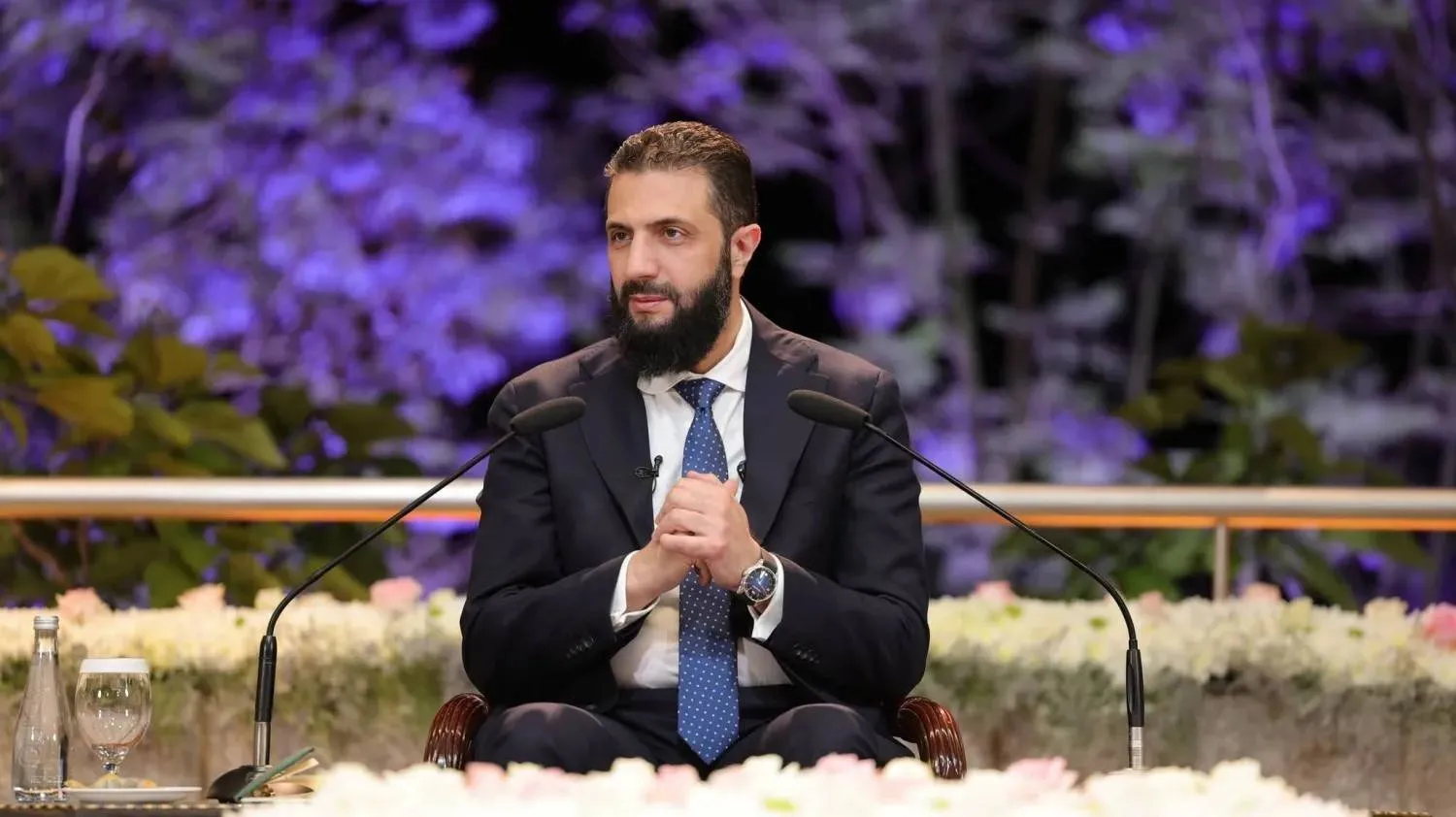
Syrian President Ahmed al-Sharaa (SANA)
TT

Sharaa: Syria Seeks to Stop Lebanon War, Not Join It

Syrian President Ahmed al-Sharaa (SANA)

Syrian President Ahmed al-Sharaa has moved to quell renewed speculation that Syria could become involved in the war in Lebanon, saying reports that Damascus intends to intervene militarily are “mere rumors.”

Sharaa said Syria’s position at this stage was based on “seeking to stop the war in Lebanon, not becoming involved in it.”

His remarks came during a meeting with a delegation from the Damascus countryside. He said demarcating the Syrian-Lebanese border was “not currently a priority” given more urgent files, foremost among them the case of about 1.4 million displaced Syrians in Lebanon and efforts to find a suitable mechanism to ensure their return.

US President Donald Trump had recently reaffirmed Washington’s goal of delivering a strong blow to Hezbollah. According to him, Israel has done what is necessary in the south, but there is still much left to eliminate Hezbollah. He then hinted at possibly having to ask Syria’s involvement.

Trump’s remarks prompted a wave of interpretations, amid reports of a possible visit by Sharaa to Washington. The Syrian presidency denied those reports.

Sources in Damascus told Asharq Al-Awsat that the US remarks were “a form of reshuffling the cards” and fell within “the framework of negotiating statements and sending messages to Iran.”

The sources said, “So far, there has been no official US request to Damascus related to any form of Syrian military intervention in Lebanon.” They said Tom Barrack, Trump’s envoy to Syria and Iraq and Washington’s ambassador in Ankara, had previously asked Damascus “to take a clear, explicit and serious position against Hezbollah.”

The sources said Damascus believes it already has such a position, reflected in border control, cutting smuggling routes and high-level coordination with the Lebanese government.

They added that “entering the quagmire of war and sending military forces unilaterally is completely ruled out,” and that it was “very, very early” to discuss the possibility of Syrian forces entering Lebanon in support of the Lebanese army.

Brigadier General Hassan Abdul Ghani, commander of the Border Guard Forces in the Syrian Arab Army, met last Thursday with a Lebanese army delegation headed by liaison official Brigadier General Michel Boutros, in the presence of several officers.

The talks focused on issues of mutual concern, mainly “enhancing cooperation and coordination between the two sides in border control and combating smuggling activities, in a way that contributes to strengthening border security between the two countries.”

At the same time, Syria’s Interior Ministry said “Lebanon is a sovereign state and not a backyard, as the former regime viewed it,” stressing that “coordination with Lebanon is the basic pillar for any assistance Syria provides to Lebanon.”

Sharaa had expressed Syria’s readiness to provide Lebanon with whatever support and assistance it can, within available capabilities and circumstances, when he received former Lebanese Prime Minister Najib Mikati in Damascus on the ninth of this month.

Media reports said Sharaa told Mikati that “Lebanon’s stability and security constitute a direct Syrian interest,” and that Damascus was keen to build the best relations with the Lebanese state on the basis of mutual respect, good neighborliness and non-interference in internal affairs.

The meeting between Sharaa and Mikati, which lasted for hours, discussed the state of bilateral relations between Damascus and Beirut and prospects for developing them in the next stage, along with several economic and investment files of mutual interest, in light of the transformations taking place in the region.


Eight Muslim Countries Condemn Israel’s Rejection of Trump’s Gaza Plan

 Displaced Palestinian children carry food portions in Deir al-Balah, central Gaza Strip, Friday, Aug 14, 2026. (AP)
Displaced Palestinian children carry food portions in Deir al-Balah, central Gaza Strip, Friday, Aug 14, 2026. (AP)
TT

Eight Muslim Countries Condemn Israel’s Rejection of Trump’s Gaza Plan

 Displaced Palestinian children carry food portions in Deir al-Balah, central Gaza Strip, Friday, Aug 14, 2026. (AP)
Displaced Palestinian children carry food portions in Deir al-Balah, central Gaza Strip, Friday, Aug 14, 2026. (AP)

The foreign ministers of eight Muslim countries on Sunday condemned Israel's rejection of a recently released roadmap for fully implementing US President Donald Trump's Gaza peace plan.

The foreign ministers of Saudi Arabia, Egypt, Jordan, Pakistan, Indonesia, Türkiye, Qatar, and the United Arab Emirates said the rejection amounts to a “direct repudiation” of the peace plan, “jeopardizes its implementation, and fundamentally undermines the collective efforts to achieve a just and lasting peace.”

“Such rejection confirms that Israel now bears responsibility for obstructing the efforts to bring peace in Gaza and the rest of the Occupied Palestinian Territory,” they said in statement.

The roadmap, which has been accepted by the Palestinian factions, is the conclusion of extensive efforts exerted by the mediators, namely Egypt, Qatar, Türkiye, the US, the High Representative of Gaza and the Board of Peace and constitutes a vital milestone for the decommissioning of weapons concurrently with the withdrawal of Israeli forces, the deployment of the International Stabilization Force, the transfer of the administrative authority to the National Committee for the Administration of Gaza and the reconstruction of Gaza as stipulated in the Comprehensive Plan, they went on to say.

Rejecting the roadmap is “an explicit refusal to proceed with the implementation of the peace plan, and directly threatens to derail the extensive efforts exerted by Trump to bring an end to the war in Gaza and establish the conditions for lasting peace.”

The ministers underscored “the importance of sustained and active US engagement to ensure and enforce Israel’s full compliance with the commitments and arrangements envisaged under the peace plan and its roadmap, and to prevent further obstruction of their implementation.”

“Israel bears direct and full responsibility for any consequences resulting from its continued rejection, obstruction, delay or non-compliance, including any resulting deterioration of the situation on the ground and disruption of ending the war in Gaza,” they added.

They underlined the urgent need for the full and immediate implementation of the peace plan in order to address the grave humanitarian situation, ensure security and stability for all in Gaza, and pave the way for reconstruction and recovery and advancing a just and lasting peace grounded in the Palestinian right to self-determination and statehood in accordance with international law, paving the way for security and stability for all countries and peoples of the region.

They categorically rejected any attempt to deny or foreclose Palestinian statehood including through unilateral actions.

“A just, lasting and comprehensive peace only will be achieved by the implementation of two-state solution, by the realization of an independent and sovereign Palestinian State based on the 1967 borders, with East Jerusalem as its capital in accordance with international law and relevant United Nations resolutions,” they added.

“Any attempt to deny or foreclose Palestinian statehood therefore directly undermines the prospects for peace, security and stability throughout the region,” they warned.

The ministers underscored the importance of the continued role of the Board of Peace and call all parties to support its efforts for the implementation of the roadmap and advancing the second phase of Trump’s peace plan.

The ministers called on the Board of Peace, with the active support and engagement of the US, to take immediate and concrete measures within its mandate to uphold the integrity of the peace plan and prevent any party from obstructing its implementation.


Trump’s Envoys Meet Mediators, Israel Strikes Gaza

15 August 2026, Palestinian Territories, Gaza: Tents sheltering displaced Palestinians crowd the beach, as the coastline has become a refuge for thousands displaced from different parts of the Gaza Strip by the war. (dpa)
TT

Trump’s Envoys Meet Mediators, Israel Strikes Gaza

15 August 2026, Palestinian Territories, Gaza: Tents sheltering displaced Palestinians crowd the beach, as the coastline has become a refuge for thousands displaced from different parts of the Gaza Strip by the war. (dpa)

Donald Trump's envoys met with Egyptian, Qatari and Turkish mediators in Cairo on Sunday, a diplomatic source said, in a bid to advance the US president's Gaza peace plan, even as Israel pressed on with airstrikes in the enclave.

Hamas officials were present at some of the meetings between mediators and with Trump's envoy and son-in-law, Jared Kushner, and Nickolay Mladenov, Trump's Board of Peace envoy for Gaza, the diplomat said.

A senior Israeli official said Kushner and Mladenov were scheduled to meet on Monday with Israeli Prime Minister Benjamin Netanyahu, who on August 9 said ‌Trump's latest roadmap ‌for Gaza peace was “unacceptable”.

GAZA MEDICS SAY STRIKES INJURED SEVERAL PEOPLE

The official ‌said ⁠that Israel was ⁠concerned about Washington's demand to end targeted assassinations of Hamas fighters in Gaza as the group rebuilds its forces.

Trump's peace plan calls for the immediate cessation of military operations in Gaza. It foresees Hamas disarming as Israeli troops withdraw from the enclave and Gaza is rebuilt under a new civilian Palestinian administration.

After scaling back its attacks in the enclave earlier this month, Israel's airstrikes have resumed in the past few days.

The Israeli military said on Sunday ⁠that its aircraft struck two Islamic Jihad and Hamas fighters in Khan ‌Younis and Nuseirat. At least five Palestinians were ‌injured in the strike which hit a tent encampment, medics in the enclave said.

One of the ‌injured in the strike on Khan Younis in southern Gaza died from their wounds, ‌medics at Nasser hospital said later.

A separate airstrike, which the Israeli military said targeted another fighter, hit an apartment in the Nuseirat camp in central Gaza, wounding several people, medics said.

Earlier, Hamas leader Khalil Al-Hayya met with Egypt's intelligence chief Hassan Rashad in Cairo. Hamas spokesperson in Gaza, Hazem Qassem, ‌said Al-Hayya would brief mediators on what he said were Israel's ceasefire violations.

Kushner had earlier met with Egyptian President Abdel Fattah al-Sisi, ⁠Sisi's office said.

Trump ⁠announced last month that there had been a breakthrough in his plan to end the war, to which both Israel and Hamas had agreed.

Hamas said it had agreed to the plan to avoid a resumption of the war, but added that implementation of the deal would depend on Israel first meeting its own commitments, including withdrawing its forces and halting attacks.

An October ceasefire halted major fighting in a devastating two-year war in Gaza that was sparked by Hamas' October 7, 2023, attack on Israel, but it failed to end Israeli attacks entirely.

Israeli fire has killed more than 1,250 Palestinians in Gaza, most of them civilians, since October. It is unclear how many of those killed were gunmen, as Hamas does not usually disclose information about dead fighters.

Four Israeli soldiers were killed by fighters in Gaza over the same period, according to Israeli figures.


Yemeni Army Says it Carried out 181 Operations against Houthis in 24 Hours

Military operations in the Taiz region. (Saba)
TT

Yemeni Army Says it Carried out 181 Operations against Houthis in 24 Hours

Military operations in the Taiz region. (Saba)

The Yemeni military announced Sunday that it carried out 181 military operations over the past 24 hours, targeting Houthi militia positions across various fronts.

The military confirmed that the strikes killed and injured dozens of Houthi fighters, and destroyed weapons depots, equipment, and military vehicles.

Yemen's armed forces spokesperson Colonel Majed Al-Nazili said the operations were executed using drones, artillery, and rocket launchers. He added that the strikes targeted military positions, assets, and Houthi threats across several combat sectors.

In a statement, Al-Nazili said that the strikes destroyed dozens of pieces of equipment and vehicles, along with several weapons depots and military assets, noting that "direct hits were achieved on the designated targets."

The operations focused on Houthi positions in Taiz, Marib, Hodeidah, Dhale, Abyan, Shabwa, Lahj, Mokha, Hailan, Harib and other regions.

Government forces possess the "necessary capability and readiness to reach threat sources, neutralize them, and prevent them from continuing their hostile acts," said Al-Nazili.

He stressed that the forces executed their missions with "high efficiency and operational discipline," while adhering to the rules of engagement and the provisions of international humanitarian law, and taking the necessary precautions to protect civilians.

Al-Nazili said the operations were a response to "repeated Houthi terrorist attacks" targeting civilians, civilian locations, economic facilities, and ports, as well as units government forces.

The Houthi militia targeted residential neighborhoods in the city of Marib on Saturday evening with six ballistic missiles and four drones.

The attacks resulted in casualties and injuries, as well as material damage to several houses, vehicles, and civilian property.

Al-Nazili said the armed forces are at the "highest state of readiness" and capable of taking the initiative and imposing a new equation on the ground. He underscored their preparedness to execute the tasks assigned to them and to deal with various developments in line with the directives of the political and military leadership.
