


30 Million Sudanese Historical Documents at Risk of Deterioration

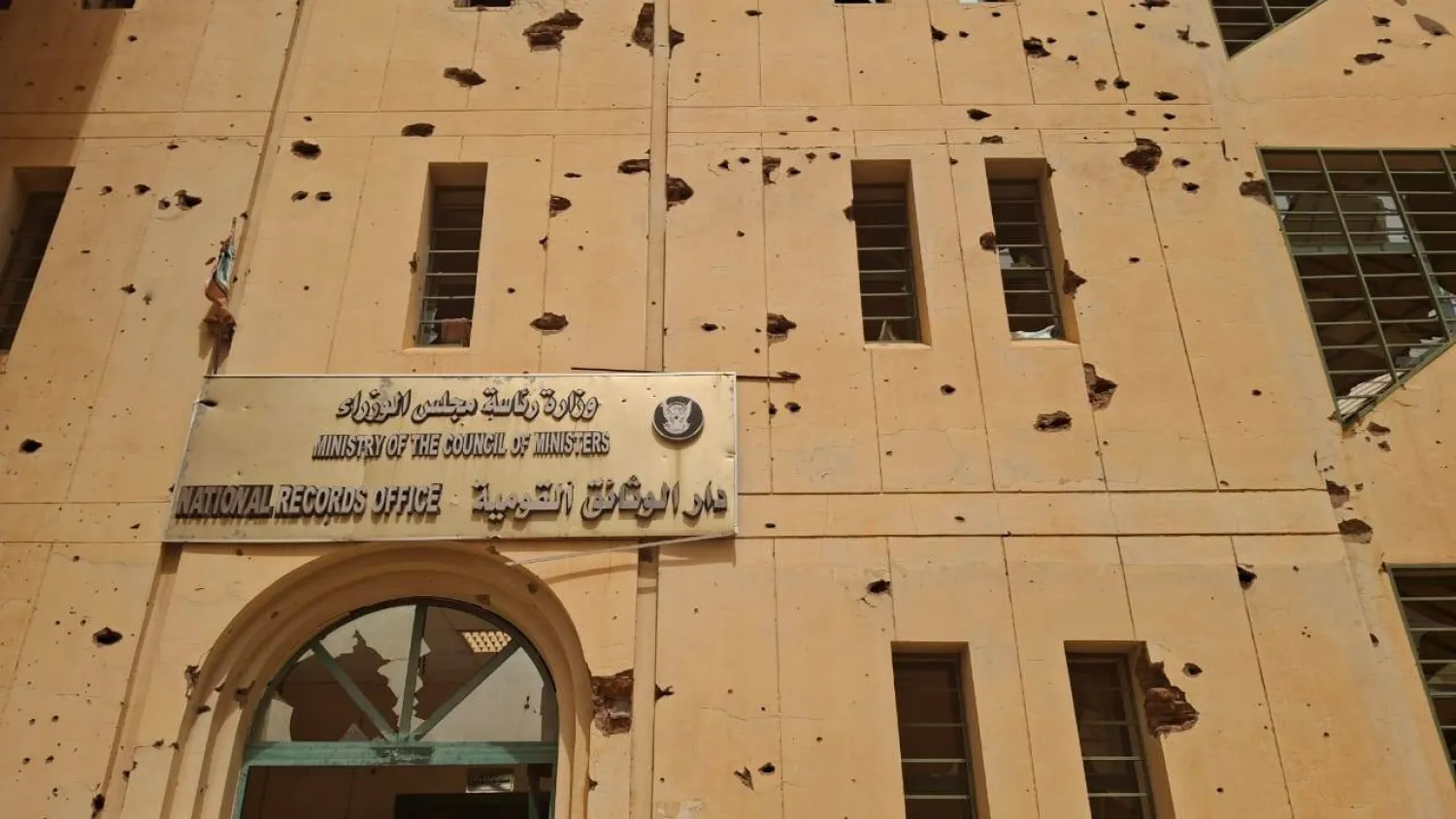
 Effects of the war on the National Records Office building. (Asharq Al-Awsat)
Effects of the war on the National Records Office building. (Asharq Al-Awsat)
TT

30 Million Sudanese Historical Documents at Risk of Deterioration

 Effects of the war on the National Records Office building. (Asharq Al-Awsat)
Effects of the war on the National Records Office building. (Asharq Al-Awsat)

Near the Sudanese army’s general command in Khartoum, millions of documents chronicling more than five centuries of Sudanese history sit inside the National Records Office, exposed to harsh wartime conditions.

Rubble and dust surround the building, which now faces the risk of further damage after sustaining extensive destruction.

The National Records Office fell under the control of the Rapid Support Forces in the first hours of the war in April 2023. Fierce fighting around the site left visible scars on the four-story building, including fire damage, destruction and structural harm that still reflect the intensity of the battles in the area.

The office holds more than 30 million historical documents collected since 1505, forming a comprehensive record of Sudan’s political, administrative and social history.

Although most of the documents survived fires that swept through large parts of the building, their continued storage in a damaged and unsuitable environment threatens their long-term survival.

Dr. Nagwa Mahmoud, director of the National Records Office, told Asharq Al-Awsat that most of its contents had survived the wartime fires. But she warned that keeping them in a damaged building could destroy old documents and manuscripts, especially those already weakened by age and fragility.

She said the office’s electronic archive had been lost, adding that the administration had prepared a digital transformation plan to begin once the documents are organized.

“We have contacted the Ministry of Communications and relevant government bodies to provide the necessary support to implement the plan, ensuring that this national heritage is protected from future risks,” she said.

After the Sudanese army regained control of Khartoum state in March 2025, the government issued a decision to relocate several state institutions from the capital's center. The decision included the National Records Office.

Mahmoud said the office had asked the Council of Ministers to exempt it from the relocation decision, stressing that the current building had been constructed in accordance with special standards for preserving historical documents and the national archive.

She said moving more than 30 million documents would pose a major logistical challenge and require an alternative site with the same technical specifications to protect them from damage and environmental factors.

Mohamed Youssef, director of the office’s General Documentation Department, voiced concern about the risks facing the documents as the rainy season approaches. He said shells that struck the building had left large openings in the ceilings, which could allow rainwater to leak into halls and storage rooms.

He said the office had memorandums of understanding with archival institutions in several Arab and African countries. He noted that important Sudanese documents were preserved at Egypt’s National Archives, along with other archives at the Arab League, particularly in documentation and archiving departments.

Documents on the floor

Inside the building, the traces of war are visible in every corner. Old manuscripts lie scattered across the floor, documenting different stages of Sudan’s history. Nearby are images of leaders who ruled the country since independence, along with documents from the Mahdist state and the Anglo-Egyptian period.

The building also contains a vast archive of Sudanese journalism spanning decades.

The ground floor, which once housed specialized laboratories and dozens of computers, was completely looted, according to officials at the office. Yet the last book digitized just days before the war began remains in place, capturing the contrast between what survived and what was lost from the country’s memory.

Despite the scale of the challenges facing the institution, officials are holding on to hopes of securing government approval to remain in the current headquarters, rehabilitate the building and restore its role in preserving Sudan’s national memory.

The roots of the National Records Office date back to 1916, when official documents were managed through the office of Sudan’s governor-general, with the participation of the financial, judicial and administrative secretaries, who preserved documents issued by state institutions at the time.

In 1965, the National Records Office Law granted the institution national status and independent legal personality. It gave the office responsibility for preserving and managing official documents produced by state institutions, as well as civil and private documents of historical value, making it the official guardian of Sudan’s national memory.



Arab League Chief: Israel’s Rejection of Peace Plan Shows Disregard for International Will

Arab League Secretary-General Nabil Fahmy attends a joint press conference on the day of the Arab Ministerial Committee meeting to discuss the situation in Jerusalem, in Amman, Jordan, August 5, 2026. (Reuters)
TT

Arab League Chief: Israel’s Rejection of Peace Plan Shows Disregard for International Will

Arab League Secretary-General Nabil Fahmy attends a joint press conference on the day of the Arab Ministerial Committee meeting to discuss the situation in Jerusalem, in Amman, Jordan, August 5, 2026. (Reuters)

Arab League Secretary-General Nabil Fahmy said statements by the Israeli prime minister rejecting the15-point roadmap to complete implementation of the comprehensive peace plan in Gaza reveal an explicit disregard for international will and the foundations of the peace process.

Fahmy said the Israeli prime minister's insistence that no Palestinian state be established in the Gaza Strip or the West Bank directly undermines prospects for a peaceful settlement and the establishment of a just and comprehensive peace, the Saudi Press Agency said on Monday.

In a statement, Fahmy stressed that continued Israeli violations of the ceasefire, including attacks targeting civilians and medical facilities in the Gaza Strip, constitute a blatant breach of existing obligations and relevant UN resolutions. He welcomed the clear position expressed by the foreign ministers of eight Arab and Islamic countries in their August 6 statement regarding these violations.

He renewed his call for the full and serious implementation of the comprehensive peace plan and for completing the process established by the Sharm El-Sheikh Peace Summit in October 2025.

Fahmy warned that continued Israeli attempts to impose new realities on the ground in the Gaza Strip and occupied West Bank seek to entrench the occupation and expand control over Palestinian territories. He said such attempts undermine the possibility of establishing a Palestinian state and blatantly contradict international law and relevant international legitimacy resolutions.

The secretary-general called on US President Donald Trump and the international community to assume their responsibilities in ensuring the full implementation of the comprehensive peace plan in accordance with UN Security Council Resolution 2803 of 2025. He also called for pressure on the Israeli government to end its violations and fulfill its obligations in a manner that preserves prospects for a just and lasting settlement.


Two Soldiers Killed in Houthi Drone Attack on Yemen’s Marib

The remains of a military projectile are embedded in the ground in the Port of Mokha the day after an attack by the Houthis on the city of Mokha, held by Yemen's legitimate Aden-based government on August 10, 2026. (AFP)
TT

Two Soldiers Killed in Houthi Drone Attack on Yemen’s Marib

The remains of a military projectile are embedded in the ground in the Port of Mokha the day after an attack by the Houthis on the city of Mokha, held by Yemen's legitimate Aden-based government on August 10, 2026. (AFP)

The Iran-backed Houthi group launched on Monday a drone attack on the Harib district in Yemen’s Marib governorate.

Two government soldiers were killed and seven others wounded in the attack, said field military sources. This was the second attack on Harib in days.

The Houthis continued their attacks on government forces, days after their escalation targeting al-Mokha city and its port on Yemen’s west coast, as well as Marib, Hadramawt, and Dhale.

Meanwhile, authorities in the southern and eastern governorates urged vigilance in anticipation of any attack.

Member of the Presidential Leadership Council Sultan Ali al-Aradah stressed the need for vigilance in the al-Mahra governorate and more coordination between military units and security agencies to confront threats.

He met with Chief of the General Staff of the Yemeni Armed Forces Lieutenant General Sagheer Aziz and other military officials, underlining the need to continue the crackdown on Houthi smuggling operations and thwarting their destabilizing activities.

He said al-Mahra was the gateway to eastern Yemen, calling for maintaining its stability, bolstering the presence of state institutions and protecting national interests.

In Hadramawt, PLC member and province governor Salem al-Khanbashi inspected the al-Riyan International Airport, Mukalla port and the al-Dhabba Oil Terminal to check the measures taken to ensure their security.

He chaired a meeting in Mukalla to tackle the level of readiness and emergency plans to confront any possible danger and protect lives.


Israel Declares Closed Military Zone in West Bank’s Taybeh

The site of a new Israeli settlement near the Palestinian Christian village of Taybeh, in the Israeli-occupied West Bank, August 10, 2026. (Reuters)
TT

Israel Declares Closed Military Zone in West Bank’s Taybeh

The site of a new Israeli settlement near the Palestinian Christian village of Taybeh, in the Israeli-occupied West Bank, August 10, 2026. (Reuters)

Israel's military said Monday it had declared a Christian-majority town in the occupied West Bank a closed military zone to keep out Israeli settlers and other non-residents.

The new tactic is designed to keep Israelis out of Taybeh, which is surrounded by settlements to its east and west and has been subject to arson, vandalism and settlers coming onto private and village property.

The order does not apply to Palestinian residents or journalists, who the army said would be allowed unless soldiers determine their presence poses a threat. The army said its troops would detain suspects and disperse gatherings to keep the peace.

The designation comes after months of the army and police struggling to maintain order throughout the territory, where at least 87 Palestinians have been killed by Israeli settlers or soldiers in 2026, according to the Ramallah-based Palestinian Health Ministry.

Parts of Taybeh lie in what's called “Area B,” where Israel maintains security control, but residents have complained that the army and police are slow to respond to attacks by extremist settlers.