
Iraqi Prime Minister Ali al-Zaidi is heading to the United States next month to try to save his oil-rich country from “bankruptcy,” while US envoy Tom Barrack is pressing Baghdad to prove it is “doing what is needed” to disarm armed factions before it receives long-awaited help from Washington or its regional allies, reliable sources and Iraqi officials said.
Barrack visited Baghdad on Monday and Tuesday.
The sources said al-Zaidi, backed by the Coordination Framework, an alliance of powerful Shiite parties, hopes US President Donald Trump will help when the two meet in Washington in mid-July, especially by securing loans from the United States that “Gulf states may contribute to,” according to two officials in the Shiite alliance.
Iraqi sources said dozens of Iraqi businessmen will accompany al-Zaidi to Washington, hoping to “revive the nearly empty state treasury.”
But those expectations hinge on more than disarming the factions. The sources said al-Zaidi must also dismantle their economic lifelines, keep their members out of government and cut the channels Tehran uses to reach Baghdad’s revenue-generating institutions, citing the substance of Barrack’s meetings in Baghdad and Erbil.
Since Iraq’s parliament approved Ali al-Zaidi’s government, the prime minister has tried to reposition himself between Iranian influence, which appears to be receding in Baghdad, and mounting US pressure to rein in armed factions and curb their power. Over time, his young government has shown a tactical tilt toward Washington.
‘A success story’
Barrack’s efforts in Baghdad now point to a quiet struggle between Iran and its allies, who are trying to preserve a grey zone without major concessions, and the Americans, who want to separate the Iraq file from negotiations over the nuclear issue and the Strait of Hormuz, in anticipation of gaps in a memorandum of understanding that provides for a 60-day truce before a final agreement.
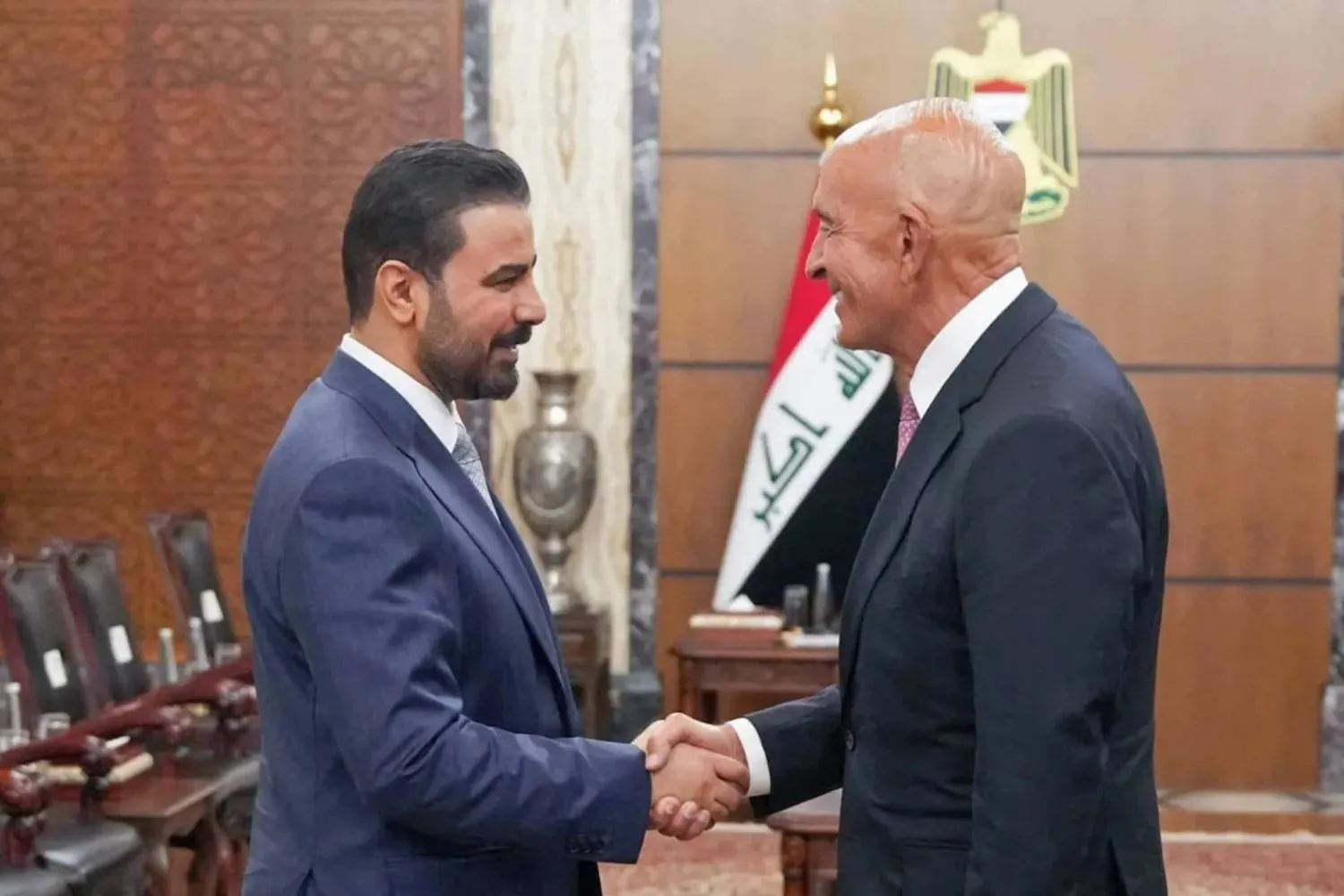
Barrack and al-Zaidi agreed on Tuesday on “the complete disarmament and dissolution of all armed groups and formations operating outside the authority of the state,” according to a joint Iraqi-US statement.
Reliable sources said US officials are trying to extract as many gains as possible in Baghdad at Iran’s expense, fearing Tehran could secure enough resources and time to rebuild its influence in the region.
The sources said, “The US president wants Iraq’s new government to become a ‘success story’.” But US intelligence circles focused on Iraq are “very cautious about reaching that assessment at the present time,” they added.
Barrack’s visit, his first since his mandate was renewed as US envoy to Baghdad and Damascus, came about two weeks after the Iraqi government launched what it called a “weapons control plan.”
It also came at the height of a financial crisis that an Iraqi official described to Asharq Al-Awsat as “suffocating.” In three months, and “in the best-case scenario,” the government could find itself unable to meet “domestic obligations,” the official said.
The financial crisis is believed to have turned Coordination Framework leaders into pragmatic politicians, pushing them, in record time, into a publicity campaign stressing their desire to bring weapons under state control.
Ammar al-Hakim, head of the Hikma Movement and one of the Coordination Framework’s leaders, said at a recent public seminar in Baghdad that the Shiite alliance would have moved ahead with the weapons-control plan even if the war with Iran had not occurred, describing it as an “internal” need.
Observers are skeptical of the weapons-control process, particularly given the absence of an Iranian reaction to a plan initiated by allied factions and later sponsored and organized by the government.
Since early June, official circles in Tehran have not commented on the integration of members of their Iraqi allies into government institutions, while insisting on including Hezbollah and its weapons in the negotiation items.
It was notable that Iran’s ambassador to Baghdad, Mohammad Kazem Al-e Sadeq, visited the prime minister about two hours after his meeting with US envoy Tom Barrack, who was then on his way to Erbil to meet Kurdish officials.
A ‘down payment’ on weapons control
Pragmatism hangs over Baghdad’s decision-making rooms.
A member of the Coordination Framework told Asharq Al-Awsat that “many inside the alliance have become more realistic in responding to the weapons control plan.”
“Some see it as a ‘down payment’ to win the confidence of regional and international players who were close to deciding to isolate Iraq,” he said.
The member, who asked not to be named, said: “Some alliance leaders shared concerns during recent meetings about a new security and political approach being adopted in the Arab region that could classify Iraq, at best, as an unfriendly state.”
But an Iraqi official said the plan, which has so far covered three armed factions, is meant to repair damage to Iraq’s relationship with Arab and Gulf states, despite doubts over how it will be carried out.
Asharq Al-Awsat learned that a US official told two Coordination Framework leaders in early June that Washington believes the announced plan needs more clarity, given the absence of transparent mechanisms to verify that armed factions will not be able to access their weapons.
Still, reliable sources said the US official described the current process as a “promising step” that was out of reach only years ago. Washington, the official said, understands that Baghdad cannot take revolutionary or shocking steps toward disarmament. But the US assessment of the process will depend on whether concerns are removed that it is “merely a cosmetic exercise.”
So far, Saraya al-Salam, Asaib Ahl al-Haq and Kataib al-Imam Ali have joined the plan by declaring their separation from the Popular Mobilization Forces. Despite the absence of a technical mechanism to handle the groups’ weapons, figures close to the government say Prime Minister Ali al-Zaidi has become “responsible for the movements of the armed members and their weapons,” and that “the remaining details are not essential.”
‘More forceful’
Barrack arrived in Baghdad to push al-Zaidi forward. Two Iraqi officials told Asharq Al-Awsat that Washington wants the government in Baghdad to be “more forceful and clear in disarming the factions.”
A second official, who asked not to be named because he was not authorized to speak publicly, said Barrack’s meetings with officials in Baghdad showed that the United States “encourages serious steps to dissolve economic offices and prevent Iran from benefiting from Iraqi resources.”
The term “economic offices” has been common for years in Iraqi circles. It refers to financial and commercial structures that include official employees and manage the interests of armed factions while increasing their resources.
Barrack’s mission in Baghdad looks like a “minesweeper” operation before US companies enter Iraq to invest in the oil, telecommunications, and transport sectors, which over the past 10 years have become fertile ground for Iran’s Revolutionary Guards, according to a former government official.
Asharq Al-Awsat understood from Western diplomats and an Iraqi official that Barrack is acting in Baghdad as “the man who can qualify Ali al-Zaidi as a successful and acceptable partner in the region,” but “not while he is lenient with the power and influence of the factions.”
One diplomat said, “The US president supports Barrack’s approach in Baghdad, but wants quick results that take into account the timing of negotiations with the Iranians.”
An Iraqi official said, “The atmosphere inside the Coordination Framework is receiving multiple signals that Tom Barrack is trying to engineer an approach that brings Baghdad together with Damascus rather than Tehran, and many Shiite forces are uncomfortable with this path.”
Bankruptcy and anger
Whatever Barrack’s approach may be, Washington wants to accelerate change in Baghdad because Iraq needs money.
Two sources said leaders of the Shiite alliance met in early June in the presence of the prime minister and voiced fears of “bankruptcy and the possibility of public anger exploding.”
One Coordination Framework leader told the prime minister: “Based on the data in your hands, we may find ourselves after three months unable to pay salaries, or to meet other domestic obligations.”
“In this case, there are no guarantees that we will be able to confront public anger if we do not find a solution,” he said.
Iraqi journalists said Prime Minister Ali al-Zaidi told them during an open meeting with the press last week that Iraq’s treasury had received 1 trillion dinars, about $1 billion, while he needed to secure about 10 trillion dinars to pay public sector salaries, along with “other expenses.”
According to unofficial estimates, Iraq has lost about $250 million a day due to the closure of the Strait of Hormuz, which has halted more than 90% of oil exports through southern ports.
The two sources told Asharq Al-Awsat that “most alliance leaders approved a plan presented by the prime minister that includes a package of political, security and economic reforms to address the crisis.”
But one source said, “The Iraqi government is seeking financial loans from Western and Gulf donors, even though the repercussions of the war with Iran are casting a heavy shadow over relations between Baghdad and those who may wish to help it.”
A ‘reward’ for weapons control
Another dilemma is emerging, one that could weaken the political alliance giving al-Zaidi his strength. The alliance now faces layered pressure as factions join the weapons-control initiative in hopes of securing government posts.
These factions see the new posts as a “deserved reward,” members of the groups say. But they also believe the posts do not match the heavy price they paid by giving up their weapons before their own supporters.
The groups are expected to react in a way that would be “uncomfortable for al-Zaidi” if the United States insists on blocking people listed as terrorists from joining the new government, according to the members.
Sources said the Coordination Framework told al-Zaidi he must fill vacant ministerial portfolios before traveling to Washington and meeting Trump. But a leader in the Shiite alliance quoted Barrack’s recent meetings as saying that “completing the government with individuals belonging to the factions will not make al-Zaidi feel comfortable when he sits in the chair next to the president at the White House.”
Al-Zaidi’s media office did not respond to requests for comment on whether the issue of armed factions’ weapons, or the participation of their representatives in the government, would be among the topics discussed at the White House next month.
Still, Iraq’s prime minister will try to persuade the US president to mobilize a donor coalition that includes Gulf states to secure loans, through contributions in exchange for investments Baghdad is working to make available to regional and US companies, Iraqi officials said.