


Yemeni Sources: Prosecutor Orders Freeze of Dissolved STC Funds

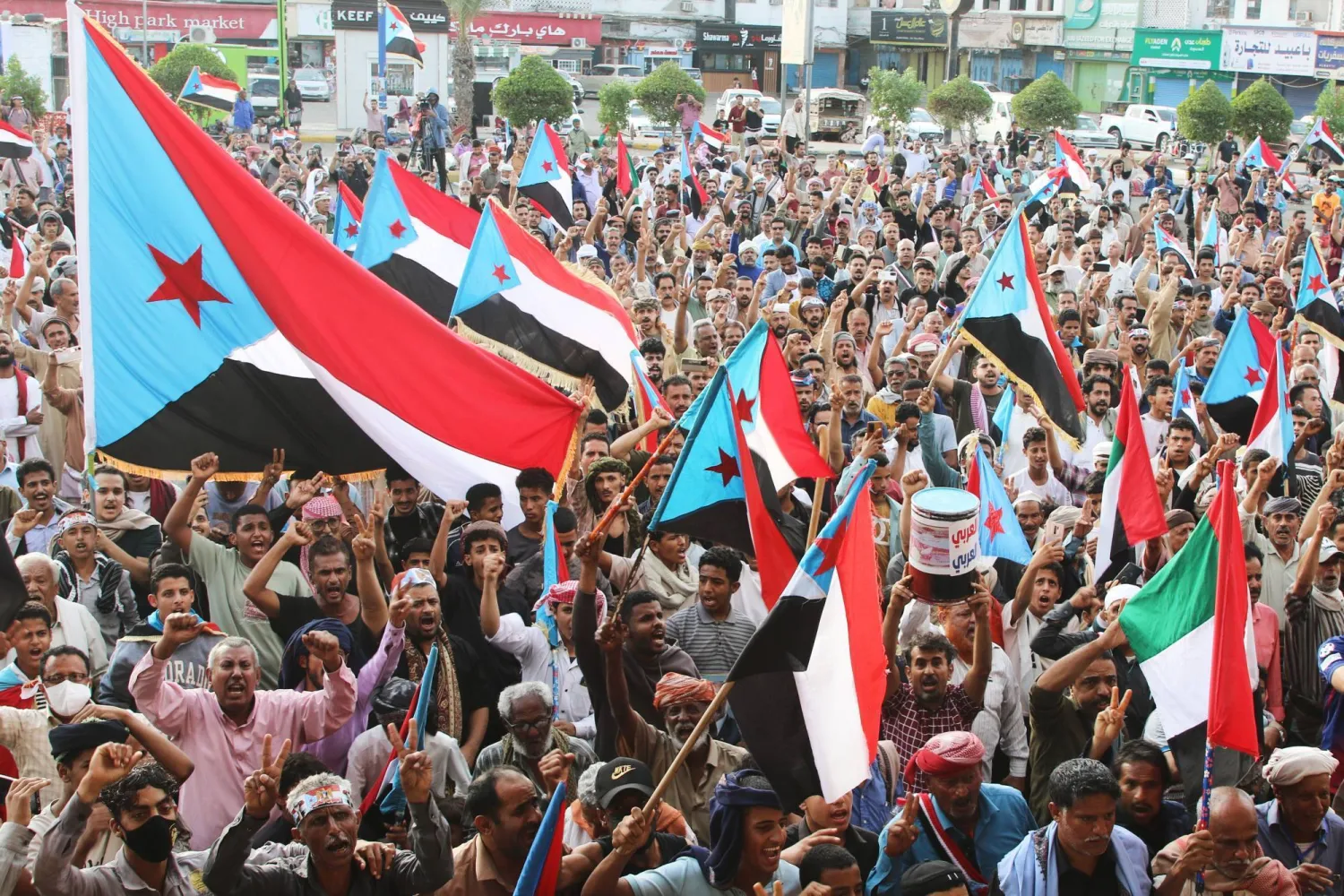
Supporters of the dissolved Southern Transitional Council at a previous protest in Aden (AP) 
TT

Yemeni Sources: Prosecutor Orders Freeze of Dissolved STC Funds

Supporters of the dissolved Southern Transitional Council at a previous protest in Aden (AP) 

The Yemeni government has escalated its measures against the dissolved Southern Transitional Council (STC), with the public prosecutor ordering a precautionary freeze on the group’s assets and bank accounts while the government simultaneously presses the UN Security Council to impose sanctions on its leader, Aidarous al-Zubaidi.

According to informed sources cited by the Aden al-Ghad newspaper, Attorney General Judge Qaher Mustafa issued an order freezing all assets and bank accounts belonging to the dissolved STC held by banks, financial institutions, exchange companies and money-transfer businesses.

The move is part of efforts aimed at protecting public funds, combating corruption and money laundering, and restoring state control over financial and sovereign resources.

The order prohibits any disposal of the frozen funds, including withdrawals, transfers, assignments or other legal and financial transactions, pending the completion of investigations and further directives from the Public Prosecution or competent judicial authorities.

It also requires the Central Bank of Yemen, commercial and Islamic banks, financial institutions and exchange companies to implement the measures immediately and report any accounts, balances or assets linked to the entity under investigation.

The Public Prosecution said the action was based on what it described as sufficient preliminary indicators suggesting that the funds may be connected to matters currently under investigation. It stressed that the asset freeze is a temporary legal measure intended to preserve disputed funds until judicial proceedings are completed.

Earlier this year, Yemen’s Presidential Leadership Council removed al-Zubaidi from its membership and referred him to the attorney general on charges including “high treason aimed at undermining the independence of the republic” under Article 125 of the Crimes and Penalties Law, and harming the republic’s military, political and economic standing under Article 128.

The referral also accused him of forming an armed group, involvement in the killing of military officers and soldiers, exploiting and damaging the Southern cause through serious abuses against civilians and attacks on military installations, and engaging in sustained armed confrontations against government forces.

According to the decision, the charges further include violating the constitution and constitutional authorities under Articles 131 and 132 of the Crimes and Penalties Law, breaching national laws and infringing on the country’s sovereignty and independence.

The judicial action coincided with a diplomatic campaign by the Yemeni government, which urged the UN Security Council to impose sanctions on al-Zubaidi and add him to the UN sanctions list.

Yemen called on the council to regularly update sanctions lists to include individuals and entities accused of undermining state institutions or attempting to impose political or military realities by force outside constitutional and legal frameworks.

The request was made during a Security Council session on developments in Yemen. Yemen’s permanent representative said the government was prepared to cooperate fully with the United Nations and the sanctions committee and provide any additional information or documentation needed to support international accountability efforts.

The government accuses al-Zubaidi of leading unilateral political and military actions that weakened state institutions, obstructed efforts to unify security and military command structures, threatened domestic stability and hindered political settlement efforts.


Syrian Authorities Say Killed Assad-Era Officer After Clash

A member of Syria's internal security forces in Tartus city. (SANA)
TT

Syrian Authorities Say Killed Assad-Era Officer After Clash

A member of Syria's internal security forces in Tartus city. (SANA)

Syrian security forces said on Sunday that they killed an army commander who served under ousted ruler Bashar al-Assad, after he opened fire on them as they tried to arrest him.

In a statement, the forces accused Firas Abdul Karim Hammoud of having taken part in anti-government insurrections that killed security personnel.

Since Assad's fall in December 2024, Syria's new authorities have arrested dozens of security officials from his rule, and trials began in April.

The security forces said they "neutralized Firas Abdul Karim Hammoud... following an armed clash and a raid on his hideout in the town of Safita" in Tartus province in the coastal Alawite heartland.

Hammoud had previously "opened fire on security personnel during an attempt to arrest him", they added.

"During the recent operation, he again opened fire and initiated a firefight with the security forces... necessitating their response."

They said Hammoud served as a commander of the special forces in the so-called "25th Division" under Assad's rule.

They accused him of working under Assad-era general Ghiath Dalla in leading pro-Assad groups on the coast after the former president's fall.

They added that he was involved in "armed insurrection operations" against state institutions that killed security personnel.

Dalla, a former officer in the much-feared Fourth Brigade, had announced on social media last year the formation of a "military council for the liberation of Syria".

The announcement came shortly before deadly violence targeting the Alawite minority, to which Assad's family belongs, erupted on the Syrian coast in March 2025.

Authorities accused armed Assad supporters of sparking the violence by attacking security forces in an ambush.


Iraq Sentences US-Sanctioned Oil Official to Prison

The sun sets behind apartment buildings in Baghdad, Iraq, Friday, Aug. 28, 2026. (AP)
TT

Iraq Sentences US-Sanctioned Oil Official to Prison

The sun sets behind apartment buildings in Baghdad, Iraq, Friday, Aug. 28, 2026. (AP)

Iraq sentenced a US-sanctioned oil official to seven years in prison after he was arrested as part of a government-led anti-corruption campaign, the country's anti-graft body said on Sunday.

Deputy oil minister for distribution affairs Ali al-Bahadli is among dozens of officials who were detained in June during anti-graft raids that took place in several areas, mostly in Baghdad's fortified Green Zone.

The Commission of Integrity said in a statement that an anti-corruption court sentenced Bahadli to seven years in prison for "illicit gains".

The ruling requires Bahadli to return to the state an amount equivalent to more than $20 million in ill-gotten gains, in addition to paying a fine of the same amount.

The United States imposed sanctions on Bahadli in May, accusing him of fraudulently mixing Iraqi and Iranian oil as part of a scheme to help Iran avoid sanctions.

At the time, Iraq's oil ministry denied the accusations against Bahadli, who was then arrested during the anti-graft raids.

Iraqi authorities said that the raids were part of new Prime Minister Ali al-Zaidi's campaign to fight the corruption that has plagued Iraq for decades.

But several Iraqi officials told AFP that the raids were also part of al-Zaidi's campaign against funding for pro-Iran armed groups and the smuggling of Iranian oil.

Iraq has been under mounting pressure from the United States to curb Tehran's influence and rein in Iran-backed armed factions, which Washington designates as terrorist groups.

Al-Zaidi, who took office this year with the blessing of the United States, has pledged to ensure the armed factions that emerged after the US-led invasion hand over their weapons to the state.

In Iraq, corruption is especially rampant across public institutions, but convictions typically target mid-level officials or minor players and rarely those at the top of the power hierarchy.


US News Agency Says Crew Attacked by Israeli Settlers in West Bank

 Israeli settlers look out through a metal fence, as an Israeli flag flutters nearby, on the day of their weekly tour in Hebron, in the Israeli-occupied West Bank, August 29, 2026. (Reuters)
Israeli settlers look out through a metal fence, as an Israeli flag flutters nearby, on the day of their weekly tour in Hebron, in the Israeli-occupied West Bank, August 29, 2026. (Reuters)
TT

US News Agency Says Crew Attacked by Israeli Settlers in West Bank

 Israeli settlers look out through a metal fence, as an Israeli flag flutters nearby, on the day of their weekly tour in Hebron, in the Israeli-occupied West Bank, August 29, 2026. (Reuters)
Israeli settlers look out through a metal fence, as an Israeli flag flutters nearby, on the day of their weekly tour in Hebron, in the Israeli-occupied West Bank, August 29, 2026. (Reuters)

Israeli settlers attacked an NBC crew in the central West Bank Saturday, as they were interviewing a Palestinian woman who said she’d been driven out of her house by settlers, the network said.

NBC’s American correspondent Matt Bradley, two other crew members and the woman they were interviewing were all treated for injuries sustained during the attack, NBC said. There were no further details on their injuries.

The assault was caught on video and shared by NBC, with footage showing masked settlers approaching the crew with sticks and beating the crew’s vehicles.

Israel’s military said it was “aware of reports of Palestinian injuries, including a Palestinian woman who sustained non-life-threatening injuries and was evacuated by the Red Crescent for medical treatment.” It did not comment on the attack on the NBC crew.

It was the latest in a growing wave of violence by West Bank settlers. Prime Minister Benjamin Netanyahu issued a rare condemnation of the violence on Saturday. The Israeli leader has come under heavy US criticism for the settler attacks.

Settlers seized British activist and held him locked in shed

Israeli settlers seized a British activist from a Palestinian village in the West Bank and locked him in a shed before turning him over to police, his lawyer said Sunday.

The lawyer, Inbar Shaked Vardi, said settlers held her client, Finn Joughin, for half an hour Saturday before turning him over to Israeli police. Joughin was set to appear before a Jerusalem court later Sunday, she said.

Video showed two settlers, one armed, restraining Joughin and marching him away from the village.

It was not immediately clear what led to his capture. Settlers say he assaulted a child, accusations Vardi vehemently denied.

Settlers point to a video where the activist uses his body in an apparent attempt to block a settler boy from passing through a fence. Vardi said the video shows he was trying to protect the village.

Police said they were investigating and holding Joughin in custody on suspicion of committing an indecent act against a minor.
