



‘Ruqaya Broke Iraqis’ Hearts’: Halabja Mourns Karbala Girl

Iraqi girl Ruqaya, who died at a tourist resort in northern Iraq (photo circulated on social media)
TT

‘Ruqaya Broke Iraqis’ Hearts’: Halabja Mourns Karbala Girl

Iraqi girl Ruqaya, who died at a tourist resort in northern Iraq (photo circulated on social media)

After nine days of searching and waiting, the body of 11-year-old Iraqi girl Ruqaya was found in a valley in the Ahmad Awa tourist area of northern Halabja province, following a drowning incident that drew widespread sympathy across Iraq and prompted officials to call for tighter safety measures at tourist sites near waterways.

Ruqaya was buried in her hometown of Karbala on Friday after a farewell ceremony in Halabja province, where hundreds of residents lined the roads to bid her farewell, carrying flowers, according to circulated video footage. One mourner said the child’s farewell had broken their hearts.

Halabja Civil Defense Director Abidin Abdulrahman said rescue teams, divers and volunteers found the girl’s body on Wednesday after intensive and continuous search operations involving specialized teams and dozens of volunteers from different areas.

The incident dates back to June 9, when Ruqaya, a resident of Karbala, was on a family vacation at the Ahmad Awa resort, one of Halabja province’s most prominent natural sites. While she was near the Zalm spring, she fell into the water before strong currents swept her away and she disappeared from view.

Local authorities launched wide search operations immediately after the incident, scouring the valley and surrounding areas with the participation of civil defense teams, specialized divers and volunteers from Halabja, Hawraman, Shahrizor and other areas, in an effort to find the child.

Local officials said the mountainous nature of the area, the large number of rocks and the force of the water flow made the search difficult. The operations continued for more than a week amid wide public and media attention.

The discovery of the body triggered grief in Iraq, where the girl’s story had become a matter of public concern in recent days and was widely followed by media outlets and social media platforms.

After the body was found, the funeral convoy set off from Halabja province toward Karbala, with broad official and public participation. Hundreds of citizens lined the roads in several cities and towns in Sulaymaniyah province to bid farewell to the child and show solidarity with her family.

Although initial arrangements called for the body to be taken directly to Karbala on Thursday morning, residents of Khormal district insisted that the convoy pass through their town so they could take a final look at the child whose search they had followed over the previous days.

Video footage showed large numbers of residents gathering in Khormal and Sayid Sadiq, carrying flowers and standing on both sides of the road as the funeral convoy passed, reflecting the scale of public reaction to the incident.

A group of ambulance volunteers in Sulaymaniyah took charge of transporting the body to Karbala, while a number of volunteers accompanied the body on the long journey to support the family and take part in the mourning ceremonies.

The body arrived in Karbala on Thursday, accompanied by an official delegation from Halabja province, including Halabja district commissioner Simko Salar and Civil Defense Director Abidin Abdulrahman.

The convoy stopped at the forensic medicine department to complete legal procedures for issuing the death certificate before the body was taken to Jannat Karbala cemetery.

Local officials, social figures, members of the child’s family and hundreds of citizens took part in the funeral, which ended with her burial at the cemetery south of the city.

In the first official response after the body was found, Kurdistan Regional Government Prime Minister Masrour Barzani offered condolences to the girl’s family and thanked the people of Halabja province and the Hawraman area, as well as the volunteer teams that took part in the search.

Barzani said in a statement that the incident required stricter safety measures and instructions at tourist sites, especially areas located near rivers, dams and water sources, in order to reduce the risk of similar incidents recurring.
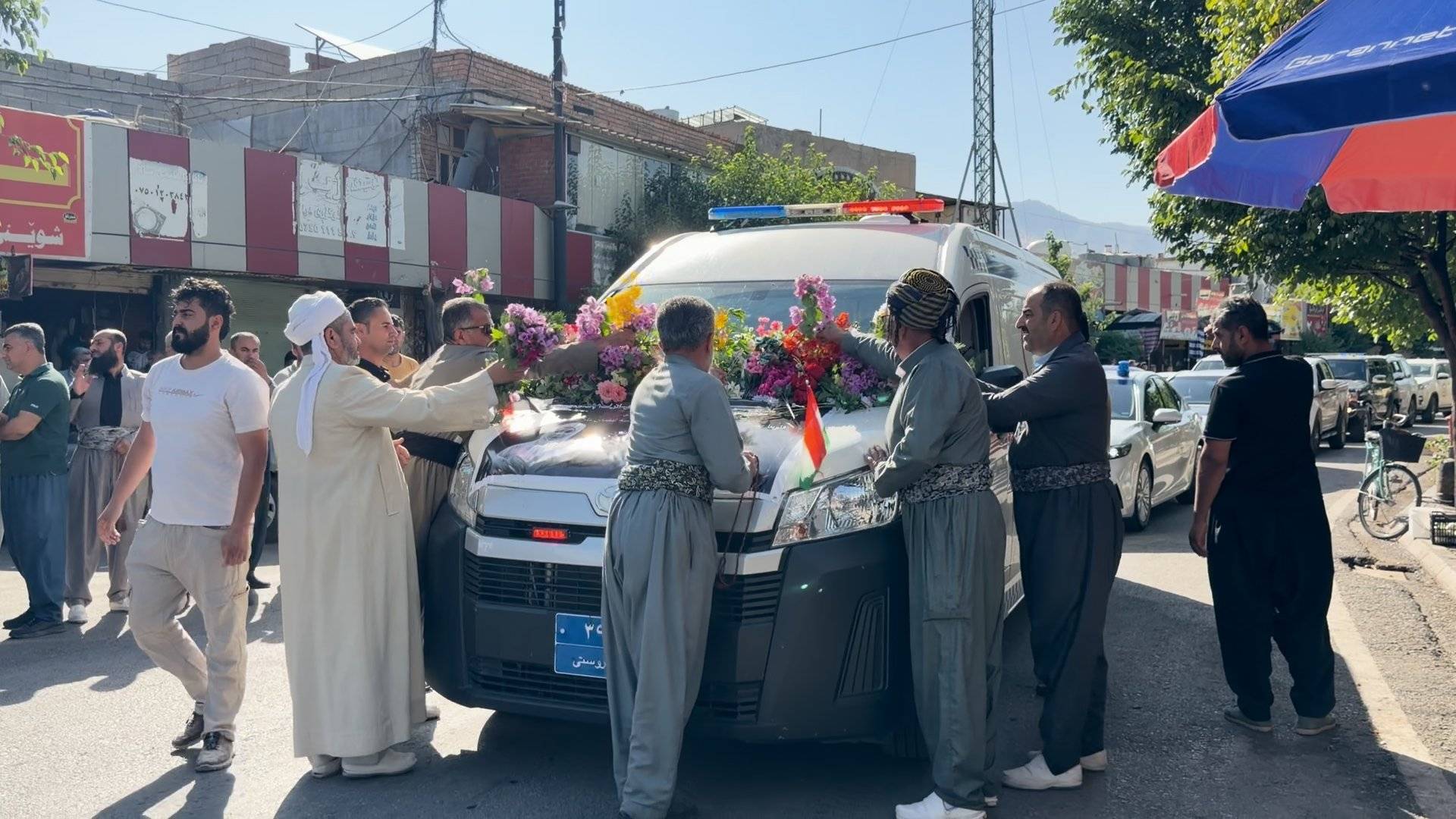
Residents of Halabja place flowers on the ambulance carrying Ruqaya's body (X)

Safety measures

Karbala Governor Nassif Jassim al-Khattabi said he planned to visit Halabja province in the coming days to thank its officials and residents for what he described as the humanitarian position they had shown toward the child’s family.

Khattabi said in a statement that the solidarity that accompanied the search operations, the discovery of the body and the funeral procession “embodies the highest meanings of brotherhood and national unity,” adding that such positions would remain deeply appreciated by the people of Karbala province.

Ahmad Awa is one of the most prominent tourist destinations in the Kurdistan Region, attracting thousands of visitors each year from various Iraqi provinces, especially during spring and summer, because of its mountainous landscape and water springs.

Ruqaya’s death has revived public and official calls for a review of safety measures at natural and tourist sites that draw large crowds during holiday seasons, especially in areas with rough terrain or fast-moving waterways.



Türkiye: Egypt Defense, Security Ties Bolster Regional Stability

Turkish Defense Minister Yasar Guler receives his Egyptian counterpart, Ashraf Salem Zaher, on July 13. (Turkish Defense Ministry/X)
TT

Türkiye: Egypt Defense, Security Ties Bolster Regional Stability

Turkish Defense Minister Yasar Guler receives his Egyptian counterpart, Ashraf Salem Zaher, on July 13. (Turkish Defense Ministry/X)

Türkiye emphasized that strengthening defense and security cooperation with Egypt, based on mutual trust and shared interests, would help advance peace and reinforce regional stability and security.

The Turkish Defense Ministry said a letter of intent on defense cooperation, signed during Egyptian Minister of Defense and Military Production Ashraf Salem Zaher’s visit to Ankara on Monday, reflected both countries’ determination to place their defense and security partnership on an institutional footing.

Ministry spokesman Zeki Akturk said on Thursday the document also reflected a strong desire to deepen ties rooted in history, while opening new areas of cooperation that could support peace, stability and security across the region.

Türkiye and Egypt share a strong legacy shaped by deep historical and cultural ties, Akturk said, adding that recent high-level visits had given military cooperation fresh momentum.

Cooperation expands

Akturk said contacts between military delegations had expanded as the two sides sought to deepen defense and security dialogue.

He said concrete steps had also been taken in military training, joint operations and defense industries.

Zaher’s visit, his first since taking office in February, was the first by an Egyptian defense minister since President Abdel Fattah al-Sisi visited Türkiye on May 8, 2013, while serving as defense minister.

It followed a late-April 2024 visit to Ankara by former Egyptian Armed Forces Chief of Staff Osama Askar, the first senior Egyptian military official to travel to Türkiye after relations began a gradual return to normal following years of tension and stagnation since the fall of Muslim Brotherhood rule in Egypt in 2013.

Egypt’s current Armed Forces Chief of Staff, Ahmed Khalifa, made an official visit to Türkiye on May 8, 2025, when the two countries held their first high-level military dialogue.

They agreed to hold the dialogue annually at the level of the two chiefs of staff.

The talks focused on strengthening military cooperation, particularly in training and the exchange of expertise.

Egypt and Türkiye later signed a military cooperation agreement during Turkish President Tayyip Erdogan’s visit to Cairo on Feb. 4.

The visit also included the second meeting of the Strategic Cooperation Council, following its first session in Ankara during Sisi’s visit on Sept. 4, 2024.

Akturk also cited exercises held in June, first in Egypt and then in Türkiye, with participation by the air force.

He said they had significantly improved interoperability between the two armed forces, strengthened their joint operational capabilities, and expanded the exchange of expertise.

Talks in Ankara on Monday between Turkish Defense Minister Yasar Guler and Zaher covered bilateral defense and security issues, as well as ways to deepen cooperation, Akturk said.

The two sides signed the letter of intent at the end of the meeting.

Defense industry push

Zaher and his delegation also met Haluk Gorgun, head of Türkiye’s Defense Industries Agency, to discuss defense industry cooperation and the development of joint capabilities.

A letter of intent was signed during the meeting.

Zaher also visited Turkish defense electronics company Aselsan, where Chief Executive Ahmet Akyol received him.

The two sides discussed the company’s office in Egypt and new opportunities for defense industry cooperation.

The Egyptian delegation also visited the Ozdemir Bayraktar National Technology Center, where it was briefed on Turkish drone manufacturing technology during a meeting with Selcuk Bayraktar, chairman of Baykar, maker of the Bayraktar drone.

Turkish sources told some media outlets that Ankara had presented plans for joint production and technology transfers covering unmanned ground and aerial systems, armored combat vehicles, warships, naval platforms, electronic warfare technology and ammunition of various calibers.

The sources said the most significant step in the aviation talks was Egypt’s agreement to join Türkiye’s fifth-generation KAAN fighter jet production program.

They also said the two countries had made notable progress on plans for a local production line in Egypt for Bayraktar TB2 drones.

The project would aim to meet the needs of Egypt’s armed forces and turn the country into a regional production hub serving global export markets, particularly in Africa, the sources said.

Strategic ties

Egypt’s ambassador to Ankara, Wael Badawi, said the strategic partnership between Egypt and Türkiye rested on longstanding historical, cultural, commercial and humanitarian ties.

Speaking at a ceremony in Ankara on Tuesday marking Egypt’s national day and the anniversary of the July 23, 1952 revolution, Badawi said cooperation spanned several strategic sectors.

These included defense and military industries, construction, tourism, healthcare, transport, energy, mining, and air and maritime links.

Badawi said Egypt and Türkiye would continue to coordinate on regional and international issues, with the Palestinian issue leading the way, while supporting efforts to end the war in Iran and strengthen regional stability.

The deepening military relationship has stirred concern among some parties, particularly Israel and Greece.

Greek newspaper Kathimerini reflected those concerns, saying the recent growth in Turkish-Egyptian defense ties was causing unease in Greece.

In a report titled “Türkiye and Egypt Draw Closer on Defense,” the newspaper examined Zaher’s talks with the head of Türkiye’s Defense Industries Agency and the letter of intent signed at the close of the meeting.

It said the document could lay the groundwork for broader defense industry cooperation between the two countries.

The report also highlighted Zaher’s meetings in Türkiye, noting that Egypt was seeking to become a center for drone production, a leading export of Türkiye’s defense industry.

Kathimerini said the rapprochement did not currently pose a direct threat to Greek interests, but added to concerns at a time of shifting geopolitical balances across the region.


Iraq Investigates Foiled Attempt to Smuggle Missiles, Drones into Syria

A member of Syria’s security forces holds parts of a drone smuggled from Iraq and seized at the al-Tanf border crossing. (Syrian Interior Ministry)
TT

Iraq Investigates Foiled Attempt to Smuggle Missiles, Drones into Syria

A member of Syria’s security forces holds parts of a drone smuggled from Iraq and seized at the al-Tanf border crossing. (Syrian Interior Ministry)

Iraq's Joint Operations Command announced on Thursday that it had formed an investigative committee to examine the circumstances surrounding the foiled attempt to smuggle a shipment of weapons and missiles across the Iraqi border into Syria.

Sources familiar with the matter said the Iraqi government intends to hold officials at a border crossing with Syria accountable if they are found to have facilitated the shipment's passage into Syria.

The developments come amid growing scrutiny of cross-border overland freight traffic between the two countries, including routes used to transport goods and fuel, as well as heightened monitoring of weapons supply routes to Lebanon's Hezbollah.

The Joint Operations Command said the committee was formed under an urgent directive from armed forces commander-in-chief Ali al-Zaidi and included security agencies and specialists to investigate the operation.

Baghdad would coordinate with Damascus to establish what happened and hold accountable any party found to have been negligent, it said.

The measures were aimed at strengthening security along the shared border and preventing Iraqi territory from being used for activities that threaten national security or regional stability, the statement added.

The Iraqi announcement came hours after Syrian authorities said they had intercepted a shipment of weapons and missiles at the Syrian-Iraqi border.

The cargo was hidden inside an oil tanker and, according to the Syrian account, was intended for Lebanon’s Hezbollah.

Syria’s state news agency SANA quoted an Interior Ministry source as saying specialized units had seized what it described as a shipment of advanced weapons entering Syrian territory.

The source said the cargo appeared to be bound for the Lebanese group.

Syria’s General Authority for Land and Sea Ports said an inspection at the al-Tanf border crossing uncovered large quantities of missiles, weapons, and drones inside an oil tanker heading to Banias.

Weapons hidden in an oil tanker

Iraqi security sources said the tanker left Iraq about nine days earlier after being officially registered as carrying fuel.

It completed customs procedures and was sealed before crossing the border, they said.

The tanker was moving as part of Iraqi fuel traffic to Syria, including shipments linked to supplying the Banias refinery with crude oil or petroleum products under commercial arrangements between the two countries.

The sources said fuel tankers could be harder to inspect than ordinary cargo, particularly when authorities relied on conventional screening methods.

The investigation would determine how the shipment passed through Iraqi checkpoints, including the al-Waleed border crossing, before it was seized at al-Tanf on the Syrian side, they said.

An Iraqi government source said the authorities were considering action against officials at al-Waleed if investigators found evidence of collusion or negligence.

Media reports citing sources said Syrian authorities did not inform Iraq of the seizure until after they had completed their investigation.

The reports said the detained driver had given statements indicating that employees at al-Waleed helped shipments pass through to Lebanon’s Hezbollah.

Sensitive frontier

The Iraqi-Syrian border is one of the region’s most sensitive security zones.

Stretching more than 600 km, it cuts through vast desert areas that have long complicated efforts to monitor the movement of people and goods.

Armed groups and smuggling networks have used the area in recent years to move fighters, weapons and prohibited materials, particularly during the war against ISIS, which controlled large parts of Iraq and Syria between 2014 and 2017.

Although Baghdad and Damascus have moved to strengthen border cooperation, smuggling remains a complex security challenge because of the terrain and the number of armed groups operating near the crossings.

The seizure comes as Iraq seeks to balance stronger economic ties with Syria with its security and diplomatic commitments to the United States and other Western countries that have imposed sanctions on networks linked to armed groups in the region.

The disclosure also coincided with Iraqi financial institutions beginning to enforce a new package of U.S. sanctions targeting financing and logistical support networks linked to Hezbollah.

The measures included asset freezes and restrictions on several individuals and companies.

Hezbollah has not commented on the Syrian allegations.

Iraqi authorities have yet to release final findings or identify those behind the attempted shipment.

The case comes amid continued international pressure on supply routes used by Iran-aligned armed groups, including overland corridors running from Iran through Iraq and Syria to Lebanon.

Iraqi and Syrian investigations are continuing into how the tanker crossed the border, who organized the shipment and how the fuel route to the Banias refinery was used.

Banias is economically important to both countries. It is home to one of Syria’s main oil refineries and provides access to the Mediterranean.

Iraq has recently sought to expand options for moving oil and petroleum products through Syria as part of efforts to diversify transport routes and reduce reliance on a single export corridor.

Reuters previously reported that Baghdad was seeking to increase oil shipments to Banias by road through Syria under existing agreements between the two countries.

Iraqi officials say the routes could bring economic gains, but border security and logistical concerns may require tighter controls on freight traffic.


Lebanese Army Steps Up Security in the South Ahead of Technical Talks with Israel

A Lebanese soldier stands at a newly established checkpoint in the southern town of Froun, which is included in the proposed pilot zone. (AP)
TT

Lebanese Army Steps Up Security in the South Ahead of Technical Talks with Israel

A Lebanese soldier stands at a newly established checkpoint in the southern town of Froun, which is included in the proposed pilot zone. (AP)

The Lebanese army has stepped up military and security measures in an area proposed for inclusion in a pilot zone in southern Lebanon, announcing deployments across towns in the districts of Bint Jbeil, Tyre and Nabatieh.

The measures come amid an Israeli military escalation and the start of construction of a line of permanent positions inside the security zone Israel occupies in southern Lebanon, Israel’s Maariv newspaper reported.

The Lebanese army said it had deployed patrols, checkpoints and observation posts in Froun, Ghandouriyeh, Qalawayh, Burj Qalawayh and Kfar Dounin in the Bint Jbeil district, as well as Qaaqaiyat al-Jisr in the Nabatieh district and Srifa in the Tyre district.

It also released photographs showing military vehicles and personnel deployed in the towns.

The measures were introduced ahead of a technical meeting scheduled to take place by video conference on Friday, with representatives of the Lebanese, Israeli and US militaries expected to discuss implementation mechanisms for the pilot zone and determine which towns it would cover.

The proposed zone could include Zawtar al-Sharqiya, which is occupied by Israel, and Zawtar al-Gharbiya, part of which is under Israeli occupation. It could also cover Froun, Ghandouriyeh, Srifa, Qalawayh and Burj Qalawayh, where Israel maintains fire control but has no forces stationed.

Airstrikes

Meanwhile, the Israeli military continued its violations of the ceasefire agreement.

Israeli warplanes carried out two strikes on Thursday afternoon targeting the outskirts of the al-Deir neighborhood in Nabatieh al-Fawqa, firing several air-to-surface missiles.

The explosions echoed across the Nabatieh area, sending thick plumes of smoke into the air.

Two people were killed in the strikes, Lebanon’s state-run National News Agency reported.

The Israeli military also set fire to several homes and plots of land on the outskirts of Beit Yahoun in the Bint Jbeil district.

Later in the afternoon, an Israeli drone carried out a guided-missile strike on the Ali al-Taher woodland on the outskirts of Nabatieh al-Fawqa.

At dawn, Israeli warplanes had also struck the outskirts of Baraachit and Beit Yahoun in the Bint Jbeil district.