


Syria’s Grand Mufti Warns Against Acts that Could Fuel Strife

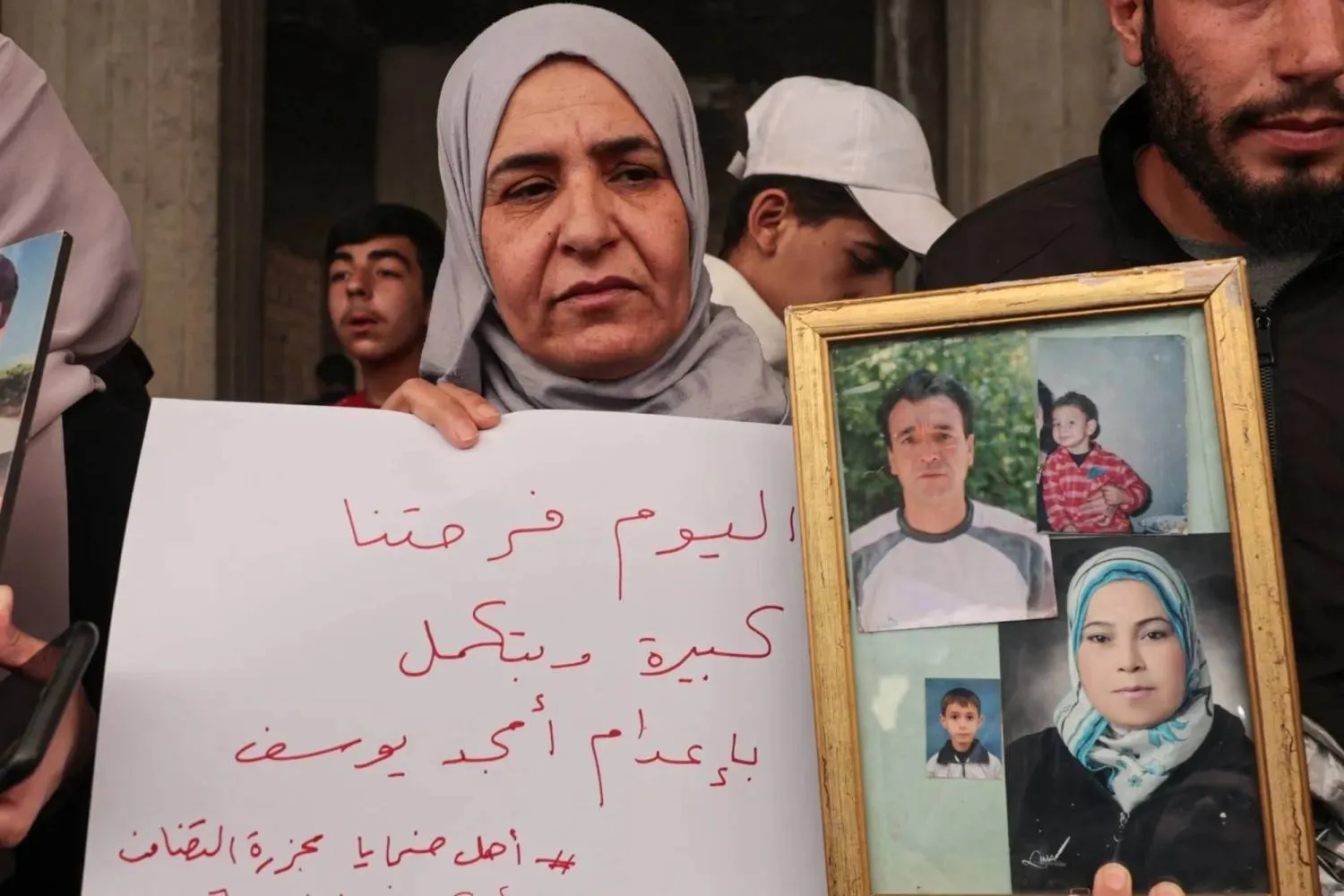
A Syrian woman holds pictures on April 24, 2026, of relatives killed by former regime forces in the 2013 Tadamon massacre south of Damascus. (EPA)
TT

Syria’s Grand Mufti Warns Against Acts that Could Fuel Strife

A Syrian woman holds pictures on April 24, 2026, of relatives killed by former regime forces in the 2013 Tadamon massacre south of Damascus. (EPA)

Syria’s Grand Mufti Sheikh Osama al-Rifai has called for calm after days of protests demanding the prosecution of supporters of the former regime, warning citizens against “undisciplined actions that could open the door to strife,” the official Syrian news agency SANA reported.

Rifai said Friday that accountability for criminals must be left to the state and its relevant agencies. He said demands for justice and for holding those involved in violations to account were “a legitimate right,” but must be pursued through the state and the law, not through unorganized individual or collective action.

“What the Syrian people endured over 60 years of injustice and suffering because of the practices of the defunct regime and its loyalists requires wise conduct today, far from strife,” SANA quoted him as saying.

He said the responsibility for applying the law and holding suspects accountable rests with the relevant state institutions, urging people to trust judicial and official procedures rather than resorting to individual acts that could have dangerous repercussions for social security.

AFP reported that dozens of Syrians joined a protest overnight Tuesday into Wednesday in which shops and cars were vandalized in a Damascus neighborhood. Protesters demanded that loyalists of the former rule be held to account, part of wider mobilizations that began in several areas and prompted the authorities to warn against turning to “revenge.”

Neighborhoods seen as supportive of the former regime in several areas, including Aleppo and Idlib, have seen similar protests in recent days. Demonstrators called for the trial of those they described as “shabiha” and “remnants of the regime,” terms used for loyalists of the ousted president, Bashar al-Assad.

Residents said the protests included attacks on private property, fueling tensions and fears of acts outside the law as the authorities work to launch a transitional justice process after years of war, AFP reported.

Videos on social media showed dozens of people moving through the Mezzeh 86 neighborhood, which had a mostly Alawite population. Shops and cars were attacked and chants were directed against residents.

A similar demonstration took place outside the nearby Great Mezzeh Mosque, demanding the expulsion of “shabiha,” before security forces deployed to control the situation and asked residents to stay in their homes.

The Ash al-Warwar neighborhood on the outskirts of Damascus, which also has a mostly Alawite population, saw a similar protest on Monday night, an AFP photographer reported.

Leaflets have spread in several provinces in recent days, giving loyalists of the former rule the choice between leaving the country or staying in their homes “awaiting accountability.”

The first such protest began last week in Kafr Aweed in rural Idlib, in the northwest of the country.

The protests came despite the authorities starting trials of former security and military officials from the previous rule, and announcing the arrest of about 6,000 people, including soldiers, officers and loyalists linked to the former rule. The authorities are trying to contain the protests, which have raised concerns among rights advocates.

Syrian President Ahmad al-Sharaa said last week, while receiving a delegation from Damascus, that “it is important that transitional justice not be used as a pretext for revenge or as a tool for domination,” warning that otherwise “we would be confronting one injustice with another.”

Arrests over the 2020 strike on Jabal al-Duwaila camp

In a related development, SANA said internal security units in Idlib province arrested Issa Ghannam and Fadi Maarouf on suspicion of leaking the coordinates of an opposition camp in Jabal al-Duwaila in the city of Kafr Takharim, Idlib province, in 2020.

The agency quoted the Interior Ministry as saying investigations showed that “Fadi Maarouf, known as Abu Jahl, sent the site’s coordinates to Issa Ghannam, who in turn transferred them to Brigadier General Abdulrahman Najm, head of the State Security branch under the defunct regime. The camp was then hit by direct air strikes during a meeting of its members, causing more than 100 deaths and injuries.”

The Interior Ministry statement did not say which faction the targeted camp belonged to or who carried out the strike.

Reports at the time said Russian warplanes bombed a parade by fighters at a Faylaq al-Sham camp, affiliated with the National Front for Liberation, in al-Duwaila in the Kafr Takharim area near the Turkish border, on Oct. 26, 2020, causing dozens of deaths and injuries.



CIA Chief Meets Egypt's Sisi in Cairo

FILED - 18 October 2023, Egypt, Cairo: President of Egypt Abdel Fattah El-Sisi is pictured in Cairo. Photo: Michael Kappeler/dpa Pool/dpa
TT

CIA Chief Meets Egypt's Sisi in Cairo

FILED - 18 October 2023, Egypt, Cairo: President of Egypt Abdel Fattah El-Sisi is pictured in Cairo. Photo: Michael Kappeler/dpa Pool/dpa

US Central Intelligence Agency Director John Ratcliffe met Egyptian President Abdel Fattah al-Sisi Sunday in a rare visit to Cairo, as the United States warned of rapid escalation in the Middle East war.

Sisi's office said the meeting, attended by Egypt's spy chief Hassan Rashad, discussed the wars in Iran, the Gaza Strip and Sudan, as well as attacks on Gulf countries and threats to maritime security.

Sisi stressed "the paramount importance of settling regional crises through political and diplomatic tracks," according to a presidency statement.

"This military conflict has the potential to escalate rapidly," it warned.

Sisi's office said Ratcliffe on Sunday "lauded Egypt's pivotal role in supporting efforts aimed at reaching peaceful, comprehensive settlements to regional crises".


Arab Parliament Condemns Houthi Militia Attack Targeting Riyadh

Arab Parliament Condemns Houthi Militia Attack Targeting Riyadh
TT

Arab Parliament Condemns Houthi Militia Attack Targeting Riyadh

Arab Parliament Condemns Houthi Militia Attack Targeting Riyadh

The Arab Parliament has strongly denounced the terrorist Houthi militia's continued attacks, including the attack targeting Riyadh, stressing that it constitutes a flagrant violation of international law and a threat to Arab national security and regional stability.

In a statement on Sunday, Arab Parliament Speaker Mohammed Al-Yamahi expressed the parliament's full solidarity with the Kingdom of Saudi Arabia and its support for the measures it takes to defend itself against any attacks targeting its security and territorial integrity, SPA reported.

Al-Yamahi called on the international community, particularly the UN Security Council, to assume its legal and political responsibilities to stop these blatant attacks, ensure that they are not repeated, and hold those responsible accountable.


French ISIS Suspects Stand Trial in Iraq

During the nearly three-hour session, the judge read the investigation findings, which were also shown on a screen, including the suspects' testimonies (INA)
TT

French ISIS Suspects Stand Trial in Iraq

During the nearly three-hour session, the judge read the investigation findings, which were also shown on a screen, including the suspects' testimonies (INA)

Six French nationals went on trial on Sunday, as Iraq moves to prosecute thousands of suspected ISIS members.

Iraq's prisons, already packed with ISIS suspects, have received thousands more detainees transferred since last year from Syria.

The trial of the six French nationals began on Sunday morning.

An AFP correspondent in the courtroom reported that the judge set the next hearing for October 5.

During the nearly three-hour session, the judge read the investigation findings, which were also shown on a screen, including the suspects' testimonies.

The investigation found that they joined ISIS after travelling first to Turkey and then Syria.

The judge then inquired about their legal representation before setting the new hearing date.

The suspects include Charlie Sun, Kamel Ben Mbarak, Najib Megherbi, Mehdi Ismael and Ibrahim Azahaf, who arrived in Syria when he was 14 years old, according to their French lawyers.

Among them was also Noureddine El Mansouri, who was stripped of his French nationality in June 2026, though the decision is still under appeal.

The suspects are part of a group of 47 French citizens transferred from Syria last year.

The larger group includes Adrien Guihal, who claimed responsibility for the 2016 Nice attack for ISIS.

The group swept across Syria and Iraq in 2014, committing massacres and forcing women and girls into sexual slavery.

French lawyers on Thursday urged the repatriation of the French nationals detained in Iraq, warning that they could face the death penalty.

In February, over 5,700 ISIS detainees from more than 60 countries were transferred to Iraq by the United States, after years held in Syrian prisons overseen by Kurdish-led forces.

Among them were at least five French nationals, some of whom were minors when their parents joined ISIS.

Earlier this month, Iraq's judiciary said it had completed their interrogation and that the cases would proceed to trial.

It added that more than 450 Syrians would be released after investigations found no evidence warranting legal action against them.

In April, Iraq handed over two detained foreigners, from Finland and the United States, to their countries after they were cleared of suspicion.