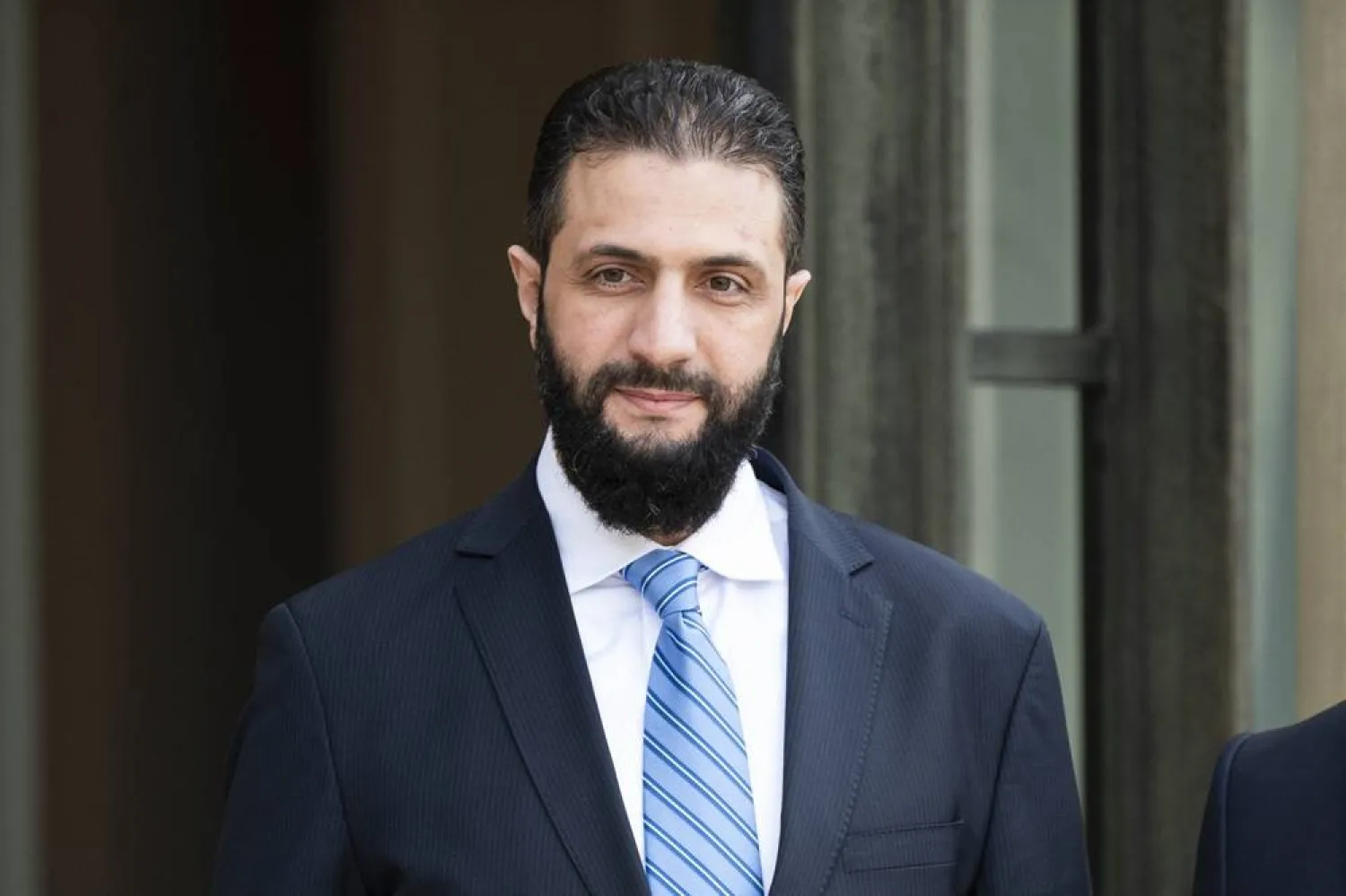
Syria President Denies Wanting to Intervene in Lebanon After Trump Remarks

Syrian President Ahmed al-Sharaa. (AFP file)
TT

Syria President Denies Wanting to Intervene in Lebanon After Trump Remarks

Syrian President Ahmed al-Sharaa. (AFP file)

Syrian President Ahmed al-Sharaa denied on Sunday that his country sought to intervene militarily in Lebanon where Israel and Hezbollah are at war, after US President Donald Trump repeatedly suggested Damascus could get involved.

"We are looking for economic channels between Lebanon and Syria, not military ones," Sharaa said in an interview broadcast on television channel Al Mashhad.

On Sunday, Trump told Fox News he was "disappointed Israel can't put Hezbollah away", adding in reference to the fight against the militant group: "I'm close to giving it over to Syria."

Hezbollah drew Lebanon into the Middle East war on March 2 with rocket fire at Israel to avenge the killing of its backer Iran's supreme leader in US-Israeli strikes days earlier.

Israel responded with airstrikes and a ground invasion.

An Iran-US deal signed this week on ending the regional conflict includes Lebanon, where fighting has paused since Saturday evening.

At the G7 summit in France this week, Trump also said "if Israel can't do the job (against Hezbollah) without killing everyone else, then he (Sharaa) will do the job. Syria will do the job."

- Syria 'greatly concerned' -

Sharaa said in Sunday's interview that "we proposed with the United States that the war must stop," adding that "there must be various solutions, including economic, political and social, and the re-establishment of relations and the vital economic lifeline between Syria and Lebanon."

"And alongside this, some security measures that respond firstly to Syrian and Lebanese concerns, and also Israeli concerns," he added.

Hezbollah fought alongside longtime Syrian ruler Bashar al-Assad in his country's civil war, making Sharaa and the new authorities who toppled the former leader in 2024 deeply hostile to the group.

Syria had dominated its neighbor for decades following its military intervention in Lebanon's 1975-1990 civil war, withdrawing only in 2005, making any new military involvement a fraught proposition.

Syria offers "many tools for having a positive impact within Lebanon, but this also depends primarily on Lebanon's agreement", Sharaa said.

"Syria is greatly concerned with Lebanon's domestic situation because Lebanon's security and stability are part of Syria's security and stability," he added.

Responding to a question about whether he would sit at the table with Hezbollah, Sharaa said that "if this serves Lebanon's interests and safeguards Syria's interests, why not?"

Earlier this month, Trump also told US broadcaster NBC that "I'd like to see a more surgical attack on Hezbollah... And we can help them with that, or we can recommend Syria," he said, adding that Sharaa "would love to help".


Man with Disability Killed by Israeli Fire in Syria

Syrians walk past shops down an alley at the Old City in Damascus on October 21, 2026. (Photo by LOUAI BESHARA / AFP)
TT

Man with Disability Killed by Israeli Fire in Syria

Syrians walk past shops down an alley at the Old City in Damascus on October 21, 2026. (Photo by LOUAI BESHARA / AFP)

A man with a disability was killed Thursday by Israeli army fire during an incursion in southern Syria, where it has stepped up operations, Syria's state news agency said.

"A civilian with a disability was killed Thursday by fire from the Israeli occupation forces during their incursion into the village of Jamla" in Daraa province, SANA news agency said.

Israeli forces deployed in one neighborhood of the village and placed snipers on the rooftops after bombing the area late on Wednesday, the report said.

After Ahmed al-Sharaa came to power in Damascus in late 2024, Israel launched hundreds of strikes against Syria.

The Israeli army also carried out incursions into Syria's south and deployed troops in the UN-monitored buffer zone separating Israeli and Syrian forces on the Golan Heights.

In recent days, Israeli forces have also uprooted vast olive groves in Quneitra province, near Daraa, according to the agency.

Trees were destroyed across an area of about 1.3 hectares by the village of Saida, SANA said.

The village faces the buffer zone where the Israeli army has been building fortifications.

"Tanks entered my land without any warning," Mohammad Ali al-Chaghla, 58, the owner of the field, told AFP. "They cut down and destroyed some 400 trees during their incursion."

The Syrian Foreign Ministry on Sunday condemned "the intensification of incursions by the Israeli occupation" in Quneitra and Daraa.


Tunisia: Former Presidential Candidate Sentenced to 4 Years in Prison

Opposition politician Olfa Hamdi
TT

Tunisia: Former Presidential Candidate Sentenced to 4 Years in Prison

Opposition politician Olfa Hamdi

A Tunisian military court sentenced opposition politician Olfa Hamdi to four years in prison on charges of plotting against state security and inciting the military to disobey orders, her lawyer said on Wednesday.

The charges against the dual Tunisian and American national stemmed from social media posts and included inciting military personnel to disobey orders, lawyer Akram Moussa said.

Hamdi briefly served as head of national airline company Tunisair before her sacking in 2021, later running a consulting firm in the United States.

In Tunisia's 2024 presidential vote, Hamdi -- then 36 -- sought to run for the top role, but her candidacy was turned down as she did not meet the 40-year age limit for candidates.

A critic of President Kais Saied, Hamdi was already sentenced to two years in prison earlier this year after her arrest upon arrival at Tunis airport in February.

The latest sentence against her came from two additional convictions, with two years in prison for each, Moussa said.

A US State Department spokesman told AFP that Washington was "closely tracking the situation."

"The Trump Administration has no higher priority than the safety and security of American citizens," he said.

Hamdi heads the Third Republic party, which she founded in 2022, and has often criticized Saied and, at times, the country's military on social media.


Druze Source Denies Reports of Plans for Israeli Base in Rural Sweida

Tal Qulaib in Syria's Sweida province (File photo: SANA)
TT

Druze Source Denies Reports of Plans for Israeli Base in Rural Sweida

Tal Qulaib in Syria's Sweida province (File photo: SANA)

A Druze source in Syria's southern Sweida province who opposes the policies of Druze spiritual leader Sheikh Hikmat al-Hijri has dismissed reports of plans to establish an Israeli military base in the province's southeastern countryside.

The source also denied reports that the so-called National Guard was preparing to launch a major offensive against areas under Syrian government control and neighboring Daraa province, telling Asharq Al-Awsat that the claims were “media rumors with no basis on the ground.”

“The reality is different,” the source said.

“While platforms and media outlets affiliated with al-Hijri and his fighters were aggressively spreading these rumors, there were limited preparations to attack internal security positions, but the attack never materialized.”

The source said the reported plans were unlikely to move “beyond the media.”

Since early last week, media outlets affiliated with al-Hijri and the National Guard have reported preparations for a major offensive against government-held areas in rural Sweida, with some threatening to extend the assault into neighboring Daraa province.

The claims have been accompanied by reports of intensive, sustained Israeli helicopter activity over southern Syria, including Sweida, Daraa and Quneitra. Some accounts alleged that helicopters carrying military equipment for Sweida's armed groups had landed in the province's countryside.

Other reports went further, alleging that Sweida’s de facto authorities were in talks with the Israeli government to establish a military base on Tal Qulaib, a hill in the province’s southeast, and install surveillance equipment at its summit.

Amid the reports, one platforms said the National Guard leadership had issued a military circular ordering all sector commanders and field units to bar civilians from approaching or filming at designated strategic hills and locations, warning of legal and judicial action against violators.

The circular called for “strict surveillance and immediate enforcement” at Tal Maaz, Tal al-Fara, Tal Alia, Jabal al-Fina, Tal Qulaib, Tal Shaaf, Tal al-Majda, Tal Sahn and Tal Zawagh in eastern Sweida.

But the Druze military source challenged the claims, saying he was in daily contact with residents of al-Kafr, a town on the slopes of Tal Qulaib.

“Residents confirm that life in the town is entirely normal. There are no signs of a base being established,” he said.

Journalist Omar al-Hariri, a native of southern Syria, also denounced the wave of reports circulated by outlets affiliated with al-Hijri as “fake,” warning against sharing them in a post on X.

He said there was “no truth whatsoever” to claims that Israel was building a military base in Sweida.

He argued that Israel had no need for an air base in Sweida, which lies less than 100 kilometers from Israeli bases in Quneitra and the Golan Heights, putting al-Hijri’s fighters within minutes of Israeli air support.

As for reports of sustained Israeli helicopter flights over southern Syria, al-Hariri said such flights were nothing new. Helicopters had previously delivered weapons, communications equipment, logistical supplies and aid, as well as transported sick and wounded people, he said.

National Guard Turns Accusations on Damascus

National Guard spokesperson Major Talal Amer, however, accused Damascus of plotting an offensive of its own, saying the government sought to distract the public from administrative failures by drawing it into an external conflict.

“We are seeing reinforcements arriving and fortifications being built around the clock in occupied areas,” Amer told Asharq Al-Awsat in a written message.

“Meanwhile, the Damascus government is spreading rumors to divert attention and convince public opinion that it is repelling an attack,” he said.

“If the National Guard intended to launch an offensive to liberate its occupied villages, it would not announce it or leak the plans on social media.”

Amer also rejected calls by Sweida Governor Mustafa al-Bakour for dialogue with residents to resolve the crisis.

Former chief Syrian opposition negotiator and lawyer Mohammed Sabra cast further doubt on the National Guard's ability to mount an offensive, citing the militias' limited manpower, inadequate weapons and internal divisions.

“The militias in Sweida simply do not have the capacity to launch a military attack,” Sabra said.

He said they faced severe shortages of fighters and possessed little beyond small arms, rifles and some anti-armor munitions.

Internal rifts had compounded their weakness, he added, with some groups turning into gangs involved in robbery, looting, kidnapping and the intimidation of civilians.

Their grip on Sweida, Sabra argued, rested not on military strength but on regional power dynamics and ties to Israel.

He warned that Israel could seize on any military operation aimed at ending what he called an "abnormal situation" as a pretext for deeper intervention inside Syria.

Israeli Arms Buildup and Election Uncertainty

Sabra acknowledged that Israeli military and logistical support for Sweida's militias had increased, but questioned whether the buildup signaled an impending offensive against government-controlled areas in western Sweida.

The explanation, he suggested, may lie instead in Israel's own political uncertainty ahead of pivotal parliamentary elections.

If Benjamin Netanyahu lost and another politician was tasked with forming a government, Sabra said, Netanyahu's administration would enter a caretaker period, limiting its ability to create new military or security realities that could obstruct the incoming government's agenda.

The next government's security policy toward Syria remained unknown, he added.

An inconclusive election could prove equally restrictive.

If neither Netanyahu's bloc nor the opposition secured enough support to form a stable government, Israel could face a political crisis and another election, a process Sabra said could take three to four months.

The government's powers would also face certain restrictions during that period.

Against that backdrop, Sabra suggested that increased Israeli weapons shipments to Sweida's militias could be designed to prepare them for either outcome, ensuring they had enough arms and ammunition to last through months of political uncertainty.

He said Israeli weapons deliveries to the militias had risen markedly over the past week.