

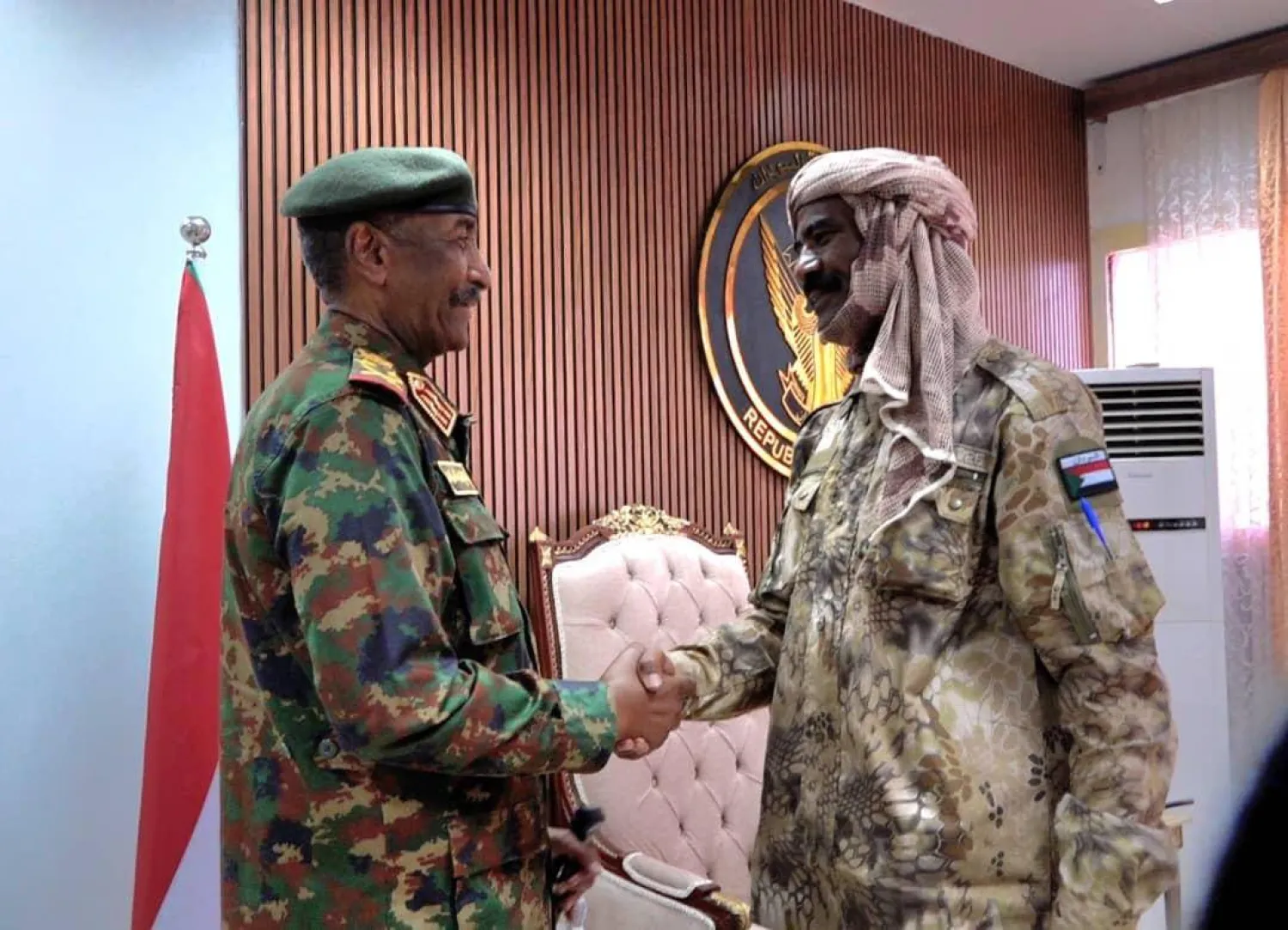

Sudanese Army Welcomes RSF Defectors

Sudanese Army commander Abdel Fattah al-Burhan receives Major General Al-Nour Qubba, who defected from the Rapid Support Forces. (Sovereignty Council)
TT

Sudanese Army Welcomes RSF Defectors

Sudanese Army commander Abdel Fattah al-Burhan receives Major General Al-Nour Qubba, who defected from the Rapid Support Forces. (Sovereignty Council)

Sudan’s army is increasingly absorbing defectors from the Rapid Support Forces (RSF), betting that growing divisions within the paramilitary group can help consolidate military gains in a civil war that has become one of the world’s worst humanitarian crises.

The latest sign of that strategy came last month when authorities in Khartoum granted a military rank to Ali Rizqallah, a former RSF commander who defected alongside several other senior figures. The army-backed government welcomed the move as evidence of widening cracks within the RSF.

The conflict erupted on April 15, 2023, after a power struggle between the army and RSF spiraled into open warfare. Since then, the war is believed to have killed hundreds of thousands of people, displaced millions, and fueled famine and disease across large parts of the country.

Some of the worst violence has unfolded in Darfur, an RSF stronghold where the force has been accused of committing atrocities. Alleged abuses during the group’s assault on al-Fashir last October were documented in a Reuters investigation.

Halima, a resident of Darfur now living in the town of Tawila, said she was forced to flee repeatedly as RSF fighters raided villages surrounding al-Fashir. She recounted that she witnessed women being raped and was herself whipped by RSF personnel.
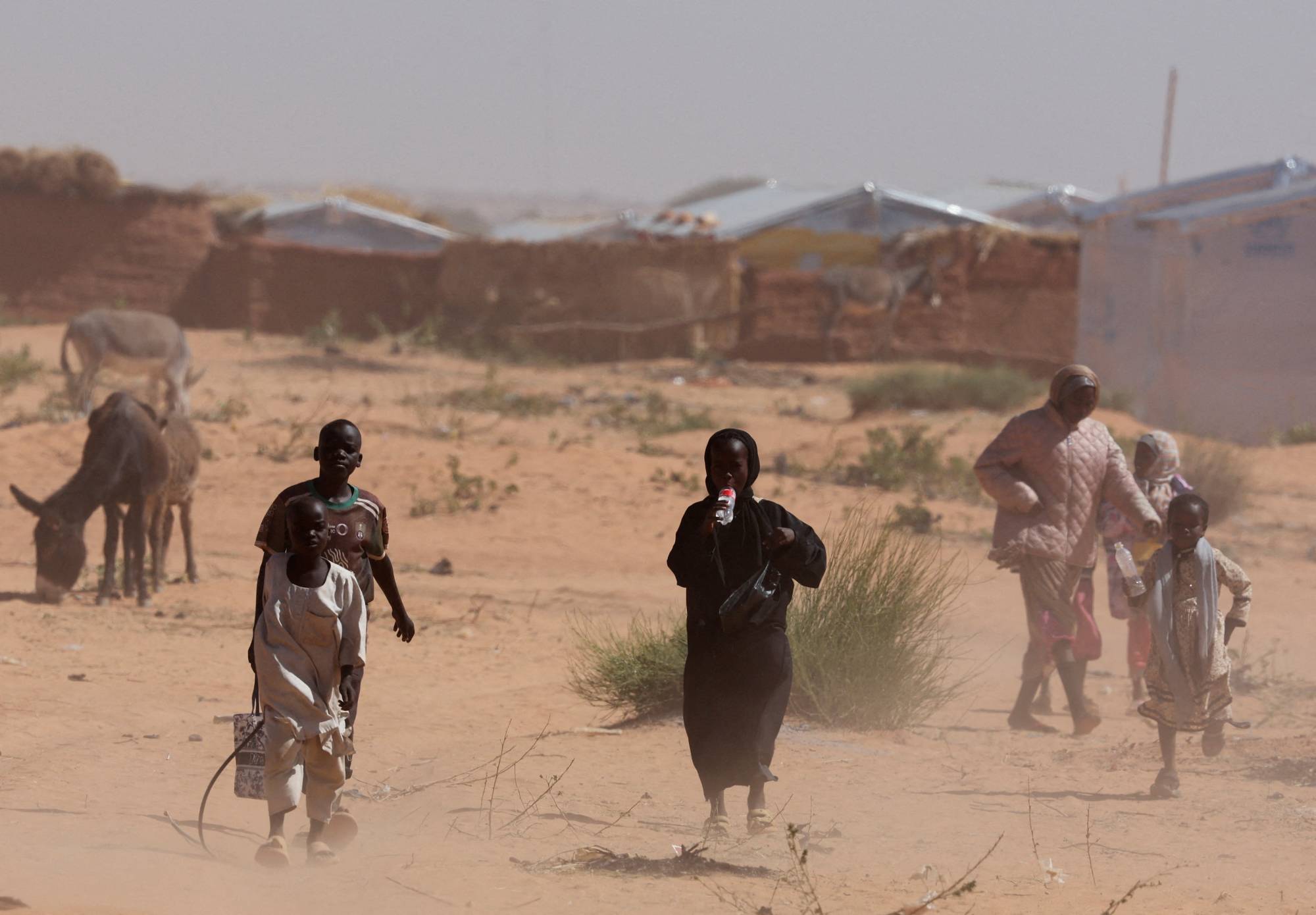
Sudanese refugees from Darfur walk amidst a sandstorm at the Touloum refugee camp, amid ongoing conflict in their country, on the outskirts of the town of Iriba in Wadi Fira province, eastern Chad, November 30, 2025. (Reuters)

“My arm is covered in scars all the way down to here,” she said, pointing toward her leg as she described the marks left on her body.

Anger toward the RSF is also widespread in neighboring Kordofan. A merchant in the town of Al-Nuhud revealed that he plans to file a lawsuit over the looting of warehouses and food stores.

Speaking on condition of anonymity for fear of retaliation, he blamed the RSF for the losses. But Mohamed Salah al-Din, a member of the executive council of the Emergency Lawyers group, said such individual cases are unlikely to gain broad traction amid the turmoil of war.

“This issue cannot be addressed piecemeal,” he stated. “It requires transitional justice.”

His comments contrast with efforts already underway to prosecute alleged collaborators. Emergency Lawyers said it has documented 243 cases referred to the courts involving accusations ranging from supplying intelligence to the RSF to cooking for its fighters.

The army is also seeking to exploit tribal tensions within the RSF’s support base. Several of the group’s senior commanders come from the Arab Rizeigat tribe, where rival clans have become increasingly divided, particularly after an RSF raid earlier this year on the hometown of Musa Hilal, a powerful tribal leader aligned with the military.

Hilal belongs to the Mahamid clan, while critics accuse the RSF of operating through a tribal and ethnic hierarchy that disproportionately benefits the family of its commander, Mohamed Hamdan Dagalo, better known as Hemedti.

“The RSF has become the preserve of a specific group and a single family,” critics said. “The project that builds a state must be a Sudanese national project, not one based on tribal loyalties.”

The Sudanese military is hoping those divisions will trigger further defections, replicating the success it achieved in Al Jazirah State, where the 2024 defection of militia commander Abu Aqla Keikal helped shift momentum decisively in the army’s favor.



Algeria Orphanage Fire Kills 11

A general view of the capital, Algiers (Reuters file photo)
TT

Algeria Orphanage Fire Kills 11

A general view of the capital, Algiers (Reuters file photo)

A fire burning at an orphanage on the outskirts of the Algerian capital has killed at least 11 people and injured 19, the country's civil defense said Thursday.

The civil defense was "continuing efforts to put out the fire" in the Mohammadia district of Algiers, with the cause of the blaze unknown.

"The provisional toll is 11 dead," it said, without specifying the age of the victims.

Ten of the injured suffered burns of varying severity, while emergency crews evacuated five people ⁠with disabilities from the orphanage to safety, the civil protection agency said.

National television showed Prime Minister Sifi Ghrieb visiting the wounded in hospital.

Algeria has been sweltering under a heatwave for several days, and nearly 1,000 fires have been recorded in the space of a week.


Syria Foils Attempt to Smuggle Weapons to Hezbollah from Iraq

Syria's (L) and Iraq's national flags are pictured near the Iraqi-Syrian border, in Al-Qaim, western Iraq on January 23, 2026. (AFP)
TT

Syria Foils Attempt to Smuggle Weapons to Hezbollah from Iraq

Syria's (L) and Iraq's national flags are pictured near the Iraqi-Syrian border, in Al-Qaim, western Iraq on January 23, 2026. (AFP)

Syrian authorities foiled an attempt to smuggle in a shipment of advanced weapons and missiles over the border from Iraq, the state news agency ‌SANA reported on ‌Thursday, citing ‌an ⁠Interior Ministry source, ⁠who said preliminary investigations showed the shipment was intended for Lebanon's Hezbollah.

US President Donald Trump ⁠said in June ‌he ‌had spoken to Syrian President ‌Ahmed al-Sharaa about ‌combating Hezbollah.

Lebanese President Joseph Aoun's office said Sharaa had assured him Syria would not take sides in Lebanon's internal affairs.


Katz: Israel Will Keep Troops in Lebanon, Syria, Gaza 'Security Zones'

FILED - 25 June 2024, Israel, Jerusalem: FILE PHOTO - Israeli Defense Minister Israel Katz is pictured in Jerusalem. Photo: Hannes P Albert/dpa
TT

Katz: Israel Will Keep Troops in Lebanon, Syria, Gaza 'Security Zones'

FILED - 25 June 2024, Israel, Jerusalem: FILE PHOTO - Israeli Defense Minister Israel Katz is pictured in Jerusalem. Photo: Hannes P Albert/dpa

Israel's Defense Minister Israel Katz told his US counterpart Pete Hegseth early Thursday that Israel is determined to keep its forces in "security zones" it has carved out inside Lebanon, Syria and the Gaza Strip.

In a statement, Katz's office said the two men spoke overnight and the minister "emphasized Israel's determination to remain in the security zones in Syria, Gaza, and Lebanon in order to protect Israel's borders and the communities near the border from the threats posed by jihadist forces.”

"We have never asked the United States to act in our place along our borders," AFP quoted Katz as saying.

His comments come days after US President Donald Trump asked Israeli Prime Minister Benjamin Netanyahu to pull Israeli forces out of Syria and Lebanon, according to US news outlet Axios.

Citing a US official, Axios reported that Trump told Netanyahu the Israeli deployment was fueling tensions in Syria.

"They don't want you there. You should redeploy," Trump told him, according to Axios.

After the December 2024 overthrow of Syria's longtime ruler Bashar al-Assad, Israel sent troops into a UN-patrolled buffer zone that separated Israeli and Syrian forces on the Golan Heights.

Israel has also carried out repeated incursions into Syrian territory since then, as well as bombings, and has said it wants a demilitarized zone in the country's south.

In Lebanon, Israeli forces remain deployed in what the military describes as a security zone extending roughly 10 kilometers (six miles) into Lebanese territory.

Lebanon and Israel are engaged in talks to end hostilities after Hezbollah drew Lebanon into the broader Middle East war by attacking Israel in March.

The two countries concluded their fifth round of talks in Rome on Wednesday.

The US-brokered negotiations are aimed at having Israeli forces steadily withdraw from Lebanon, starting with two "pilot zones" located outside the "security zone" that Israel has established in the south.

In Gaza, Israel's military controls 60 percent of the territory and is present on the entire outside perimeter along the borders with Israel and Egypt.