


Barrack Pushes Baghdad and Erbil Toward Oil Dispute Settlement

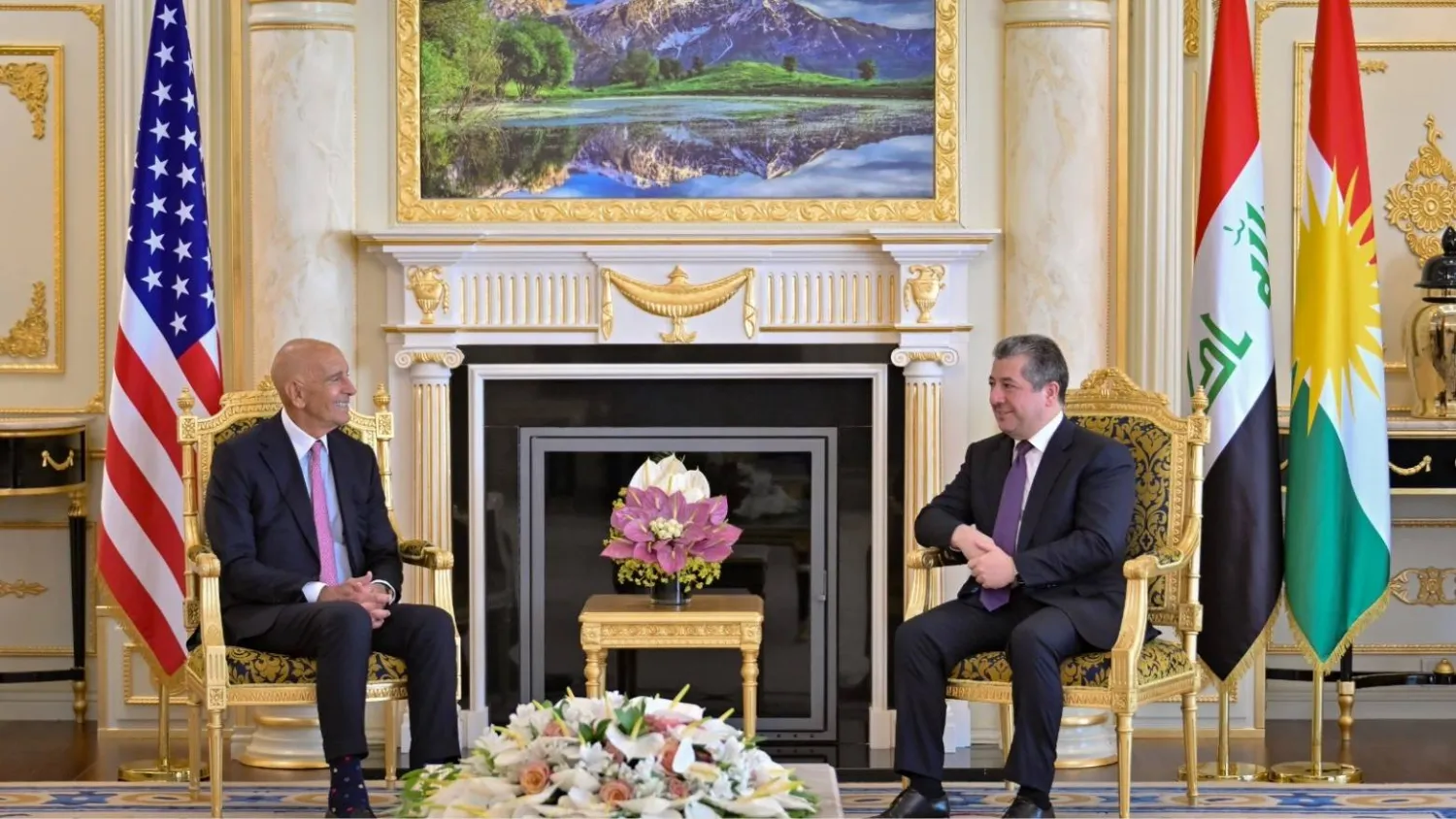
Kurdistan Region Prime Minister Masrour Barzani receives US envoy Tom Barrack in Erbil on June 16, 2026 (Government Media)
TT

Barrack Pushes Baghdad and Erbil Toward Oil Dispute Settlement

Kurdistan Region Prime Minister Masrour Barzani receives US envoy Tom Barrack in Erbil on June 16, 2026 (Government Media)

Kurdish politicians say US envoy Tom Barrack discussed possible ways to resolve the long-running oil dispute with Baghdad during his visit to Erbil, the capital of Iraq's Kurdistan Region, last week. However, they ruled out the possibility that the country's severe financial crisis would lead to the passage of a permanent federal law regulating natural resources.

Since March 2007, when the federal government led by Nouri al-Maliki submitted the first draft of the legislation, successive parliamentary terms have failed to pass a law that was intended to define how natural resources are produced and revenues distributed. Instead, political forces have relied on fragile political understandings to manage the issue.

Discussion over the law resurfaced following Barrack's visit to Erbil on June 16, 2026, during which he held meetings with regional government officials and leaders of the two main Kurdish parties. Local platforms circulated reports suggesting that the US envoy was "optimistic about Prime Minister Ali Al-Zaidi's ability to resolve the traditional disputes with Erbil."

Former Kurdish member of the Iraqi parliament Majid Shankali told Asharq Al-Awsat that Barrack discussed strengthening US-Iraqi cooperation in the energy sector, both with Baghdad and Erbil, as well as modernizing the Kirkuk-Baniyas pipeline, through which Iraqi oil is transported to Syria and onward to the Mediterranean

Former lawmaker Mayada Al-Najjar said the oil dispute between Baghdad and Erbil has moved "from a stage of stagnation to one of serious negotiations."

Speaking to Asharq Al-Awsat, Al-Najjar said that "communications between Baghdad and Erbil have gained clear momentum in recent weeks, with exchanges of visits and meetings among senior officials focused on resuming oil exports, settling financial issues, and preparing the ground for the passage of an oil and gas law."

What Is the Root of the Dispute?

Observers tend to believe that political disagreements have always been the primary obstacle to passing the law. At the same time, disputes over the interpretation of constitutional provisions, including the powers of the Kurdistan Region, have remained unresolved in most political settlements.

The dispute continues over whether the Kurdistan Region has the right to contract directly with foreign companies and pursue independent oil projects, or whether the federal government is the sole authority empowered to do so under the constitution and existing laws. Sharp differences also persist regarding discovered oil fields and the nature of contracts signed, whether under service agreements or production-sharing arrangements.

The Kurdistan Region attempted to address the legal vacuumwhen its parliament passed a regional oil and gas law in August 2007. However, Iraq's Federal Supreme Court effectively nullified the legislation when it issued a ruling in February 2022 challenging its legal basis.

"There is no hope in the foreseeable future of passing an oil and gas law," Shankali said, citing "Baghdad's strong tendency to consolidate full centralized control over the region's oil resources."

Shankali, a member of the Kurdistan Democratic Party, said Prime Minister Ali Al-Zaidi "will not be able to pass an oil and gas law through the Iraqi parliament without an agreement among the political blocs represented in parliament." He expressed regret that "the current parliament has yet to reach a formula acceptable to Erbil, Baghdad, and the oil-producing provinces that would allow the law to be passed and finally end disputes that have persisted for more than 20 years."

He predicted that political forces would continue "managing the crisis, as before, through temporary agreements between the federal government and the regional government." That would mean maintaining the latest arrangement that led to the adoption of the three-year federal budget law during the government of Mohammed Shia Al-Sudani.

In June 2023, political forces in Baghdad, led by the Coordination Framework and the Kurdistan Democratic Party, agreed on a financial settlement under which the Kurdistan Region would deliver 250,000 barrels of oil per day after deducting the region's share for domestic consumption. The agreement also allowed Kirkuk crude to be transported through the Kurdistan pipeline to Türkiye's Ceyhan port, in exchange for the federal government's commitment to pay the region's share of the state budget.

"In the coming phase, this agreement could be further developed between Baghdad and Erbil, given all sides' desire to confront the severe financial crisis," Shankali said.
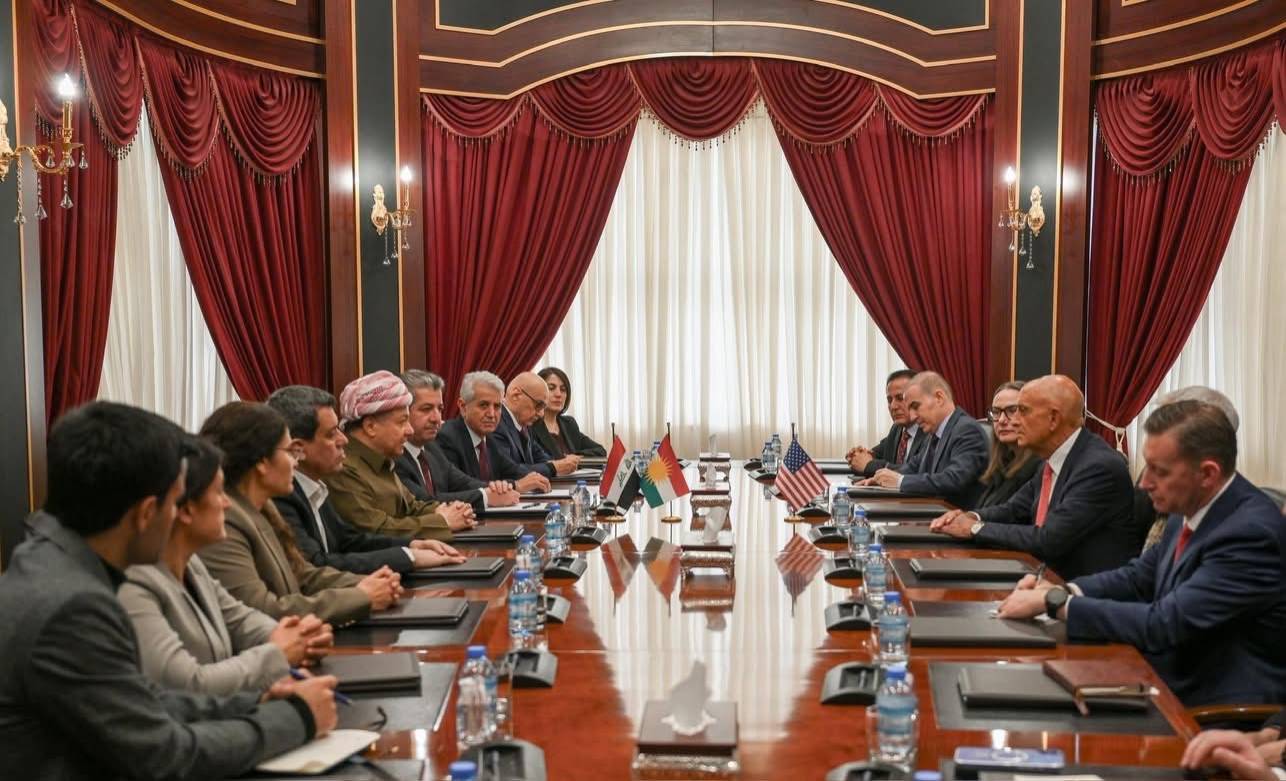
Masoud Barzani, with Mazloum Abdi beside him, during talks with US envoy Tom Barrack in Erbil (File photo: Kurdistan Democratic Party)

Positive Signs

Sobhi Al-Mandalawi, a member of the Kurdistan Democratic Party, pointed to what he described as "positive indicators" since Al-Zaidi assumed office as prime minister.

Speaking to Asharq Al-Awsat, Al-Mandalawi said that "the new Iraqi government moved early in its tenure to engage positively with the national and domestic environment, including contentious issues such as relations with Erbil." He added that "the Kurdistan Regional Government, led by Masrour Barzani, views these indicators positively."

However, Al-Mandalawi suggested that efforts to resolve disputes between the two governments may gather momentum under pressure from the international community, particularly the United States.

He stressed that the Kurdistan Democratic Party has consistently partnered with every new government in Baghdad in seeking the passage of an oil and gas law. Although he hopes the legislation can be approved during the current parliamentary term, he argued that "the same political forces that opposed a legislative settlement in the past will continue to use every means available to prevent the law from being passed."

Former lawmaker Mayada Al-Najjar said there are "encouraging signs" that the disputes could be resolved, reflected in growing cooperation between the two sides in both security and economic coordination.

In mid-June 2026, an Iraqi military delegation headed by Army Chief of Staff Lt. Gen. Abdul Amir Rashid Yarallah conducted meetings and field visits in Erbil, including inspections of several oil fields, to assess security conditions and discuss measures aimed at protecting facilities and personnel.

Despite political indicators suggesting Baghdad and Erbil are moving closer to resolving the oil dispute, Al-Najjar said any definitive progress should be measured by an official announcement of a final or comprehensive agreement between Kurdistan Democratic Party leader Masoud Barzani and Prime Minister Ali Al-Zaidi that would fully settle the oil and gas crisis.



UN Says Sudan Resources Fuel Civil War

FILE PHOTO: A displaced Sudanese mother of five, including her child, prepares food at a camp shelter amid the ongoing conflict between the RSF and the Sudanese army, in Tawila, North Darfur, Sudan, July 30, 2025. REUTERS/Mohamed Jamal/File Photo
TT

UN Says Sudan Resources Fuel Civil War

FILE PHOTO: A displaced Sudanese mother of five, including her child, prepares food at a camp shelter amid the ongoing conflict between the RSF and the Sudanese army, in Tawila, North Darfur, Sudan, July 30, 2025. REUTERS/Mohamed Jamal/File Photo

Sudan's rival factions are profiting from control over the country's resources and the "war economy" was sustaining the conflict, the United Nations said Wednesday.

To fund the growing cost of military operations, the two sides rely on exploiting territory, trade routes, and commodities, contributing to a conflict that has become "increasingly self-perpetuating", said the UN human rights office OHCHR.

The war between Sudan's regular army and the Rapid Support Forces (RSF), that erupted in April 2023, has killed 200,000 people by some estimates and displaced upwards of 11 million.

Several areas of Sudan have been plunged into hunger and famine.

OHCHR called on the two sides, and corporations involved in collecting and selling Sudanese commodities, to ensure compliance with international law.

"Sudan's vast wealth of natural resources should benefit its people," said UN rights chief Volker Turk.

"Distressingly, what we are seeing today is anything but that. In fact, this wealth is only serving to undermine human rights and drive conflict, bringing pain and suffering on an enormous scale.

"This war economy must be disrupted, and the international community must pay much closer attention to the commodities and trade routes that help keep it alive."

OHCHR issued a report focusing on the trade in gum arabic -- a key ingredient in products ranging from soft drinks, to cosmetics and pharmaceuticals.

Sudan accounted for 70-80 percent of global crude gum arabic exports before the war.

Although modest in export value compared with other commodities, it is an important income source for millions of Sudanese, and remains one of the country's most internationally relied-upon exports.

The report found that many who depend on the gum arabic trade have faced looting, extortion, arbitrary detention and threats -- particularly at the hands of the parties to the conflict and their allies.

In May 2025, for instance, the Gum Arabic Exchange and its warehouses, plus part of the local market in El-Nuhud in West Kordofan state, were reportedly looted by the RSF when stocks were full and ready for export.

This severely disrupted local trade and livelihoods, the report said.

OHCHR said that Sudan's gum arabic trade had been reshaped by the fragmentation of the country since the war started.

Gum arabic from areas controlled by the armed forces goes towards Port Sudan for export, while significant quantities from RSF-controlled areas have been redirected to neighboring countries via cross-border smuggling routes.

The report said this may then be treated and traded as locally-produced, making its origin hard to verify.

According to AFP, Turk, the UN high commissioner for human rights, urged countries and companies linked to trade in Sudanese commodities, including gum arabic, to ensure their business was not fueling the conflict or damaging human rights.

He urged countries to strengthen accountability, traceability and regulatory oversight and respect human rights.

"Companies cannot continue business as usual when sourcing from conflict-affected value chains," Turk said.


Israel Kills Four People in Gaza, Including a Child, Medics Say

Smoke rises following an Israeli airstrike in southern Gaza City, 12 July 2026. (EPA)
TT

Israel Kills Four People in Gaza, Including a Child, Medics Say

Smoke rises following an Israeli airstrike in southern Gaza City, 12 July 2026. (EPA)

An Israeli airstrike killed a man, his wife and their six-year-old daughter in the Gaza Strip on Wednesday, Palestinian health officials said as talks to advance the US-brokered Gaza ceasefire deal faltered.

The strike on an apartment building in Deir Al-Balah in central Gaza killed Omar Abu Qassem, his wife, Asma, and their daughter, Habeeba, medics said. Their son survived, but was injured, medics said.

The Israeli military said the strike targeted a Hamas fighter.

In Sheikh Radwan neighborhood in Gaza City, an Israeli airstrike killed one person, medics said.

The Israeli military didn't immediately comment on this incident.

The deaths add to a toll of more than 1,100 Palestinians, mostly civilians, killed by Israeli attacks since an October ceasefire between ‌Israel and Hamas ‌to end the war took effect, according to health officials in the ‌enclave. ⁠Hamas doesn't usually disclose ⁠information about its fatalities.

The truce halted major fighting, but has failed to stop near-daily Israeli strikes. Four Israeli soldiers have been killed by fighters in Gaza over the same period.

CEASEFIRE FALTERS

The latest violence comes as Hamas leaders wrapped up another round of truce talks in Cairo on Tuesday.

The discussions — mediated by Egypt, Türkiye and Qatar — were aimed at implementing the second phase of US President Donald Trump's Gaza peace plan.

The talks included the disarmament of Hamas and the Israeli military's withdrawal from the strip, according to sources ⁠close to the talks, who said there had been little progress amid deep distrust ‌between the two sides.

The second phase also includes allowing ‌a US-backed Palestinian technocratic committee to assume power from Hamas, the deployment of an international security force, and the ‌start of the reconstruction of Gaza, which has been devastated by the war.

Five countries — Indonesia, Morocco, Kazakhstan, ‌Kosovo and Albania — have committed to providing troops to the US-backed International Stabilization Force. However, none have yet been deployed as negotiations between Trump's Board of Peace and Hamas have stalled for months.

Speaking at an aid donor meeting in Brussels on Monday, Nickolay Mladenov, the Board of Peace envoy for Gaza, said he would be visiting Morocco on ‌Tuesday to "sign Morocco's contribution to the International Stabilization Force, and soon we hope to see them on the ground undertaking their tasks."

Mladenov said the ⁠October ceasefire was holding ⁠but "imperfectly" with violations continuing, adding that Hamas has yet to agree to what he called a "roadmap" for negotiations.

Hamas official Basem Naim accused Mladenov of supporting Israel’s position in negotiations, and failing to hold the country accountable for violating the ceasefire and not upholding the terms of the first phase of the Trump plan.

The plan called for Israel to withdraw its troops to a demarcated "yellow" line, but Israel has been slowly moving its troops forward and now effectively occupies more than 60% of the strip.

Hamas has repeatedly said that it cannot advance to the second phase of the peace plan until the terms of the first phase are fulfilled.

Nearly all of Gaza's 2 million people, most of whom have been displaced several times, now live on a tiny strip of land along the coast, mainly in makeshift tents or damaged buildings, under Hamas control.

Hamas-led fighters killed 1,200 people during their cross-border attack into Israel on October 7, 2023, according to Israeli tallies. The Gazan health ministry said Israel’s subsequent offensive on the strip killed more than 73,000 Palestinians.


Yemeni Information Minister to Asharq Al-Awsat: We Prevented Sanaa Airport from Becoming an Iranian Platform

Graphic content / TOPSHOT - This screen grab taken from a video footage made available via AFPTV on July 13, 2026 shows smoke rising from the airport in Sanaa
TT

Yemeni Information Minister to Asharq Al-Awsat: We Prevented Sanaa Airport from Becoming an Iranian Platform

Graphic content / TOPSHOT - This screen grab taken from a video footage made available via AFPTV on July 13, 2026 shows smoke rising from the airport in Sanaa

Yemeni Minister of Information Moammar Al-Eryani said on Wednesday that the state will not tolerate any new violations, and will take all political, diplomatic, legal, and military measures guaranteed by the constitution and international law to prevent any attempt to undermine Yemen’s sovereignty or impose faits accomplis by force.

Al-Eryani made his remarks to Asharq Al-Awsat following the Yemeni Ministry of Defense’s announcement on Monday that it had targeted the runway of Sanaa International Airport to prevent an Iranian aircraft from landing outside legal and sovereign procedures.

Al-Eryani said the Yemeni government’s position had been clear since the beginning of the crisis. He noted that the government had exhausted all political, diplomatic, and legal avenues and had put forward initiatives aimed at maintaining civilian flights through Yemenia Airways in a manner that safeguarded citizens’ interests while respecting Yemen’s sovereignty.

Al-Eryani stated that “the terrorist Houthi militia, with direct support from the Iranian regime, has rejected these initiatives and insisted on imposing a fait accompli outside the institutions of the state.”

He told Asharq Al-Awsat that the Chairman of the Presidential Leadership Council (PLC), the Supreme Defense Council, the Cabinet, and the Ministry of Defense had all stressed that protecting Yemen’s sovereignty, airspace, and ports of entry is a constitutional duty that cannot be compromised.

The minister reassured the Yemeni people, saying that the armed forces and security agencies are currently at the highest level of preparedness, in implementation of directives issued by the PLC Chairman, the National Defense Council, and Cabinet decisions.

He stressed that they are fully capable of carrying out their constitutional duty to protect Yemen’s sovereignty and defend its airspace and land, sea, and air borders.

Crisis Management Room

Asked about Yemen’s options should the Houthis choose to escalate, Al-Eryani highlighted the role of a crisis management room through which state institutions are working in full coordination.

He revealed that developments are being monitored around the clock and that necessary measures are being taken based on military, security, and political assessments.

According to him, this ensures the protection of citizens and national interests and demonstrates that the state has the ability to deal decisively and responsibly with any developments.

He also placed full responsibility for any escalation and its consequences on “the Houthi militia and the Iranian regime, which chose to reject all peaceful initiatives and continue violating international law and undermining peace opportunities.”

Houthi Rejection of Government Initiatives

Regarding the Iranian plane’s eventual landing at Hodeidah Airport, Al-Eryani stressed that the government’s success in this crisis should not be measured by where the aircraft landed, but rather by preventing Iran and the Houthis from achieving their objective of establishing Sanaa Airport as a permanent platform for Iranian flights outside state authority.

He explained that the government handled the crisis from the outset with responsibility, exhausting all political, diplomatic, and legal means. It also proposed practical solutions to spare Yemen and the region further escalation, including operating civilian flights through Yemenia Airways and facilitating the transport of the Houthi delegation via the national carrier. However, he said, the militia rejected all such initiatives.

“When the militia insisted on imposing a fait accompli, the state implemented what it had previously announced and prevented the Iranian aircraft from landing at Sanaa Airport, demonstrating that its warnings ... were an expression of a sovereign position stemming from the state’s responsibility to protect its airspace and ports,” Al-Eryani explained.

He reiterated that preventing the aircraft from landing at Sanaa Airport was the most significant turning point in the crisis, because it thwarted attempts to establish the airport as a platform for regular Iranian flights and confirmed that the Yemeni government would not grant the Houthis sovereign powers they do not possess.

Allowing the Plane to Land in Hodeidah

Al-Eryani noted that “the decision to allow the aircraft to land at Hodeidah Airport was taken from a position of strength, after the state had demonstrated its readiness and ability to impose its will.”

He stressed that this did not alter Yemen’s legal and sovereign position, which rejects the operation of any Iranian flights outside official frameworks.

He argued that the crisis had established a new equation: Any future Iranian air movement toward Yemeni territory would not be viewed as a civilian flight but rather as an attempt to violate Yemeni sovereignty and impose a new reality.

He stressed that the Yemeni state would deal with any similar attempt in line with the constitution and international law so as to protect Yemen’s sovereignty and prevent its territory and airports from being used to serve Iran’s regional project.

On Monday, Al-Eryani announced that the Houthis had detained an International Committee of the Red Cross aircraft at Sanaa Airport, preventing it from departing, and had held the pilot and co-pilot hostage.

In his remarks to Asharq Al-Awsat, he described this as “not an isolated incident, but part of a systematic pattern by the militia of violating international law and international humanitarian law.”

“The militia has previously abducted dozens of UN employees and staff members of international agencies and humanitarian organizations from their workplaces and homes, detaining them arbitrarily. It has also targeted humanitarian institutions, confiscated their property, and used humanitarian workers as leverage for political blackmail, in blatant violation of all international norms and conventions.”

Seizure of National Airline Aircraft

Al-Eryani further revealed that the Houthis’ record includes “the seizure of four Yemenia Airways aircraft and the disruption of the national carrier’s operations, causing severe harm to citizens and to the civil aviation sector.”

He expressed surprise that some international organizations continue to operate flights to Sanaa Airport despite the absence of security and legal guarantees and despite the militia’s ongoing detention of aircraft, individuals, and threats to civil aviation safety.

The minister said this requires a serious review by the United Nations and international organizations of how they deal with such violations. He called for a firmer stance to ensure the protection of their personnel and aircraft and to prevent the militia from using humanitarian work as a cover for imposing a fait accompli or extorting the international community.