


Palestinians Decry Israeli Push for Control over Ancient West Bank Sites

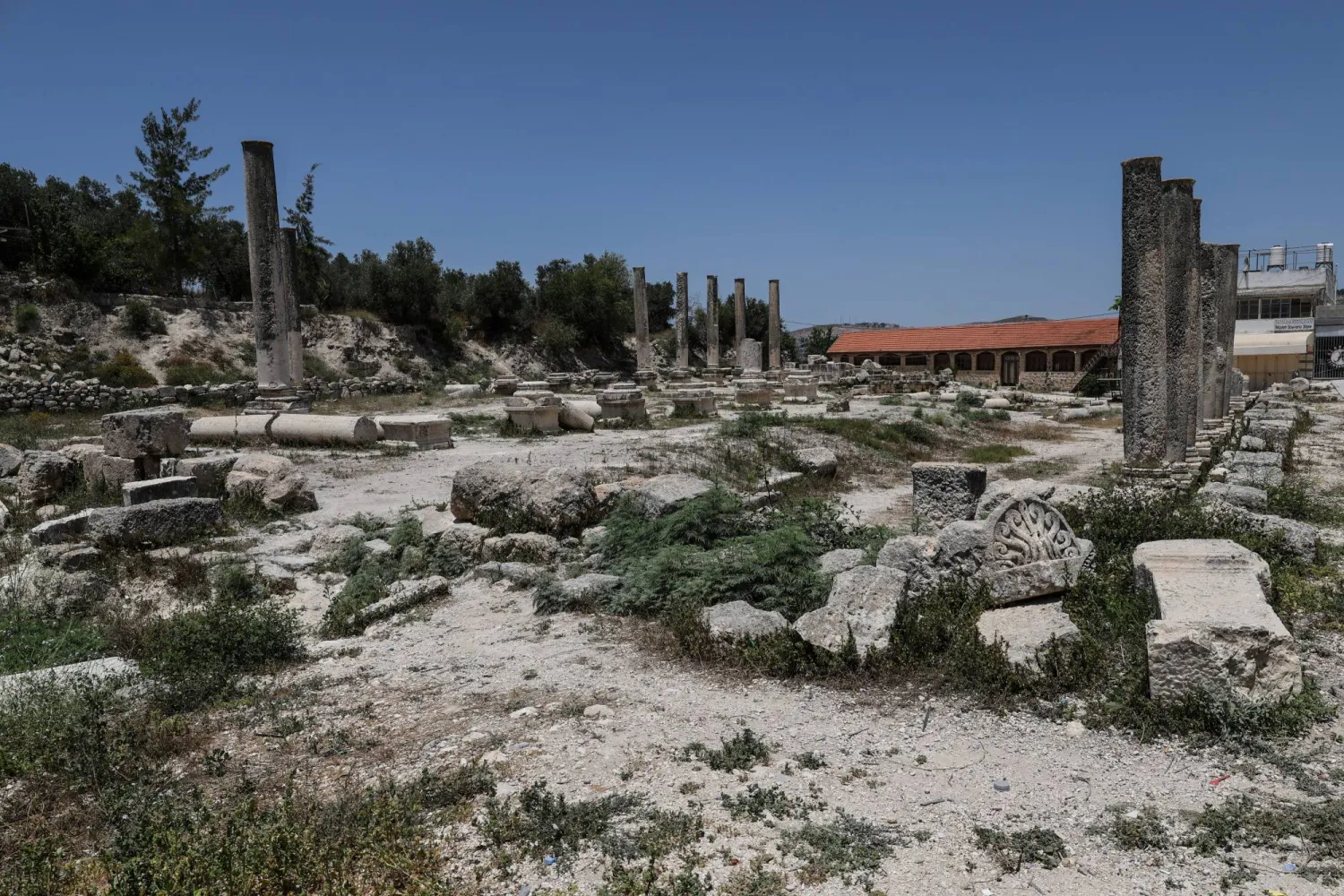
Pillars and archaeological remains in the ancient village of Sebastia, near Nablus in the Israeli-occupied West Bank, June 4, 2026. REUTERS/Ammar Awad
TT

Palestinians Decry Israeli Push for Control over Ancient West Bank Sites

Pillars and archaeological remains in the ancient village of Sebastia, near Nablus in the Israeli-occupied West Bank, June 4, 2026. REUTERS/Ammar Awad

An Israeli bill that would extend civil control over ancient sites in the West Bank has drawn criticism from Palestinians and Israeli rights groups who say it is tantamount to annexation of occupied land and would expand Jewish settlements.

The "Heritage Authority in Judea and Samaria" bill passed one of three votes by Israel's parliament in May, but it is unclear whether the final vote will be held before parliament disperses ahead of an election expected by October 27.

The bill would bring management of Roman, Byzantine and Crusader-era sites under Israeli Ministry of Heritage management and allow related "expropriation and purchase of real estate" in the West Bank, which Israel calls by its Hebrew biblical name, Reuters reported.

That in effect would strip away oversight of some ancient sites from the Western-backed Palestinian Authority, which under the 1990s Oslo peace accords has exercised limited self-rule in parts of ‌the West Bank, ‌territory Israel captured in a 1967 war.

The PA's tourism minister, Hani Al-Hayek, said "control over these ‌antiquities ⁠is intended to ⁠expand control and expand settlements in these areas, deep inside Palestinian territories."

Israel says the bill's purpose is to protect ancient sites.

VILLAGE NEAR ANCIENT SEBASTIA SITE FACES LAND CONFISCATION

Peace Now, an Israeli settlements watchdog, said the bill "constitutes an annexationist measure in every respect" and would lead to broad-scale confiscation of Palestinian land.

Using archaeology to expand settlements is not a new practice, but the scope of the Israeli government's measures has been unprecedented, Peace Now said.

One example is the Palestinian village of Sebastia in the northern West Bank where residents, many of whom trace their roots to the land back centuries, rely heavily on tourism to a nearby archaeological site.

The ancient site in ⁠Sebastia has ruins from the 9th-century B.C. Israelite kingdom as well as Roman, Byzantine, Crusader ‌and Ottoman remnants, archaeologists say. It is on a tentative list for inclusion as ‌a UNESCO World Heritage Site.

In late 2025, Israel announced a plan to seize about 1,800 dunams (445 acres) at the site, which it ‌said was meant to develop the area, affecting around 5,000 olive trees growing in the village groves, village officials said.

"They ‌are incorporating areas containing water resources, roads and antiquities, leaving us as residents without any resources. It is part of settlement expansion," said Sebastia Deputy Mayor Nizar Kayed.

Business had already been suffering since late 2023 with tourism dropping because of war in the region, said Nahed Sakha, whose Sebastia restaurant is on land slated for confiscation.

"It seems that the Israeli plan (is) to isolate the archaeological site from the people," Sakha said.

ISRAEL CITES ‌ANCIENT TIES TO THE LAND

Israeli parliament member Zvi Sukkot, who has been key in advancing the new bill, says extending Israeli control over the sites is meant to safeguard ⁠ancient remnants dating back to biblical ⁠times.

"There's nothing here that changes the legal status of Judea and Samaria," he told Reuters.

"There are many people who are bothered by our desire to prove the ties between the people of Israel and this land," he said. "All the stories of the Bible, all our history, the people (of Israel) were born in Judea and Samaria."

Sukkot is a member of the pro-settler Religious Zionism party. Like many in Prime Minister Benjamin Netanyahu's coalition, he opposes the creation of a Palestinian state and advocates annexation of the West Bank.

UN bodies and most countries view Israel's settlements as illegal under international law, violating the Fourth Geneva Convention provision barring the transfer of civilian population into occupied territory.

Israel rejects this view, saying the West Bank, which it captured in the 1967 war, is disputed territory. It cites security needs and biblical and historical ties to the land.

But the new bill has also caused concern among legal officials in Israel's defense establishment and Israeli scientists.

In an open letter to Netanyahu and Sukkot, the Israel Academy of Sciences and Humanities called for it to be scrapped.

"This will undoubtedly lead to an immediate deterioration in Israel's international relations in the field of archaeology, and it will also have an impact on other areas of science and research," the academy said.



IMF Backs Yemeni Reforms to Restore Economic Stability

An international program aims to reduce Yemen's budget deficit by increasing domestic revenues. (Government media)
TT

IMF Backs Yemeni Reforms to Restore Economic Stability

An international program aims to reduce Yemen's budget deficit by increasing domestic revenues. (Government media)

The Yemeni government and the International Monetary Fund (IMF) have reached a staff-level agreement on an 18-month economic reform program aimed at supporting economic stability, advancing fiscal and monetary reforms, and improving the management of public resources. The program is intended to help Yemen establish a credible reform track record that strengthens confidence among donors and international financial institutions.

The agreement followed talks between an IMF mission and Yemeni officials in Amman, Jordan, from July 5 to 16. The IMF stressed that the proposed program still requires approval by the Fund's management, noting that it is designed to preserve macroeconomic stability amid the continuing impact of the regional conflict while advancing economic and institutional reforms.

The IMF projects that Yemen's economy will contract by 1.5 percent in 2026, marking a fifth consecutive year of economic decline. The downturn is attributed to deteriorating terms of trade caused by the regional conflict, the ongoing energy crisis, and weak domestic demand. However, the Fund expects the economy to begin regaining stability in 2027 as regional conditions improve and economic activity gradually recovers.

The IMF also noted that Yemen will continue to rely heavily on remittances from expatriate workers and donor support to finance imports, particularly humanitarian assistance, given the country's weak public finances and declining traditional sources of revenue. It forecasts that the current account deficit will remain at around 3.4 percent of gross domestic product, while foreign exchange reserves are expected to stay at inadequate levels.

The reform program seeks to reduce the budget deficit during 2026 and 2027 by increasing domestic revenue, following a sharp decline in government spending after oil exports were suspended in 2022.

Fiscal and Monetary Reforms

The IMF said the Yemeni government has already implemented a number of measures, including the liberalization of the customs exchange rate in May, a step expected to increase customs duties and goods and services tax revenues. The authorities have also moved to strengthen tax compliance, particularly among large taxpayers and state-owned enterprises.

The program further includes measures to improve fiscal transparency by bringing previously off-budget revenues and expenditures into the official public accounts, strengthening oversight of government spending, and establishing a Treasury Single Account to improve the management of public resources.

Monetary Policy

On the monetary front, the program focuses on maintaining price stability and gradually rebuilding foreign exchange reserves. It also calls for greater exchange rate flexibility to help absorb external shocks, while reducing reliance on monetary financing of the budget deficit and improving the efficiency of the foreign exchange market.

The program also includes reforms to the financial and banking sector, including the adoption of new bank risk management frameworks, expanded supervision to cover all deposit-taking institutions, publication of audited financial statements for banks, and stronger measures to combat money laundering and terrorist financing.

The IMF said these measures will strengthen Yemen's ability to improve its fiscal position, meet its financial obligations, and create the conditions for broader discussions with international partners on debt restructuring, helping to support more sustainable economic growth in the years ahead.

Yemen and the IMF have agreed on an 18-month economic reform program. (Government media)

Electricity Sector

In the electricity sector, the IMF called for the gradual implementation of a cost recovery plan to improve the financial position of electricity utilities and reduce their reliance on government budget support. It also encouraged efforts to attract new investment to expand power generation capacity and improve the reliability of electricity supplies.

The Fund emphasized that sustained implementation of the agreed reforms will be critical to strengthening Yemen's economic recovery. It said the program represents an important step toward building a track record that would help strengthen confidence among international financial institutions and donors.

At the conclusion of the talks, the IMF mission praised what it described as constructive dialogue and close cooperation with the Yemeni authorities, reaffirming its commitment to continue working with them throughout the implementation of the reform program.


Lebanese Soldier Killed in Army Vehicle Explosion in Southern Lebanon

This photograph taken from the southern Lebanese city of Nabatieh shows smoke as it rises from the site of an Israeli-controlled explosion in the village of Kfar Tebnit on July 18, 2026. (Photo by Abbas FAKIH / AFP)
TT

Lebanese Soldier Killed in Army Vehicle Explosion in Southern Lebanon

This photograph taken from the southern Lebanese city of Nabatieh shows smoke as it rises from the site of an Israeli-controlled explosion in the village of Kfar Tebnit on July 18, 2026. (Photo by Abbas FAKIH / AFP)

A Lebanese soldier was killed and an officer and another soldier were wounded when a suspicious object exploded in an army vehicle in the southern Lebanese town of Mansouri, the Lebanese army said on Saturday.

The army said it was continuing to investigate the incident and did not provide further details.

Lebanon is currently engaged in negotiations with Israel centered on the withdrawal of Israeli forces from areas in southern Lebanon that have remained under Israeli occupation since its most recent war with the Iran-backed Hezbollah.


Jordan's Army Says Shot Down 10 Iranian Missiles

This screen grab made on July 18, 2026 from handout video footage released by the US Central Command (CENTCOM) on July 17, 2026 shows what the US military says is the latest wave of precision strikes on strategic Iranian military sites. (Photo by US Central Command (CENTCOM) / AFP)
TT

Jordan's Army Says Shot Down 10 Iranian Missiles

This screen grab made on July 18, 2026 from handout video footage released by the US Central Command (CENTCOM) on July 17, 2026 shows what the US military says is the latest wave of precision strikes on strategic Iranian military sites. (Photo by US Central Command (CENTCOM) / AFP)

Jordan's army said on Saturday it had shot down 10 Iranian missiles with no casualties or damage, as Tehran retaliated against American strikes by pressing attacks on other countries.

"Air defense systems... intercepted 10 Iranian missiles that had entered Jordanian airspace and were targeting the Kingdom's territory (which) were intercepted and shot down," the army said in a statement, adding that there were no casualties or material damage.

The United States and Iran exchanged strikes aimed at infrastructure and military targets on Saturday as their battle over the Strait of Hormuz intensified.

The region has endured days of back-and-forth attacks in a conflict increasingly focused on control of the strait. The collapse of an interim ceasefire leaves no clear end in sight for the war that the US and Israel began more than four months ago.