
Syria on Friday marked what it called its shift from a “Captagon hub” to a “partner in combating it,” as the world observed the International Day against Drug Abuse and Illicit Trafficking.
The official Syrian Arab News Agency, SANA, said this year’s event was held under the slogan “The global drug problem: persistent issues, new challenges and innovative responses,” citing rapid changes in global drug markets, the rise of new substances and increasingly complex smuggling routes.
SANA said the occasion came as Syria presses ahead with efforts to dismantle drug production and smuggling networks following changes in the file after the fall of the former government, a reference to the government of former President Bashar al-Assad.
“After years in which Syria, under the former regime, was one of the world’s most prominent hubs for producing and smuggling Captagon, the country entered a new phase after liberation,” SANA said in a report on Friday.
That phase, it said, is focused on dismantling drug factories, pursuing trafficking networks and expanding international cooperation, turning Syria “from a source of threat into an active partner in combating it.”
SANA said that in December 2025, one year after Assad’s government fell, the United Nations Office on Drugs and Crime, UNODC, confirmed the disruption of large-scale Captagon manufacturing in Syria.
It said the Syrian government had dismantled 15 Captagon manufacturing facilities and 13 smaller storage sites since December 2024, the month the former government fell.
The agency said UNODC’s 2026 report also noted that disruption in the Captagon market after Assad’s fall had pushed up pill prices in some areas. The report also warned that some users could turn to other synthetic drugs, such as methamphetamine.
Coinciding with the international anti-drug day, SANA said the Interior and Health ministries had launched a national campaign under the slogan “Syria Without Drugs.”
Brig. Gen. Khaled Eid, head of the Anti-Narcotics Directorate, told Syrian Alikhbariah that reaching a “Syria Without Drugs” was not just a slogan, but a national project built on scientific and carefully studied plans.
He said the campaign rests on a balance between deterrence and treatment. “The user is viewed as a victim who requires care, while the dealer and smuggler are treated as perpetrators of a crime that requires punishment,” he said.
Eid said the Interior Ministry had faced “a complex reality” in recent months, including local manufacturing centers and distribution networks targeting young people. He said this required stronger security controls, tighter oversight of border crossings, better-equipped anti-narcotics units with modern tracking technology, and an integrated database on active networks.
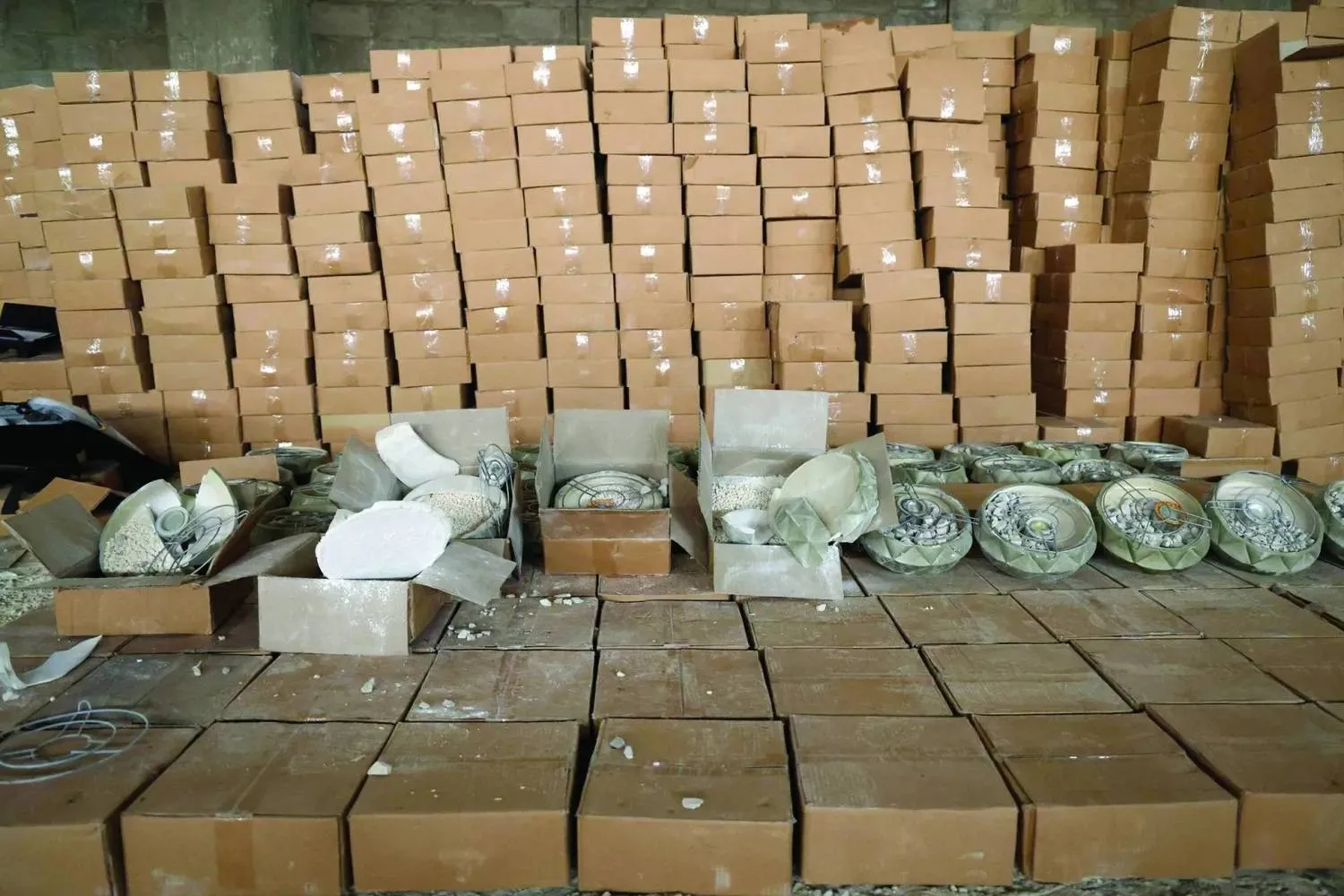
According to SANA, Syria’s Anti-Narcotics Directorate has carried out 1,550 drug seizures and interdiction operations since Assad’s fall. The operations led to the dismantling of 90 international smuggling networks and the closure of 17 Captagon factories.
The seized materials included 697 million Captagon pills, 15 metric tons of hashish, 10 million narcotic pharmaceutical pills, 180 kg of cocaine, 84.5 kg of crystal meth, 7 kg of heroin and 221 metric tons of chemical precursors, according to Eid.
Separately, the UN Security Council unanimously passed a resolution renewing the mandate of the United Nations Disengagement Observer Force in the Golan, known as UNDOF, during a session on Thursday.
Syrian Alikhbariah quoted Syria’s Permanent Representative to the United Nations, Ibrahim Olabi, as saying at the session that Syria was now one of the most stable countries in the region and was “engaged in reconstruction, restoring institutions and attracting investment.”
He also cited Syria’s cooperation with international partners on counterterrorism, chemical weapons-related obligations and regional security.
Olabi also addressed political change in Syria, saying “the change in Syria was represented by the disappearance of a regime that practiced torture and used chemical weapons.”
On Israel, Olabi expressed “Syria’s concern over Israeli statements about not withdrawing from Syria,” saying “Israel’s current actions can be interpreted as an attempt to seize the lands it occupied.”
Olabi said the change in Syria that Israel appeared to fear was the removal of “an authoritarian regime that used chemical weapons against its people.” He asked whether Israel preferred the situation that had existed under Assad.
UNDOF was established after the October 1973 war under the Disengagement of Forces Agreement signed by Syria and Israel in 1974. The force has operated since then in the buffer zone to monitor compliance with the ceasefire in the Syrian Golan Heights, which Israel has occupied since 1967.