


Regional Turmoil Fuels Growing Defense Cooperation Between Egypt, Türkiye

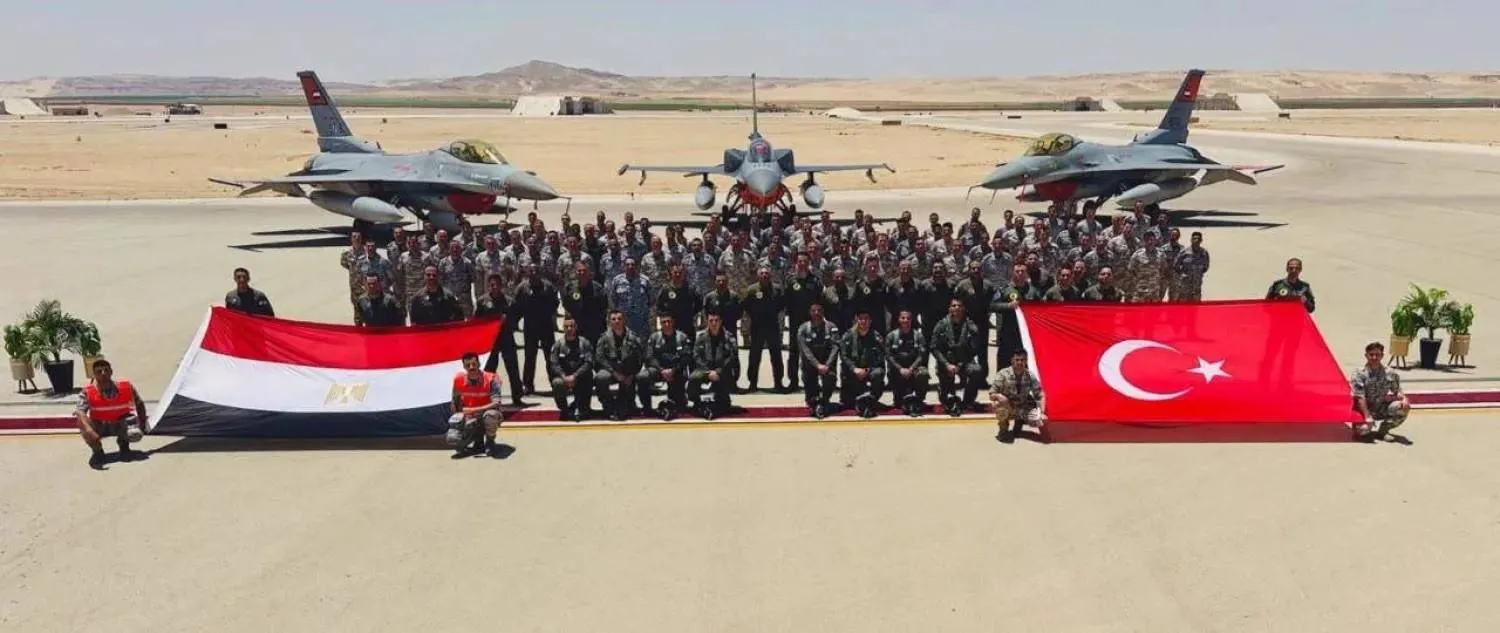
An Egyptian-Turkish joint air exercise hosted at Egyptian air bases this month (Egyptian military spokesman) 
TT

Regional Turmoil Fuels Growing Defense Cooperation Between Egypt, Türkiye

An Egyptian-Turkish joint air exercise hosted at Egyptian air bases this month (Egyptian military spokesman) 

Egypt and Türkiye have stepped up military cooperation in recent months through a series of joint exercises, the launch of a high-level military dialogue in Cairo, and the signing of a “framework military agreement” four months ago, against the backdrop of escalating regional tensions.

Türkiye’s Ministry of National Defense announced Thursday that the Turkish, Egyptian and Azerbaijani air forces are conducting their first trilateral air exercise in Turkish airspace. The announcement came days after the conclusion of a separate Egyptian-Turkish air drill. The Turkish Armed Forces also said that Chief of the General Staff Gen. Selcuk Bayraktaroglu held talks with Egyptian officials in Cairo on Thursday.

Military officers and analysts told Asharq Al-Awsat that the expanding defense partnership is primarily intended as a deterrent amid regional instability. They said it is part of the broader Egyptian-Turkish rapprochement and reflects growing coordination on key regional issues.

Relations between Cairo and Ankara have steadily improved after years of estrangement. The two countries reinforced ties by establishing a Strategic Cooperation Council, which held its second meeting in Cairo in February during President Recep Tayyip Erdogan’s visit to Egypt. The meeting produced several cooperation agreements, including a framework military accord.

Alongside closer political coordination, defense ties have expanded through a series of joint exercises. According to Türkiye’s Defense Ministry, the trilateral drill will run through July 3 and is designed to enhance operational capabilities while testing new technical and tactical procedures for air operations.

The exercise follows a bilateral Egyptian-Turkish air drill held at Egyptian air bases from June 11 to 21, involving multirole fighter aircraft of various types.

Military cooperation has also expanded beyond air operations. Egypt and Türkiye conducted the Sea of Friendship naval exercise in the Mediterranean in September 2025, while Turkish and Egyptian special forces held joint training in Ankara from April 21 to 29, 2025.


Maj. Gen. Nasr Salem, former head of the Egyptian Armed Forces Reconnaissance Department, and advisor at the Nasser Military Academy for Postgraduate Studies, said joint exercises serve several strategic objectives, including exchanging expertise and enhancing combat readiness.

Salem told Asharq Al-Awsat that the intensified Egyptian-Turkish drills also send a deterrent message in light of regional turmoil by demonstrating the capabilities and preparedness of both militaries to confront threats to their national security and strategic interests. “The principle of military deterrence,” he stated, “is that if you want to prevent war, you must prepare for it.”

In parallel with the exercises, Egypt and Türkiye held a high-level military dialogue attended by Egyptian Armed Forces Chief of Staff Lt. Gen. Ahmed Fathi Khalifa, Bayraktaroglu, and senior military officials from both countries, Türkiye’s Defense Ministry said.

Political analyst Taha Oghlu, who specializes in Turkish affairs and international relations, described Egyptian-Turkish ties as undergoing “an unprecedented rapprochement.” He said cooperation now extends beyond diplomacy to encompass deepening military and defense ties, reflected in joint exercises and the launch of the military dialogue.

Speaking to Asharq Al-Awsat, Oghlu said the defense partnership is driven by shared interests and growing coordination on Libya, Syria, Gaza, and the Iran war. He added that instability across the Middle East — particularly the war in Gaza and the crisis in southern Lebanon — has accelerated the rapprochement.

The two countries have also intensified diplomatic contacts. Most recently, Turkish Foreign Minister Hakan Fidan visited Cairo last week for talks with his Egyptian counterpart Badr Abdelatty on bilateral ties. He also joined a meeting of the regional quartet comprising the foreign ministers of Egypt, Türkiye, Saudi Arabia, and Pakistan to discuss regional developments.

Oghlu said Azerbaijan’s participation in the latest exercise sends a clear signal that Egyptian-Turkish defense cooperation is acquiring broader strategic and geographic dimensions that extend beyond the Eastern Mediterranean and could help reshape the region’s security outlook.


How Egypt Benefits From Expanding Nile Basin Power, Water Projects

Tanzania’s president and Egypt’s prime minister attend the inauguration of the Julius Nyerere Dam in Tanzania last month. (Egyptian Cabinet/Facebook)
TT

How Egypt Benefits From Expanding Nile Basin Power, Water Projects

Tanzania’s president and Egypt’s prime minister attend the inauguration of the Julius Nyerere Dam in Tanzania last month. (Egyptian Cabinet/Facebook)

Egypt is seeking funding for 36 projects in the southern Nile Basin, expanding its role in the region through hydropower, electricity and water schemes that experts say could benefit both Cairo and its neighbors.

The projects include power interconnections, transmission lines, water supplies and multipurpose schemes. Experts told Asharq Al-Awsat that Egypt’s growing involvement was guided by a principle of mutual benefit.

The southern Nile Basin countries are Burundi, Congo, Kenya, Rwanda, South Sudan, Tanzania and Uganda. They are among the Nile’s upstream countries and, together with the eastern Nile countries of Ethiopia, Sudan, Egypt and Eritrea, make up the Nile River Basin region.

Egyptian Minister of Water Resources and Irrigation Hani Sewilam said on Friday that Cairo had agreed to support efforts to mobilize funding for the 36 projects after studying them, exchanging information, assessing their impacts and reaching agreement through consultations.

Sewilam pointed to Tanzania’s Julius Nyerere Dam as a practical example of cooperation among Nile Basin countries. The Egyptian-Tanzanian partnership had brought gains to both sides, he said.

The dam provides electricity for Tanzania, Sewilam said, and its power could also support regional integration, cross-border connections and electricity trade with neighboring countries.

He also cited the Grand Fula Dam project in South Sudan, saying Egypt supported Juba’s development goals, including that project.

Tanzania inaugurated the Julius Nyerere hydropower dam and plant in late August. The Egyptian consortium of Arab Contractors and Elsewedy Electric built it over five years, with 1,700 Egyptian engineers and technicians among a workforce of about 12,000.

Hussein al-Buheiri, an African affairs expert at the National Center for Middle East Studies, said Egypt had the resources and capabilities to play a central role in developing Nile Basin and Horn of Africa countries, particularly through hydropower dams and irrigation and agricultural projects.

He said Egyptian companies’ work on the Julius Nyerere Dam and Egypt’s help in building power plants in countries such as Djibouti showed how the country could act as a strategic development partner.

African countries gained development, while Egypt gained investment and thousands of jobs, he said.

That approach also advanced Egyptian foreign policy and helped protect its Nile water security by drawing basin countries closer to Cairo and countering Ethiopian moves, al-Buheiri said.

Salah Halima, deputy chairman of the Egyptian Council for African Affairs and a former assistant foreign minister, said Egypt’s support for development projects reflected a broader commitment to shared interests and sustainable development across the basin.

Egypt had long supported water and electricity projects in Nile Basin countries, approving and helping carry out dozens of them, he said. That record showed Cairo’s support for those countries’ right to develop without harming others.

Halima described current water projects as an expression of partnership and mutual investment between Egypt and its African neighbors. Their expansion, he said, was part of longstanding collective action and close cooperation.

The message, he said, was clear: understanding and cooperation, rather than confrontation or dispute, should guide the management of international rivers.


Can Libyan Lawmakers Force a Change in Parliament’s Leadership?

A still from the Libyan House of Representatives’ latest session on Sept. 15 (video posted by the House on its Facebook page)
TT

Can Libyan Lawmakers Force a Change in Parliament’s Leadership?

A still from the Libyan House of Representatives’ latest session on Sept. 15 (video posted by the House on its Facebook page)

A push to change the rules of Libya’s parliament and rotate its leadership has put a question to the Benghazi-based chamber: Can lawmakers unseat Speaker Aguila Saleh after nearly 12 years at its helm?

The effort has also raised questions about why a bloc opposed to Saleh’s “unilateral decision-making” is acting now, whether its campaign is tied to the “4+4” agreement, and whether that deal can be carried out.

The agreement is seen as a possible route out of Libya’s political divide through a unified executive authority that would lead the country to elections within two years.

The lawmakers opposing Saleh say they will press on with efforts to “reform parliament and change its leadership.”

They say they were blocked from holding a session on the issue in the middle of last week when the chamber’s Benghazi headquarters was closed on its leadership’s orders.

Issam al-Jehani, a prominent member of the bloc, said its 86 lawmakers could meet in any Libyan city where they could carry out their duties.

Their aim was “neither a conspiracy nor an attempt to take Saleh’s seat,” he said, but reform in response to Saleh’s unilateral decisions and determination to stay in office.

Other political figures say the campaign could splinter and fade. Its momentum, they argue, depends on the balance of power in eastern Libya and on regional pressure.

Lawmaker Ali al-Takbali expects it to lose steam. He told Asharq Al-Awsat that a similar call in March for a session to change parliament’s rules came to nothing.

He also questioned whether Saleh’s opponents could keep enough lawmakers together to hold a session to remove him. They may unite over a grievance, al-Takbali said, but become harder to assemble once they return home, particularly if some reconsider their position because of personal interests or tribal ties.

Fellow lawmaker Montaser al-Hassi warned that some members’ actions could split parliament. Lawmakers have the right to amend its rules, he said, but must do so through legal channels.

Libya has long been divided between two governments: the interim Government of National Unity led by Abdulhamid al-Dbeibah in Tripoli, and Osama Hammad’s parliament-appointed government, which runs the east and some southern cities and is backed by Libyan National Army commander Field Marshal Khalifa Haftar.

Under the “4+4” agreement reached late last month by representatives of the Government of National Unity and the Libyan National Army under UN auspices, a new presidential council and unified government would prepare the country for general elections within two years.

Some observers and political figures say regional countries regard Saleh’s continued leadership as a safeguard against a split in the legislature, which they describe as the only institution to have remained intact through Libya’s institutional divisions.

Analyst Hossam Fnish linked the turmoil in parliament to the “4+4” deal. He said the reform bloc’s insistence on changing the rules before holding sessions would delay incorporating the agreement into Libya’s constitutional declaration, hindering a deal that could lead to elections and end the divide.

The UN mission, he said, prefers to incorporate the agreement through a constitutional amendment before seeking Security Council endorsement.

Fathi al-Shibli, head of the Voice of the People party, questioned the reform bloc’s motives. Complaints about Saleh making decisions alone and sessions going ahead without a quorum had circulated for years without drawing objections from lawmakers, he said.

That, in his view, lent weight to suspicions that the dispute was a struggle between blocs backed by powerful interests, rather than a drive for reform.

Al-Shibli expects Saleh to remain in office until the UN mission calls for a constituent council to replace parliament and the High Council of State to implement the “4+4” agreement. He said both bodies oppose a change to Libya’s political landscape.

Political analyst Mohammed Mahfouz likewise described the parliamentary dispute as a contest between powerful groups in eastern and western Libya, each seeking to show the international community that it can control the political scene.

Saleh’s hold on his position rests on two factors, Mahfouz told Asharq Al-Awsat: whether he and his allies can absorb the current anger, and whether regional and Western countries support him.

Saleh’s two deputies may help him contain the challenge, Mahfouz said, because they too could face replacement.


Iraq’s PM Tells UN The State Alone Will Decide War, Peace

Iraqi Prime Minister Ali al-Zaidi speaks during the 81st session of the United Nations General Assembly on Sept. 25, 2026. (AP)
TT

Iraq’s PM Tells UN The State Alone Will Decide War, Peace

Iraqi Prime Minister Ali al-Zaidi speaks during the 81st session of the United Nations General Assembly on Sept. 25, 2026. (AP)

Iraqi Prime Minister Ali al-Zaidi said on Friday that one of his government’s priorities was to ensure the state alone decides matters of war and peace, stressing that weapons must remain in the hands of constitutional institutions.

“The practical measures to bring weapons and decisions on war and peace under state control are moving in the right direction,” al-Zaidi told the UN General Assembly.

He called them essential to building state institutions, protecting sovereignty and securing stability.

He said the end of the international coalition’s mission in Iraq would mark a new phase in relations with strategic partners, shifting from military cooperation to economic and development cooperation. Iraq would continue to strengthen its security and military capabilities, he added.

Al-Zaidi called for tighter border controls, the closing of security gaps and continued vigilance against conditions that could fuel extremism.

He reiterated Iraq’s support for dialogue, diplomacy, respect for sovereignty, noninterference and good neighborly relations, and urged countries to resolve conflicts through negotiations and prevent renewed wars.

He urged the world to engage more closely with Iraq, saying the country could contribute to security and stability.

He also highlighted the Development Road project as a “strategic corridor for trade, investment and energy” linking Iraq’s Grand Faw Port to Türkiye and, from there, Europe.

“Iraq has never been on the margins. It is at the heart of history and the pulse of the present, and it deserves a partnership for the future,” he said.

US Secretary of State Marco Rubio had warned Baghdad that militias must be disarmed to avoid the “Balkanization of Iraq,” amid growing pressure on the Iraqi government to bring weapons under state control.

Rubio expressed US support for al-Zaidi’s efforts to strengthen state authority and called for armed factions to be dismantled. He warned that competing centers of power could fragment Iraq and weaken its institutions.

Al-Zaidi had proposed a plan beginning with a 90-day period during which armed factions would cease attacks, with the transfer of weapons to the state to be completed by June 30, 2027.
