Political Stalemate Opens Door to Re-elections in Iraqi Kurdistan

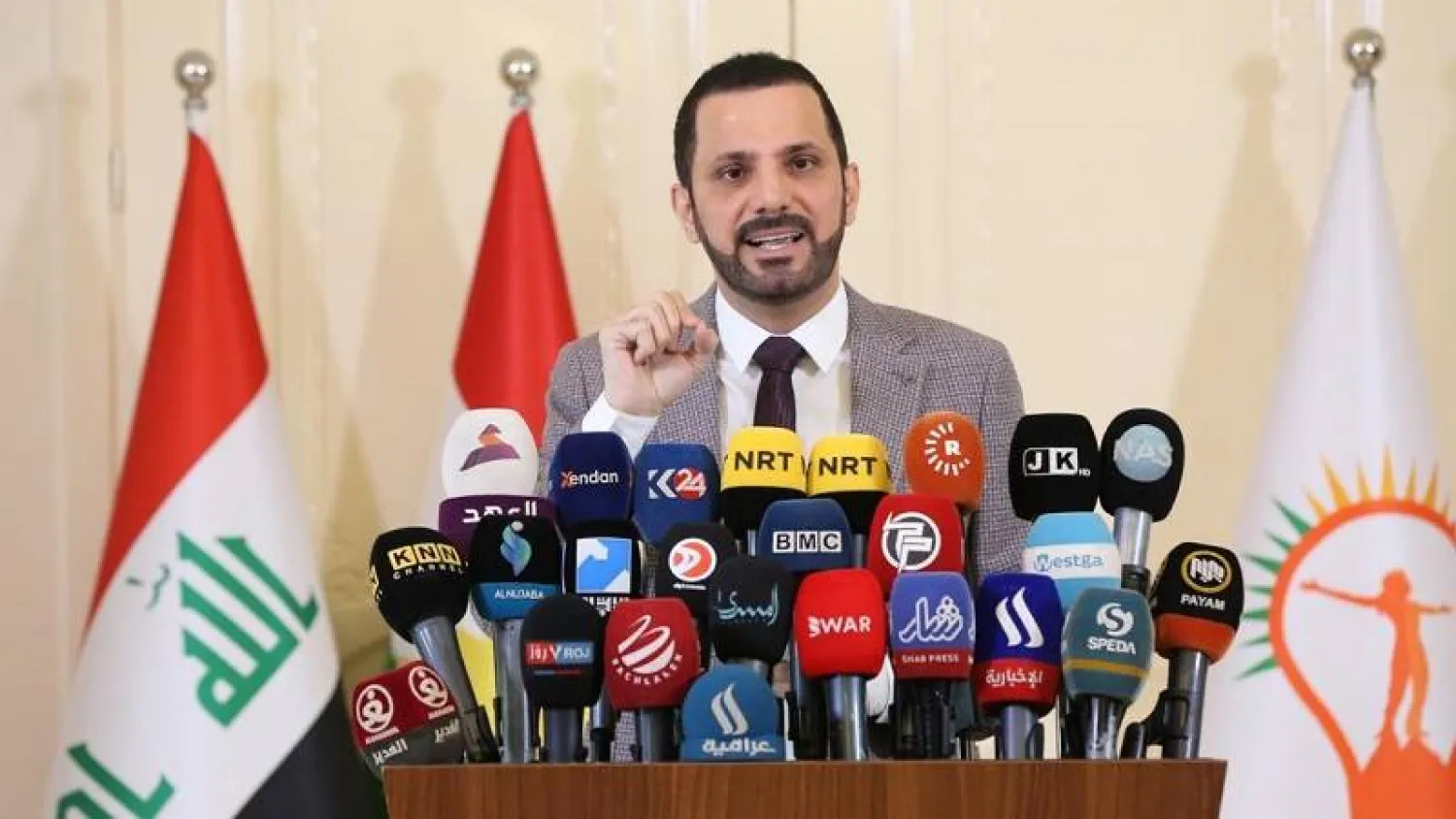
New Generation party leader Shaswar Abdulwahid (NRT Channel)
TT

Political Stalemate Opens Door to Re-elections in Iraqi Kurdistan

New Generation party leader Shaswar Abdulwahid (NRT Channel)

The stagnant situation in the Kurdistan Region is stirring towards the formation of a new government, a process delayed for nearly two years since the elections in October 2024; however, the task may prove difficult due to skirmishes between two camps of rival parties vying for greater influence within the anticipated ministerial lineup.

Despite the presence of emerging parties like the New Generation in the alliance map, the Kurdistan Democratic Party (KDP), led by Masoud Barzani, and the Patriotic Union of Kurdistan (PUK), led by Bafel Talabani, still control the political tempo in the Kurdish region of Iraq.

A KDP leader stated that "the continued failure to form a government brings the factions closer to the option of re-elections", while the rival front demands the position of Prime Minister in the region and an equal share of government positions, according to politicians and activists.

Both the PUK and the New Generation are betting on an alliance that, so far, secures about 38 seats, bringing them close to the KDP's 39 seats, out of the one hundred seats that make up the Kurdistan Region Parliament.

Given this numerical equation, the numerically smaller parties in parliament play the role of a "kingmaker" that can tip the scales for one of the two fronts over the other, leading to an absolute majority (51 seats), which fuels the political squabbles and maneuvers active in the public sphere these days.


Egypt, Türkiye Conclude Joint Military Exercise

The training featured conventional and unconventional live-fire drills, vertical assault exercises using an aircraft simulator and training on handling improvised explosive devices. (Egyptian military spokesman on Facebook)
TT

Egypt, Türkiye Conclude Joint Military Exercise

The training featured conventional and unconventional live-fire drills, vertical assault exercises using an aircraft simulator and training on handling improvised explosive devices. (Egyptian military spokesman on Facebook)

Egypt and Türkiye have concluded a joint military exercise focused on countering drones and conducting unconventional live-fire drills, with the participation of Egyptian airborne and commando units and Turkish special forces.

According to a statement issued Saturday by the Egyptian military spokesperson, the final phase of the multi-day Golden Eagle exercise included “an operation to storm a terrorist stronghold in a residential area using helicopters, during which hostages were freed and the terrorist elements apprehended.”

The training featured conventional and unconventional live-fire drills, vertical assault exercises using an aircraft simulator and training on handling improvised explosive devices.

Participants trained in first aid and lifesaving procedures, the use of unmanned aerial vehicles and methods of countering them, free-fall simulation in a vertical wind tunnel and operational free-fall parachute jumps.

The exercise comes amid growing military cooperation between Egypt and Türkiye, reflected in a series of joint drills held since the two countries signed a military framework agreement five months ago during Turkish President Recep Tayyip Erdogan’s visit to Cairo in February.

The Egyptian military spokesperson said the exercise also included a “friendship jump” in which troops carried the flags of both countries, demonstrating the participants’ “high level of proficiency and advanced technical skills.”

The final phase was attended by several senior Egyptian and Turkish military commanders, as well as Türkiye’s military attaché in Cairo.

The first phase of Golden Eagle included theoretical lectures on a range of subjects aimed at standardizing operational concepts and improving integration and coordination among participating personnel. An exhibition of the weapons and equipment used during the exercise was also held.

Last week, Egypt’s commander-in-chief of the armed forces and minister of defense and military production, Ashraf Salem Zaher, met Turkish Defense Minister Yaşar Güler in Türkiye to discuss strengthening military cooperation in training and the transfer and exchange of expertise between the two countries’ armed forces.


Iran, Iraqi Factions Criticize Al-Zaidi’s Washington Visit

US President Donald Trump shakes hands with Iraqi Prime Minister Ali al-Zaidi at the White House on July 14, 2026. (AFP) 
TT

Iran, Iraqi Factions Criticize Al-Zaidi’s Washington Visit

US President Donald Trump shakes hands with Iraqi Prime Minister Ali al-Zaidi at the White House on July 14, 2026. (AFP) 

Iraqi Prime Minister Ali al-Zaidi received a notably warm welcome during his visit to the United States, where he met President Donald Trump and sought to translate political rapprochement into economic and investment partnerships.

Drawing on his business background, al-Zaidi told US companies they shared “a common language — the economy.” He stressed, however, that he had not come to the United States as a “contractor,” but to pursue broad-based development in Iraq, which he said had missed opportunities for growth over the past two decades despite its ties with successive US administrations.

Al-Zaidi linked Iraq’s next security and political phase to a new era of economic cooperation. He noted that the departure of the remaining US forces after September 30, under an agreement reached between the government of former Prime Minister Mohammed Shia al-Sudani and Washington, could open the door to broader economic and investment partnerships.

Before the visit, al-Zaidi said Iraq would no longer need the concept of “resistance” after the end of September, arguing that “resistance is not a profession, but a necessity” imposed by the country’s past circumstances.

His outreach drew criticism from Iran-aligned groups and their Iraqi allies, who argued that opening the door to US companies represented a political and economic shift requiring reassessment.

The criticism coincided with Iraq’s signing of about 48 memorandums of understanding and agreements with US companies, alongside energy deals that included an oil export route bypassing the Strait of Hormuz and a memorandum of understanding with Syria to transport Iraqi oil to the Syrian port of Banias.

Velayati Criticizes Al-Zaidi

The developments also drew criticism in Tehran, where Ali Akbar Velayati, an adviser to Iran’s supreme leader, described al-Zaidi as “inexperienced,” according to media reports.

Writing in the newspaper Farhikhtegan, Velayati said the Iraqi prime minister’s conduct during his meeting with Trump, shortly after the funeral of former Supreme Leader Ali Khamenei, was “a great disgrace.”

Observers say the dispute reflects intensifying competition over Iraq’s future relationship with both the United States and Iran, as Baghdad seeks to attract foreign investment while preserving its regional balance.

Analyst Iyad al-Samawi questioned whether Iraq was truly prepared to host major US companies and provide an adequate investment climate.

“Global companies do not invest on emotion or gamble with their decisions,” he underlined, stating that they look not only for oil, but also for security, stable legislation, judicial independence, efficient procedures, clear decision-making, and institutional integrity.

He added that major US companies operate under strict anti-bribery and anti-corruption laws and would not lower their standards to accommodate an unstable business environment. The success of the agreements signed in Washington, he said, “begins not with the companies, but with the Iraqi state itself.”

A former security official told Asharq Al-Awsat that the campaign against al-Zaidi was “not merely a passing political escalation,” but reflected concerns that his economic opening could create a more favorable environment for US companies.

Speaking on condition of anonymity, the official said al-Zaidi was seeking to apply his business experience to government by “blending politics with finance and business.” But major US companies, he added, would not invest in Iraq as long as political corruption and security instability persisted.

The official argued that pressure from Iran and allied Iraqi factions was intended to slow the economic opening championed by the prime minister.


Lebanon’s Aoun to Meet Trump at White House, Hoping to Generate Pressure on Israel

Lebanese President Joseph Aoun attends a cabinet session to discuss the army's plan to disarm Hezbollah, at the Presidential Palace in Baabda, Lebanon, September 5, 2025. (Reuters)
TT

Lebanon’s Aoun to Meet Trump at White House, Hoping to Generate Pressure on Israel

Lebanese President Joseph Aoun attends a cabinet session to discuss the army's plan to disarm Hezbollah, at the Presidential Palace in Baabda, Lebanon, September 5, 2025. (Reuters)

Lebanese President Joseph Aoun will make his first trip to the White House this week to present a plan to US President Donald Trump on how to disarm Iran-backed group Hezbollah and secure Israel's withdrawal from Lebanon.

Aoun, who served as the commander of Lebanon's US-backed army before being elected president last year, is the first Lebanese head of state in nearly 20 years to visit the White House, where he will meet Trump face-to-face for the first time.

Tuesday's meeting comes at a crucial moment for Lebanon: Israeli troops are occupying a swathe of the country's south, hundreds of thousands of Lebanese remain displaced following Israeli strikes and Hezbollah has firmly rejected the government's direct talks with Israel and efforts by the state to strip it of its arms.

In comments published by his office last week, Aoun said he would ask Trump to "exert the necessary pressure on Israel" to implement a US-brokered June 26 agreement between Lebanon and Israel. That deal aims to disarm ‌Hezbollah, see a progressive Israeli ‌troop withdrawal and set the stage for peaceful ties between the two countries.

A Lebanese official ‌said ⁠Aoun would present ⁠Trump with a written proposal on how to decommission Hezbollah's massive arsenal. The official said Aoun believes only Trump possesses the leverage needed to pressure Israel to withdraw its troops and help Lebanon restore its sovereignty.

SEEKING HEZBOLLAH'S DISARMAMENT

Aoun, 62, became president last year just before Trump began his second term in the White House. The US welcomed Aoun's election.

A career soldier, Aoun was wounded twice and still carries a shrapnel wound. His rise reflected a major shift in the power balance in Lebanon, following a devastating Israeli offensive against Hezbollah in 2024 and the ousting ⁠of Hezbollah's Syrian ally President Bashar al-Assad — seismic events that weakened the group and its long-decisive hold ‌over the state.

At his swearing-in ceremony, Aoun vowed to affirm "the state's right to a ‌monopoly on arms".

His presidency's first year was defined by a government bid to secure the disarmament of Hezbollah, which was founded by Iran's Revolutionary Guards ‌in 1982 and has fought numerous wars with Israel.

Lebanese troops deployed in southern Lebanon to collect Hezbollah weapons caches, in line with ‌a ceasefire after the 2024 war and without opposition from a weakened Hezbollah.

A NEW WAR ERUPTS

But early into his term's second year, a new war erupted when Hezbollah fired at Israel on March 2 in support of Iran, which was under US and Israeli attack.

Hezbollah's attack triggered a fierce Israeli air and ground campaign that has killed more than 4,300 people, according to Lebanon's health ministry, including nearly 800 children, women and medics.

The toll does not distinguish ‌between civilians and combatants. Hezbollah has not announced a toll for its fighters.

After the war began, Aoun swiftly called for direct talks with Israel, a historic departure for a state repeatedly ⁠invaded by Israel since 1978. It led ⁠to the highest-level face-to-face contacts in decades between the two countries.

It also made him the focus of fierce criticism by Hezbollah and its supporters.

Aoun has stood firm, criticizing Hezbollah for starting the war and saying Lebanon was being destroyed for the sake of Iran.

Still, he has stopped short of agreeing to Trump's call for him to meet Israeli Prime Minister Benjamin Netanyahu.

A MILITARY VETERAN

Aoun was born in Sin al-Fil, a suburb of eastern Beirut. His family originally hails from south Lebanon. His first army assignment was as a platoon commander in the army rangers in 1985, during Lebanon's 1975 to 1990 civil war.

Shortly after his promotion to commander, he oversaw a campaign to rout ISIS militants at the Syrian-Lebanese border. He led the army through the crisis that followed Lebanon's financial implosion of 2019, which devastated the Lebanese currency after decades of state corruption and bad governance.

At the time, Aoun warned that the crisis would lead to the collapse of the Lebanese army, "the backbone of the country".

In an unusually political statement for an army commander, he criticized ruling politicians over the collapse, saying soldiers were going hungry along with the rest of the population and asking politicians, "what do you intend to do?"

Aoun's election ended a two-year presidential vacuum following the 2022 end of the term of Hezbollah ally Michel Aoun, who is no relation. He has pledged to work on long-delayed economic reforms and vowed justice for victims of the Beirut port explosion of 2020.