


In South Lebanon, Netanyahu Says Israel Will Stay as Long as Hezbollah ‘Threatens Us’

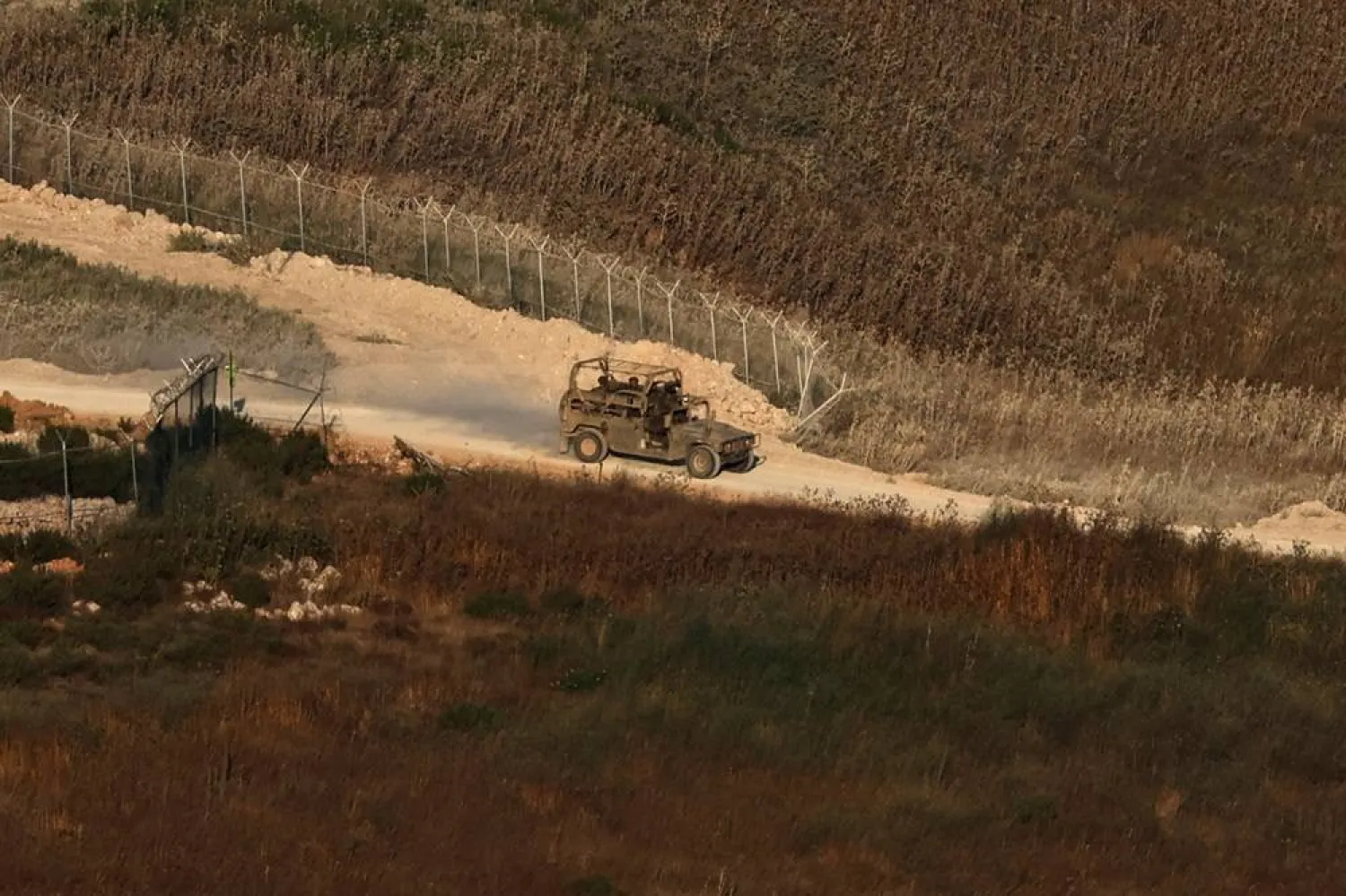
An Israeli military vehicle maneuvers on the Lebanese side of the Israel-Lebanon border, as seen from the Upper Galilee in northern Israel, 29 June 2026, amid a ceasefire between Israel and Lebanon. (EPA)
TT

In South Lebanon, Netanyahu Says Israel Will Stay as Long as Hezbollah ‘Threatens Us’

An Israeli military vehicle maneuvers on the Lebanese side of the Israel-Lebanon border, as seen from the Upper Galilee in northern Israel, 29 June 2026, amid a ceasefire between Israel and Lebanon. (EPA)

Israeli Prime Minister Benjamin Netanyahu visited troops in southern Lebanon on Tuesday, vowing that his country's forces would stay in the area as long as Iran-backed Hezbollah remained a "threat". 

His comments came after Lebanon and Israel signed a framework agreement under US sponsorship last week to pave the way for peace between them and disarm Hezbollah. 

The deal makes any Israeli withdrawal from occupied Lebanese land conditional on Beirut disarming Hezbollah by creating "pilot zones" that the Lebanese military will take over. 

"Our position is clear: we will not leave southern Lebanon until the threat has disappeared. And as long as Hezbollah, armed, is here and threatening us, we will stay here," Netanyahu said according to a statement from his office. 

He added that "we say to Iran and to Hezbollah: leave this place, you no longer belong here... There are two sovereign states that want to live in peace". 

Hezbollah drew Lebanon into the Middle East war in March with rocket fire at Israel, triggering Israeli airstrikes and a ground invasion. 

Israeli troops are operating in a self-declared occupied "security zone" stretching around 10 kilometers (six miles) deep inside Lebanese territory along the border. 

Lebanese authorities say Israeli attacks since the war began on March 2 have killed more than 4,200 people. 

In the same period, the Israeli military has reported 38 soldiers and one civilian contractor killed. 


Lebanon Hopes for New Staff-Level Agreement with IMF

A view of the International Monetary Fund (IMF) logo at its headquarters in Washington, DC, US, November 24, 2024. (Reuters)
TT

Lebanon Hopes for New Staff-Level Agreement with IMF

A view of the International Monetary Fund (IMF) logo at its headquarters in Washington, DC, US, November 24, 2024. (Reuters)

Lebanon hopes for a new staff-level agreement with the International Monetary Fund, Finance Minister Yassine Jaber has said, adding that a full IMF program still required Beirut to pass a final law to address losses from its financial crisis.

Lebanon first signed a staff-level agreement with the IMF in April 2022, more than two years after its financial system imploded following decades of profligate spending and corruption in the ruling elite. But it was slow to implement the promised changes.

The current government has fast-tracked ‌reforms, including ‌a bank restructuring law that was welcomed by the ‌IMF ⁠in August.

Jaber was ⁠in Washington on Monday to meet with IMF Managing Director Kristalina Georgieva. In comments published late on Sunday, Jaber said he would tell her it was imperative to start work on a full IMF program, which would be expected to involve loans, as Lebanon had worked seriously on financial reforms over the last 18 months.

"Lebanon has ⁠accomplished a phase; it passed the banking restructuring law, ‌which was of course a ‌very important message to the Fund and to the world that the parliament ‌and the Lebanese government are serious about reforms," Jaber said ‌in a video released by his ministry.

He said a full-scale agreement with the IMF would have to wait for the passing of the "financial gap law", legislation intended to distribute the losses from the 2019 crash.

In 2022, the ‌government put the losses at about $70 billion, a figure that is likely to be higher now. ⁠Those losses ⁠need to be distributed between the state, the central bank, commercial banks and depositors, to allow depositors who have been frozen out of their savings to gradually recover their money.

A source familiar with the process said a staff-level agreement could be signed as soon as Monday. A second source said it was likely by the end of the year.

A full IMF program in any case takes longer as it requires approval by the IMF board.

The government put forward a financial gap bill last year but it has yet to be passed.

Financial reforms have been repeatedly derailed by political and private interests over the last seven years.


Lebanon Says Israeli Army Set off Large Explosion in South

 Smoke rises in al-Mansouri following Israeli explosions reported by Lebanon’s state news agency NNA as seen from Hinniyeh, southern Lebanon, September 28, 2026. (Reuters)
Smoke rises in al-Mansouri following Israeli explosions reported by Lebanon’s state news agency NNA as seen from Hinniyeh, southern Lebanon, September 28, 2026. (Reuters)
TT

Lebanon Says Israeli Army Set off Large Explosion in South

 Smoke rises in al-Mansouri following Israeli explosions reported by Lebanon’s state news agency NNA as seen from Hinniyeh, southern Lebanon, September 28, 2026. (Reuters)
Smoke rises in al-Mansouri following Israeli explosions reported by Lebanon’s state news agency NNA as seen from Hinniyeh, southern Lebanon, September 28, 2026. (Reuters)

The Israeli military set off a significant explosion in the southern Lebanese village of al-Mansouri on Monday, Lebanese state media and AFP correspondents said as Israel said it had completed an operation in the area.

"A massive explosion rocked the town of al-Mansouri in the Tyre district a short while ago. The explosion was carried out by Israeli occupation forces," Lebanon's state-run National News Agency reported.

"The sound of the explosions was heard in the city of Tyre and several surrounding villages," the NNA added.

AFP correspondents saw large clouds of smoke emerge from the largely destroyed town after the loud explosion was heard.

The Israeli military said in a statement that it had completed an operation in al-Mansouri where it dismantled "more than 600 terrorist infrastructure sites" and "eight underground routes".

Lebanese authorities accuse Israel of systematically destroying villages in the south, including homes, schools, places of worship and water and electricity infrastructure.

The town of al-Mansouri, located around nine kilometers (six miles) south of Tyre and 10 kilometers north of Israel, and its surroundings were subjected to several Israeli strikes and to artillery shelling in recent weeks despite a ceasefire that took hold in June.

During the truce, al-Mansouri's municipality had told residents they could return home but that they should avoid the parts that came under Israel's self-proclaimed occupied "security zone".

But last month, the Israeli military had ordered al-Mansouri's residents to evacuate the town before fully occupying it.

It has since regularly carried out demolitions and detonations in the town, which residents in the Tyre region can clearly see, according to correspondents.

Tehran-backed Hezbollah drew Lebanon into the Middle East war in March this year by attacking Israel to avenge the killing of Iran's supreme leader in US-Israeli strikes.

Israel responded with massive airstrikes and a ground invasion that Lebanon says have killed more than 4,300 people.

Violence has decreased since a fragile ceasefire announced in June after a US-Iran understanding on the broader war, while Lebanon and Israel reached a framework agreement later that month.

But Israel has kept up attacks and maintains troops in the occupied "security zone" running around 10 kilometers (six miles) inside south Lebanon, where it has carried out widespread demolitions in villages it occupies.


Lebanon PM Pushes for Further Implementation of Israel Deal in Rubio Meeting

Lebanese Prime Minister Nawaf Salam (L) shakes hands with US Secretary of State Marco Rubio as they pose for photos before a meeting at the US State Department on September 28, 2026, in Washington, DC. (Getty Images/AFP)
TT

Lebanon PM Pushes for Further Implementation of Israel Deal in Rubio Meeting

Lebanese Prime Minister Nawaf Salam (L) shakes hands with US Secretary of State Marco Rubio as they pose for photos before a meeting at the US State Department on September 28, 2026, in Washington, DC. (Getty Images/AFP)

Lebanese Prime Minister Nawaf Salam on Monday called for the further implementation of a framework agreement with Israel in his meeting with US Secretary of State Marco Rubio in Washington.

Tehran-backed Hezbollah drew Lebanon into the broader Middle East war in March this year by attacking Israel, which responded with massive airstrikes and a ground invasion that Lebanon says has killed more than 4,300 people.

Lebanon and Israel concluded a framework agreement in June under US auspices, providing for the gradual withdrawal of Israeli forces and the disarmament of Hezbollah, but its implementation has stalled.

In a statement, Salam's office said that in his meeting with Rubio, he "stressed the need to move to the stage of implementation of the tripartite framework and translation of the principles of reciprocity and phased implementation into practical steps and tangible results on the ground, leading to the restoration of Lebanon's full sovereignty, the achievement of a complete Israeli withdrawal from Lebanese territory, and the confinement of weapons to the state throughout its territory."

In a post on X, Rubio said he reaffirmed "strong US support as Lebanon implements the Trilateral Framework - the only path to a durable peace with Israel."

"The United States stands with a sovereign Lebanon, free from Hezbollah and Iranian influence," he added.

The agreement also involves the deployment of the Lebanese army to the south, starting in test areas known as "pilot zones."

Earlier this month, US Ambassador to Lebanon Michel Issa visited one of the "pilot zones" that recently came under Lebanese military control "to assess conditions on the ground and see firsthand the progress and challenges" there.

Salam "called for the establishment of a credible verification mechanism to monitor implementation and ensure compliance with the commitments" and stressed the importance of continued US support to the Lebanese military, tasked with the difficult mission of disarming Hezbollah.

The group refuses to lay down its weapons, and Israel still carries out strikes on Lebanon and occupies a swath of its south despite the agreement.

On Monday, Lebanon reported a large explosion set off by the Israeli army in the southern town of Mansouri, with the military saying it had completed an operation there and dismantled "terrorist" infrastructure.
