

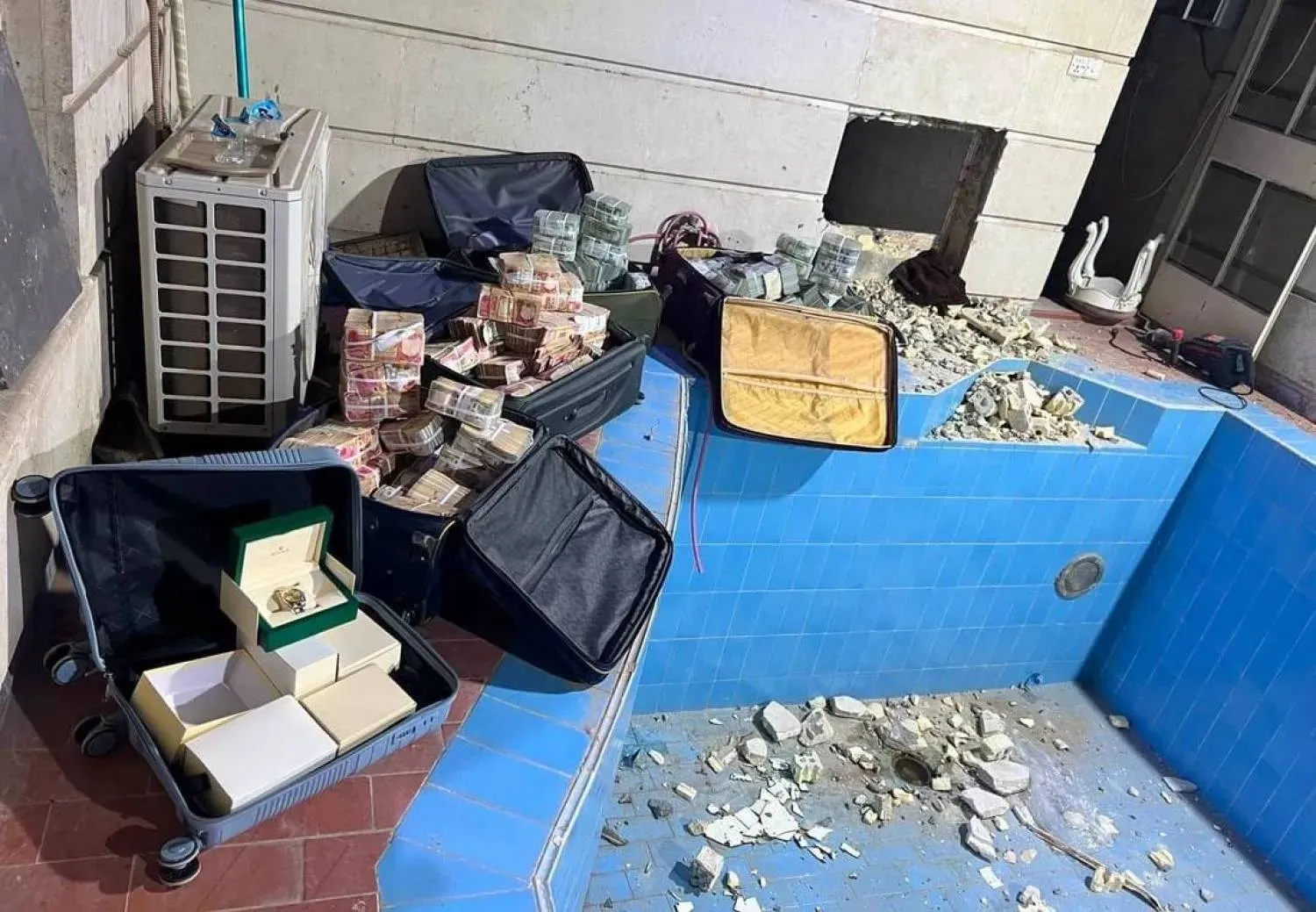

Iraq Seizes Millions of Dollars at Deputy Oil Minister’s Home

A photo released by Iraq’s judiciary shows cash and valuables that were hidden in the home of Deputy Oil Minister Ali Maarij al-Bahadly.
TT

Iraq Seizes Millions of Dollars at Deputy Oil Minister’s Home

A photo released by Iraq’s judiciary shows cash and valuables that were hidden in the home of Deputy Oil Minister Ali Maarij al-Bahadly.

Iraqi authorities arrested Deputy Oil Minister Ali Maarij al-Bahadly, a US-sanctioned official accused of using his post to help Iran-linked networks smuggle oil.

Iraq’s Supreme Judicial Council said initial questioning of al-Bahadly led to the seizure of $11 million and 4 billion Iraqi dinars, about $3 million, as well as several properties. It said investigations were continuing.

Al-Bahadly was arrested before dawn on Sunday at his home in Baghdad’s upscale Zayouna district. Later, state media published images showing security forces pulling bags of cash from inside the walls of the house.

From politics to oil

Al-Bahadly entered Iraq’s oil sector in the early years after 2003, working as head of drilling operations at the Maysan oil fields authority. He later became director general and chairman of Maysan Oil Company.

His career also reflected shifting political loyalties. He won a parliamentary seat in 2014 with the State of Law Coalition and chaired parliament’s oil and energy committee.

He later moved toward the Reconstruction and Development coalition led by former Prime Minister Mohammed Shia al-Sudani, which backed him for the oil ministry before he hit a US veto and, later, arrest.

The US Treasury Department sanctioned al-Bahadly in May under Executive Order 13902.

Washington accused him of using his position to facilitate oil smuggling for Iran-linked networks by falsifying certificates of origin, mixing Iranian oil with Iraqi oil and exporting it.

It also accused him of providing financial support to sanctioned figures and groups, including smuggler Salim Ahmed Said and the Asaib Ahl al-Haq faction.

Accountability

A former Oil Ministry official told Asharq Al-Awsat that al-Bahadly “works within an integrated system in which most of the powerful, dominant political forces take part while remaining beyond accountability.”

The former official, who asked not to be named, did not clear al-Bahadly of corruption allegations.

But he said any serious fight against corruption would have to strike at “the powerful parties under whose protection and umbrella some officials in the Oil Ministry and other ministries operate.”

Observers see “US fingerprints” behind the pursuit of senior Oil Ministry officials, including deputy ministers Adnan al-Jumaili who was arrested recently.

Analysts say Washington views Baghdad’s latest “anti-corruption” campaign as a way to contain Iranian influence and a necessary step toward dismantling it.

Public support for the campaign is broad. But some Iraqis fear its momentum could fade, and that authorities may avoid the “big heads” that are widely blamed for corruption across Iraq over the past two decades.

On the street, Iraqis remain stunned by the methods corruption suspects allegedly used to hide cash, from underground pits to sealed rooms that security forces had to break open to reach the money.

Observers are also struck by the scale of the sums allegedly stolen and by the failure of oversight bodies to uncover them in recent years. Many believe what has emerged so far is only a tiny fraction of the public money looted.

Prison sentences

In the latest corruption cases, the Supreme Judicial Council said on Tuesday that the Diyala Criminal Court sentenced three people to 10 years in prison for embezzling funds allocated to compensate martyrs and people wounded in terrorist attacks.

It said the convicts exploited their jobs at the Diyala governorate office to issue 301 fake checks and transfer money from the compensation account to the governorate office’s operating advances account.

In other developments, authorities released former lawmaker Mohammed al-Sayhood on bail on Tuesday.

Sayhood, a cousin of former PM al-Sudani, was arrested on Sunday as part of a wider campaign targeting lawmakers and officials over suspected corruption.

A security source said he was released for health reasons.


Türkiye’s Erdogan Urges World to ‘Immediately’ Start Rebuilding Gaza

Türkiye’s President Recep Tayyip Erdogan addresses the 81st United Nations General Assembly at UN headquarters in New York City, US, September 22, 2026. (Reuters)
TT

Türkiye’s Erdogan Urges World to ‘Immediately’ Start Rebuilding Gaza

Türkiye’s President Recep Tayyip Erdogan addresses the 81st United Nations General Assembly at UN headquarters in New York City, US, September 22, 2026. (Reuters)

The world must immediately start the reconstruction of the devastated Gaza Strip, Turkish President Recep Tayyip Erdogan said on Tuesday.

"We must begin the reconstruction of Gaza immediately," he told the United Nations General Assembly, urging world leaders to "exert greater pressure on Israel."

Since Hamas fighters launched their October 7, 2023 attack on Israel, triggering a massive response, the tiny Palestinian territory has been devastated by countless Israeli airstrikes, which by October 2025 had left 84 percent of all structures damaged or destroyed, UN figures show.

Despite a US-brokered ceasefire in October 2025, Israel has continued its airstrikes and restricted entry of equipment that international NGOs say is needed for the territory's reconstruction, which has yet to begin.

According to a joint assessment published by the United Nations, the World Bank and the European Union in April, Gaza will require $71.4 billion in recovery and reconstruction spending over the next decade.

Erdogan also urged all nations that have yet to recognize Palestine as an independent state to "reconsider," with his words prompting the Israeli delegation to walk out of the hall.

"I would like to call upon all those countries who have yet not recognized the state of Palestine to reconsider their decisions," he said.

A year ago, France led a special UN summit to recognize a Palestinian state at which 10 countries formally made the move, among them Britain, Canada and Australia, bringing the number of UN member states to do so to around 157, more than four-fifths of the UN membership.

The move has been roundly rejected by Israel.


In UN Farewell, Macron Denounces Trump’s Gaza Diplomacy as Spectacle of Shame

President of France, Emmanuel Macron speaks during the 81st session of the UN General Assembly at UN Headquarters on September 22, 2026 in New York City. (Getty Images/AFP)
TT

In UN Farewell, Macron Denounces Trump’s Gaza Diplomacy as Spectacle of Shame

President of France, Emmanuel Macron speaks during the 81st session of the UN General Assembly at UN Headquarters on September 22, 2026 in New York City. (Getty Images/AFP)

France's President Emmanuel Macron on Tuesday dismissed US President Donald Trump's claims of having secured peace in Gaza, saying not a single humanitarian corridor had been reopened in the enclave despite the proclaimed peace.

In his final address to the United Nations before leaving office next year, Macron said the world was witnessing a spectacle that should shame everyone, rebuking Trump's portrayal of his Gaza peace plan as a diplomatic triumph.

He spoke at the United Nations General Assembly hours after Trump had from the same rostrum hailed his Gaza peace plan as a diplomatic triumph.

"A year ago, here in this very hall, about a dozen states had recognized Palestine. I hear the cynicism of some people: 'Recognition is just a ‌piece of paper, ‌look at the reality,'" Macron said, banging his fist on the podium ‌in ⁠his last speech at ⁠the United Nations before stepping down next May.

"But what credibility do we have if we continue to remain inactive in the face of Gaza? Some boast of a supposed peace. But that peace has not reopened humanitarian access for a single second. Are we simply to stand by and watch this spectacle that should shame us all?"

WHITE HOUSE RESPONDS

In response to Macron's criticism, White House spokeswoman Anna Kelly said: “President Trump ended the war between Israel and Hamas, freed all living hostages, returned the bodies of the deceased to their loved ones, and ⁠is now leading the implementation of the 20-Point Plan for Peace in ‌Gaza. While others talk, this President took this complex problem head ‌on. No one has done more for peace and stability in the region.”

Macron has faced criticism among some politicians ‌and activists in France that he has done little since recognizing a Palestinian state last September.

Despite the ‌criticism, Paris has toughened its stance on settler violence against Palestinians in the West Bank, imposing some national sanctions and launching a process to ban products from Israeli settlements in the occupied West Bank.

"Look at what is happening in the West Bank, where every day violations are committed. In whose name? Hamas has never operated in the West Bank," ‌Macron said.

"What is happening there is building, day by day, the impossibility of a project that should be based on respect for the legitimate right ⁠of the Palestinian people ⁠to exist."

France's ties with Israel have been particularly strained over the last year. Macron said those who believed that violating the sovereignty of all of Israel's neighbors would ensure its security were mistaken.

"They are weakening Israel's security, both today and in the future," he said.

'LONG LIVE THE UNITED NATIONS'

Seven months from France's next presidential election, Macron was making his last appearance after first taking to the rostrum in 2017.

Often showing a keen eye for the trappings of diplomacy — the grand settings, the symbolism, the personal connections — he has at the same time failed to translate this into lasting strategic gains, analysts say.

However, he has always been a staunch defender of the multilateral system and the United Nations.

Macron warned against a global "return to the law of the jungle", saying countries faced a choice between a world governed by power and coercion and a "civilized international society."

"Our duty, more than ever, is to stand alongside the United Nations. We cannot accept the new order of impunity that some would like to build," he said.

He ended his speech with "Long Live the United Nations!"


Yemen Govt Expands Community Mobilization to Support Fighters on Frontlines

This frame grab taken from AFPTV video footage shows fighters affiliated with the Yemeni government engaging in clashes with Houthi militants in Al-Jawf province on September 15, 2026. (AFPTV / AFP)
TT

Yemen Govt Expands Community Mobilization to Support Fighters on Frontlines

This frame grab taken from AFPTV video footage shows fighters affiliated with the Yemeni government engaging in clashes with Houthi militants in Al-Jawf province on September 15, 2026. (AFPTV / AFP)

The Yemeni government has expanded community support for the armed forces and frontlines by mobilizing various social groups and provinces to participate in backing fighters and providing essential supplies to the frontlines.

Nayef Al-Bakri, Minister of Youth and Sports and head of a committee for popular support and government backing for the armed forces, told Asharq Al-Awsat that the committee operates under the directives of Chairman of the Presidential Leadership Council Dr. Rashad Muhammad Al-Alimi, council members, and the prime minister.

The committee aims to organize and activate popular support for the armed forces and fighters across various frontlines, which includes providing food, petroleum products, fuel, and essential materials needed for fighters to maintain their positions, he added.

The committee includes representatives from several ministries, including Interior, Defense, Social Affairs, Transport, Health, and Industry. A broader committee includes representatives from more than 15 provinces, aiming to unify popular efforts and strengthen the state of mobilization.

Several provinces, including Socotra, are preparing to dispatch relief convoys to battle areas, Al-Bakri revealed.

Community support encompasses the health sector through blood donations and backing provincial blood banks. Various social groups have become part of the support system, he went on to say.

Taiz, Hodeidah, Lahij, Dhale, Marib, Al-Jawf and Shabwa are priority frontlines, the minister said.

Taiz is witnessing a "decisive battle," he stressed.

On whether the support committee would handle preparing youths to join the frontlines, Al-Bakri explained that the responsibility for recruitment is the responsibility of military authorities.

The minister said that the Iran-backed Houthi group is threat to Yemen and regional stability, especially in light of its "attempts to undermine the security of navigation and regional waters."

He stressed that Saudi Arabia stands as the primary supporter of Yemen, a role that encompasses all economic, political, and military sectors, in addition to relief and development aid.

Al-Bakri was optimistic that the Yemeni armed forces would make progress on several fronts, including in Taiz, Kahbub, and Shabwah.
