


Demolitions in South Lebanon as Israel Redraws Border Strip

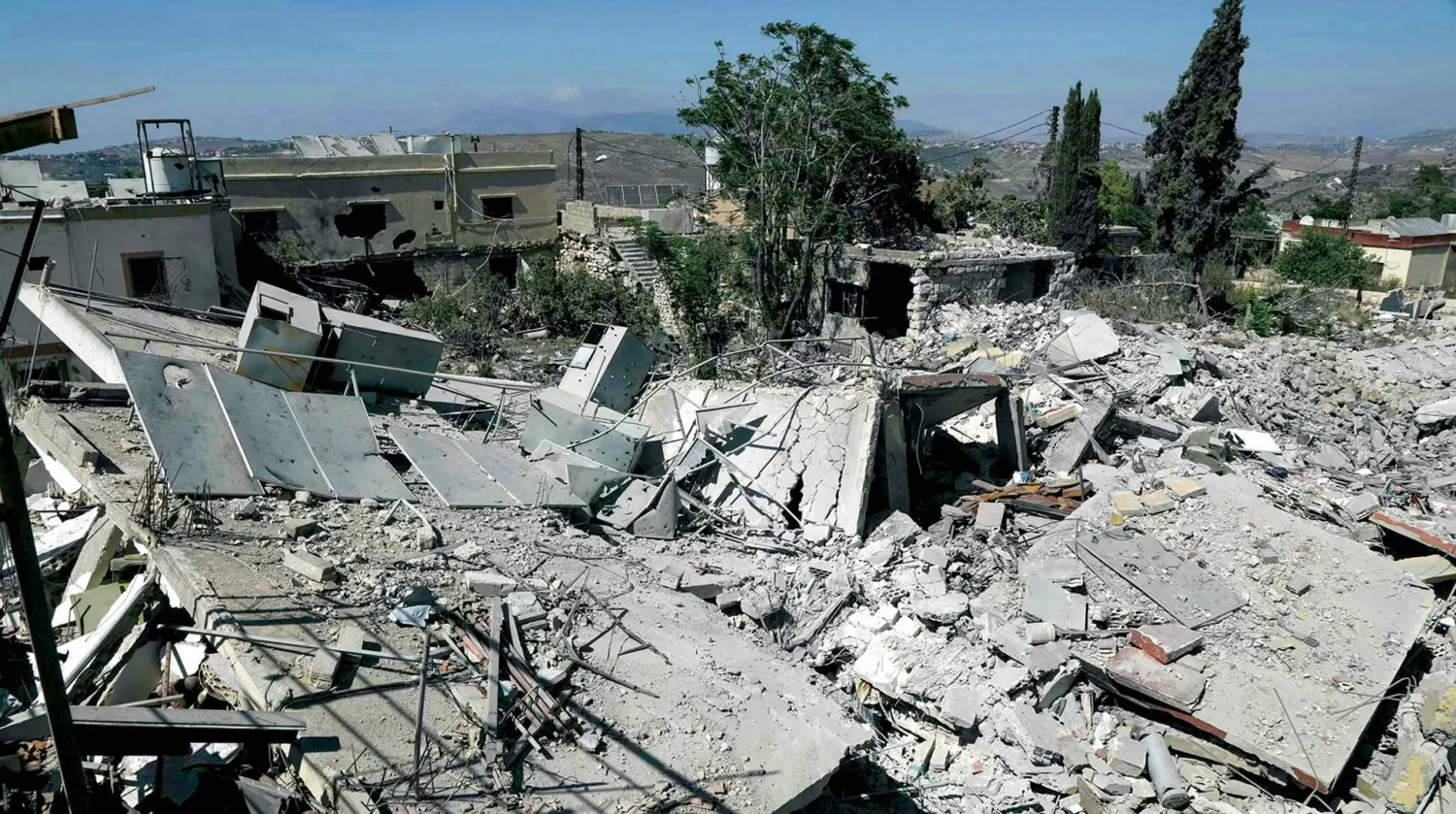
This picture shows the destruction in the southern Lebanese village of Froun on June 30, 2026. (Photo by Kawnat HAJU / AFP)
TT

Demolitions in South Lebanon as Israel Redraws Border Strip

This picture shows the destruction in the southern Lebanese village of Froun on June 30, 2026. (Photo by Kawnat HAJU / AFP)

Israel has revived its policy of wide-scale demolitions in southern Lebanon, with the Israeli army blowing up sites on Thursday and Friday in the towns of Hadatha, Beit Yahoun, Kounine, al-Tiri and Kfar Tibnit.

The operations coincided with air strikes, artillery fire, heavy warplane and drone flights, and attacks around Arnoun-al-Shaqif, Nabatieh al-Fawqa and Yater.

An Israeli drone also struck a vehicle in Siddiqin, in Tyre district, in two consecutive attacks, wounding two people. Israeli drones dropped stun grenades in Safad al-Battikh and al-Mansouri, with no casualties reported.

The Israeli army said it killed a Hezbollah member in the Ali al-Taher heights, saying he was detected as he emerged from an underground facility and was hit in an air strike.

It also said the Givati Brigade had ended its mission in southern Lebanon after eight months of operations, saying it had destroyed hundreds of Hezbollah infrastructure sites.

As the escalation unfolded, Israeli military spokesperson Ella Waweya said the air force struck about 10 sites it described as Hezbollah infrastructure in Bint Jbeil, Beit Yahoun, Kounine and Baraachit.

She said forces from the 91st Division also targeted a truck overnight near the security zone, saying it was carrying weapons for Hezbollah and that secondary explosions after the strike pointed to ammunition inside.

The operations come as Lebanon awaits the implementation of the first phase of the “framework agreement,” which is meant to open the way for gradual Israeli withdrawals.

But no practical steps have been taken, while Israel’s military presence, bulldozing and demolition work continue, raising questions over whether the operations are preparing for withdrawal or redrawing the security reality in the south.

Facts on the ground suggest the campaign goes beyond targeting Hezbollah sites or tunnels. It points to a re-engineering of the border area by removing anything that could be used militarily and turning border villages into devastated zones where life would be difficult to restore.

Removing anything that can be used militarily

Retired Brig. Gen. Saeed Qozah told Asharq Al-Awsat that the large-scale demolitions carried out by the Israeli army in Hadatha, Beit Yahoun, al-Tiri and around Kounine did not appear to be isolated operations.

“Rather, they fall within a military plan aimed at clearing the areas Israel now controls of any military infrastructure that could pose a future threat, especially tunnels, ammunition depots and facilities that could be reused,” he said.

Qozah said the towns fall within what Israel now regards as a security zone. The Israeli army, he said, is combing through them “inch by inch,” so that if it is forced to withdraw at any stage, it does not leave behind tunnels, weapons depots or facilities that armed groups could later use.

“The Israelis have announced in recent days that they discovered tunnels in several areas. They had also previously blown up a large tunnel in Majdal Zoun, causing a powerful tremor.

So it is natural that they continue to blow up any tunnel or military facility they find inside the areas they control, because their goal is to remove anything that could pose a future threat to them,” he said.

He told Asharq Al-Awsat that the Israeli army seizes the equipment and weapons it finds, while destroying facilities, tunnels and depots to prevent them from being used again. The pace of demolitions, he added, is “likely to continue as long as surveying and military engineering operations last inside these areas.”

Qozah said developments in the battlefield, together with the installation of military gates and repeated Israeli statements about not withdrawing from the areas it has occupied, show that Israel is moving to entrench a new security belt in southern Lebanon.

“The installation of gates, the continued demolition operations and the insistence of Israeli officials, foremost among them Benjamin Netanyahu and Israel Katz, on remaining in what they call the security zone are all signs that Israel is working to create a security belt that closely resembles the belt that existed between 1982 and 2000,” he said.

The main difference between the previous security belt and what is happening today is that villages inside this zone have suffered sweeping destruction, making it easier for the Israeli army to impose control and reducing the chances of resistance operations against its positions, he added.

From removing tunnels to preventing life from returning

Retired Brig. Gen. Bassam Yassin told Asharq Al-Awsat that the Israeli army’s return to wide-scale demolitions in southern Lebanese towns, especially Hadatha, Beit Yahoun, Kounine and al-Tiri, “does not fall only within the framework of targeting Hezbollah’s military infrastructure, but reflects Israel’s move into a new phase of cementing facts on the ground in the areas it controls.”

Yassin said Israel is working to turn the strip it occupies into a buffer zone stripped of the basic conditions for life.

“The goal is not only to remove military sites or facilities, but to prevent any sign of life from remaining inside this area, because rebuilding it will take many years, making the return of residents more difficult,” he said.

He added that the widespread destruction also serves a direct military purpose: securing full freedom of movement for Israeli forces inside the occupied area.

Removing buildings and urban infrastructure exposes the terrain to the Israeli army and limits any future ability to use it for military operations or fortified positions, ensuring Israeli forces retain freedom of maneuver.



West Bank Siege Exposes Israel Army Inaction on Settler Violence

Israeli soldiers secure the weekly tour of settlers in the streets of Hebron in the occupied West Bank (Reuters)
TT

West Bank Siege Exposes Israel Army Inaction on Settler Violence

Israeli soldiers secure the weekly tour of settlers in the streets of Hebron in the occupied West Bank (Reuters)

The Israeli military is touted as the most powerful in the Middle East, striking targets deep into enemy territory. But for more than a week, Israeli troops have somehow failed to evict a small group of settlers sitting on rocks in the occupied West Bank.

Experts says the military has long shown inertia when its task is stopping surging violence against Palestinians, due to government backing for the settlement movement and the increasing influence of settler ideology within the army's ranks.

More than a week ago, a handful of settlers at Qusra near Nablus began besieging Palestinians inside their homes, blocking supplies and drawing international and even domestic condemnation.

The Israeli military repeatedly deployed troops, with the United States saying it had requested action by its ally as one of the besieged Palestinians is a US citizen.

But beyond condemnatory statements, the detention of one Israeli, and the dismantling of settlers' tents, little was done to force them out.

Some of the first soldiers to arrive at the scene were even filmed praying with the settlers. The military later vowed disciplinary action.

By Monday, settlers on quadbikes were back at the site shaking hands and chatting with Israeli forces, according to videos shared with AFP by a besieged resident.

The government's support for extremist settlers puts the military in an "impossible situation," said Nimrod Novik, a senior advisor and special envoy to former Israeli prime minister Shimon Peres.

The military is "forced to choose between operating on the basis of its professional judgement and duty, which calls for applying harsh measures against violent settlers, or... adhere to government policy, which provides those terrorists with political backwind as well as resources," he told AFP.

"The result is paralysis with rare exceptions due either to the severity of the crimes or US intervention," Novik added.

Israel has since 1967 occupied the West Bank, where more than 500,000 Israelis now live in settlements which are illegal under international law. The territory is home to some three million Palestinians.

Construction of settlements has reached historic highs under Prime Minister Benjamin Netanyahu's right-wing government, with several ministers cheering the establishment of outposts deemed illegal even under Israeli law and openly calling for the territory's annexation.

Settler violence against Palestinians has persisted for years, with perpetrators in most cases facing no repercussions, but recent months have seen a dramatic surge in attacks.

"The infrastructure of the occupation is built in a way that for a soldier, for us, it's almost impossible to enforce the law on violent settlers and very easy to do whatever we want on Palestinians," said Nadav Weiman, a former sniper who now heads Breaking the Silence, an advocacy group for Israeli veterans.

Weiman told AFP that the rules of engagement for dealing with settlers were rarely explained, with soldiers told to refer to police due to their status as Israeli citizens.

"In 22 years of collecting testimonies from soldiers in the West Bank, I can tell you that in the majority of the units, nothing is being told to the soldier on what they can do with settlers," he added.

The reluctance to act also comes from increasingly blurred lines between settlers and soldiers in the West Bank, Weiman said, with a growing number of settlers becoming officers after attending hardline ideological pre-military academies.

The military's commander for the West Bank, Major General Avi Bluth, himself attended the Bnei David pre-military academy in the settlement of Eli.

A further blurring happened following Hamas's October 7, 2023 attack on Israel.

With most soldiers sent to fight in Gaza or Lebanon, the military drafted thousands of settler reservists into regional defense units, tasked with securing their own communities in the West Bank.

According to rights group Yesh Din, around 7,000 settlers were armed and mobilized into these units during the first months of the war, with such reservists more likely to do nothing to stop settler attacks or to participate themselves.

While many are no longer on active reserve duty, the military has allowed them to keep their firearms and uniforms, according to Yesh Din, enabling soaring violence by settlers posing as soldiers.

When contacted by AFP, the military said the main body responsible for handling violations by Israeli citizens in the West Bank is the police, with soldiers instructed to "act to stop the violation and to delay or detain the suspects until the police arrive at the scene".

"In situations where soldiers fail to adhere to army orders, the incidents are thoroughly reviewed, and disciplinary actions are implemented accordingly", it added.

In the wake of the Qusra siege, Israel's Defense Minister Israel Katz has called for the police to take over West Bank law enforcement, saying it is not soldiers' responsibility to "chase" violent settlers.

The measure, while unlikely to be implemented soon, would be a step towards Israeli annexation of the territory.

Observers doubt the political will to crack down on violent settlers ahead of October 27 elections, but say the issue should be treated with urgency.

"Should settler violence continue, it will be astonishing if a major bloody conflagration doesn't ensue," Novik said.


UN Says Only 3% of Gaza Cropland Accessible and Undamaged

Salvage workers shovel the scrapped rubble of a building that was destroyed during Israel's war against Hamas in Gaza, to use the recycled remains in the future, in Gaza City on August 16, 2026. (Photo by Omar AL-QATTAA / AFP)
TT

UN Says Only 3% of Gaza Cropland Accessible and Undamaged

Salvage workers shovel the scrapped rubble of a building that was destroyed during Israel's war against Hamas in Gaza, to use the recycled remains in the future, in Gaza City on August 16, 2026. (Photo by Omar AL-QATTAA / AFP)

Just three percent of the cropland in Gaza remains accessible and undamaged, the UN's Food and Agriculture Organization warned Tuesday, citing an analysis of satellite images.

The report found that since October 2025, when a fragile ceasefire between Israel and Hamas took hold, the area of accessible and undamaged cropland had fallen to 448 hectares from 601 hectares, a reduction of 25.5 percent, said AFP.

Another 3,643 hectares of cropland are accessible but too damaged to be farmed without rehabilitation, the FAO said.

"Without urgent action to restore safe access and provide farmers with the support they need, opportunities to restore local food production will continue to diminish," said Rein Paulsen, director of the agency's Office of Emergencies and Resilience.

Restrictions on the import of agricultural goods are also hampering recovery, with livestock farmers struggling to obtain animal feed and veterinary supplies.

Greenhouse availability has also declined, dropping 17.3 percent since October 2025 to 224 hectares that are accessible and undamaged.

The FAO said the reduced access could be explained mainly by the westward expansion of the so-called "Yellow Line" that separates the ceasefire zone from the area controlled by the Israeli military.

The Palestinian militant group Hamas launched an attack on Israel on October 7, 2023, that resulted in the deaths of 1,221 people, according to an AFP tally based on official Israeli figures.

Militants also took 251 hostages to Gaza.

Israel's retaliatory military campaign in Gaza has killed more than 73,000 people, according to the territory's health ministry, which operates under Hamas authority and whose figures are considered reliable by the United Nations.

A ceasefire took hold in October 2025 but progress on permanently ending the war has stalled, and Israeli forces currently control nearly 70 percent of the territory.

Before October 2023 agriculture accounted for about 10 percent of Gaza's economy and supported the livelihoods of more than 560,000 people, according to the FAO.


Syria Says 3 Dead in Hydrogen Tank Blast at Coastal Power Plant

The Banias power plant. (Tartus Governorate on Facebook)
TT

Syria Says 3 Dead in Hydrogen Tank Blast at Coastal Power Plant

The Banias power plant. (Tartus Governorate on Facebook)

A hydrogen tank explosion at a power plant in western Syria killed three people on Tuesday, an electricity company official said.

Alaa Sawda, head of the Syrian Electricity Company's media department told the official SANA news agency that "the explosion at the Banias thermal power plant was caused by maintenance work on the hydrogen tank, and occurred during the replacement of the tank's float valve, resulting in the death of three workers".

"The station continues its operations and was not affected by the explosion," he added.

SANA had initially reported "an explosion in the thermal power plant in Banias" with the cause under investigation.

It cited a regional health official as saying the blast resulted in three deaths.

Banias's thermal plant, located in the western Tartus province, is one of the most important electrical facilities in Syria.

Syria's dilapidated electricity sector suffered heavy blows during the country's civil war with heavy damage to its infrastructure, leading to power cuts that can last up to 20 hours a day.

Since the ousting of longtime ruler Bashar al-Assad in 2024, the new Syrian authorities have repeatedly vowed to increase electricity production.