More Than 300 Children Killed in Sudan War in 6 Months, Mostly in Drone Strikes, UNICEF Says

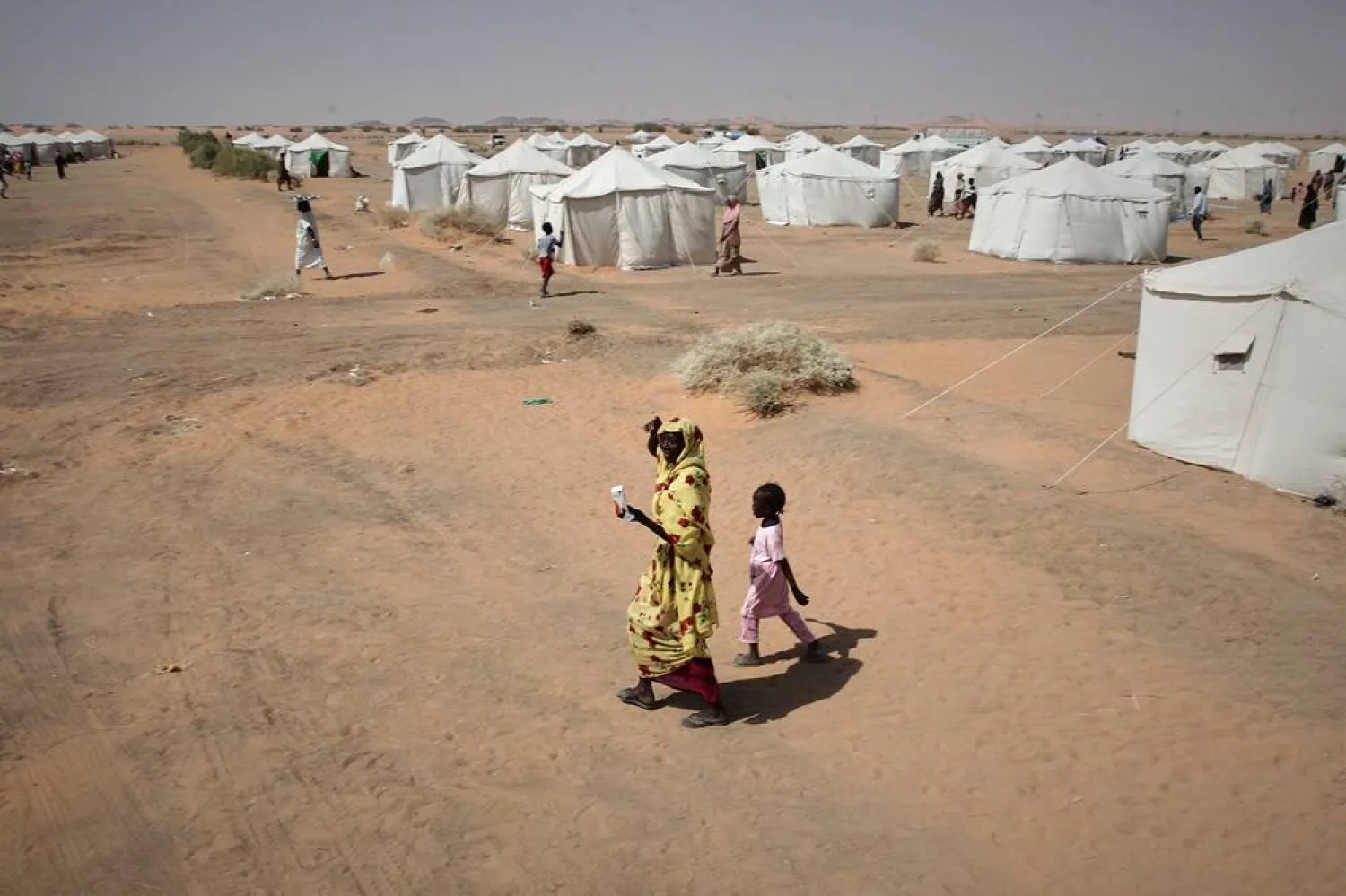
A woman and a child, displaced from North Darfur's capital, al-Fashiar or other conflict-affected areas walk in the newly established el-Afadh camp in al-Dabbah, in Sudan's Northern State, Sudan, Thursday, Nov. 13, 2025. (AP)
TT

More Than 300 Children Killed in Sudan War in 6 Months, Mostly in Drone Strikes, UNICEF Says

A woman and a child, displaced from North Darfur's capital, al-Fashiar or other conflict-affected areas walk in the newly established el-Afadh camp in al-Dabbah, in Sudan's Northern State, Sudan, Thursday, Nov. 13, 2025. (AP)

More than 300 children have been killed in the last six months in the war in Sudan, mostly from drone strikes, the UN children's agency said Monday.

Sudan has been mired in a war between the Sudanese military and the paramilitary Rapid Support Forces since April 2023.

The war is now concentrated in the Kordofan, Darfur and Blue Niles states, with drone warfare causing 60% of casualties, according to UNICEF.

The UN, US UK and others have expressed alarm about potential atrocities as the RSF and the military fight for control of the strategic city of el-Obeid, in North Kordofan.

The conflict has killed at least 59,000 people, displaced some 13 million and pushed many parts of Sudan into famine. More than 30 million people are in need of humanitarian assistance.

Drone strikes and shelling have targeted civilian infrastructure including schools, markets, fuel and water stations putting over 500,000 people at risk. Civilians have faced almost siege-like conditions for over a year.

“Children are being caught in a relentless cycle of violence, displacement and deprivation,” said Sheldon Yett, UNICEF Representative for Sudan.

The UN called on parties “to protect civilians and civilian infrastructure, allow and facilitate safe, rapid and unimpeded humanitarian access, and take all possible measures to protect children from harm.”


UN Rights Council Orders 'Urgent Inquiry' in Sudan's El-Obeid

A Sudanese girl reacts while carrying a plastic canister in al-Rahmaniyah camp for displaced people, near the city of El-Obeid in the southern Kordofan region, on June 25, 2026. (Photo by AFP)
TT

UN Rights Council Orders 'Urgent Inquiry' in Sudan's El-Obeid

A Sudanese girl reacts while carrying a plastic canister in al-Rahmaniyah camp for displaced people, near the city of El-Obeid in the southern Kordofan region, on June 25, 2026. (Photo by AFP)

The UN rights council on Monday ordered an "urgent inquiry" into violations and abuses in the Sudanese city of El-Obeid, warning of the looming risk of "large-scale atrocities".

In a resolution adopted by consensus, the 47-member council voiced "deep concern about the imminent risk of large-scale atrocities" in El-Obeid, calling on an independent UN fact-finding mission to conduct "an urgent inquiry into any violations and abuses of international... law and related to international crimes" allegedly committed there.


Macron Becomes First Western Leader to Visit Damascus

Participants at the international conference on Syria in Paris with French President Emmanuel Macron (Reuters)
TT

Macron Becomes First Western Leader to Visit Damascus

Participants at the international conference on Syria in Paris with French President Emmanuel Macron (Reuters)

Since the fall of President Bashar al-Assad‘s regime and the assumption of power by interim President Ahmed al-Sharaa, Paris has led Western efforts to engage with Syria’s new leadership.

That policy has been reflected in three key steps. The first was France’s push within the European Union to lift sanctions imposed on the former Syrian regime, a process that has since been carried out gradually.

The second was its call for an economic conference, hosted in Paris on February 13, 2025, just weeks after Assad’s ouster, to support Syria. The conference produced a political, economic, and social roadmap, along with recommendations on good governance, minority protection, and the establishment of an inclusive political system.

The third step was inviting al-Sharaa to visit Paris. That visit took place on May 7, making Paris the first Western capital to receive the interim Syrian president. It also encouraged other European capitals to follow suit.

Earlier, French Foreign Minister Jean-Noël Barrot became the first Western foreign minister to visit Damascus, alongside his German counterpart Annalena Baerbock, on January 3 last year. On that occasion, the French Embassy in Damascus was “theoretically” reopened, although its staff continue to operate from Beirut while restoration work on the embassy building is completed.

These moves reflect President Emmanuel Macron‘s determination to take the lead in engaging Syria’s new authorities. As one former French ambassador to the region put it, Paris aims “to influence and engage the new leadership while preparing for the country’s reconstruction.”

France is also motivated by its longstanding ties with the Kurds, particularly the Syrian Democratic Forces (SDF), as well as its interest in Syrian-Lebanese relations. Paris believes it can help facilitate dialogue between Damascus and Beirut and encourage both sides to resolve their longstanding border issues.

The former ambassador added that France has sought to support “a peaceful and inclusive political transition.” At the same time, it has not hesitated to condemn the serious security incidents that have occurred across Syria, from the Mediterranean coast to the northeast and south, while calling for those responsible to be prosecuted. Nevertheless, French officials have generally maintained that “overall, developments are moving in the right direction.”

For weeks, diplomatic and media circles have been discussing Macron’s planned visit to Syria, which would mark the first visit by a Western head of state to Damascus since Assad’s fall. The last French president to visit Syria was Nicolas Sarkozy, who made an official trip to Damascus on September 3–4, 2009, as part of efforts to relaunch French-Syrian relations following Assad’s visit to Paris in July of that year.

Among the notable visits to Damascus was that of Ursula von der Leyen, President of the European Commission, in January this year, followed three months later by a visit from Ukrainian President Volodymyr Zelenskyy.

Given the political backing Paris has extended to Syria’s new leadership — reminiscent of the role former President Jacques Chirac sought to play with Bashar al-Assad shortly after he came to power — France is betting on its ability to strengthen its diplomatic, political, and economic position in Syria.

This week’s NATO summit, held Tuesday and Wednesday, provided Macron with an opportunity to make a brief visit to Syria. The trip is expected primarily to advance bilateral relations, deepen consultations on regional issues, continue cooperation in combating terrorism, and explore opportunities for collaboration across a wide range of sectors, as Paris seeks to maintain the close engagement with Syria’s new authorities that it has pursued since they assumed power.


Implementation of Deal on Pilot Zones in Southern Lebanon Runs into Israeli, Hezbollah Resistance

An Israeli soldier works on a tank on the Israeli side of the Israel-Lebanon border (Reuters)
TT

Implementation of Deal on Pilot Zones in Southern Lebanon Runs into Israeli, Hezbollah Resistance

An Israeli soldier works on a tank on the Israeli side of the Israel-Lebanon border (Reuters)

Lebanon is awaiting the launch of the first phase of Israel’s withdrawal from two pilot areas in the south, although no date has yet been set. The move remains uncertain amid Israeli military violations and threats, while Hezbollah continues to denounce the US-brokered framework agreement as “nonexistent” and refuses to cooperate in its implementation.

Speaking Sunday from Beaufort Castle overlooking southern Lebanon, Israeli Chief of Staff Lt. Gen. Eyal Zamir issued fresh warnings.

He described the Beaufort area as “packed with terrorist infrastructure,” saying Hezbollah, “with Iranian funding and direction,” had spent decades building underground tunnels and military networks there to threaten Israeli communities in the north.

Zamir stressed that the Lebanese army “must fulfill its commitments under the historic agreement” by clearing the area of Hezbollah operatives.

He added that the Israeli military would continue acting “decisively” against threats from Lebanese territory and was prepared to launch a rapid offensive if the ceasefire were violated.

He also claimed Hezbollah had been significantly weakened by Israeli military operations and was now relying on Iran for support.

Israeli Pressure, Hezbollah Rejection

Against this backdrop, Lebanese officials say implementation of the pilot-zone provision is being hindered by resistance from both Israel and Hezbollah.

Ministerial sources told Asharq Al-Awsat that contacts are underway to establish a US-chaired trilateral committee comprising the United States, Lebanon, and Israel to oversee the deployment of the Lebanese army in two pilot zones covering the towns of Froun and Ghandouriyeh in Bint Jbeil district, and Zawtar al-Gharbiyeh in Nabatieh district.

The committee would supervise the pilot phase, with Washington expected to pressure Israel to proceed. However, the sources said Hezbollah’s refusal to cooperate further complicates implementation.

US Mediation

The sources said Washington is holding talks with both Iran and Israel in an effort to devise a mechanism for a simultaneous Israeli withdrawal and Hezbollah redeployment. Israel insists that its withdrawal be linked to Hezbollah’s evacuation of the areas, while Hezbollah maintains that no such steps will be taken before Israel pulls out.

They added that contacts had slowed in recent days because of Iran’s near-total absence from diplomatic exchanges, as Tehran has been preoccupied with funeral ceremonies following the death of Supreme Leader Ali Khamenei.

Despite the lull, Israel’s public broadcaster Kan reported Sunday that preparations for the next withdrawal phase were advancing under direct US coordination.

The plan calls for a joint mechanism to oversee the ceasefire and transfer security responsibility to the Lebanese army.

The pilot phase is part of the US-brokered framework agreement, which envisions two experimental security zones under the exclusive control of the Lebanese army, alongside reconstruction efforts and the return of displaced residents, under the supervision of a US-led trilateral military coordination group.

Continuing Violations

Israeli forces continued military operations in southern Lebanon. Artillery shelled the towns of Braachit and Deir Siryan, while an Israeli drone dropped two stun grenades over Hadatha in Bint Jbeil district.

An Israeli helicopter also carried out aerial sweeps over Majdal Zoun, while fighter jets flew over Beirut’s southern suburbs, Sidon, and surrounding areas. Israeli forces also continued demolishing homes and neighborhoods in several southern villages, most recently in Talloussah in Marjayoun district.

Meanwhile, the Lebanese army said its engineering units had dismantled four unexploded Israeli munitions in Meifadoun, Braachit, Kfardounine, and Shaqra, moving them to secure locations while urging residents to report suspicious objects.

Politically, Hezbollah escalated its criticism of the framework agreement. Hezbollah MP Hassan Fadlallah argued that the deal “has no provision that serves Lebanon,” claiming it seeks to achieve through diplomacy what Israel failed to impose by force: entrenching the occupation, creating a buffer zone, shielding Israel from international legal accountability, and ultimately eliminating the “resistance.”

Fadlallah also asserted that the agreement lacks constitutional, legal, and national legitimacy, declaring that Hezbollah would not allow its implementation.

He insisted that southern Lebanon’s villages “are not a testing ground” and that the group would continue to uphold what it described as its right to defend Lebanon.