


Trump’s Board of Peace Planning Pilot ‘Humanitarian Zone’ in South Gaza, Says Official

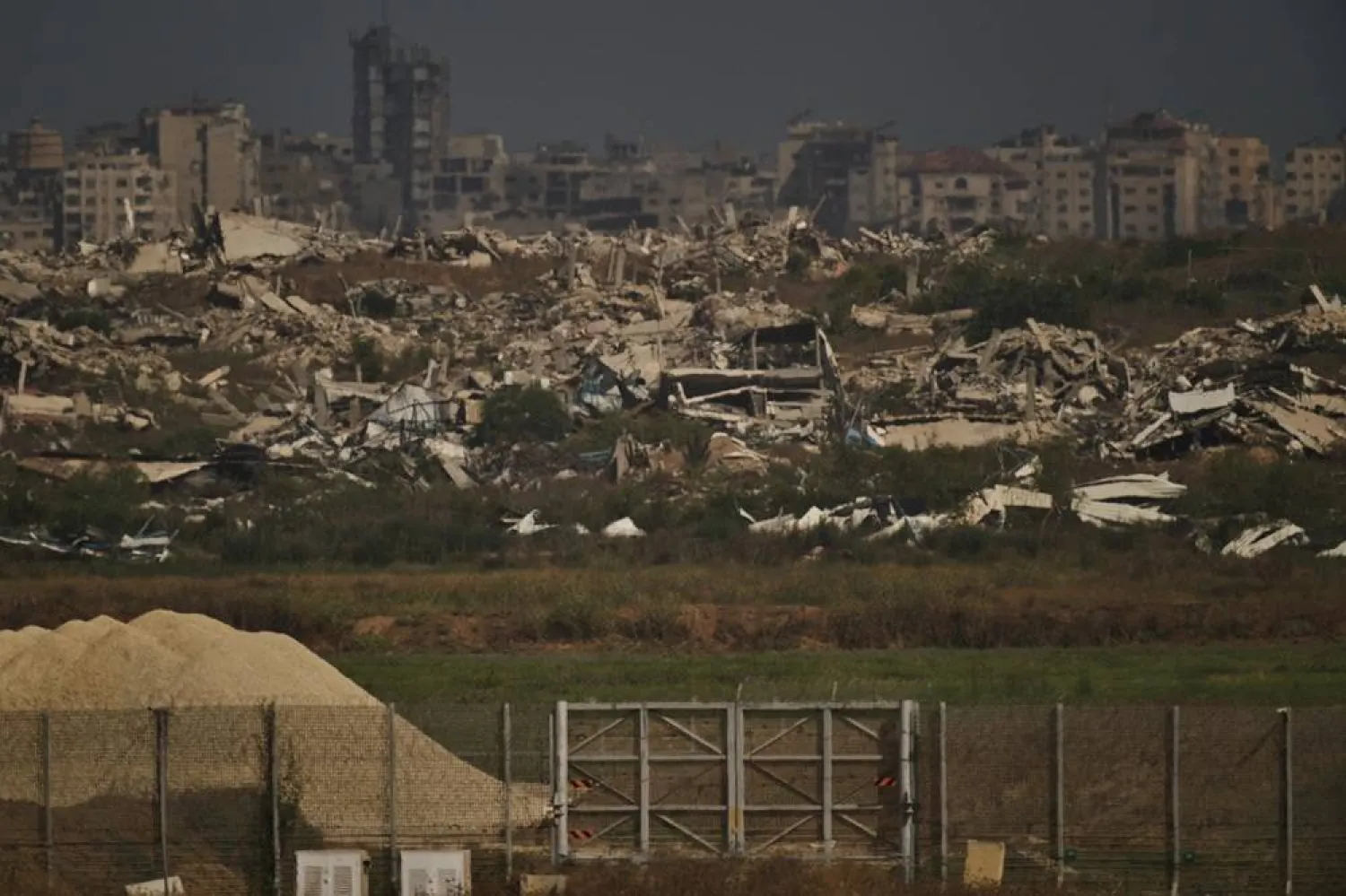
 Buildings that were destroyed during the Israeli ground and air operations stand in the northern Gaza Strip as seen from southern Israel, Thursday, July 2, 2026, on the 1,000th day of war since the Hamas-led attack on Israel sparked the war in Gaza. (AP)
Buildings that were destroyed during the Israeli ground and air operations stand in the northern Gaza Strip as seen from southern Israel, Thursday, July 2, 2026, on the 1,000th day of war since the Hamas-led attack on Israel sparked the war in Gaza. (AP)
TT

Trump’s Board of Peace Planning Pilot ‘Humanitarian Zone’ in South Gaza, Says Official

 Buildings that were destroyed during the Israeli ground and air operations stand in the northern Gaza Strip as seen from southern Israel, Thursday, July 2, 2026, on the 1,000th day of war since the Hamas-led attack on Israel sparked the war in Gaza. (AP)
Buildings that were destroyed during the Israeli ground and air operations stand in the northern Gaza Strip as seen from southern Israel, Thursday, July 2, 2026, on the 1,000th day of war since the Hamas-led attack on Israel sparked the war in Gaza. (AP)

US President Donald Trump's Board of Peace is planning a pilot "humanitarian zone" in southern Gaza which would aim to accommodate tens of thousands of vetted Palestinian civilians, a board official told AFP.

The official said the zone could act as a "starting point" for the Palestinian technocratic committee meant to assume the day-to-day governance of Gaza's transitional phase out of war under Trump's 20-point plan.

The pilot zone, which the board is eyeing for Rafah in the southern Gaza Strip, would be secured by multinational troops from the International Stabilization Force (ISF), a fledgling body which operates under the Board of Peace.

The National Committee for the Administration of Gaza (NCAG), the group of Palestinian technocrats established by the Board of Peace, would carry out screening and access control, supported by the ISF.

The concept of closed humanitarian zones, which has been discussed in various forms for several months, has raised serious reservations, with diplomats and NGO officials working in Gaza telling AFP on condition of anonymity that such a mechanism seems to them to be incompatible with international humanitarian law.

Movement in and out "will remain free for all unarmed civilians," the board official told AFP on condition of anonymity.

Efforts to advance the US-backed ceasefire plan for Gaza have been stalled for months, with the NCAG stuck in Cairo and yet to actually enter the territory.

Since the truce between Israel and Hamas came into effect last October, Israeli forces have expanded their presence in Gaza, and now control more than 60 percent of the territory.

"There's one pilot project we're looking at particularly, that maybe you can get the NCAG a starting point, you can enable tens of thousands to come if they wish voluntarily to this area, and you start giving them a space where they exercise effective governance and they're the administration," the official said.

- 'Buffer' -

The official said the board was "looking at Rafah" as a location for the project but remained vague on its exact positioning. He said that no building work had begun.

Rafah, which sits at Gaza's southern edge, was effectively razed by Israeli bombing during the war and the area is now largely under Israeli military control.

The ISF would act as a "kind of buffer" separating the Palestinian population from the Israeli military, the official said.

"A screening mechanism will ensure that armed individuals and fighters cannot enter these safe humanitarian zones," he said.

"This function will not be performed by the Israeli military, which will have no contact with the civilian population and no role in separating these areas from the rest of Gaza," the official said.

The Board of Peace was formally established earlier this year as part of the US-backed ceasefire plan for Gaza endorsed by the UN Security Council.

It aims to facilitate a transition away from Hamas rule while supporting the restoration of civilian administration and basic services.

Diplomats and NGO officials working in Gaza say that grouping civilians into demarcated areas subject to access controls could amount to forced displacement of the population, restrict Palestinians' freedom of movement and undermine the principle of impartiality.


Abbas Calls For Unified Arms, End to ‘Coup’ in Seven-Point Palestinian Reconciliation Plan

 An Israeli soldier stands inside a Palestinian-owned home in the West Bank after Israeli settlers attacked and set it on fire on Tuesday. (Reuters)
An Israeli soldier stands inside a Palestinian-owned home in the West Bank after Israeli settlers attacked and set it on fire on Tuesday. (Reuters)
TT

Abbas Calls For Unified Arms, End to ‘Coup’ in Seven-Point Palestinian Reconciliation Plan

 An Israeli soldier stands inside a Palestinian-owned home in the West Bank after Israeli settlers attacked and set it on fire on Tuesday. (Reuters)
An Israeli soldier stands inside a Palestinian-owned home in the West Bank after Israeli settlers attacked and set it on fire on Tuesday. (Reuters)

Palestinian President Mahmoud Abbas has set out seven principles for reconciliation talks expected to be held in Cairo, including an end to the fallout from what his document calls the “coup in Gaza,” four sources from Palestinian factions told Asharq Al-Awsat.

Fatah and Hamas delegations began preparing for the talks yesterday. The sources, including one from each movement, said Abbas’s document, titled “The Palestinian-Palestinian Path to Palestinian Reconciliation,” calls for “one system, one law and one legitimate armed force.”

It also calls for adherence to the Palestine Liberation Organization and its platform, recognizing the PLO as the Palestinians’ sole legitimate representative.

The document calls for peaceful popular resistance and a political settlement based on a two-state solution and international resolutions.

It proposes a technocratic government appointed by Abbas to govern the West Bank, East Jerusalem and the Gaza Strip, and assigns responsibility for negotiating a comprehensive peace agreement to the PLO.

Hamas’s position on the principles is not yet known. A senior Hamas source said the movement was open to talks that would serve what he called the “broader Palestinian interest” and achieve “a genuine partnership aimed at changing the status quo.”

Preparations for Palestinian talks

Delegations from Palestinian factions are preparing to arrive in Cairo in stages for bilateral meetings that could lead to a broader national dialogue.

Fatah is expected to participate after previously declining such a dialogue and refusing to meet with Hamas bilaterally.

No arrival dates or dates for the broader dialogue have been finalized.

Six sources from different Palestinian factions told Asharq Al-Awsat separately that, under Palestinian and Egyptian arrangements, a Hamas leadership delegation would arrive in Cairo, followed by a Fatah delegation headed by Jibril Rajoub.

Other figures already in Cairo, including Azzam al-Ahmad, would join them. Delegations from other factions are also expected, with some of their leaders already in the Egyptian capital.

A Fatah source said al-Ahmad had met Palestinian figures in recent days to discuss elections to the Palestinian National Council.

He may join the delegation coming from Ramallah for the factional meetings, the source said. Egypt has reservations about holding council elections now without a consensus, the source added.

On Abbas’s instructions, Fatah’s Central Committee recently formed a committee to take part in the national dialogue. Rajoub will chair it, with Mohammad Shtayyeh and Majed Faraj as members.

Election delay grows more likely

The bilateral meetings and any broader dialogue would address Palestinian affairs and internal unity, including legislative elections scheduled for November, the sources said.

Their accounts indicated an increasing likelihood of a delay.

One source said that, although no decision had been announced, “Israel is likely not to allow the elections to take place.”

The source said Israel would seek to block voting in East Jerusalem and carry out military operations in the West Bank to disrupt the elections, while conditions in Gaza were also difficult.

Two sources from different factions, one of them left-wing, said the factions recognized the difficulties and saw a need to postpone the vote.


EU Top Diplomat Says Bloc Wants to 'Upgrade' Syria Partnership

29 September 2026, Syria, Damascus: Syrian Foreign Minister Asaad Al-Shaibani receives the EU High Representative for Foreign Affairs Kaja Kallas at Tishreen Palace. Photo: Moawia Atrash/dpa
TT

EU Top Diplomat Says Bloc Wants to 'Upgrade' Syria Partnership

29 September 2026, Syria, Damascus: Syrian Foreign Minister Asaad Al-Shaibani receives the EU High Representative for Foreign Affairs Kaja Kallas at Tishreen Palace. Photo: Moawia Atrash/dpa

EU foreign affairs chief Kaja Kallas said on Tuesday in Damascus that the European Union wanted to "upgrade" its partnership with Syria and help boost its recovery but called for further domestic reform.

"The European Union is using its political and economic tools to help Syria on the path of inclusive and peaceful transition," Kallas told a press conference with Syrian Foreign Minister Asaad al-Shaibani.

After the new authorities toppled longtime ruler Bashar al-Assad in December 2024, the EU lifted its economic sanctions on Syria and in May this year restored an EU-Syria cooperation agreement.

"Now we aim to mobilize even more investment and upgrade our partnership. But that's also very much dependent on Syria's side," Kallas said, while also calling for institutional and security improvements.

"Aid alone cannot build Syria. Foreign and domestic investment needs trust, and trust needs security, clear rules, rule of law, functioning institutions" and the equal participation of women in society, as well as reconciliation and transitional justice, she said.

"We are ready to help to build the institutions," she said.

The 27-nation bloc has launched a new chapter with Syria since Assad's fall, with EU chief Ursula von der Leyen telling President Ahmed al-Sharaa in January that Europe would "do everything it can" to support Syria's recovery.

The country is trying to rebuild, reboot its economy and attract investment after more than 13 years of conflict that killed more than half a million people and ravaged the country's infrastructure and industry.

Kallas noted that the EU "is already providing 620 million euros for recovery, humanitarian needs and strengthening institutions".

The war also sent millions of Syrians fleeing abroad, and Syrians have made up the lion's share of asylum-seekers in the bloc over a decade, with a push for large numbers to eventually return home.

Shaibani said that he and Kallas had "discussed several tracks, beginning with achieving a new partnership agreement" to replace the one dating to the 1970s, indicating that steps to advance the issue would continue into next year.

He noted that Syria had been "active in combatting cross-border crime, combatting illegal migration, drugs and human trafficking".

"We discussed ways to support the capacities of the Syrian coast guard, in the belief that the security of the Mediterranean also begins with our shores," he said.

"Syria's security is an integral part of Europe's own security," he added.


UN Expands List of Companies Linked to Israeli Settlements

This picture taken from the Israeli-occupied West Bank village of Bruqin shows homes belonging to Palestinians in the foreground, and the Israeli settlement of the same name in the background on September 21, 2026.  (Photo by JAAFAR ASHTIYEH / AFP)
This picture taken from the Israeli-occupied West Bank village of Bruqin shows homes belonging to Palestinians in the foreground, and the Israeli settlement of the same name in the background on September 21, 2026. (Photo by JAAFAR ASHTIYEH / AFP)
TT

UN Expands List of Companies Linked to Israeli Settlements

This picture taken from the Israeli-occupied West Bank village of Bruqin shows homes belonging to Palestinians in the foreground, and the Israeli settlement of the same name in the background on September 21, 2026.  (Photo by JAAFAR ASHTIYEH / AFP)
This picture taken from the Israeli-occupied West Bank village of Bruqin shows homes belonging to Palestinians in the foreground, and the Israeli settlement of the same name in the background on September 21, 2026. (Photo by JAAFAR ASHTIYEH / AFP)

The United Nations human rights office issued a list on Friday adding 61 more companies operating in Israeli West Bank settlements, which the global body considers illegal.

The database is highly sensitive as firms could be targeted for boycotts or divestment to pressure Israel over settler expansion in the territory that is home to over 3 million Palestinians.

The database, first released in 2020, now includes 214 firms, mostly from Israel, but also from 10 other countries including France, Germany, China and the US.

Newly added firms included Israeli pesticides maker ADAMA, part of Chinese-owned Syngenta Group, Israel-based real estate investment holding company Alony Hetz and Spain's Salvat Logistica.

The Spanish logistics company said it had not been informed of any investigation and that its inclusion in the list was "surprising and entirely inconsistent with the facts". A UN rights office spokesperson said Salvat was contacted along with all other firms and given the opportunity to respond.

Companies already on the list include travel agency Expedia and home-rental company Airbnb already on the list.

Israel, which views the West Bank as disputed rather than occupied, has previously said the list unfairly vilifies companies working legally.

"This is a distorted mechanism — created by a deeply flawed body with an automatic majority against Israel," Israel's diplomatic mission said on Friday, alleging that the database was establish to "persecute" the Jewish state.

There has been a surge in settler attacks against Palestinians as outposts proliferate, prompting Britain, France and Canada to block imports from settlements this month.

The UN rights office assessed companies active in a group of sectors including energy, food, hospitality, transport and agriculture, based on confidential submissions to the UN rights office.

Another 60 or so companies were assessed but not included since they did not meet the UN criteria of involvement in activities that violate the Palestinian right to self-determination.

Examples include supplying demolition equipment to destroy Palestinian buildings, provision of surveillance for settlements and other services like transport that help maintain their existence, according to the UN website.

Other companies, like British-registered online travel company Opodo and Spanish-domiciled online travel agent eDreams, have been dropped from the original list after submitting a reassessment request.

The UN found that there were reasonable grounds to believe they were no longer involved in the activities that previously justified their inclusion.

eDreams said last year it had withdrawn and would continue to block listings of accommodation in illegal Israeli settlements, saying that some had appeared on its website automatically after owners uploaded them.

Palestinians want the West Bank to be part of a future independent homeland.

But Prime Minister Benjamin Netanyahu's nationalist government has largely backed settlers, with building ramped up since the militant Hamas group's attack on Israel in October 2023 and the ensuing Gaza war.

Travel firm Expedia has previously said that the listings in what it called "disputed areas" were clearly labelled, complied with international laws and sanctions and undergo enhanced due diligence guided by UN standards.
