


Study Says 93% of Sudanese Want Peace

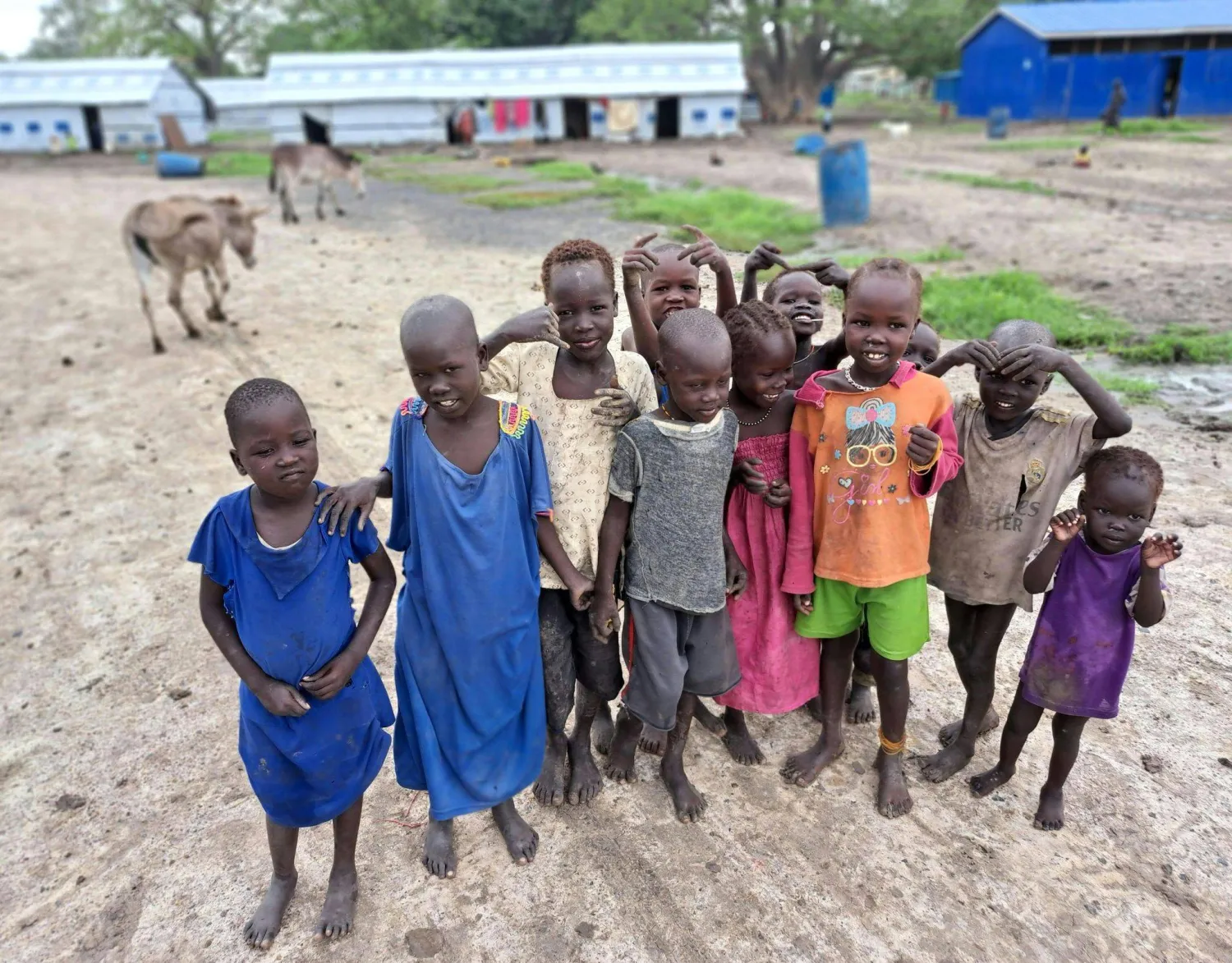
24 June 2026, Sudan, Juba: Children gather at the Renk Returnees Camp during a Caritas press trip in Renk, Upper Nile State. Photo: Martin Hanser/APA/dpa
TT

Study Says 93% of Sudanese Want Peace

24 June 2026, Sudan, Juba: Children gather at the Renk Returnees Camp during a Caritas press trip in Renk, Upper Nile State. Photo: Martin Hanser/APA/dpa

A comprehensive Sudanese study has revealed that 93.2% of Sudanese support peace negotiations, a finding that participants described as “digital evidence refuting claims used to justify the continuation of the war in the name of the Sudanese people.”

The Advocacy Group for Peace in Sudan (AGPS) said in a press statement that it presented the preliminary results of the study during a workshop attended by researchers, journalists, civil society representatives, and public policy experts.

According to the group, the study was based on 1,668 online surveys, 30 in-depth qualitative interviews, and a random sample covering all 18 Sudanese states, in addition to Sudanese communities in Chad, Egypt, South Sudan, Uganda, the Gulf states, and several other countries.

Dr. Issam Abbas, one of the study’s supervisors, explained that “the use of the Python programming language in data analysis, together with the stratified random sampling method, enhanced the reliability and scientific accuracy of the results.”

The findings showed that 74.3% support an immediate ceasefire, 88.3% of those who favor a political settlement are willing to actively support it and Central Darfur State recorded the highest level of support for peace, at 94.7%.

The study found that competition over power and wealth was viewed as the leading cause of the conflict, followed by the legacy of the former regime, marginalization, and foreign interference.

It also found that 80.9% of respondents hold both branches of the military establishment responsible for the war, 79.2% blame the former regime and 73.7% blame armed movements.

Confidence in peace agreements was low, with only 14.4% expressing high confidence, compared with 9% who said they had no confidence in such deals.

The results further showed that 90% of participants demand accountability, while 8% favor a hybrid justice system combining national and international mechanisms. The study identified key red lines for any future settlement, including the rejection of Sudan’s partition, the existence of multiple armies, and ontinued military involvement in politics.

Meanwhile, 77.9% of respondents said that social media is their primary source of information, while 93.4% believed that tribal and regional rhetoric poses a direct threat to citizenship and national cohesion.

Dr. Asmaa Elnaiem, Executive Director of the Advocacy Group for Peace in Sudan and a member of the Executive Office of the Sudan Peace Appeal, said the results presented so far represent only about 20% of the full analysis.

She noted that the study was designed to be expandable and regularly updated to reflect developments on the ground.

Sudan has been engulfed in war between the Sudanese Armed Forces (SAF) and the Rapid Support Forces (RSF) since April 2023. The conflict has killed at least 59,000 people, displaced around 13 million others, and pushed large parts of the country into famine. More than 30 million people are now in need of humanitarian assistance.



Syrian Authorities Say Killed Assad-Era Officer After Clash

A member of Syria's internal security forces in Tartus city. (SANA)
TT

Syrian Authorities Say Killed Assad-Era Officer After Clash

A member of Syria's internal security forces in Tartus city. (SANA)

Syrian security forces said on Sunday that they killed an army commander who served under ousted ruler Bashar al-Assad, after he opened fire on them as they tried to arrest him.

In a statement, the forces accused Firas Abdul Karim Hammoud of having taken part in anti-government insurrections that killed security personnel.

Since Assad's fall in December 2024, Syria's new authorities have arrested dozens of security officials from his rule, and trials began in April.

The security forces said they "neutralized Firas Abdul Karim Hammoud... following an armed clash and a raid on his hideout in the town of Safita" in Tartus province in the coastal Alawite heartland.

Hammoud had previously "opened fire on security personnel during an attempt to arrest him", they added.

"During the recent operation, he again opened fire and initiated a firefight with the security forces... necessitating their response."

They said Hammoud served as a commander of the special forces in the so-called "25th Division" under Assad's rule.

They accused him of working under Assad-era general Ghiath Dalla in leading pro-Assad groups on the coast after the former president's fall.

They added that he was involved in "armed insurrection operations" against state institutions that killed security personnel.

Dalla, a former officer in the much-feared Fourth Brigade, had announced on social media last year the formation of a "military council for the liberation of Syria".

The announcement came shortly before deadly violence targeting the Alawite minority, to which Assad's family belongs, erupted on the Syrian coast in March 2025.

Authorities accused armed Assad supporters of sparking the violence by attacking security forces in an ambush.


Iraq Sentences US-Sanctioned Oil Official to Prison

The sun sets behind apartment buildings in Baghdad, Iraq, Friday, Aug. 28, 2026. (AP)
TT

Iraq Sentences US-Sanctioned Oil Official to Prison

The sun sets behind apartment buildings in Baghdad, Iraq, Friday, Aug. 28, 2026. (AP)

Iraq sentenced a US-sanctioned oil official to seven years in prison after he was arrested as part of a government-led anti-corruption campaign, the country's anti-graft body said on Sunday.

Deputy oil minister for distribution affairs Ali al-Bahadli is among dozens of officials who were detained in June during anti-graft raids that took place in several areas, mostly in Baghdad's fortified Green Zone.

The Commission of Integrity said in a statement that an anti-corruption court sentenced Bahadli to seven years in prison for "illicit gains".

The ruling requires Bahadli to return to the state an amount equivalent to more than $20 million in ill-gotten gains, in addition to paying a fine of the same amount.

The United States imposed sanctions on Bahadli in May, accusing him of fraudulently mixing Iraqi and Iranian oil as part of a scheme to help Iran avoid sanctions.

At the time, Iraq's oil ministry denied the accusations against Bahadli, who was then arrested during the anti-graft raids.

Iraqi authorities said that the raids were part of new Prime Minister Ali al-Zaidi's campaign to fight the corruption that has plagued Iraq for decades.

But several Iraqi officials told AFP that the raids were also part of al-Zaidi's campaign against funding for pro-Iran armed groups and the smuggling of Iranian oil.

Iraq has been under mounting pressure from the United States to curb Tehran's influence and rein in Iran-backed armed factions, which Washington designates as terrorist groups.

Al-Zaidi, who took office this year with the blessing of the United States, has pledged to ensure the armed factions that emerged after the US-led invasion hand over their weapons to the state.

In Iraq, corruption is especially rampant across public institutions, but convictions typically target mid-level officials or minor players and rarely those at the top of the power hierarchy.


US News Agency Says Crew Attacked by Israeli Settlers in West Bank

 Israeli settlers look out through a metal fence, as an Israeli flag flutters nearby, on the day of their weekly tour in Hebron, in the Israeli-occupied West Bank, August 29, 2026. (Reuters)
Israeli settlers look out through a metal fence, as an Israeli flag flutters nearby, on the day of their weekly tour in Hebron, in the Israeli-occupied West Bank, August 29, 2026. (Reuters)
TT

US News Agency Says Crew Attacked by Israeli Settlers in West Bank

 Israeli settlers look out through a metal fence, as an Israeli flag flutters nearby, on the day of their weekly tour in Hebron, in the Israeli-occupied West Bank, August 29, 2026. (Reuters)
Israeli settlers look out through a metal fence, as an Israeli flag flutters nearby, on the day of their weekly tour in Hebron, in the Israeli-occupied West Bank, August 29, 2026. (Reuters)

Israeli settlers attacked an NBC crew in the central West Bank Saturday, as they were interviewing a Palestinian woman who said she’d been driven out of her house by settlers, the network said.

NBC’s American correspondent Matt Bradley, two other crew members and the woman they were interviewing were all treated for injuries sustained during the attack, NBC said. There were no further details on their injuries.

The assault was caught on video and shared by NBC, with footage showing masked settlers approaching the crew with sticks and beating the crew’s vehicles.

Israel’s military said it was “aware of reports of Palestinian injuries, including a Palestinian woman who sustained non-life-threatening injuries and was evacuated by the Red Crescent for medical treatment.” It did not comment on the attack on the NBC crew.

It was the latest in a growing wave of violence by West Bank settlers. Prime Minister Benjamin Netanyahu issued a rare condemnation of the violence on Saturday. The Israeli leader has come under heavy US criticism for the settler attacks.

Settlers seized British activist and held him locked in shed

Israeli settlers seized a British activist from a Palestinian village in the West Bank and locked him in a shed before turning him over to police, his lawyer said Sunday.

The lawyer, Inbar Shaked Vardi, said settlers held her client, Finn Joughin, for half an hour Saturday before turning him over to Israeli police. Joughin was set to appear before a Jerusalem court later Sunday, she said.

Video showed two settlers, one armed, restraining Joughin and marching him away from the village.

It was not immediately clear what led to his capture. Settlers say he assaulted a child, accusations Vardi vehemently denied.

Settlers point to a video where the activist uses his body in an apparent attempt to block a settler boy from passing through a fence. Vardi said the video shows he was trying to protect the village.

Police said they were investigating and holding Joughin in custody on suspicion of committing an indecent act against a minor.