

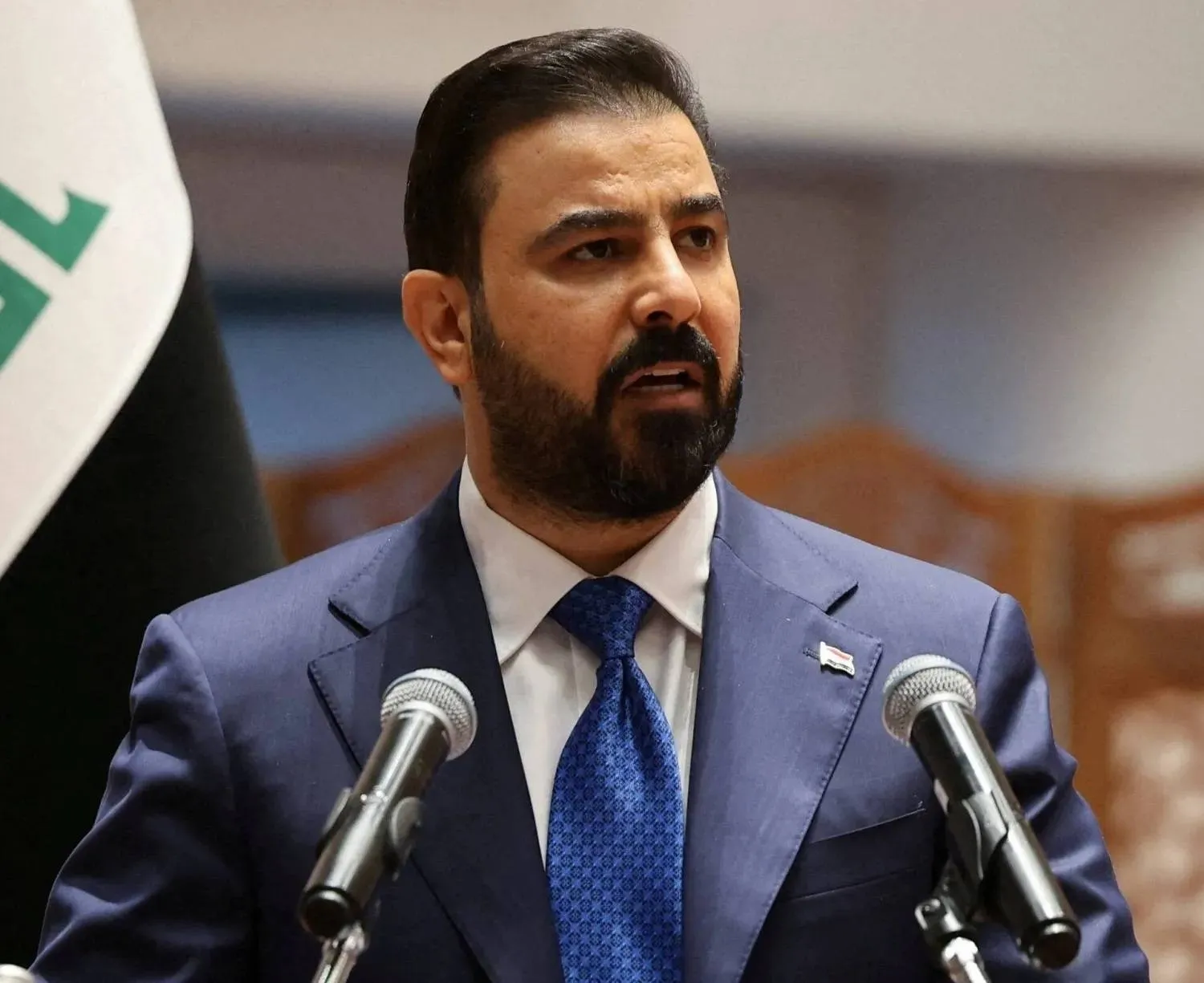

Iraq Moves to Mend Gulf Ties, Al-Zaidi Proposes New Partnership

Iraqi Prime Minister Ali al-Zaidi. (Reuters)
TT

Iraq Moves to Mend Gulf Ties, Al-Zaidi Proposes New Partnership

Iraqi Prime Minister Ali al-Zaidi. (Reuters)

The Iraqi government is intensifying diplomatic engagement with its Arab neighbors, especially Gulf Arab states, ahead of an expected visit by Iraqi Prime Minister Ali al-Zaidi to the United States.

It is an effort to strengthen regional and international partnerships, address economic and security issues, and recover funds linked to corruption cases.

As part of that push, Deputy Prime Minister and Foreign Minister Fuad Hussein began a visit to Kuwait at the head of a delegation that included the national security adviser, the governor of Basra and senior Foreign Ministry officials.

Hussein said in a post on X that the visit aimed to “discuss developing relations with Kuwait in a way that serves the interests of the two brotherly peoples.”

Hours after his arrival, Hussein said in a separate statement that Kuwaiti authorities had agreed to release Iraqi fishermen detained by the Kuwaiti coast guard last week. He said they would return to Basra province with the Basra governor after legal procedures were completed.

The Iraqi minister said the decision came in response to a request made by the Iraqi delegation during its meeting with Kuwaiti First Deputy Prime Minister and Interior Minister Sheikh Fahad Yusuf Saud al-Sabah.

A government source said the Iraqi government was “keen to maximize its relations with its Arab surroundings, especially the Gulf, which requires sending positive messages that reinforce this direction,” adding that the foreign minister carried several important files with him during the visit.

The source told Asharq Al-Awsat that the delegation also discussed economic files, including strengthening investment partnerships and the possibility of Kuwait supplying Iraq with gas to operate power plants, as Iraq faces chronic challenges in its energy sector, particularly during the summer months.

‘Iraq will not join any axis’

The diplomatic moves come as al-Zaidi prepares to visit the United States. In press remarks on Thursday, he said Washington’s release of cash dollar shipments to Iraq after a suspension lasting several months represented “a gesture of goodwill” toward Baghdad.

Al-Zaidi said his expected visit would include “an announcement of economic and political partnership with Washington,” adding that the two countries could expand the exchange of security information.

He stressed that Iraq “will not join any axis” amid regional tensions, but said Baghdad continued to seek to bring the United States and Iran closer together to help resolve their disputes and achieve stability in the region.

The prime minister said his foreign tour would not be limited to Washington and would be followed by visits to several Arab countries. He said it was “important for Iraq to be part of the Arab incubator.”

He added that Baghdad sought to establish an economic partnership with Saudi Arabia during an expected visit to Riyadh before heading to Damascus, citing the importance of strengthening economic cooperation with neighboring Syria.

On energy, al-Zaidi denied reports that Iraq intended to withdraw from OPEC, saying his country would remain a member of the organization but was seeking a “fair share” of oil exports.

Impact of Iranian influence

Observers say Iraq’s moves toward Gulf states are part of an effort to rebalance its foreign policy, alongside its opening to the United States, as the regional environment grows more complex.

Issam al-Fayli, a professor of political science at Mustansiriyah University, told Asharq Al-Awsat that the government faced the challenge of balancing Iranian influence inside Iraq with the prospects of relations with the United States.

He said the prime minister was “serious about limiting the influence of Iranian arms in preparation for a new Iraqi project based on economic openness and energy projects in the region.”

Ihsan al-Shammari, head of the Political Thinking Center, said Iraq could repair its relations with Gulf states if it adopted a new vision to redefine those ties, adding that previous governments had not achieved tangible progress on that front.

He said Baghdad needed to restore Gulf Arab trust by reducing the impact of Iranian influence and addressing the issue of armed factions, opening the way for broader economic and trade partnerships.

Ghalib al-Daami, a professor of political science at Mustansiriyah University, said “loose weapons” represented the biggest obstacle to developing relations with Gulf states. He said the current government appeared serious about fighting corruption and addressing the issue of armed factions.

Talib Mohammed Karim, a professor of political science, told Asharq Al-Awsat that Iraq had a real opportunity to strengthen relations with its Arab surroundings, especially Gulf states, amid regional shifts.

But he said the success of that path depended on the state’s ability to entrench stability, strengthen its sovereignty and provide an environment attractive to investment.

Muhannad Salloum, a professor of security studies, said Baghdad’s success in rebuilding trust with Gulf states first required the state to monopolize the use of force and address the issue of militias and armed factions.

Second, he said, Iraq needed to expand economic links with Gulf states through projects such as railway connectivity, the Development Road and security cooperation systems.

Third, it needed to take confidence-building steps, address mutual accusations of attacks that some Gulf states attribute to Iraqi factions, and strengthen mutual understanding between the two sides.


Al-Zaidi: Iraq Eyes Europe as It Seeks to Diversify Oil Exports

 German Chancellor Friedrich Merz, right, and Iraqi Prime Minister Ali al-Zaidi attend a press conference in Berlin, Germany, Tuesday, Sept. 15, 2026. (AP)
German Chancellor Friedrich Merz, right, and Iraqi Prime Minister Ali al-Zaidi attend a press conference in Berlin, Germany, Tuesday, Sept. 15, 2026. (AP)
TT

Al-Zaidi: Iraq Eyes Europe as It Seeks to Diversify Oil Exports

 German Chancellor Friedrich Merz, right, and Iraqi Prime Minister Ali al-Zaidi attend a press conference in Berlin, Germany, Tuesday, Sept. 15, 2026. (AP)
German Chancellor Friedrich Merz, right, and Iraqi Prime Minister Ali al-Zaidi attend a press conference in Berlin, Germany, Tuesday, Sept. 15, 2026. (AP)

Iraqi Prime Minister Ali al-Zaidi said on Tuesday that he discussed selling oil to Europe during visits to France and Germany, as Baghdad seeks to diversify its export routes and reduce its reliance on the Strait of Hormuz.

During a press conference with German Chancellor Friedrich Merz in Berlin, al-Zaidi said: "We want to expand and diversify our export routes".

He added that "Iraq cannot remain hostage to a single corridor" as recent events have demonstrated, referring to the Strait of Hormuz, which has been blockaded by Iran during the Middle East war.

Al-Zaidi said that he had discussed oil exports to Europe with Merz and French President Emmanuel Macron, whom he met in Paris on Monday.

Crude oil sales account for nearly 90 percent of Iraq's revenue but its exports have been hurt by the outbreak of the Middle East war between Iran and the United States.

Before the war began in February, Iraq produced around four million barrels per day, and exported an average of 3.4 million bpd, mostly via Hormuz.

Most of its oil exports go to East Asia, with China and India its largest buyers.

Due to the disruption, Iraq began exporting crude using tanker trucks through Syria, as well as through a pipeline to the Turkish port of Ceyhan, although these routes can handle only a fraction of its usual sea-bound trade.

Al-Zaidi said that Baghdad could "double its oil exports through the Mediterranean" to supply markets in Europe and the United States.

Al-Zaidi, who hopes to increase Iraq's oil production to 10 million barrels per day, said that "a large share, or nearly half, can go to European countries and the West".

He said that Iraq and Germany were expected to reach "an understanding on the export of crude oil" while Baghdad would purchase German technology and equipment.

Merz said that the main focus for Iraqi-German cooperation is the economy.

"Many German companies are now active in Iraq. They are developing new solutions, for example for energy supply," he said, adding that "the best example is an agreement on Iraq's electricity supply, which we will sign today".

Merz also expressed his concerns after Yemen's Houthis cemented their control over the Bab al-Mandeb waterway at the entrance to the Red Sea.

"This further exacerbates the situation on the energy markets, and also affects Germany," he said.


Lebanon Prosecutor Requests Charges for Ex-President Aoun Over Beirut Port Blast

Lebanon's then President Michel Aoun is pictured at the presidential palace in Baabda, Lebanon April 7, 2021. (Dalati Nohra/Handout via Reuters)
TT

Lebanon Prosecutor Requests Charges for Ex-President Aoun Over Beirut Port Blast

Lebanon's then President Michel Aoun is pictured at the presidential palace in Baabda, Lebanon April 7, 2021. (Dalati Nohra/Handout via Reuters)

A Lebanese prosecutor on Tuesday requested that former president Michel Aoun be indicted over the 2020 Beirut port blast that killed more than 200 people, a judicial official told AFP. 

The prosecutor at Lebanon's Court of Cassation asked the judge overseeing the case, Tarek Bitar, to "press charges against (former) president Aoun," said the official, requesting anonymity. 

The official added that charges were being sought against Aoun because he "had prior knowledge of the presence of ammonium nitrate at the port and its danger, without taking the necessary measures" or referring it to the country's Higher Defense Council. 

The massive explosion on August 4, 2020 killed more than 220 people, injured more than 6,500 and laid waste to swathes of the capital. 

Lebanese authorities have said the explosion was triggered by a fire in a warehouse where tons of ammonium nitrate fertilizer had been stored haphazardly for years, despite repeated warnings to senior officials. 

Nobody has been punished for the blast despite public anger and families of the blast victims demanding justice in a country long plagued by official impunity. 

In March, a judicial official told AFP that judge Bitar had completed his probe. 

He referred the case to the public prosecutor who was to study it, and prosecutor Mohammad Saab submitted his review on Tuesday, the official said. 

The review specified the responsibility of more than 70 defendants, including current and former politicians, security and military officials, and civil servants, some of whom were previously charged by Bitar. 

The charges remain up to Bitar, who could issue them in the coming weeks. 

The case had been bogged down by political and legal wrangling since 2023, after Iran-backed Hezbollah led a campaign demanding Bitar's removal and dozens of lawsuits also sought to remove him from the case. 

However, Bitar resumed his investigations last year as Lebanon's balance of power shifted. 

President Joseph Aoun and Prime Minister Nawaf Salam took office following a 2023-2024 war between Israel and Hezbollah, which weakened the Lebanese armed group. 

Since then, several legal impediments to Bitar's work have also been removed, including the lifting of a travel ban against him. 


Alarmed Yemenis Flee South as Houthis Keep Up Attacks

 Salma Mohammed, 60, a displaced Yemeni woman, sits inside her tent at the Al-Firdaws camp in Ras Imran, just outside Aden, Yemen, Monday, Sept. 14, 2026. (AP)
Salma Mohammed, 60, a displaced Yemeni woman, sits inside her tent at the Al-Firdaws camp in Ras Imran, just outside Aden, Yemen, Monday, Sept. 14, 2026. (AP)
TT

Alarmed Yemenis Flee South as Houthis Keep Up Attacks

 Salma Mohammed, 60, a displaced Yemeni woman, sits inside her tent at the Al-Firdaws camp in Ras Imran, just outside Aden, Yemen, Monday, Sept. 14, 2026. (AP)
Salma Mohammed, 60, a displaced Yemeni woman, sits inside her tent at the Al-Firdaws camp in Ras Imran, just outside Aden, Yemen, Monday, Sept. 14, 2026. (AP)

After a drone strike sent shrapnel flying into his wife's chest, killing her, Muhammad Aiyash and his three children fled with no belongings to a new makeshift camp for the displaced in the southern Yemeni city of Aden, the interim capital.

Panic has spread as Yemen's Houthis captured territories along the country's Red Sea coast that has enabled the Iran-aligned militants to seize another part of the country and tighten their grip over the Bab al-Mandeb Strait, one of the world's most important shipping routes for goods and commodities, including oil.

"By God, we do not possess even a single grain of flour. We have no mattresses and no clothes," said Aiyash, who is in his 60s and left his home behind in the ancient port city of Mokha in ‌a desperate search ‌for shelter in Yemen's latest crisis.

The UN refugee agency said on Tuesday ‌that ⁠more than 100,000 people ⁠had been internally displaced by the renewed conflict in Yemen, and that thousands more have fled by sea to Djibouti.

In the latest round of fighting, the Houthis have extended their control from the northern, most populous areas of Yemen, to cities and towns and islands in the west.

They have also opened a new area of combat in the Iran war, increasing pressure on ⁠global energy markets following the earlier effective closure of the Strait of Hormuz. The ‌Houthis have also stepped up attacks on Saudi Arabia.

'THE WAR CAME SUDDENLY'

At the Aden camp, families ‌sat beside tents, tending sheep and trying to assemble rudimentary shelters. Children stayed close to their parents as ‌adults carried belongings.

One displaced man, Tawfiq al-Kharij, showed a shrapnel injury to his leg as he sat with relatives outside a tent. He said he escaped with nothing but the clothes he was wearing.

"We were living peacefully in God's care, then the war came suddenly,” Kharij said. "Some died, and others survived."

UNHCR said on Tuesday that humanitarian access ‌remained "a major challenge".

"Insecurity, damaged roads, telecommunications disruptions and movement restrictions are affecting operations," the agency said in a statement.

Khadija Kudaf and her children had to walk for ⁠three days to get to ⁠Aden, a port city. "We didn't even bring the children's clothes," she said.

Yemenis are all too familiar with suffering.

The Arab world's most impoverished country has been mired in conflict since the Houthis seized the capital, Sanaa, in 2014, leading to a civil war that led to one of the world's biggest humanitarian crises.

A UN-brokered truce in 2022 largely halted major fighting, despite expiring six months later, but efforts to turn it into a lasting political settlement have stalled as regional tensions have intensified.

In Taiz province, northwest of Aden, another newly erected camp has begun to receive people fleeing fighting. Women and children carried water in jerrycans at the camp, while others washed clothes and gathered around tents.

A displaced woman there, Taghreed Salem, said families were struggling to find basic supplies.

“We arrived fleeing from the war, from the shells, from the missiles, from the aircraft that strike,” Salem said. “We came as newly displaced people. We want water, we want anything from them,” she said.
