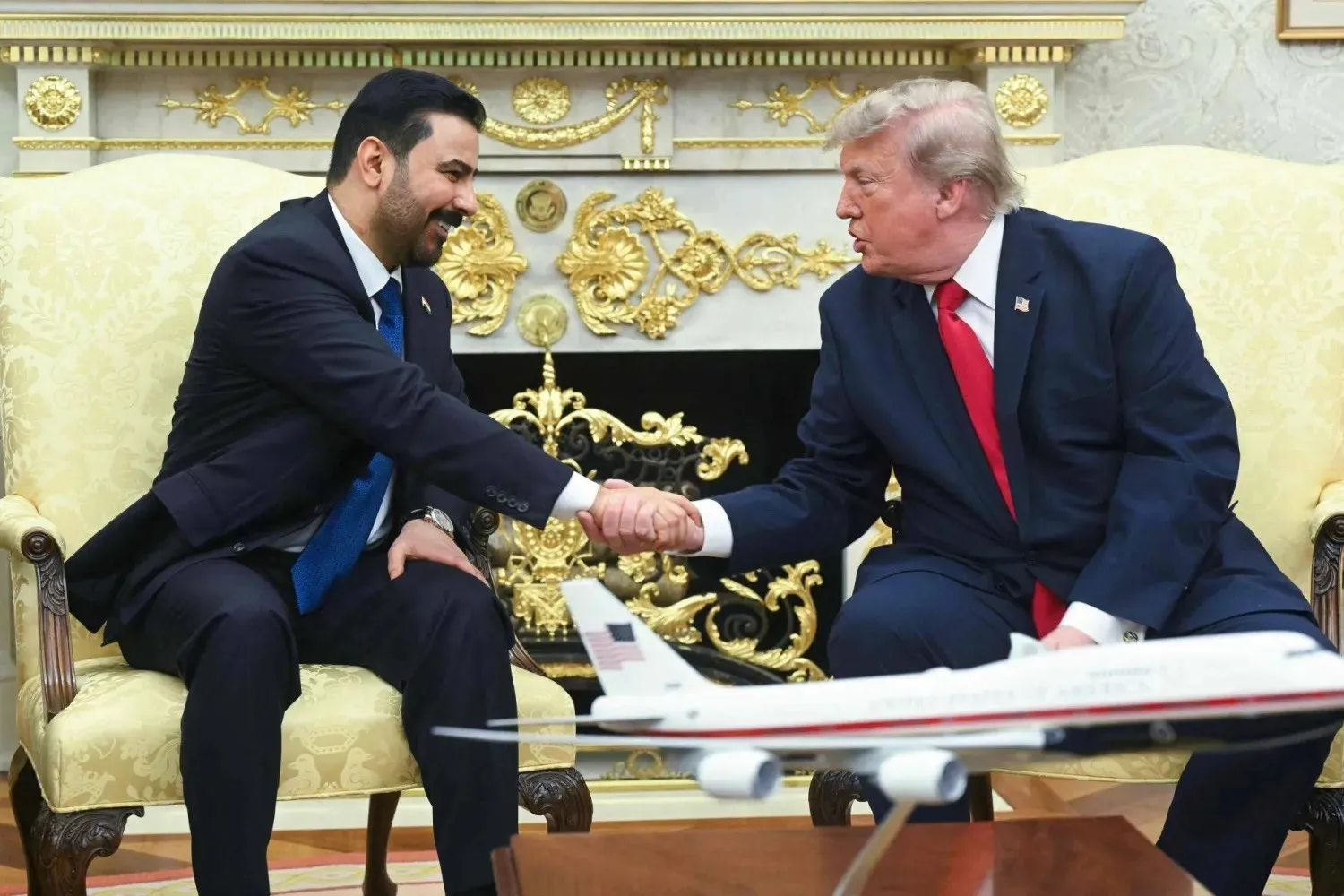

Iran, Iraqi Factions Criticize Al-Zaidi’s Washington Visit

US President Donald Trump shakes hands with Iraqi Prime Minister Ali al-Zaidi at the White House on July 14, 2026. (AFP) 
TT

Iran, Iraqi Factions Criticize Al-Zaidi’s Washington Visit

US President Donald Trump shakes hands with Iraqi Prime Minister Ali al-Zaidi at the White House on July 14, 2026. (AFP) 

Iraqi Prime Minister Ali al-Zaidi received a notably warm welcome during his visit to the United States, where he met President Donald Trump and sought to translate political rapprochement into economic and investment partnerships.

Drawing on his business background, al-Zaidi told US companies they shared “a common language — the economy.” He stressed, however, that he had not come to the United States as a “contractor,” but to pursue broad-based development in Iraq, which he said had missed opportunities for growth over the past two decades despite its ties with successive US administrations.

Al-Zaidi linked Iraq’s next security and political phase to a new era of economic cooperation. He noted that the departure of the remaining US forces after September 30, under an agreement reached between the government of former Prime Minister Mohammed Shia al-Sudani and Washington, could open the door to broader economic and investment partnerships.

Before the visit, al-Zaidi said Iraq would no longer need the concept of “resistance” after the end of September, arguing that “resistance is not a profession, but a necessity” imposed by the country’s past circumstances.

His outreach drew criticism from Iran-aligned groups and their Iraqi allies, who argued that opening the door to US companies represented a political and economic shift requiring reassessment.

The criticism coincided with Iraq’s signing of about 48 memorandums of understanding and agreements with US companies, alongside energy deals that included an oil export route bypassing the Strait of Hormuz and a memorandum of understanding with Syria to transport Iraqi oil to the Syrian port of Banias.

Velayati Criticizes Al-Zaidi

The developments also drew criticism in Tehran, where Ali Akbar Velayati, an adviser to Iran’s supreme leader, described al-Zaidi as “inexperienced,” according to media reports.

Writing in the newspaper Farhikhtegan, Velayati said the Iraqi prime minister’s conduct during his meeting with Trump, shortly after the funeral of former Supreme Leader Ali Khamenei, was “a great disgrace.”

Observers say the dispute reflects intensifying competition over Iraq’s future relationship with both the United States and Iran, as Baghdad seeks to attract foreign investment while preserving its regional balance.

Analyst Iyad al-Samawi questioned whether Iraq was truly prepared to host major US companies and provide an adequate investment climate.

“Global companies do not invest on emotion or gamble with their decisions,” he underlined, stating that they look not only for oil, but also for security, stable legislation, judicial independence, efficient procedures, clear decision-making, and institutional integrity.

He added that major US companies operate under strict anti-bribery and anti-corruption laws and would not lower their standards to accommodate an unstable business environment. The success of the agreements signed in Washington, he said, “begins not with the companies, but with the Iraqi state itself.”

A former security official told Asharq Al-Awsat that the campaign against al-Zaidi was “not merely a passing political escalation,” but reflected concerns that his economic opening could create a more favorable environment for US companies.

Speaking on condition of anonymity, the official said al-Zaidi was seeking to apply his business experience to government by “blending politics with finance and business.” But major US companies, he added, would not invest in Iraq as long as political corruption and security instability persisted.

The official argued that pressure from Iran and allied Iraqi factions was intended to slow the economic opening championed by the prime minister.


Aqaba Port Operations Normal, Says Director General

The Jordanian capital, Amman. Petra file photo
TT

Aqaba Port Operations Normal, Says Director General

The Jordanian capital, Amman. Petra file photo

Director-General of Aqaba Company for Ports Operation and Management Mahmoud Khleifat refuted reports on Sunday that Jordan’s Aqaba seaport has been evacuated due to unspecified threats.

“Aqaba seaport is working normally; it has not been evacuated”, he said.

Earlier, the US embassy in Amman said that Jordanian authorities evacuated the airport and the seaport in the coastal city of Aqaba, citing a threat that was not immediately specified.

"Due to a specific and credible threat, Jordanian authorities evacuated the international airport and seaport in Aqaba. We strongly advise all Americans to refrain traveling to either the airport or seaport," the embassy said in a statement.


Palestinians Say Israeli Settlers Torch Mosque, Factory

A Palestinian man checks the torched entrance at the damaged Al-Taqwa mosque, whose walls were also daubed with Hebrew graffiti in an attack allegedly carried out by Israeli settlers in the Palestinian village of Al-Tuwani, south of Yatta, near Hebron in the occupied West Bank on July 19, 2026. (AFP)
TT

Palestinians Say Israeli Settlers Torch Mosque, Factory

A Palestinian man checks the torched entrance at the damaged Al-Taqwa mosque, whose walls were also daubed with Hebrew graffiti in an attack allegedly carried out by Israeli settlers in the Palestinian village of Al-Tuwani, south of Yatta, near Hebron in the occupied West Bank on July 19, 2026. (AFP)

Israeli settlers set fire overnight to a mosque in a village in the occupied West Bank, a Palestinian official said Sunday, as an AFP journalist saw the structure's entrance scorched and Hebrew graffiti sprayed on its walls.

The incident came during a period of increased attacks against Palestinian communities by settlers in the Israeli-occupied West Bank since the start of the Gaza war in 2023.

More than two dozen settlers, some masked, attacked the Al-Taqwa mosque in the village of Al-Tuwani during the night and set it on fire, Mohammed Rabie, head of the village council, told AFP.

The settlers also set fire to two houses and a dairy factory, he said, adding the attackers spray-painted Hebrew graffiti on the walls of the mosque.

Rabie said the settlers fled after villagers emerged from their homes, adding that local volunteers managed to extinguish the flames before they spread further.

AFP photographs showed a child and an elderly man inspecting the charred entrance and windows of the mosque, where part of a prayer carpet had also been burned.

Rabie said the dairy factory, run by women from the Masafer Yatta community, suffered extensive damage.

"We thank God that this attack did not turn into a tragedy with loss of life," he said.

The Israeli police said it deployed officers to the village last night "after a report of suspects who caused damage at the site, including a vehicle that was set on fire, damage to the door of a prayer structure, and graffiti sprayed on walls."

"The investigation into the circumstances of the incident... is still ongoing."

"The settlers' attack took place in full view of the Israeli army," Palestinian activist Osama Makhamra told AFP, noting that an Israeli military watchtower stands close to the mosque that was set ablaze.

Rabie, however, said Israeli army, police and fire service personnel arrived in the village about half an hour after the attack and inspected the damage to the mosque and other property.

The Palestinian religious affairs ministry condemned the attack.

In a statement, the ministry described the arson as "a full-fledged terrorist act", accusing Israel's "extremist occupation government" of encouraging settler violence in an effort to displace Palestinians from Masafer Yatta and turn the conflict into "a religious war".

In a recent report, the United Nations Office for the Coordination of Humanitarian Affairs (OCHA) said Israeli settler violence in the occupied West Bank had reached "unprecedented" levels, averaging six attacks per day that resulted in casualties or property damage.

Excluding East Jerusalem, around three million Palestinians live in the occupied West Bank alongside more than 500,000 Israelis residing in settlements that are considered illegal under international law.

Israel has occupied the West Bank since 1967.


Eight Peshmerga Forces Wounded in Iranian Strike Targeting Northern Iraqi Kurdistan

A drone is intercepted in the sky over Erbil, Iraq, July 15, 2026, in this screengrab obtained from a social media video. Dlawer/X/via REUTERS
TT

Eight Peshmerga Forces Wounded in Iranian Strike Targeting Northern Iraqi Kurdistan

A drone is intercepted in the sky over Erbil, Iraq, July 15, 2026, in this screengrab obtained from a social media video. Dlawer/X/via REUTERS

Eight members of the Kurdish Peshmerga forces were wounded on Sunday in a drone attack targeting the headquarters of the Kurdistan Freedom Party, a Kurdish opposition group, in Erbil in Iraq's Kurdistan region.

Security sources also told Reuters that an attack drone was shot down near the US consulate in Erbil.

Kurdish media outlet Rudaw quoted Adib Khaledian, a member of the leadership of the Kurdistan Freedom Party, as saying that a drone strike early on Sunday targeted the party's Jamshar headquarters near the Darashakran camp in Erbil province, wounding eight Peshmerga fighters.

He added that "four of the Peshmerga fighters were seriously wounded," and said that "surveillance drones are constantly flying over our positions and gathering information," according to the German news agency.

According to the network, the force has been targeted several times by Iran, with previous attacks killing two Peshmerga fighters and wounding 26 others.