


Syrians Await Verdicts in Trials of Former Assad Officials

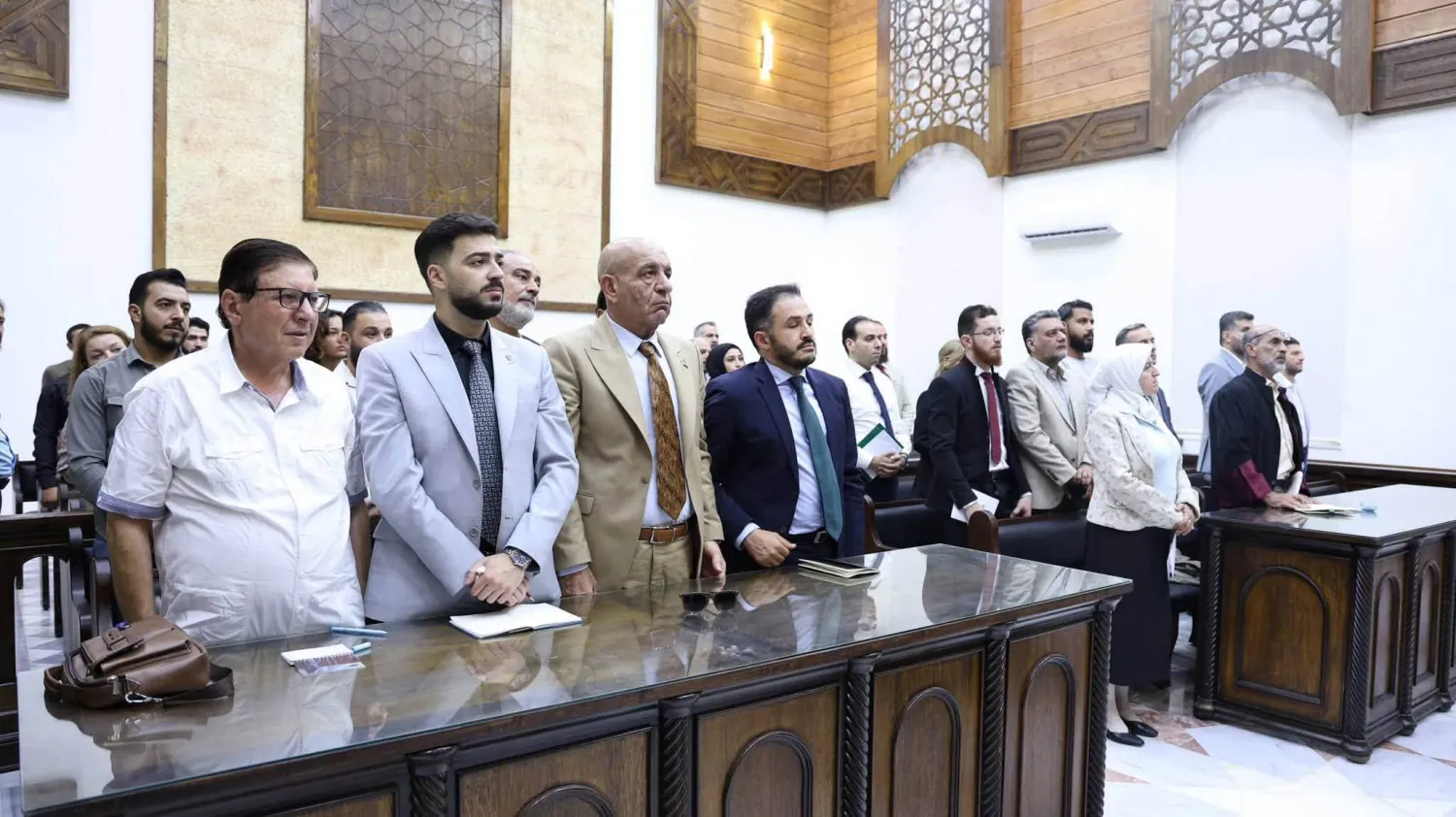
International and human rights organizations, and civil society attended the fifth session of Atef Najib's trial (Syrian Ministry of Justice)
TT

Syrians Await Verdicts in Trials of Former Assad Officials

International and human rights organizations, and civil society attended the fifth session of Atef Najib's trial (Syrian Ministry of Justice)

As public hearings gather pace in the trials of former officials from Syria’s ousted regime, families of victims and survivors of torture are anxiously awaiting the verdicts, with many calling for the defendants to receive the death penalty.

Proceedings before the Fourth Criminal Court at Damascus’ Palace of Justice have accelerated since April 25, when the court opened the in-absentia trial of deposed President Bashar al-Assad, his brother Maher al-Assad, and several senior figures from the former regime. Former security chief Atef Najib also appeared before the court in handcuffs.

The court has so far held six hearings for Najib and three for Wassim al-Assad, a cousin of the former president. According to the National Transitional Justice Commission, Wassim al-Assad’s next hearing, scheduled for July 29, is expected to move to deliberations and a verdict.

Three consecutive hearings have also been held for former Grand Mufti Ahmad Hassoun, who is charged with inciting violence and justifying killings during the rule of the former regime.

The trials are being closely followed in the southern province of Daraa, where Najib headed the Political Security branch. In February 2011, his branch arrested more than 20 schoolboys over anti-government graffiti, including the slogan, “It’s your turn, Doctor.” The case, later known as that of the “Children of Freedom,” helped ignite protests in Daraa on March 18, 2011, widely regarded as the start of the Syrian uprising.

Mohammad Abdul Rahman, a Daraa resident whose son died in Saydnaya prison after being arrested at the outset of the uprising, told Asharq Al-Awsat that residents were demanding “the execution of everyone whose hands are stained with the blood of hundreds of thousands of Syrians, not just Atef Najib.”

“There isn’t a single household in Daraa that hasn’t paid a price. Some lost one or more sons to the bullets of the former regime’s army and security services or in its prisons, while those who did not lose loved ones now live amid destruction,” he said. “The people want all of them executed.”

Youssef Sweidan, one of the children arrested in Daraa who remains unable to work because of the severe torture he endured in detention, also called for Najib to be sentenced to death.

“We want Atef Najib executed as a warning to others. Even execution is too lenient given the crimes he committed against the people of Daraa.”

The hearings have been held only days apart. Hassoun’s latest session took place on July 23, with the next set for July 30. Wassim al-Assad appeared on July 22, and prosecutors requested the death penalty, citing evidence and testimony linking him to premeditated murder as well as drug trafficking and distribution. His next hearing is scheduled for July 29. Najib’s latest hearing was held on July 21, with proceedings due to resume on July 28.

Lawyer Noha al-Masri, one of five attorneys serving on a prosecution team representing the plaintiffs in the cases against senior former regime officials, including Najib, dismissed suggestions that the trials were being rushed.

According to al-Masri, the cases reached public hearings only after progressing through the Public Prosecution, the investigating judge, the referral judge, and finally the Criminal Court. Those earlier stages received little public attention, creating the mistaken impression that proceedings had been expedited. In fact, the case against Najib has been underway since February 2025.

Al-Masri said the next hearing in Najib’s case would hear the defense’s arguments, after which the court would decide whether another procedural session was needed or whether the case was ready for deliberation and judgment.

She argued that the prosecution was seeking the death penalty under Syrian law, which provides that the alleged crimes are not subject to a statute of limitations because they were committed while the defendants represented a ruling regime that remained in power until its collapse. By contrast, she noted, international humanitarian law classifies such offenses as crimes against humanity but does not provide for capital punishment, making life imprisonment a possible sentence.

“We cannot prejudge the outcome, but we hope these killers and criminals receive death sentences. We have confidence in our judiciary and its justice.”

Syria’s new authorities have pledged to ensure justice and accountability for atrocities committed under Assad’s rule, while Syrian activists and the international community continue to stress the importance of transitional justice in the war-ravaged country.




Gaza Parents Urged to Stop Kids Flying Kites After Israel Warning to Hamas

Palestinians make a kite at a tent camp sheltering displaced people in Gaza City, August 25, 2026. (Reuters)
TT

Gaza Parents Urged to Stop Kids Flying Kites After Israel Warning to Hamas

Palestinians make a kite at a tent camp sheltering displaced people in Gaza City, August 25, 2026. (Reuters)

Gaza parents have been warned to stop their children flying kites in the war-ravaged enclave, after Israel threatened a forceful response if the Hamas group revives a tactic of launching incendiary kites over the border.

The popular committees, comprising representatives of local non-government organizations and charities that run Gaza displacement camps and shelters, issued the warning in a statement late on Monday.

The announcement was coordinated with Hamas authorities, a source in the movement ‌said.

"We are ‌working tirelessly on the ground and doing everything possible ‌to ⁠stop this practice, ⁠not to restrict the childhood of our children, who have already been deprived of the most basic rights to play and live in safety, but to protect their innocent lives," the statement said.

In 2018, Gazans sent incendiary balloons and kites over the border, causing fires across hundreds of acres of open fields and farmlands, in what they said was in protest at the ⁠Israeli blockade of the Hamas-controlled enclave.

KITES SCARE ISRAELI VILLAGERS

In ‌the past month, several kites that ‌were not reported to be carrying incendiary materials were spotted drifting from Gaza into Israel, ‌alarming Israelis who live in the nearby villages which came under ‌attack by Hamas in the October 7, 2023 assault that sparked the Gaza war.

On Sunday, Israeli Prime Minister Benjamin Netanyahu warned Hamas that unless that stopped immediately, "those responsible" for launching kites, balloons or drones toward Israel would be targets of assassination and ‌that areas from which they are sent will be ordered to evacuate.

Umm Mohammed, a mother from Gaza ⁠City who spoke ⁠with Reuters over a chat app, said she was worried her son could be hurt.

"Every summer, my kid, Ahmed, 10, and the kids in the street fly those kites to entertain themselves, but I will not allow him to, not anymore," she said.

A senior Israeli defense official said that Hamas was trying to provoke Israel by encouraging Gazans to fly kites across the border.

A Hamas official told Reuters the group has complained to ceasefire mediators that "Israel was making fake pretexts to continue the war on Gaza."

Israel complained to US President Donald Trump's Board of Peace, which oversees the implementation of the 2025 Gaza ceasefire deal, about the kites, according to a second Israeli official.


Strikes in Gaza Kill 4, Including 2 Children, a Week After US Asked Israel to Curb Attacks

A Palestinian inspects the old Abu Salim mosque a day after it was hit by an Israeli airstrike in Deir al-Balah in the central Gaza Strip on August 25, 2026. (AFP)
TT

Strikes in Gaza Kill 4, Including 2 Children, a Week After US Asked Israel to Curb Attacks

A Palestinian inspects the old Abu Salim mosque a day after it was hit by an Israeli airstrike in Deir al-Balah in the central Gaza Strip on August 25, 2026. (AFP)

Palestinian residents of war-battered Gaza fled homes and businesses as Israeli strikes and tank fire killed at least four people Monday, including two children, hospital officials said, a week after a US delegation asked Israel to draw down attacks.

After evacuation warnings by Israel's military, a strike hit a building in the Bureij refugee camp in central Gaza. One family was unable to flee and a 4-year-old child was killed, according to Awda Hospital, where he was taken. His mother and sister were wounded. There was no Israeli military comment.

Israeli strikes hit three other buildings across the territory after residents said they received evacuation warnings. Some people sprinted away, with mothers carrying children, while others moved amid the rubble in wheelchairs or with canes.

Smoke rose over the already devastated landscape.

Israel's military said it carried out strikes in the Shati refugee camp in Gaza City and in Deir al-Balah after issuing warnings, targeting what it described as two Hamas weapons storage facilities inside mosques. The military did not provide evidence but said the facilities contained dozens of “Kalashnikov rifles, magazines and additional military equipment.”

An earlier Israeli strike on a tent in Deir al-Balah killed a man, according to Al-Aqsa Hospital, where his body was taken. Israel’s military said it killed a militant affiliated with Hamas’ special forces unit.

A man was killed and five others were wounded in an Israeli strike in Khan Younis in southern Gaza, according to Nasser Hospital, which received the casualties.

And Israeli tank fire hit an area east of Khan Younis, killing a 10-year-old girl, according to the hospital, where her body was taken.

Israel's military did not immediately comment on the strike in Khan Younis and said it was not aware of the incident with the child.

Israel has continued to carry out targeted killings in the week since a US delegation met with Prime Minister Benjamin Netanyahu in an effort to push last year's ceasefire deal forward.

US negotiator Jared Kushner asked Netanyahu to draw down Israel’s attacks in Gaza, a person familiar with the meeting said last week, speaking on condition of anonymity because they weren’t authorized to brief journalists.

Israel has announced strikes on six of the seven days since that meeting.

While the heaviest fighting in Gaza has subsided since the ceasefire took hold in October, Israeli airstrikes have killed at least 1,288 Palestinians, according to Gaza's health ministry. The ministry, part of the Hamas-led government, maintains detailed casualty records that are seen as generally reliable by UN agencies and independent experts. It does not give a breakdown of civilians and fighters.

Gunmen have carried out shooting attacks on Israeli troops, and Israel says its strikes are in response to that and other ceasefire violations. Five Israeli soldiers have been killed since the ceasefire.

Palestinian officials have reported strikes on homes and police stations, and Hamas has claimed that attacks are designed to destabilize Gaza and prevent progress on the ceasefire's next steps, which include demilitarizing and reconstructing the territory and the deployment of an international stabilization force.

Israel warns against kites sent from Gaza

In the period before the Hamas-led Oct. 7, 2023, attack on southern Israel that sparked the war, burning kites and balloons were sent from Gaza into Israel, causing fires and other damage.

Now Israeli officials are expressing concern after several kites were found in a kibbutz near Gaza. No weapons or dangerous materials were attached.

Netanyahu and Defense Minister Israel Katz in a statement Sunday threatened to ramp up strikes on Gaza unless Hamas ensures the kites stop flying toward Israel.

Hamas spokesperson Hazem Qassem has called the kites “essentially children’s toys” and accused Israel of using them as “an attempt to justify the continuation of aggression and violations against our people.”

The Oct. 7 attack killed some 1,200 people and saw 251 taken hostage. All hostages or their remains were later released. Israel’s retaliatory offensive in Gaza has killed more than 73,422 Palestinians, according to Gaza’s health ministry.


Al-Zaidi: Iraq Will Not Become a Platform to Harm Others

Iraqi Prime Minister Ali al-Zaidi delivers his speech at the event in Baghdad. (INA)
TT

Al-Zaidi: Iraq Will Not Become a Platform to Harm Others

Iraqi Prime Minister Ali al-Zaidi delivers his speech at the event in Baghdad. (INA)

Iraqi Prime Minister Ali al-Zaidi stressed on Monday that his government is forging ahead in building a “free” and “sovereign” Iraq, adding that international coalition forces will complete their withdrawal on September 30.

“Since assuming responsibility for the government, we have pledged to move toward building a fully sovereign Iraq in which the people enjoy all the foundations of respect, dignity and security, and whose citizens cooperate in protecting the country and safeguarding its wealth and the future of its generations,” he said during a speech at an event in Baghdad marking the Prophet Muhammed’s birthday.

Iraq will declare the completion of its sovereignty over its entire territory on September 30, he announced, reported Iraq’s state news agency INA.

Moreover, he said: “Iraq should not be a platform for harming others.”

“Our region has lived for decades amid ongoing tensions that have led to divisions in the approaches and governing visions of the countries of the Arab and Islamic world,” remarked al-Zaidi.

“Our government program included a clear approach to construction and reform, combating corruption and strengthening a productive working environment, alongside building security institutions operating under the framework of the Constitution.”

Earlier, al-Zaidi received in Baghdad Commander of German Forces Deployed Abroad Gunter Schneider.

The PM highlighted “the importance of transitioning toward multidimensional relations with the coalition countries.”

The meeting reviewed preparations for completing the withdrawal of coalition forces from Iraq.

Al-Zaidi commended Germany’s longstanding role in assisting Iraq in its fight against terrorism, particularly during the war on ISIS.