Tensions Rise between Locals, Israeli Forces in Syria’s Yarmouk Basin

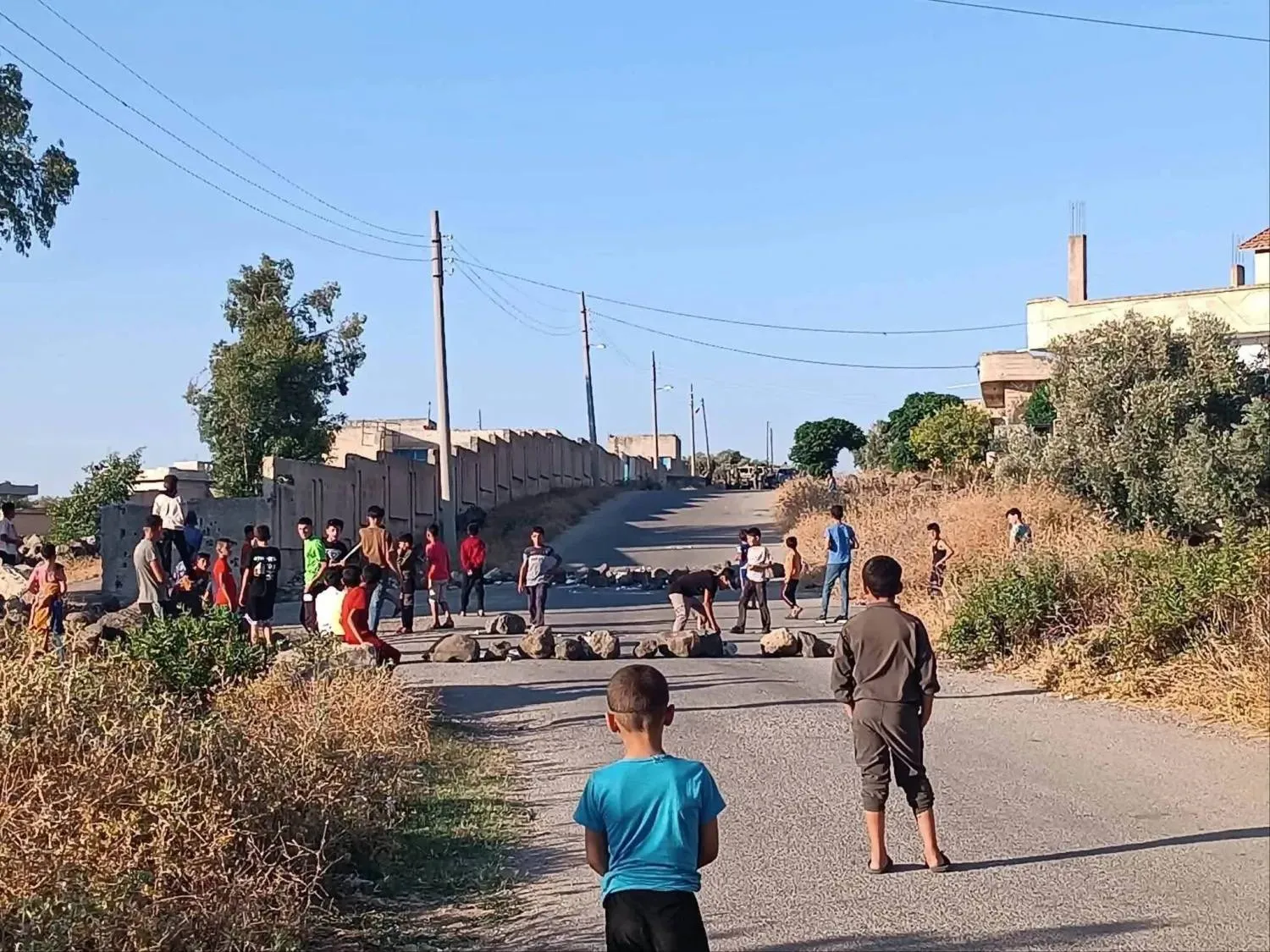
Children block a road in the Yarmouk Basin area in southern Syria in an attempt to prevent an Israeli patrol from entering the area. (Facebook)
TT

Tensions Rise between Locals, Israeli Forces in Syria’s Yarmouk Basin

Children block a road in the Yarmouk Basin area in southern Syria in an attempt to prevent an Israeli patrol from entering the area. (Facebook)

Tensions are mounting between the locals and Israeli forces in the Yarmouk Basin region in the western countryside of Daraa, southern Syria.

On Monday, residents responded to incursions by the Israeli army by re-closing roads to its patrols, and distributed leaflets, in response to Israeli ones, warning the military against entering their lands.

They declared that they "will defend their land with all the strength they possess," read one leaflet.

Speaking to Asharq Al-Awsat, local sources described the situation in the region as a "ticking time bomb" that could explode at any moment.

A local source in the village of Maariyah told Asharq Al-Awsat that an Israeli military incursion took place on Monday morning. It advanced from its base on Al-Jazeera Hill toward the village, stationed itself on the road connecting the village to the base, and opened the road leading to the village of Al-Ardah after residents had blocked it.

Israeli troops also searched several homes in the area.

Speaking on condition of anonymity, the source said that after the troops left the area, the residents again blocked the road with rocks to prevent a new incursion.

The residents had done this before with Israeli forces reopening the blocked roads and the locals again closing it.

The locals distributed leaflets in areas where Israel has been carrying out patrols, warning its forces against entering their regions.

They stressed that they are the owners of the land and that they will defend it with all their might.

Israeli jets had thrown leaflets on Sunday warning the locals against obstructing its troop incursions.

Israeli forces have made repeated incursions into the region over the past months. They often carry out search operations, detain people and then withdraw from the area.

The local source noted, however, that now, the forces are destroying infrastructure. On Sunday, a military unit damaged a power plant in Maariyah, taking it out of service and cutting power to several homes.

It also damaged solar panels used for the main water well.

On the possibility of a clash erupting between the locals and the troops, the source said it was unlikely because the residents are unarmed and can only attack the forces with rocks.

The incursions have greatly impacted living conditions. The source revealed that obtaining water has become an arduous task and some people have resorted to freelance work because they are afraid of heading out the agricultural fields. Many are now out of work.

Following the ousting of President Bashar al-Assad in late December 2024, Israel launched hundreds of airstrikes on military targets in Syria. Its forces carried out incursions beyond the buffer zone, reaching villages in the western countryside of Damascus, where it announced its intention to establish a demilitarized zone.

Since the 1967 war, Israel has occupied parts of the Golan Heights, which it annexed in 1981 - a move not recognized by the international community, with the exception of the United States.

During a meeting with Syrian President Ahmed al-Sharaa on Saturday, UN Secretary-General António Guterres reaffirmed the United Nations' commitment to "Syria's sovereignty, independence, unity, and territorial integrity," expressing "grave concern over Israeli violations" of the 1974 Disengagement Agreement.


Israel Strikes East Lebanon, Says Targeting Hezbollah Arms

Smoke rises from the site of an Israeli strike that targeted the southern Lebanese village of Kfar Tebnit on May 21, 2026. (AFP)
TT

Israel Strikes East Lebanon, Says Targeting Hezbollah Arms

Smoke rises from the site of an Israeli strike that targeted the southern Lebanese village of Kfar Tebnit on May 21, 2026. (AFP)

Israel struck a mountainous area in eastern Lebanon on Monday, according to Lebanese state media, with the Israeli military saying it was targeting a shipment of weapons headed for Hezbollah.

"Enemy aircraft launched a strike at dawn against the Al-Shaara region, in the highlands of the Anti-Lebanon mountain range, without resulting in victims or damage," Lebanon's official National News Agency (NNA) said.

The Israeli military said it "struck a weapons shipment transferred from Syria to Lebanon, intended for the Hezbollah terrorist organization".

Hezbollah, which is backed by Iran, emerged badly weakened from two successive wars with Israel since 2023.

The ousting in 2024 of Syrian president Bashar al-Assad, a key ally of the group, cut off a major weapons route.

Hezbollah lawmakers have nonetheless maintained that the group is rebuilding its military capacities, as fighting with Israel has wound down since June.

In October, Lebanese security forces seized a half-ton of explosives transported in a truck from east Lebanon towards Beirut.

Hezbollah acknowledged ownership of the explosives, saying they were intended for "resistance" against Israel.

Lebanese authorities have announced a plan to disarm Hezbollah, but the group has refused to lay down its weapons.


US Envoy Says Lebanon’s Hezbollah Should Disarm ‘Voluntarily'

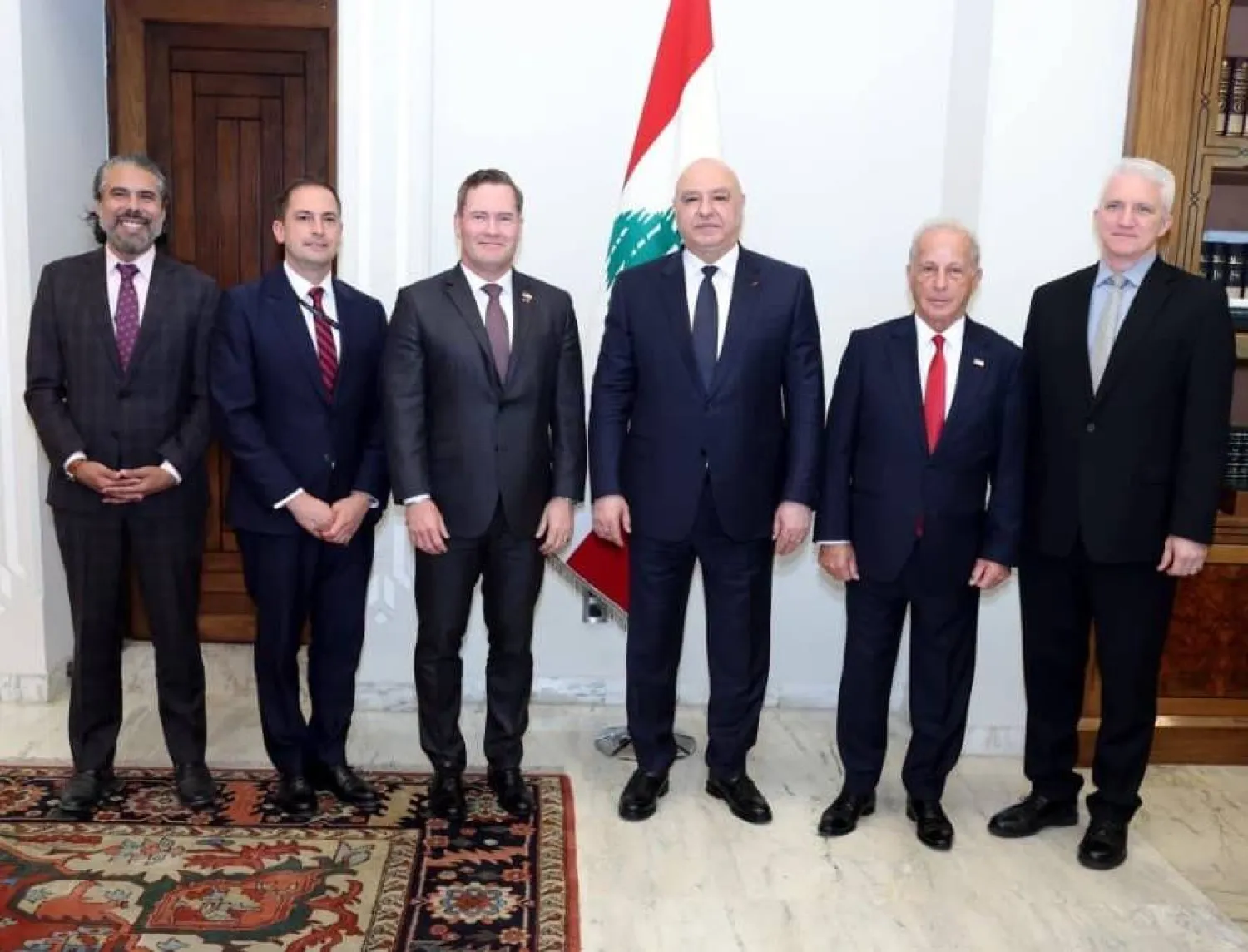
Lebanese President Joseph Aoun receives US envoy Mike Waltz at the Baabda presidential palace on Monday. (NNA)
TT

US Envoy Says Lebanon’s Hezbollah Should Disarm ‘Voluntarily'

Lebanese President Joseph Aoun receives US envoy Mike Waltz at the Baabda presidential palace on Monday. (NNA)

Iran-backed Hezbollah should "voluntarily" lay down its weapons and hand them over to the Lebanese state, visiting US envoy Mike Waltz said on Monday, adding that "no country can have two armies". 

"I think the message should be loud and clear, that Lebanese sovereignty must be fully restored," said Waltz, who is the US ambassador to the United Nations. 

"And the mechanism to do that will be the Lebanese armed forces." 

Waltz held separate talks in Lebanon with President Joseph Aoun and Prime Minister Nawaf Salam.

Hezbollah, which has fought successive wars with Israel, is under pressure to disarm. 

It was the only armed group that refused to hand over its weapons after Lebanon's civil war ended in 1990. 

"I appreciate every Lebanese soldier that steps forward to defend their country, to restore their sovereignty, to defend their people. This is a unique opportunity in history to do that, one," Waltz said. 

"And two, to Hezbollah and to their Iranian backers, no country can have two armies. I hope and pray Hezbollah will disarm. They should do that voluntarily." 


Syria Needs EU Support to Ensure Stability, Kallas Says

High Representative of the European Union for Foreign Affairs Kaja Kallas speaks prior to the Foreign Affairs Council meeting in Brussels, Belgium, 16 November 2026. (EPA)
TT

Syria Needs EU Support to Ensure Stability, Kallas Says

High Representative of the European Union for Foreign Affairs Kaja Kallas speaks prior to the Foreign Affairs Council meeting in Brussels, Belgium, 16 November 2026. (EPA)

European Union foreign ministers will discuss on Monday elevating their relationship with Syria as the war-torn country needs urgent support to ensure stability amid ‌escalating tensions ‌in the ‌region, ⁠the bloc's foreign policy ⁠chief said.

"We really see that Syria needs a lot of investments, to build ⁠up institutions and ‌its ‌reforms," Kaja Kallas ‌told reporters ahead of ‌a monthly foreign ministers meeting in Brussels.

"On the European side we ‌want to see Syrian refugees return but ⁠they ⁠need conditions to return. There's a lot we can do together because the stability of Syria is in our interest and the interest of region."