


Hamas Agrees to Deal for Disarmament, Israel’s Withdrawal from Gaza

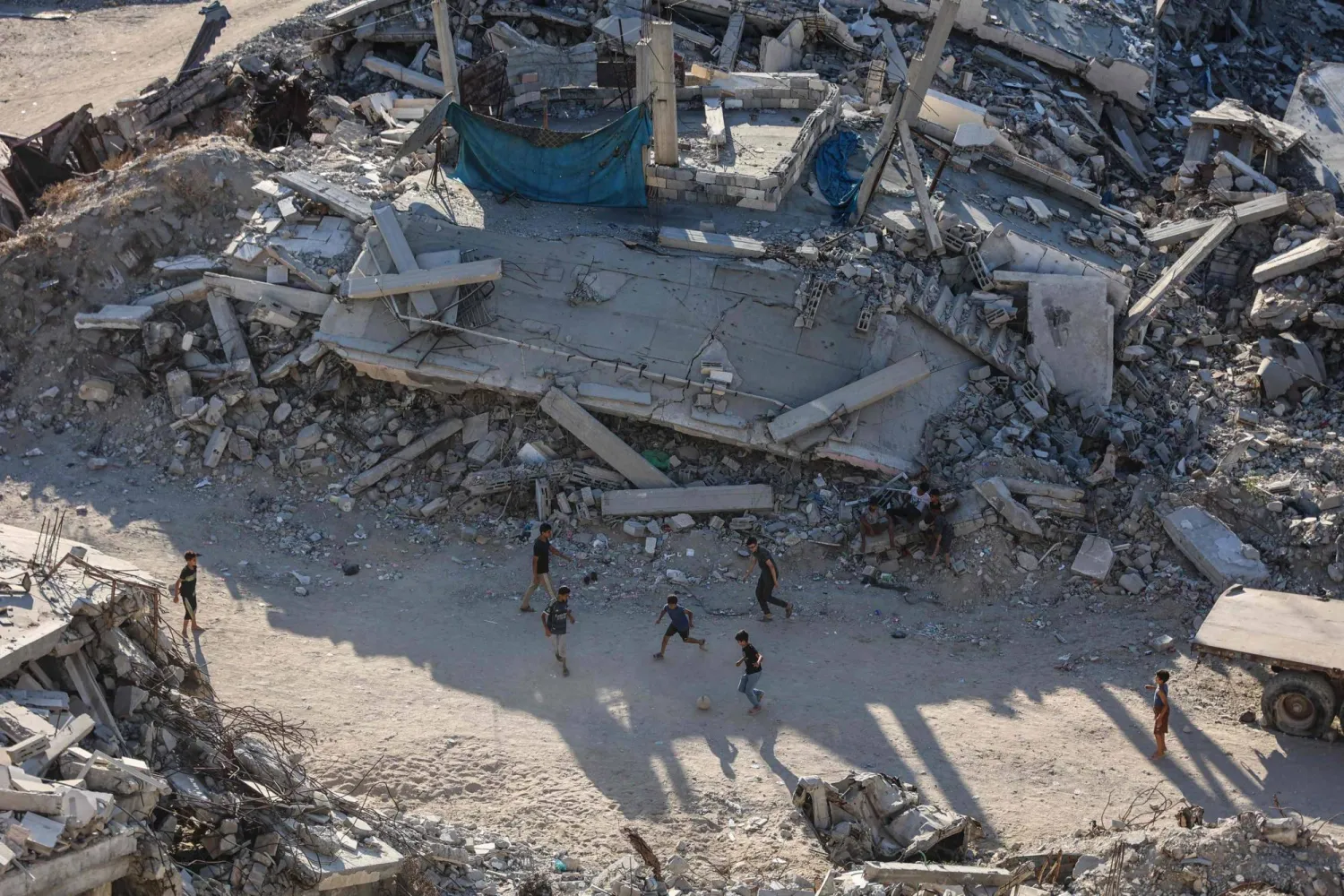
Children play football amid the ruins of destroyed buildings in Gaza City on July 27, 2026. (AFP)
TT

Hamas Agrees to Deal for Disarmament, Israel’s Withdrawal from Gaza

Children play football amid the ruins of destroyed buildings in Gaza City on July 27, 2026. (AFP)

Hamas said Friday it agreed to a deal to end the war with Israel that included provisions addressing its weapons and the gradual withdrawal of Israeli forces from the Gaza Strip.

The group's disarmament has been one of the key sticking points in the advancement of a ceasefire deal that has been in place in Gaza since October.

US President Donald Trump announced late Thursday an agreement for the "complete disarmament" of Hamas, calling it a critical step toward a new Palestinian government in Gaza.

"Today, the Board of Peace reached a HISTORIC agreement for the COMPLETE DISARMAMENT of Hamas and all other armed groups in Gaza," Trump said in a social media post, adding that the disarmament would come in phases.

"This is a monumental step toward lasting PEACE and SECURITY."

Hamas officials told AFP a committee established by Trump's Board of Peace to govern Gaza would oversee the process of storing the movement's weapons.

The group said it expected mediators and the Board of Peace to ensure Israel complied with the deal's terms, which included Israel's withdrawal from Gaza.

Ghazi Hamad, a member of the group's negotiating team, said the movement was making "concessions for the sake of our people in the Gaza Strip, to save them from killing and displacement".

"Israel will not intervene in the issue of disarmament. The National Committee is the body that will undertake this task," he said, referring to the National Committee for Administration of Gaza (NCAG).

There was no immediate statement from Israel.

Despite the October ceasefire, violence has continued in Gaza, with Israeli strikes killing at least four people, including two children, on Thursday, according to health officials.

- Focus now on implementation -

The Board of Peace confirmed in a post on X that Hamas had "agreed to a detailed Roadmap for implementing the next phases of the Gaza ceasefire".

"Our focus now turns to implementation," the organization wrote, adding the NCAG will "soon begin a phased transition toward full authority".

Trump, in an earlier social media post, said that once Hamas's disarmament is complete, "Israeli forces will withdraw, and the International Stabilization Force will work with a new Palestinian police force to take responsibility for Gaza being safe for its residents and its neighbors".

Nickolay Mladenov, the Board of Peace's high representative for Gaza, said Friday the deal "took months of very difficult negotiations".

"What happens next matters even more. Implementation and verification have to be real," Mladenov wrote on X.

"Withdrawal must move in lockstep with decommissioning," he added.

Egypt's state-linked Al-Qahera News said early Friday that Cairo is set to host a meeting "soon" of the Gaza truce mediators, which also include the United States, Qatar and Türkiye, focused on the second phase of the Gaza ceasefire plan.

- 'No exceptions' -

Earlier, a diplomatic source told AFP: "We continue to advance the implementation roadmap that offers a balanced and pragmatic path forward, with all weapons decommissioned and a phased transition of responsibilities taking place to hand over full authority to the technocratic government."

The source, who spoke on condition of anonymity as he was not authorized to speak publicly on the matter, said there would be "no exceptions for certain weapons or certain people. One authority, one law, one weapon".

The roadmap, the source said, would create "a process for the elimination of all tunnels, depots of weapons and any weapons production facilities".

The source said a verification mechanism would ensure compliance by each side.

A Hamas source familiar with the talks told AFP earlier that the movement was "awaiting the Israeli response to the amendments we recently submitted to the mediators".

The source said the amendments concerned two articles in the roadmap presented by the Board of Peace.

Regarding the article concerning weapons, the Hamas source said that "some points were removed, and alternatives were proposed".

Before the deal's announcement, an Israeli political source told AFP that the proposed agreement did not "satisfactorily" address Israeli demands.

"Israel demands the complete disarmament of Hamas, including the removal of weapons from Gaza and full demilitarization of the Strip as a precondition for any process," the source said.

The source also said that "the issue of Gaza did not come up at all" in the meeting between Israeli Prime Minister Netanyahu and Trump in Washington this week.



US Hits Hezbollah with Fresh Sanctions, Says Iran Controls it

FILE PHOTO: A general view of the US Department Of The Treasury on day two of a partial government shutdown in Washington, D.C., US, February 1, 2026. REUTERS/Ken Cedeno/File Photo
TT

US Hits Hezbollah with Fresh Sanctions, Says Iran Controls it

FILE PHOTO: A general view of the US Department Of The Treasury on day two of a partial government shutdown in Washington, D.C., US, February 1, 2026. REUTERS/Ken Cedeno/File Photo

The United States announced new sanctions Thursday against a Hezbollah financing network, while highlighting the Lebanese armed group's close ties to Iran's Revolutionary Guards.

Hezbollah's legal designation as a terrorist organization has been amended to note that it operates in "service to the Iranian regime under the command of Iran's Islamic Revolutionary Guard Corps," particularly the elite Quds Force, the Treasury Department said in a statement.

The new redesignation "specifies that Hezbollah is an Iranian proxy, not a stand-alone operation as implied by the previous designation," a State Department official said.

"This underscores that Hezbollah operates with little to no regard for Lebanese sovereignty, the Lebanese people, or the Lebanese state."

Hezbollah drew Lebanon into the broader Middle East war in March with rocket fire at Israel in support of its backer Iran.

Israel responded with a heavy air campaign and ground invasion that Lebanese authorities say have killed more than 4,300 people.

"This action builds on years of US designations that have repeatedly documented the operational, financial, and logistical integration between Hezbollah and the IRGC-QF," the State Department official said, calling Hezbollah "an extension" of the latter.

"It is not a Lebanese resistance movement," as Hezbollah describes itself, the official said.

The new sanctions target 10 people who are allegedly part of a network that transfers cash to Hezbollah, which has already been punished with US sanctions many times, the Treasury statement said.

The network utilizes couriers travelling on commercial airline flights “to move up to hundreds of millions of dollars between jurisdictions, providing an avenue outside the formal financial system for Hezbollah to obtain foreign currency and evade sanctions," the statement said.

US Treasury Secretary Scott Bessent said earlier on Thursday that he would hold a press conference on Monday about "the toughest sanctions in history" that Washington plans to impose on Iran.

He said that a plan to sharply increase pain from economic sanctions on Iran aims to "collapse" the country's government.

"It is going to work in Iran and we are going to collapse this regime," he told CNBC. "This is going to be the greatest coordinated economic isolation in the history of the world."


Arab League Chief Condemns Israeli Violations in Palestinian, Syrian, Lebanese Territories

Arab League headquarters in Cairo (The League's official Facebook page)
TT

Arab League Chief Condemns Israeli Violations in Palestinian, Syrian, Lebanese Territories

Arab League headquarters in Cairo (The League's official Facebook page)

Secretary-General of the Arab League Nabil Fahmy denounced Israel’s violations against Palestinian, Syrian, and Lebanese territories saying they cannot be viewed as isolated incidents or justified by fabricated security claims.

He said these actions reflect a persistent approach marked by the use of force, the imposition of a fait accompli, and violations of states' sovereignty and territorial integrity, the Saudi Press Agency said on Thursday.

In a statement, Fahmy asserted that Israel continues to act as a state that disregards international law. He called on the UN Security Council and the international community to take responsibility and implement practical measures to stop these violations and end the policy of impunity.

Fahmy underscored that Israel's actions not only threaten countries in the region but also undermine the credibility of the international legal order. He said they reinforce the notion that force can serve as an alternative to international legitimacy.


Abdi Announces Completion of SDF’s Civil, Military Integration with Damascus

(FILES) Syrian Democratic Forces (SDF) commander-in-chief Mazloum Abdi, speaks during a press conference in Syria's northeastern city of Hasakeh on December 6, 2024. (Photo by Delil SOULEIMAN / AFP)
TT

Abdi Announces Completion of SDF’s Civil, Military Integration with Damascus

(FILES) Syrian Democratic Forces (SDF) commander-in-chief Mazloum Abdi, speaks during a press conference in Syria's northeastern city of Hasakeh on December 6, 2024. (Photo by Delil SOULEIMAN / AFP)

The integration of the Kurdish administration within Syria's state institutions is now complete, Syrian Kurdish leader Mazloum Abdi said on Thursday.

The announcement follows months of negotiations between the two sides after a January agreement that called for the full integration of Kurdish civil and military institutions into the state -- a move Washington deemed "historic.”

"I want to say that the phase of integrating military, security and administrative institutions into national state institutions is complete and finished," Abdi, who heads the Kurdish-led Syrian Democratic Forces, said at an event in Qamishli in northeastern Syria.

"From now on, we begin a new phase," he added.

"Our struggle will continue, to cement our people's rights in the constitution."

Syrian President Ahmed al-Sharaa shakes hands with Mazloum Abdi, commander of the Syrian Democratic Forces (SDF), in Damascus on March 10, 2025 (SANA)

The January agreement, signed by Abdi and Syrian President Ahmed al-Sharaa, followed clashes between Syrian Kurdish fighters and the new authorities' forces that saw the Kurds lose swathes of territory they held in the oil-rich north and northeast.

Amid the violence, al-Sharaa signed on January 16 a decree enshrining the Kurds' national rights and recognizing Kurdish as a national language.

A photo showing SDF Commander Mazloum Abdi with his fighters wearing the military uniform of the Syrian Ministry of Defense as part of the integration steps last February (social media)

In February, Noureddine Ahmed Eissa, a Kurd from the city of Qamishli, was appointed governor of Hasakeh. In March, senior Kurdish military official Sipan Hamo was appointed regional assistant defense minister.

As part of the deal's implementation, government forces entered the cities of Hasakeh and Qamishli, and Damascus took over the management of Qamishli airport and key oil fields.

US troops also transferred more than 5,700 ISIS detainees in previously Kurdish-controlled camps to neighboring Iraq.