


Israeli Strikes Kill Two in Gaza, Destroy Medicine Storage Warehouses

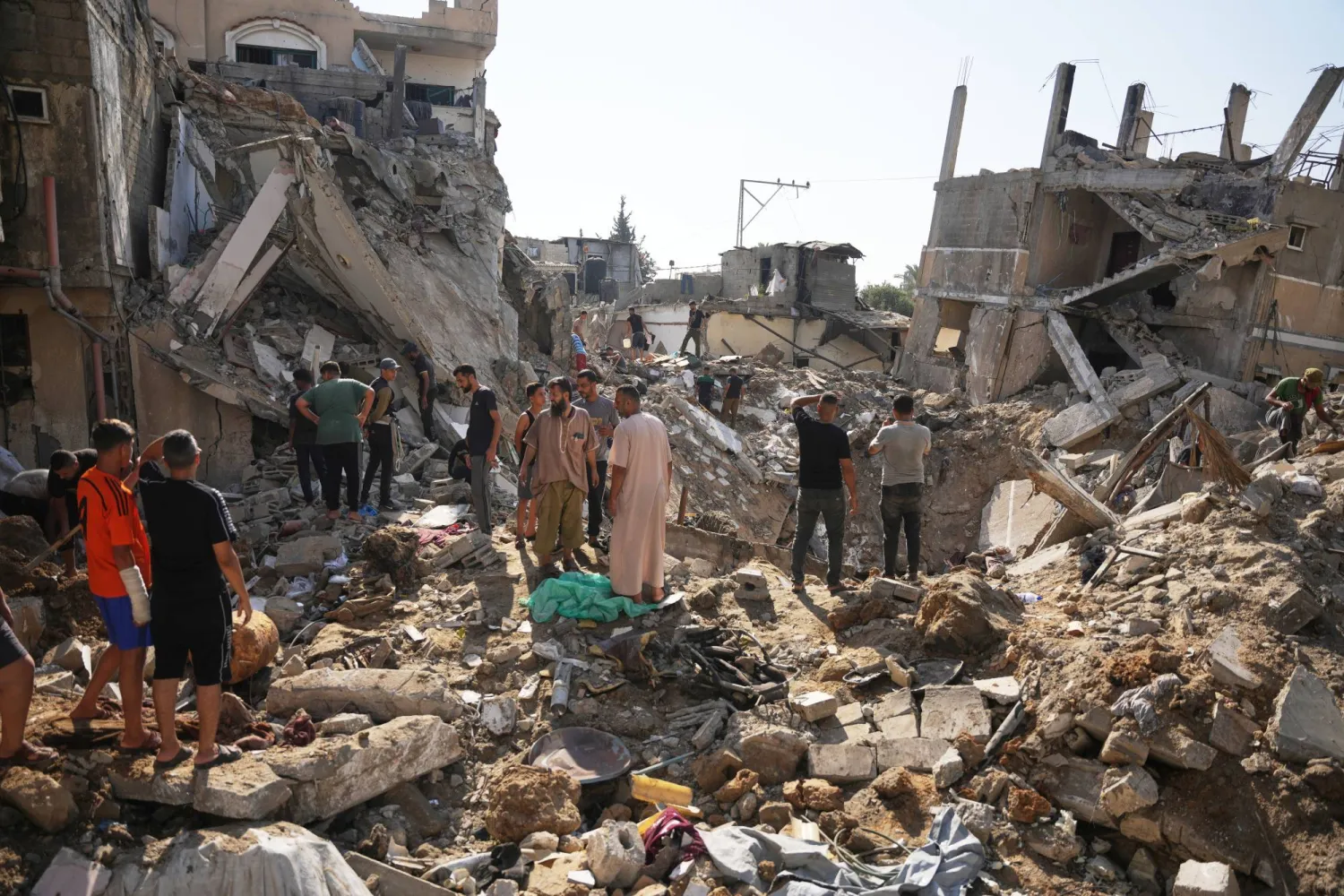
Palestinians inspect destroyed buildings at the scene of an Israeli airstrike, at al-Maghazi refugee camp, central Gaza Strip, Saturday, Aug. 1, 2026. (AP Photo/Abdel Kareem Hana)
TT

Israeli Strikes Kill Two in Gaza, Destroy Medicine Storage Warehouses

Palestinians inspect destroyed buildings at the scene of an Israeli airstrike, at al-Maghazi refugee camp, central Gaza Strip, Saturday, Aug. 1, 2026. (AP Photo/Abdel Kareem Hana)

Israel's military on Saturday killed two Palestinians in Gaza and destroyed two warehouses near a hospital that were said to be storing medicine in separate strikes, amid uncertainty over whether Israel has accepted a deal reached with Hamas over the group's disarmament.

Palestinian health officials said two Palestinians were killed in the Sheikh Radwan area of Gaza City in central Gaza in an Israeli air strike. A military spokesperson said those targeted were Hamas militants but declined to provide further details.

In an earlier incident, an Israeli air strike destroyed two warehouses that were used to store medicine by the Al-Aqsa Martyrs Hospital in Deir al-Balah in southern Gaza, the Palestinian health ministry in Gaza said in a statement.

Several hours after the strike, the Israeli military said it had struck a Hamas hideout near the hospital which the group used to store weapons. Other sites in Gaza that it said were used by Hamas to store arms were also struck, a military statement said.

The military said the strikes were directed by the Shin Bet intelligence agency. It did not disclose any evidence to support the claim that Hamas was storing weapons at any of the sites.

Reuters footage of the Deir al-Balah strike showed a crater several metres wide marking the site of the explosion, with debris strewn across the area, including what appeared to be medical supplies, close to a densely packed tent encampment.

Two other warehouses storing medicine and the hospital's outpatient clinic were damaged in the strike, the Palestinian Health Ministry said. There were no immediate reports of any injuries.

The hospital said the warehouses had stored essential medical supplies used to treat kidney failure patients undergoing dialysis, along with other materials like gauze used in wound care and routine treatment.

"The Israeli occupation has committed a heinous crime," Khalil al-Daqran, a doctor at the hospital, said of the strike.

"In the middle of the night, (the military) targeted a warehouse containing medical supplies for the hospital, and the occupation completely destroyed it," he told Reuters.

Witnesses said the military had issued an evacuation warning for the area before carrying out the Deir al-Balah strike.

Hospitals and other civilian sites are protected under international humanitarian law, although that protection can be lost if they are used for military purposes. Israel's military says Hamas and other armed groups operate from within civilian areas and facilities, including hospitals.

Fatima Sharab, a displaced Palestinian living in a tent near the warehouses, said many people in need of medical care had been sheltering in the area to be close to the hospital.

Israel has continued to carry out strikes on Gaza since agreeing last October to a US-mediated ceasefire, killing 1,222 Palestinians in the past nine months. Palestinian health officials say many of those killed were women and children. Hamas rarely announces its casualties.

US President Donald Trump on Thursday said there had been a breakthrough in his plan to end the war, which both Israel and Hamas agreed to last year and which started with the ceasefire. Trump said that Hamas, which ruled Gaza for nearly two decades before carrying out the October 7, 2023, attack on Israel that triggered the Gaza war, had agreed to lay down its weapons.

Israeli Prime Minister Benjamin Netanyahu is yet to comment publicly, while his National Security Minister Itamar Ben-Gvir has called the agreement unacceptable and said that Israel must continue to carry out its policy of assassinating Hamas leaders.

Trump's Board of Peace, established to implement his plan for ending the Gaza war, released a roadmap on Thursday outlining the final steps for carrying out the initiative. The document states that Israel will cease military operations as part of its commitment to Trump's 20-point plan, which it signed last year.



Judicial Source: Lebanon Arrests 2 Suspected Hezbollah Members over Explosives

This photograph taken during a media tour organized by Hezbollah shows a flag of Hezbollah installed on the balcony of a damaged building at Nabi Sheet town after an Israeli military operation in the Bekaa Valley of Lebanon, on March 7, 2026. (Photo by FADEL itani / AFP)
TT

Judicial Source: Lebanon Arrests 2 Suspected Hezbollah Members over Explosives

This photograph taken during a media tour organized by Hezbollah shows a flag of Hezbollah installed on the balcony of a damaged building at Nabi Sheet town after an Israeli military operation in the Bekaa Valley of Lebanon, on March 7, 2026. (Photo by FADEL itani / AFP)

Lebanese authorities arrested two suspected Hezbollah members accused of secretly transporting half-a-ton of explosives, a judicial source told AFP on Saturday.

According to the source, who spoke on condition of anonymity, the two men were caught Thursday afternoon at a security checkpoint in Dahr al-Baidar in Lebanon's east, near a road linking the country with Syria.

They were in a car heading towards Beirut.

After searching the vehicle, security forces seized "250 kilograms of TNT-type explosives and 250 kilograms of C4-type, a highly explosive substance,” the source said.

Based on initial investigations, one of the suspects is the son of a Hezbollah official and the other is also a member of the group, according to the source.

The explosives' destination remains unknown, the source added.

Lebanese authorities have not confirmed the source's information.

But Justice Minister Adel Nassar vowed on X Saturday that "the investigation into the seized explosives, and everything that follows from it, will continue to the very end.”

He insisted that work toward "disarming illegal groups, combating terrorism and prosecuting all outlaws is... irreversible and speeding up.”

Lebanon approved a plan to disarm Hezbollah in 2025, following a ceasefire the previous November that ended a devastating war between the group and Israel.

However, the conflict flared back to life in March this year when Hezbollah attacked Israel in support of Iran in the Middle East war.

Israel invaded in response and now occupies a band of territory in Lebanon's south.

A new ceasefire was struck in June, and Israel and Lebanon have agreed to a framework deal that involves Hezbollah's disarmament, a gradual Israeli withdrawal and the deployment of the Lebanese army to the region.


MSF: Houthi Escalation Leaves Thousands of Yemenis Without Shelter

A relief worker walks among the tents at a temporary shelter for displaced people north of Aden (AFP)
TT

MSF: Houthi Escalation Leaves Thousands of Yemenis Without Shelter

A relief worker walks among the tents at a temporary shelter for displaced people north of Aden (AFP)

The ordeal is far from over for the thousands of Yemenis who have fled the Houthi escalation in western Taiz and southern Hodeidah.

Reaching safer areas did not mark the end of their struggle, as many families found themselves without shelter after traveling long distances on foot under intense heat, only to face hunger, disease, and a shortage of clean water amid growing risks of malnutrition and cholera.

Médecins Sans Frontières (MSF) has warned of deteriorating health and living conditions among displaced people in the governorates of Lahj and Aden, noting that those fleeing the escalation are experiencing high rates of severe acute malnutrition, cholera, acute watery diarrhea, measles, and other infectious diseases. At the same time, their ability to secure food, clean water, and medical care continues to decline.

According to MSF, the latest wave of escalation has displaced families from areas along Yemen’s western coast that have come under Houthi control, leaving them once again facing harsh conditions after abandoning their homes, possessions, and livelihoods in search of safety.

Conditions documented by mobile medical teams reveal the extent of the displaced population’s suffering. Many have traveled long distances across desert terrain in extreme heat, with no guarantee of access to food, water, or shelter from the harsh weather.

“Displaced people who cannot find shelter in host communities, and formal or informal camps have been seen by our teams on the road or sleeping under the shade of trees,” MSF said.

Those who have settled around Lahj governorate “are in critical need of medical and humanitarian support, including water and sanitation services in the informal places where they settle, such as schools and mosques. The risk of waterborne diseases, like cholera, is increasing rapidly in the current conditions.”

The consequences of displacement extend far beyond the loss of homes and the hardships of the journey. Women and children face growing health risks amid worsening food insecurity, the loss of income and livelihoods, and the struggle to meet basic needs, making daily survival a constant challenge for families forced to flee.

“In the many camps across Lahj and Aden governorates, 70 percent of the patients treated by MSF mobile clinics are women and children. People present with skin infections, fever, diarrhea, and communicable diseases,” MSF said.

“The long walks have caused foot injuries and ear and eye infections,” it added.

The risks are even greater for children suffering from malnutrition, as their chances of obtaining adequate nutrition and regular healthcare continue to decline due to poverty, displacement, and limited access to medical services. MSF teams have identified cases of severe acute malnutrition among children requiring specialized medical intervention.

Food insecurity and declining sources of income, coupled with a rise in cholera cases, are further exacerbating the health challenges faced by displaced people. Many are struggling to access medical facilities or obtain the referrals needed for essential treatment.

“In response to the needs of displaced people, we sent mobile clinics across Aden and Lahj governorates, with 775 total consultations since 15 September. Twenty children were diagnosed with severe acute malnutrition,” said MSF.

For families that have traveled long distances in search of safety, the struggle does not end once they leave conflict zones behind. Instead, a new battle begins: securing food, drinking water, and shelter to protect their children from heat and disease.

As needs continue to grow, the urgency of providing shelter, food, healthcare, and clean water for displaced people becomes increasingly evident. These are families who have been forced to abandon their homes and start over under extremely harsh conditions.


Lebanon Welcomes Trump's Move to Lift 41-year US Flight Ban

FILED - 17 January 2025, Lebanon, Baabda: FILE PHOTO - Lebanese President Joseph Aoun speaks during a press conference at Baabda Palace. Photo: Marwan Naamani/dpa
TT

Lebanon Welcomes Trump's Move to Lift 41-year US Flight Ban

FILED - 17 January 2025, Lebanon, Baabda: FILE PHOTO - Lebanese President Joseph Aoun speaks during a press conference at Baabda Palace. Photo: Marwan Naamani/dpa

Lebanese President Joseph Aoun said on Saturday that President Donald Trump's decision to revoke flight restrictions between Lebanon and the US that were imposed four decades ago was an indication of American confidence in steps taken by Lebanon to address civil aviation safety.

Direct flights between the US and Lebanon were suspended in 1985 by the Reagan administration following the hijacking of TWA Flight 847.

Trump made the surprise announcement that he would allow American carriers to resume direct flights to Lebanon during a visit by Aoun to Washington in July.

While he ordered the lifting of the restrictions nearly two weeks ago, the decision was publicly announced on Saturday.