

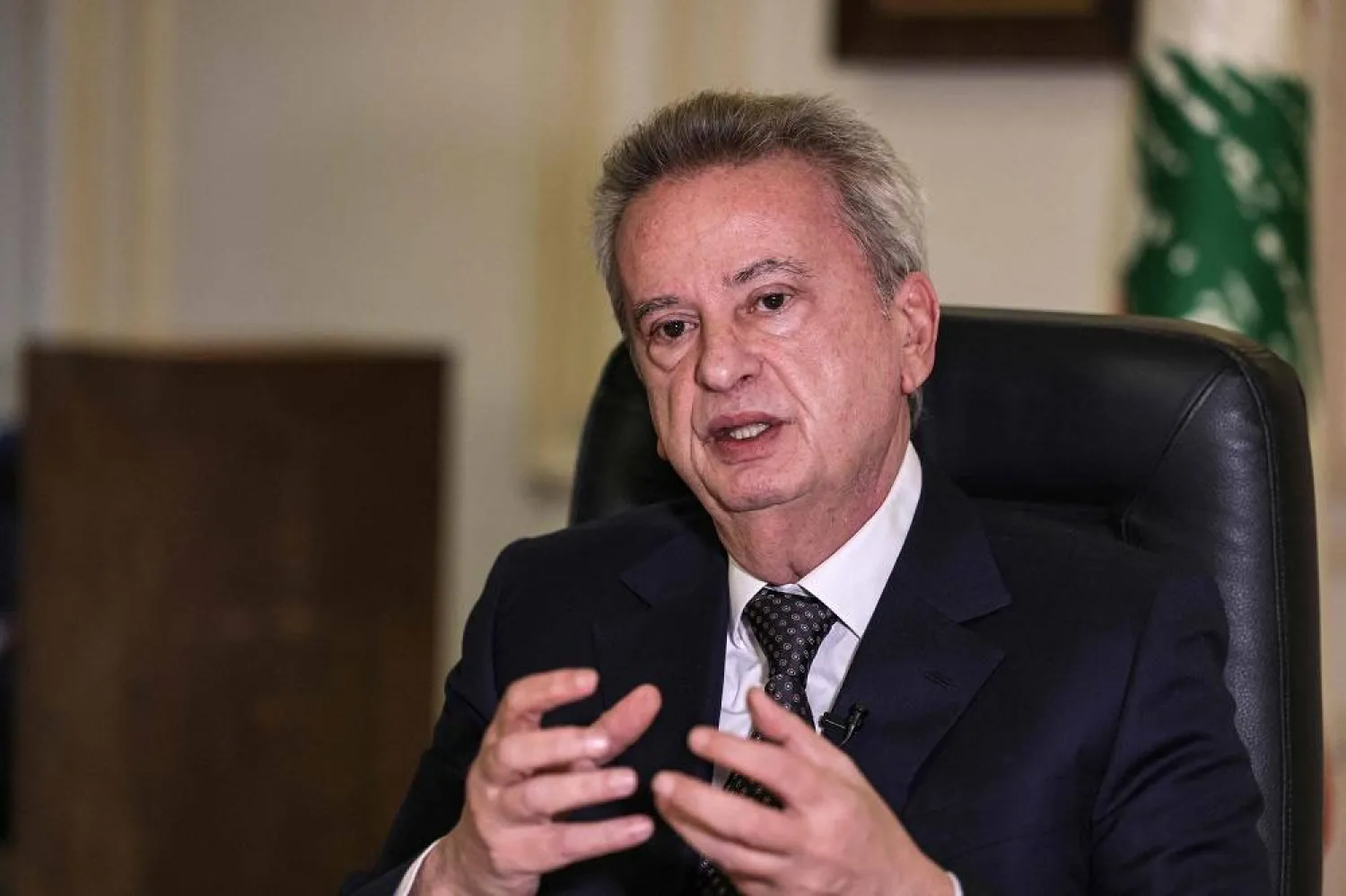

Lebanon Ex-central Banker Transferred to Jail after Hospital

Lebanon's Central Bank Governor Riad Salameh gives an interview with AFP at his office in the capital Beirut on December 20, 2021. (AFP)
TT

Lebanon Ex-central Banker Transferred to Jail after Hospital

Lebanon's Central Bank Governor Riad Salameh gives an interview with AFP at his office in the capital Beirut on December 20, 2021. (AFP)

Former Lebanese central bank governor Riad Salameh was transferred to prison on Saturday after being placed under police guard in a hospital, a judicial official told AFP.

Salameh, who fell ill earlier this week on his way to court to face embezzlement charges, "was admitted and placed among the detainees" in prison following a judge's order, the official said, requesting anonymity.

The official added that Salameh's health "will remain under close observation, and should his condition require medical treatment or transfer to a hospital, the appropriate legal and medical measures will be taken as necessary".

Salameh had been due to appear in court on Thursday in connection with a complaint filed by new central bank governor Karim Soueid accusing him of embezzlement, illicit enrichment and money laundering.

When he failed to appear, a judge directed authorities to escort him to court. Instead Salameh decided to go voluntarily but fell ill en route, and the judiciary postponed the hearing, according to another judicial official.

However, later on Thursday, when Salameh was not found at the hospital emergency department or at addresses registered for him, the judge issued another order for security forces to find him and bring him in for questioning.

After he was located at a hospital outside Beirut, the judge on Friday ordered the security forces "to reinforce measures in the wing where Salameh is staying" and at the facility's entrances, and for the former bank chief to be considered "in custody", the official added.

Last month, an initial hearing was held at Salameh's home due to his deteriorating health, with a judge presiding over his questioning.

The central bank previously told AFP it was the "victim of the embezzlement of funds amounting to several hundred million euros, committed at its expense by its former governor, Mr. Riad Salameh, with the assistance of several individuals in his circle".

Salameh, who headed the central bank from 1993 to July 2023, is accused of having amassed a fortune during his time in the job and has faced numerous accusations including embezzlement and tax evasion in probes in Lebanon and abroad.

The 76-year-old has consistently denied any wrongdoing and has insisted he is being made a "scapegoat" for the country's economic collapse, which began in 2019.



Egypt's Sisi Rejects Palestinian Displacement in Abbas Meeting

A handout photo made available by the Palestinian President Office (PPO) shows Palestinian President Mahmoud Abbas (L)  meeting with the Egyptian President Abdel Fattah al-Sisi  (R) in Cairo, Egypt, 08 January 2024.File / EPA
A handout photo made available by the Palestinian President Office (PPO) shows Palestinian President Mahmoud Abbas (L) meeting with the Egyptian President Abdel Fattah al-Sisi (R) in Cairo, Egypt, 08 January 2024.File / EPA
TT

Egypt's Sisi Rejects Palestinian Displacement in Abbas Meeting

A handout photo made available by the Palestinian President Office (PPO) shows Palestinian President Mahmoud Abbas (L)  meeting with the Egyptian President Abdel Fattah al-Sisi  (R) in Cairo, Egypt, 08 January 2024.File / EPA
A handout photo made available by the Palestinian President Office (PPO) shows Palestinian President Mahmoud Abbas (L) meeting with the Egyptian President Abdel Fattah al-Sisi (R) in Cairo, Egypt, 08 January 2024.File / EPA

Egyptian President Abdel Fattah al-Sisi rejected on Wednesday any plans for Palestinian displacement, hours after Israel's defense minister said the army would "finish the job" in Gaza and remove Palestinians.

During a visit by Palestinian president Mahmud Abbas, Sisi "reiterated Egypt's firm stance against the displacement of the Palestinian people or any attempt to annihilate the Palestinian cause".

Egypt shares the only land border with the Gaza Strip that is not controlled by Israel, and has since 2023 rejected plans to displace the territory's more than two million people into the Sinai peninsula.

Last year, Egyptian Foreign Minister Badr Abdelatty said Cairo had turned down multiple offers to forgive parts of its massive foreign debt bill in exchange for allowing mass displacement into its territory.

Israeli Defense Minister Israel Katz on Wednesday said it was only a matter of time before Israel resumes full-scale war in Gaza, "to finish the job so that we can also implement the migration plan".

He said earlier this month that Israel was ready to remove Palestinians from Gaza by sea and land but was waiting for the United States, which he said was discussing where the two million people would go.

US Ambassador Mike Huckabee has denied any plan to "displace people out of Gaza against their will".

Nearly all of Gaza's population has been internally displaced and most of the territory lies in rubble after three years of war that has killed more than 73,700 Palestinians.

The war began on October 7, 2023 after a Hamas-led attack on Israel that killed 1,221 people, according to an AFP tally based on Israeli official figures.


Aoun: Lebanon Wants Israel Security Deal, Hezbollah Disarmament Without Confrontation

Lebanese President Joseph Aoun speaks during an interview with AFP at the Presidential Palace in Baabda on September 15, 2026. (Photo by JOSEPH EID / AFP)
TT

Aoun: Lebanon Wants Israel Security Deal, Hezbollah Disarmament Without Confrontation

Lebanese President Joseph Aoun speaks during an interview with AFP at the Presidential Palace in Baabda on September 15, 2026. (Photo by JOSEPH EID / AFP)

Lebanese President Joseph Aoun told AFP in an exclusive interview he wants to reach a security agreement with Israel once it withdraws from the south, and is determined to disarm Hezbollah without resorting to confrontation.

Speaking ahead of his departure to France on Wednesday, Aoun said Lebanon wanted a new force, European or otherwise, to prevent a security vacuum after UN peacekeepers leave south Lebanon when their mandate expires at the end of the year.

He called on the United States, European Union and Arab countries to support Lebanon's military as it deploys across the south.

In Paris, Aoun will attend a meeting hosted by President Emmanuel Macron and attended by King Abdullah II of Jordan to build international support for Lebanese troops as they deploy across the country.

"What matters is that there is no vacuum," Aoun told AFP on Tuesday. He added that any new force for Lebanon's south, part of which is occupied by Israel, would be "temporary until the (Lebanese) army can deploy."

"Whatever the nature of this force, that poses no problem for me: European, non-European, American, another United Nations force, Asian, or even a mix of European, Arab and Asian forces," Aoun said.

"The best and most optimal option remains extending UNIFIL's mandate," he added.

Under US pressure, the UN Security Council voted last year to end the force's mandate on December 31, 2026.

The mission, currently involving around 8,500 peacekeepers from nearly 50 countries, has been deployed in south Lebanon since 1978.

Aoun also said he wants a security agreement with Israel "primarily to end the state of hostility and the deployment of the army on the border. This could be a prelude to a later peace agreement, but we cannot jump directly to a peace agreement."

"We have no choice but negotiations, because the alternative is war, which would be very costly for us," Aoun added.

"Our Arab and European partners, as well as the United States and our friends, must share with us the responsibility of supporting the army and strengthening the Lebanese state," he said.

Aoun reiterated Lebanon was determined to disarm Hezbollah, saying the decision was "neither negotiable nor open to discussion."

However, he said, "the objective is not a confrontation... We are determined to resolve this issue peacefully.

"This is not about building a state at the cost of a bloody conflict... or a new civil war."

Aoun said he had told Iran that after Hezbollah's disarmament, relations "must be based on mutual respect and non-interference in the internal affairs of the Lebanese people.

"We have no problem with having a relationship with Iran, but we do have a problem with interference in our internal affairs."


Yemeni Government Forces Regroup to Shift the Momentum

Othman Mujalli, a member of Yemen’s Presidential Leadership Council, inspects forces in Hajjah. (government media)
TT

Yemeni Government Forces Regroup to Shift the Momentum

Othman Mujalli, a member of Yemen’s Presidential Leadership Council, inspects forces in Hajjah. (government media)

Yemen’s army and allied forces have raised their state of alert on the Taiz and Hajjah fronts as they move to reorganize their military positions to shift the momentum, while the Houthis increase pressure on Taiz after seizing the western coast as far as Bab al-Mandab.

In northwestern Hajjah province, Presidential Leadership Council member Othman Mujalli inspected Fifth Military Region forces and affiliated fronts, reviewing their readiness, training and morale.

Mujalli said the armed forces would continue confronting the Houthis and working to restore state institutions, stressing the need to maintain morale and prepare for the battle to liberate the country.

He also praised the Fifth Military Region’s ability to develop equipment for ammunition production and the maintenance of weapons and vehicles, as well as bolster its drone unit and advanced surveillance system.

The visit included naval forces, the coast guard and several islands off Midi district. Mujalli reviewed efforts to evacuate civilians and personnel from Zubair Island after they were stranded because of recent developments along the western coast. He also inspected naval readiness to secure the islands and territorial waters and strengthen the military and security presence along the coast.

The visit comes as government forces seek to hold their positions in the northwest while reassessing their military deployment following rapid developments on the western coast.

Pressure on Taiz

In southwestern Taiz, the Yemeni army announced Tuesday that it had struck a Houthi ballistic missile launch platform at Taiz airport, east of the city. The Taiz Military Axis said warplanes targeted the platform as military vigilance increases around the city amid growing pressure from the west.

The Yemeni Armed Forces had earlier announced strikes on Houthi equipment, personnel and positions seized by the group in Dhubab in Taiz province and Al-Khawkhah in Hodeidah province, according to military spokesman Col. Majid al-Nazili.

The strikes coincided with an inspection tour by Taiz Military Axis Chief of Staff Maj. Gen. Abdulaziz al-Majidi of several fronts surrounding the city.

In southern Taiz, Tur al-Bahah Axis commander and 4th Mountain Infantry Brigade commander Maj. Gen. Abu Bakr al-Gbouli inspected front lines stretching from Bani Omar to Jardad and the outskirts of Al-Wazi’iyah district.

Al-Gbouli said his forces were at a high level of combat readiness and capable of responding to developments on the ground, stressing vigilance, operational discipline and constant preparedness for Houthi movements.

Regrouping

The moves follow a major shift after the Houthis seized large parts of the western coast, including Mokha, Al-Khawkhah and Hays, before reaching Bab al-Mandab and several Red Sea islands. The developments have increased pressure on Taiz, which could become a target for Houthi attempts to expand their control and tighten their grip on the city and surrounding countryside.

Observers say government military activity in Taiz and Hajjah reflects an effort to contain the repercussions of losing the coast and prevent the Houthis from turning their recent gains into a permanent reality on the ground, while reorganizing forces and raising readiness in the most sensitive sectors.

Mujalli also urged tribes to protect their sons from Houthi recruitment and being drawn into fighting. He praised Saudi support for Yemeni forces and humanitarian and development projects and inspected efforts by the Masam mine-clearance project to remove mines planted by the Houthis in government-held areas.

The developments indicate that government forces are seeking to move beyond responding to the recent setback and build a more cohesive military posture, particularly in Taiz, where inland fronts intersect with the coast and Red Sea routes, making the province central to any attempt to shift the momentum.