
Israel Resumes Lebanon Strikes as Talks Underway in Rome

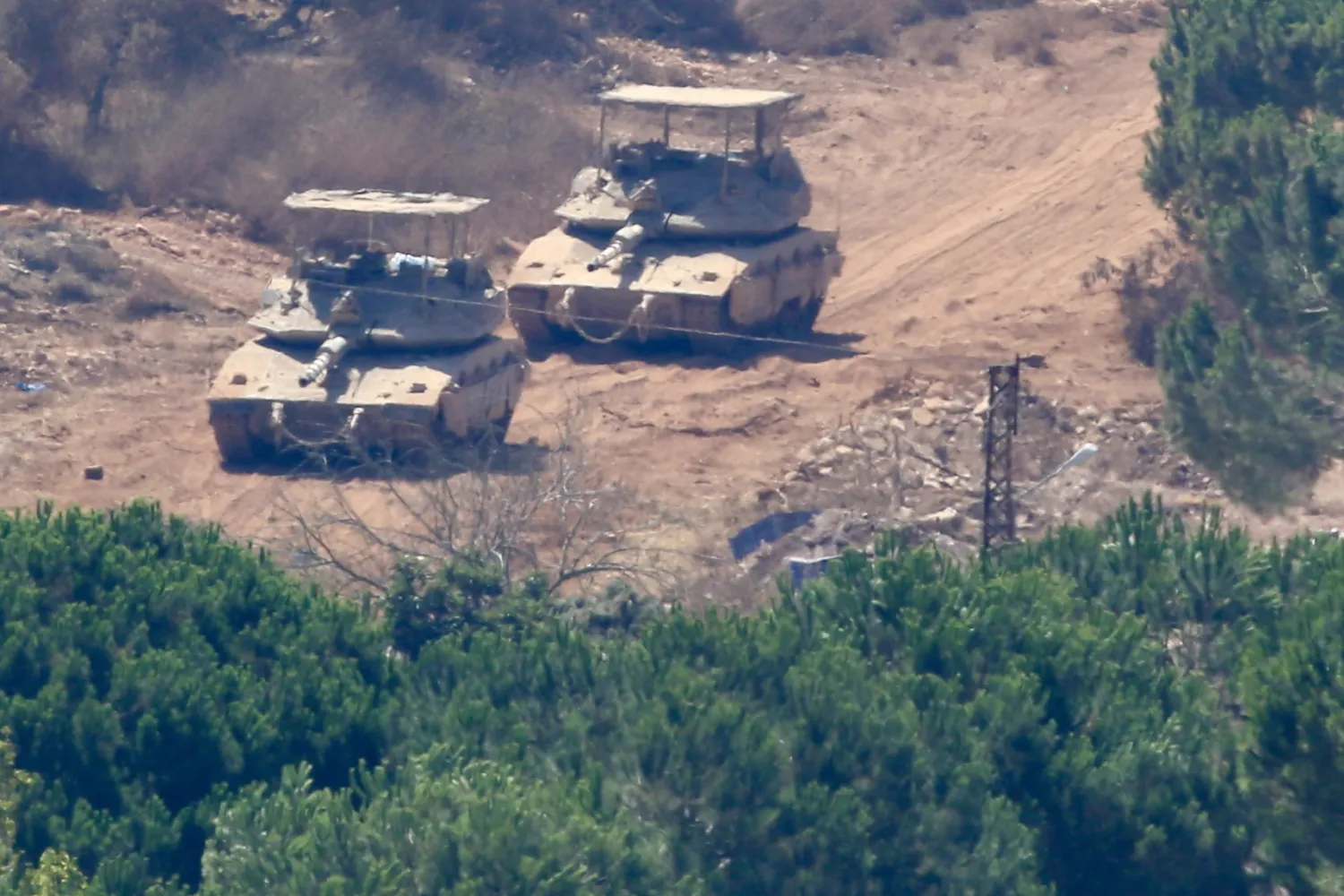
Israeli tanks in Zawtar al-Sharqiyeh as seen from Zawtar al-Gharbiyeh, southern Lebanon, 05 August 2026. (EPA)
TT

Israel Resumes Lebanon Strikes as Talks Underway in Rome

Israeli tanks in Zawtar al-Sharqiyeh as seen from Zawtar al-Gharbiyeh, southern Lebanon, 05 August 2026. (EPA)

Israel's military resumed strikes in southern Lebanon on Wednesday despite ongoing talks, blaming a ceasefire violation by the Hezbollah group as state media reported at least one person killed. 

The fresh strikes, accompanied by the first evacuation warning in weeks, came as the United States led diplomacy between Israel and Lebanon in Rome aimed at putting an end to hostilities, with Beirut seeking Israel's phased withdrawal from the south. 

"In response to a blatant violation of the ceasefire by the Hezbollah terrorist organization, the army has begun conducting precise strikes in southern Lebanon," the Israeli military said in a statement, shortly after telling residents to evacuate the town of Mansouri in the south. 

Lebanese state media said one person died and 11 were wounded in a separate strike. 

In Rome, Israel requested that the day's talks with Lebanon end three hours early, a source in the negotiations told AFP, saying the head of the Israeli delegation, US ambassador Yechiel Leiter, had blamed alleged "misleading leaks" by the Lebanese side. 

But the talks were expected to resume on Thursday for a third and final day. 

In previous US-sponsored talks in June, Israel and Lebanon agreed to a framework deal that involves the disarmament of Hezbollah, a gradual withdrawal of Israeli forces from Lebanon's south and the deployment of the Lebanese army to the region, starting in test areas known as "pilot zones". 

This week's negotiations are the seventh round since Hezbollah drew Lebanon into the Middle East war in March with rocket fire at Israel in support of its backer Iran. 

Israel responded with heavy airstrikes and a ground invasion that Lebanon says have killed more than 4,300 people. 

In its first such warning since June, the Israeli military on Wednesday told the residents of Mansouri: "In light of Hezbollah's violations of the ceasefire agreement, the Israeli forces are compelled to act against it with force." 

"For your safety, you must evacuate your homes immediately and move north," the military's Arabic-language spokeswoman, Ella Waweya, posted on X. 

The UN's humanitarian agency had said just the night before that more than 800,000 people displaced by earlier fighting in Lebanon had begun heading back home following the recent lull in violence, though more than 360,000 remained displaced. 

- 'Shame, humiliation' - 

The town of Mansouri, located around nine kilometers (six miles) south of Tyre and 10 kilometers north of Israel, and its surroundings were subjected to several Israeli strikes and artillery shelling in recent weeks despite the ceasefire between Hezbollah and Israel that took hold in June. 

The town's municipality told residents on June 22 that they could return, but asked them to avoid the part of the town that fell within Israel's so-called "security zone" in southern Lebanon. 

The "security zone" designates a strip of territory where Israeli forces continue to operate that runs around 10 kilometers deep inside southern Lebanon along its border with Israel. 

A US State Department official had told AFP that this week's discussions would "include expanding the pilot zone process, resolving all outstanding border issues, and working on a comprehensive peace and security agreement". 

As the delegations met in Rome, Italian Foreign Minister Antonio Tajani spoke with his counterpart from Iran, Hezbollah's main patron, and called on Tehran to halt the group's operations. 

Tajani, in a post shortly before the Israeli strikes, voiced hope that the talks would "yield concrete results". 

Hezbollah leader Naim Qassem said on Tuesday that the direct negotiations would bring "nothing but shame, humiliation" and successive concessions for Lebanon. 

Hezbollah has repeatedly rejected the direct talks and refuses to surrender its weapons. 

Violence in Lebanon has decreased since the Lebanon-Israel deal and the signing in June of a preliminary US-Iran agreement on the Middle East conflict. 

But Lebanon continued to report intermittent Israeli strikes and shelling, as well as detonations and demolitions in southern villages. 

Since the war between Israel and Hezbollah erupted in early March, Israel's military has lost 38 soldiers and one civilian contractor. 


Sudan’s Al-Burhan Backs Inclusive Dialogue but Pledges to Continue Fighting the RSF

Al-Burhan flanked by Yasser Al-Atta and Shams El Din Kabbashi during the Army Day celebration (Transitional Sovereignty Council Media)
TT

Sudan’s Al-Burhan Backs Inclusive Dialogue but Pledges to Continue Fighting the RSF

Al-Burhan flanked by Yasser Al-Atta and Shams El Din Kabbashi during the Army Day celebration (Transitional Sovereignty Council Media)

The Chairman of the Transitional Sovereignty Council and Commander of the Sudanese Army, Abdel Fattah al-Burhan, has approved an initiative to launch a dialogue that brings together all political and civil parties.

Despite his announcement, he pledged to continue fighting until the rebellion of the Rapid Support Forces (RSF) is defeated across the country.

Speaking on Friday on the 72nd anniversary of the Sudanese Armed Forces, al-Burhan said: "In light of this troubled political reality, a group of Sudanese citizens took the initiative to present their vision to work as an independent national mechanism to prepare for an inclusive Sudanese dialogue, with the goal of reaching a comprehensive national consensus that puts the country on the path to stability."

He added that he agreed to provide the necessary guarantees for holding the all-party talks, facilitate the participation of the different groups, and protect their safety.

Al-Burhan stressed that the state was willing to provide the necessary logistical support as well as legal, political, and security guarantees, without being the organizing entity of the dialogue.

He noted that providing these guarantees does not mean the state will dictate the participants of the dialogue, draft its agenda, control its outcomes, or provide it with political sponsorship.

Al-Burhan clarified that "the action taken by the state regarding any of the participants in the dialogue is not considered a pardon, but rather means suspending the criminal proceedings previously taken by the state against them."

He stated that these measures represent a "temporary immunity" to create appropriate conditions that ensure the participation of the parties.

The Sudanese army commander also pledged legal protection for the opinions and positions expressed by participants, saying statements made during dialogue sessions would not be used as grounds for legal prosecution.

A-Burhan said the army was ready to engage with any serious peace initiative but would not accept what he called an “incomplete peace” that returned the RSF and its supporters to power.

He stated that the army would continue the “completion of the cleansing of the country from the terrorist militia.”

The path to peace must begin with RSF forces withdrawing from cities and gathering in designated areas, followed by the return of displaced people and refugees to their homes, he added.

The Democratic Bloc welcomed al-Burhan’s announcement to hold the all-party talks.

Its spokesperson, Mohamed Zakaria, said Saturday that al-Burhan’s emphasis on the importance of inter-Sudanese dialogue and the need to create a conducive environment for its launch represents a significant step towards addressing the crisis through a national political process.

He called on all sides to engage positively with any serious effort to launch a comprehensive national dialogue, provided that the process is managed entirely by Sudanese parties and that the regional and international role is limited to facilitation and support without interfering in determining participants or imposing an agenda or outcomes.


Egypt, China Consolidate Cooperation by Holding Air Combat Maneuvers

Egyptian President Abdel Fattah El-Sisi and China’s President Xi Jinping held summit talks in the Chinese capital, Beijing, in May 2024. Photo: Egyptian Presidency
TT

Egypt, China Consolidate Cooperation by Holding Air Combat Maneuvers

Egyptian President Abdel Fattah El-Sisi and China’s President Xi Jinping held summit talks in the Chinese capital, Beijing, in May 2024. Photo: Egyptian Presidency

Egypt and China have consolidated their military cooperation by announcing new air combat drills that are set to start this month.

"The Chinese and Egyptian air forces will hold Eagles of Civilization 2026 joint training in Egypt from mid-August to early September," said Senior Colonel Chen Xi, spokesperson for China's Ministry of National Defense (MND), at a press briefing on Friday.

"The training will focus on such subjects as air combat tactics, air superiority operations, and combat search and rescue, and will include force employment drills," said the spokesperson.

"As the second iteration of its kind, the joint training will further enhance mutual trust and traditional friendship, deepen substantive cooperation between the Chinese and Egyptian militaries, and contribute to regional peace and stability," stressed the spokesperson.

The joint air force exercise between China and Egypt "Eagles of Civilization 2025" was held in April last year at an Egyptian air base. It marked the first-ever military air drill between the two nations and the first time the Chinese PLA Air Force systematically deployed multiple troop types to the African continent.

In May 2024, Egyptian President Abdel Fattah el-Sisi and Chinese President Xi Jinping met in Beijing to mark the 10th anniversary of their comprehensive strategic partnership.

The leaders declared 2024 the "Egypt-China Partnership Year,” signing bilateral agreements on the Belt and Road Initiative, technology, and industrial localization.


Yemen's Mokha Port Halts Operations after Houthi Attacks

Flames and smoke rise from the port of Mokha during a strike in Yemen, Friday, Aug. 14, 2026. (AP Photo/Abdulnasser Alseddik)
TT

Yemen's Mokha Port Halts Operations after Houthi Attacks

Flames and smoke rise from the port of Mokha during a strike in Yemen, Friday, Aug. 14, 2026. (AP Photo/Abdulnasser Alseddik)

Yemen's Mokha port has suspended commercial and maritime operations after being hit by more than 25 missiles in Houthi attacks over recent days, the port's director said on Saturday.

The attacks killed seven people and caused an estimated $16 million in losses, the director told a news conference.

The latest attacks come amid an ongoing Houthi escalation that has lasted for about two weeks, targeting military positions and vital facilities in government-controlled provinces, alongside an intensification of operations on several fronts.

Brig. Gen. Sadiq Duwaid, spokesman for the National Resistance Forces, said the group had launched dozens of ballistic missiles and drones in recent days at the city of Mokha, its port, and surrounding facilities.

Duwaid believes the group turned to targeting civilian infrastructure after suffering losses on the battlefronts, while government forces say the latest attacks are aimed at weakening economic activity and depriving residents of essential services and sources of income.

The repeated strikes made it difficult for ambulance and field teams to reach the port in the early hours, according to the National Resistance Forces' military media outlet, which said the intensity of the bombardment hindered firefighting operations and efforts to assess the damage and casualties.