

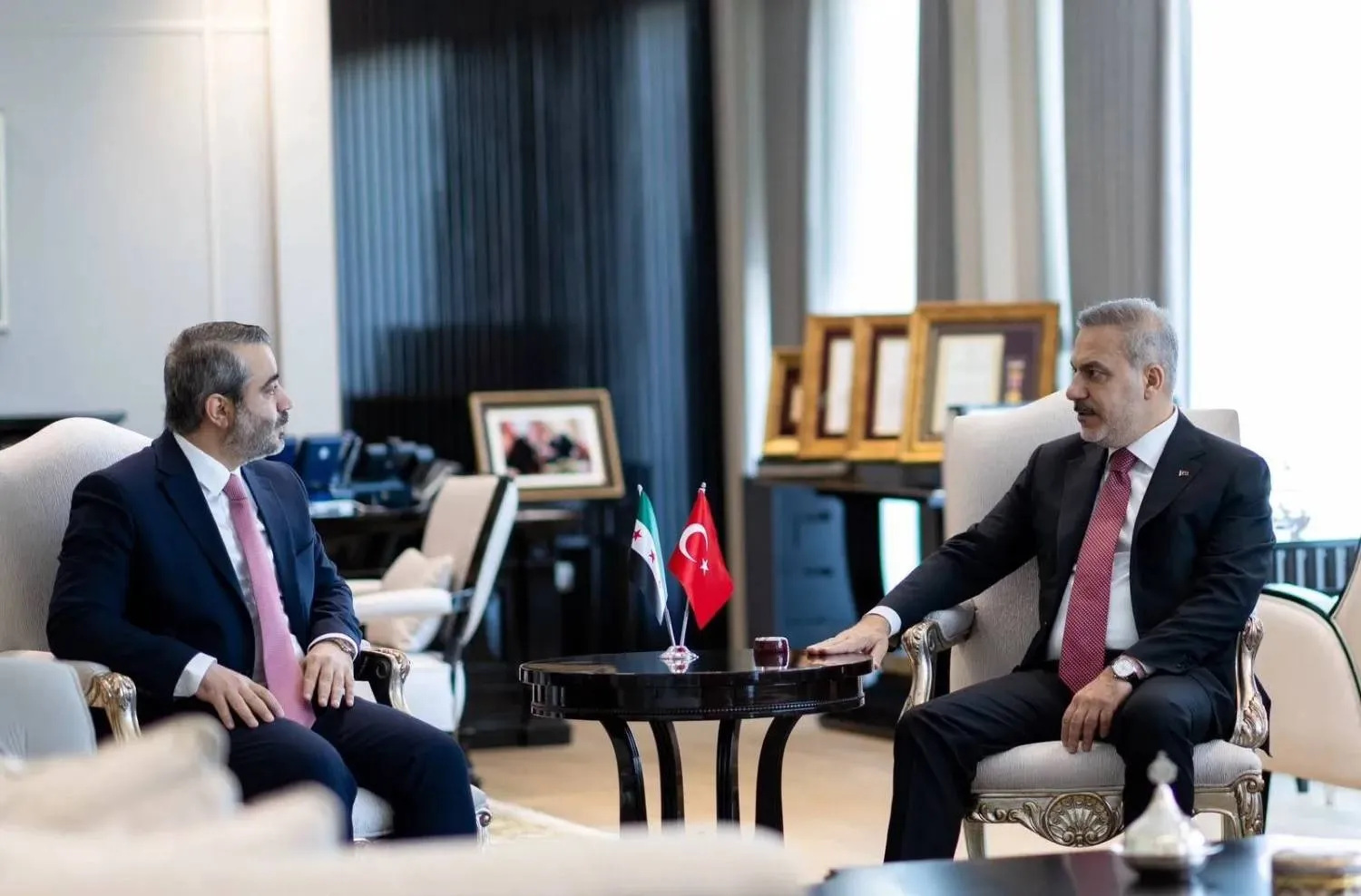

Syria Says Ending Weapons Outside State Control Key to Regional Stability

Turkish Foreign Minister Hakan Fidan and his Syrian counterpart, Asaad al-Shaibani, hold talks in Ankara on Thursday (Turkish Foreign Ministry)
TT

Syria Says Ending Weapons Outside State Control Key to Regional Stability

Turkish Foreign Minister Hakan Fidan and his Syrian counterpart, Asaad al-Shaibani, hold talks in Ankara on Thursday (Turkish Foreign Ministry)

Syrian Foreign Minister Asaad al-Shaibani said Damascus is working to end the presence of weapons outside state control, arguing that dismantling armed formations operating beyond the legal framework is essential to Syria’s stability and could help bolster security across the region.

Speaking at a joint news conference with Turkish Foreign Minister Hakan Fidan following talks in Ankara on Thursday, Shaibani said Syria and Türkiye were cooperating closely on counterterrorism, describing that cooperation as a cornerstone of their partnership.

He said Damascus’ decision to extend state authority and control illegitimate arms had been reflected in dialogue and a legal agreement to unify institutions, referring to the deal to integrate the Syrian Democratic Forces (SDF) into state institutions.

“A unified Syria free of terrorism and armed militias is the best wall protecting our shared borders,” Shaibani stressed, adding that Damascus was coordinating with Ankara to ensure the process succeeds in serving their shared national interests.

Fidan announced that Türkiye and Syria would deepen cooperation and coordination on counterterrorism, defense and security, stressing the importance of completing the integration process underway in Syria without interruption.

“Integrating all armed elements, so-called organizations and militias under a central, legitimate national structure is essential for Syria’s unity and our region’s stability,” Fidan said.

He said Syria had emerged as a country contributing to regional stability throughout the war in Iran, making the protection of its security and peace a shared responsibility for countries in the region.

Fidan also condemned Israeli attacks targeting Syria’s sovereignty and territorial integrity, describing them as among the greatest threats to the country’s stability. Continued Israeli attacks despite understandings over a Gaza agreement showed that Israeli Prime Minister Benjamin Netanyahu did not want peace, he stated.

He urged the international community to respond more forcefully to what he called Israel’s “occupation mentality” and press for compliance with the 1974 Disengagement Agreement and respect for Syrian sovereignty.

Fidan said the talks also covered Palestine and Lebanon, welcoming steps toward normalizing Syrian-Lebanese relations and exploring areas of cooperation. He described Lebanon as another regional challenge amid what he called Israel’s “aggressive and expansionist ambitions,” saying thousands of innocent people had been killed and more than a million civilians displaced.

He also referred to Wednesday’s meeting in Jordan of foreign ministers from more than 20 Muslim countries on Jerusalem, as well as talks involving Türkiye, Egypt, Saudi Arabia and Pakistan. He noted that the four countries agreed on diplomatic steps and could meet again in September.

State control of weapons

Shaibani said ending armed formations outside legitimate state institutions should become the basis for regional stability.

He revealed that Damascus and Ankara had agreed to support efforts in Iraq and Lebanon to strengthen state sovereignty and place weapons exclusively under the control of national institutions, ending sources of instability across the region.

Success in those countries, combined with Syria’s efforts to consolidate state control over weapons, would create an integrated regional security network and pave the way for development and prosperity, he underlined.

Shaibani also condemned repeated Israeli attacks in southern Syria and renewed calls for a return to the 1974 Disengagement Agreement and an Israeli withdrawal to positions held before Dec. 8, 2024.

Regional cooperation

The ministers also discussed expanding economic and regional ties. Fidan said Türkiye was working to facilitate customs procedures, improve border crossings, activate banking channels and coordinate transportation infrastructure with Syria. Turkish public institutions and private companies were also contributing to Syria’s reconstruction and the rehabilitation of its energy and transportation infrastructure.

He highlighted a road and rail initiative linking Türkiye, Syria, Saudi Arabia and Jordan, saying work had begun to implement the project as quickly as possible.

Shaibani said Syria’s geographic position should make it a central hub for regional and global trade, citing plans for rail links with Türkiye, Saudi Arabia and Jordan.

On the US-Iran war, Shaibani pointed that Syria favored diplomacy to prevent the region from sliding into open conflict and strongly condemned attacks targeting Gulf Arab states, describing Gulf security as an integral part of regional security.

He also said Syria faces threats from militias operating across neighboring borders outside state authority and would strengthen border security through technology and coordination with neighboring countries.

The talks also addressed the return of Syrians to their country, which Shaibani described as a top national priority. He pointed that sustainable returns require infrastructure and basic services, with Damascus and Ankara working to link return programs directly to early-recovery projects.



Abdi: Dissolution of SDF Marks New Beginning, Kurds Must Help Draft Syria’s New Constitution

This photo taken on August 25, 2026 shows Syrian presidential adviser Mustafa “Mazloum” Abdi speaking during a televised speech at the People's Palace in Damascus. (AFP)
TT

Abdi: Dissolution of SDF Marks New Beginning, Kurds Must Help Draft Syria’s New Constitution

This photo taken on August 25, 2026 shows Syrian presidential adviser Mustafa “Mazloum” Abdi speaking during a televised speech at the People's Palace in Damascus. (AFP)

New Syrian presidential adviser Mustafa “Mazloum” Abdi described the dissolution of the Syrian Democratic Forces (SDF) after 15 years of armed activity as “an end and a beginning at the same time.”

“Today, for the first time, Kurds have an opportunity to participate, of their own free will, in building the new Syrian state, after the Baath regime pursued policies that denied Kurdish identity,” he stated.

In his first interview with a Turkish media outlet, the former SDF commander said the main objectives of Syria’s Kurds were “not to establish an entity separate from the state, but to become one of the constituent elements of the new state with their own identity, and to expand the gains that have been achieved through constitutional guarantees.”

He also stressed the need for Kurds to take part in the process of drafting a new Syrian constitution.

No deadline has been set for the completion of the process and a committee for drafting it should be formed in two to three months. “We want Kurds to be part of the committee,” he added.

Dissolution of the SDF

Abdi, who is on Türkiye’s terrorism list, told Ilke TV in an interview broadcast Thursday night that Kurds “experienced a particular situation in the region. They lived as a state, and political developments required that, but some changes have taken place recently.”

“The Syrian regime has changed, and a new Syria is being built. The international community wants the current Syrian administration to succeed, and the entire world supports Syria’s unity,” he remarked.

In written responses to questions from the Turkish newspaper Yeni Yasam published Friday, he noted that Kurds could have achieved more through the Autonomous Administration of North and East Syria over the past 15 years, but had not done so.

He added that “the SDF joined the Syrian army with all its resources, under an agreement and a plan. We decided to take our place within this structure, and it has a role within the Syrian army.”

Asked about recognition of Kurdish as a mother tongue, Abdi replied that “we are now at a more advanced stage. For the first time, the Kurdish language has been introduced in schools, and this is a major achievement” for the Kurdish people.

New system of government

“Syria also wants to open up to the international community and comply with international law. Therefore, there is greater scope for establishing a democratic and secular state in the new era,” Abdi added.

He stressed “the need to resolve the problems of all segments of Syrian society,” noting that “the problem of democratic governance remains, and we will work hard to resolve it through political action.”

“The main task facing the Syrian state is to ensure a strong presence within the state for Druze, Alawites, Kurds and all other groups, and efforts are underway to achieve that,” he said.

Asked about his role as an adviser to Syrian President Ahmed al-Sharaa, he explained: “Frankly, the reason we agreed to be present in Damascus during this process is to ensure its success, achieve integration and ensure that Kurds obtain the strongest possible position within the state. That is our main objective.”

“However, our demand is for broader inclusivity. We want to play a positive and constructive role throughout Syria, not only in Kurdish areas,” he went on to say.

On the process underway in Türkiye to dissolve the Kurdistan Workers’ Party (PKK), disarm it and integrate its members into society, he said the process between PKK leader Abdullah Ocalan and Ankara “could contribute to resolving the Kurdish issue in Syria.”

He also expressed openness to developing relations with Türkiye moving forward.

Asked about reports that he could visit Türkiye to meet Ocalan, he gave no clear answer, remarking only: “That would be good.”


Houthi Attack on Western Yemen Tests Readiness of Govt Forces

Government forces are waging fierce battles against the Houthis in Taiz. (Military media)
TT

Houthi Attack on Western Yemen Tests Readiness of Govt Forces

Government forces are waging fierce battles against the Houthis in Taiz. (Military media)

The Iran-backed Houthi attack on western Yemen appears to be aimed at not only achieving gains on the ground, but pressuring the government forces to stretch out their troops on various fronts from Taiz to southern Hodeidah, while keeping marine passageways on the west coast under threat.

The Houthis carried out attacks on government forces in al-Barh, al-Kadha, Maqbanah, al-Ahtoub and Ghabari mountain in one of the fiercest assaults in years.

The attacks allow the Houthis to apply pressure on Taiz city on the west and cut supply routes between it and al-Mokha port.

Government forces on Friday recaptured a strategic position in western Taiz after fierce fighting with the Houthis.

Official military sources said clashes continued on the Maqbanah and al-Kadha fronts as government forces repelled Houthi advances. Government reinforcements have arrived in the area as the Houthis continued to dig in their positions in western Taiz.

Also on Friday, the Houthi launched a ballistic missile at a restaurant in western Taiz, causing fatalities and injuries among civilians. The restaurant and nearby property were heavily damaged.

AFP reported on Friday that over 120 people have been killed in the fighting since Thursday. No official or Houthi death tolls have been released.

The Houthis are focusing their attacks on western Taiz because it connects the city to the coast. Capturing al-Kadha and Maqbanah brings the militants closer to vital supply routes between Taiz and al-Mokha.

Moreover, capturing the areas brings them closer to the west coast and Red Sea waterways. The Houthis have no direct control over the regions overlooking the Bab al-Mandeb Strait, but they do hold Hodeidah city north of al-Mokha.

They had previously launched attacks against vessels transiting the Red Sea.

The legitimate Yemeni government had warned in August of Houthi plans to seize the Bab al-Mandeb coast, which it tied to the regional escalation and the war on Iran.

On the political level, Chairman of the Presidential Leadership Council Dr. Rashad al-Alimi held talks with several military commanders, including PLC member Tariq Saleh, to review the latest developments in Taiz and Hodeidah.

He stressed that the armed forces are capable of handling any escalation and thwarting the Houthi plots, said official sources.

He hailed the level of readiness and morale of the armed forces, adding that the Houthi attacks will not alter the equation on the ground and they will not be allowed to make any advances.

The attacks go beyond defending ground positions, but are tied to restoring state institutions and protecting civilians, waterways and vital facilities, he stressed.

The government will firmly respond to the escalation, while ensuring that the fighting does not spread so as to protect civilian lives, al-Alimi said.


Israeli Strikes on Lebanon Kill Three

04 September 2026, Lebanon, Tyre District: Smoke rises after Israeli forces carried out an explosion targeting homes in Mansouri, southern Lebanon. (dpa)
TT

Israeli Strikes on Lebanon Kill Three

04 September 2026, Lebanon, Tyre District: Smoke rises after Israeli forces carried out an explosion targeting homes in Mansouri, southern Lebanon. (dpa)

Israeli strikes in southern and eastern Lebanon late on Friday killed at least three people and injured 23, the Lebanese health ministry said. 

The ministry said in a statement that strikes hit five locations in the southern Tyre and Nabatieh regions and the Bekaa region in the east. 

It updated an earlier toll given by Lebanese official media which had reported two of the deaths in the south. 

The strikes came despite a truce between Israel and the Iran-backed Hezbollah group. 

Lebanon's state-run National News Agency (NNA) reported the strike hit near the strategic Ali al-Taher ridge, which the Israeli army said it had captured, though Hezbollah did not confirm losing it. 

Two young men were targeted while riding a motorcycle in the city of Nabatieh, NNA said, adding that rescuers transported their bodies to a local hospital. 

Israel announced on Thursday it had taken control of the ridge. Defense Minister Israel Katz said the military would work to "prevent the enemy from re-establishing itself in the area". 

Israel stepped up strikes in the Nabatieh region on Friday and also targeted the village of Rmadiyeh in the Tyre area, located more than 10 kilometers from the Israeli border. 

The ministry said the third person was killed and 15 others hurt there, including two children, three women and six rescuers. 

A rescue service source earlier told AFP that the strike in the village, which is sheltering people displaced from other southern areas, had hit a house. 

Israel and Hezbollah have been trading fire since March when the group dragged Lebanon into the wider Middle East war by attacking Israel in support of Iran. 

Israel responded with airstrikes and a ground invasion that Lebanon says have killed more than 4,300 people. 

The conflict has calmed since a US-Iran memorandum of understanding and a framework agreement between Israel and Lebanon was agreed in June, but Beirut still reports Israeli strikes. 

Imran Riza, the UN humanitarian coordinator for Lebanon, said on X on Friday that families returning to Nabatieh following the truce "face widespread destruction, lack of basic services, ongoing insecurity and uncertainty".