


Syria Sentences Bashar Al-Assad to Death in Absentia Over Atrocities

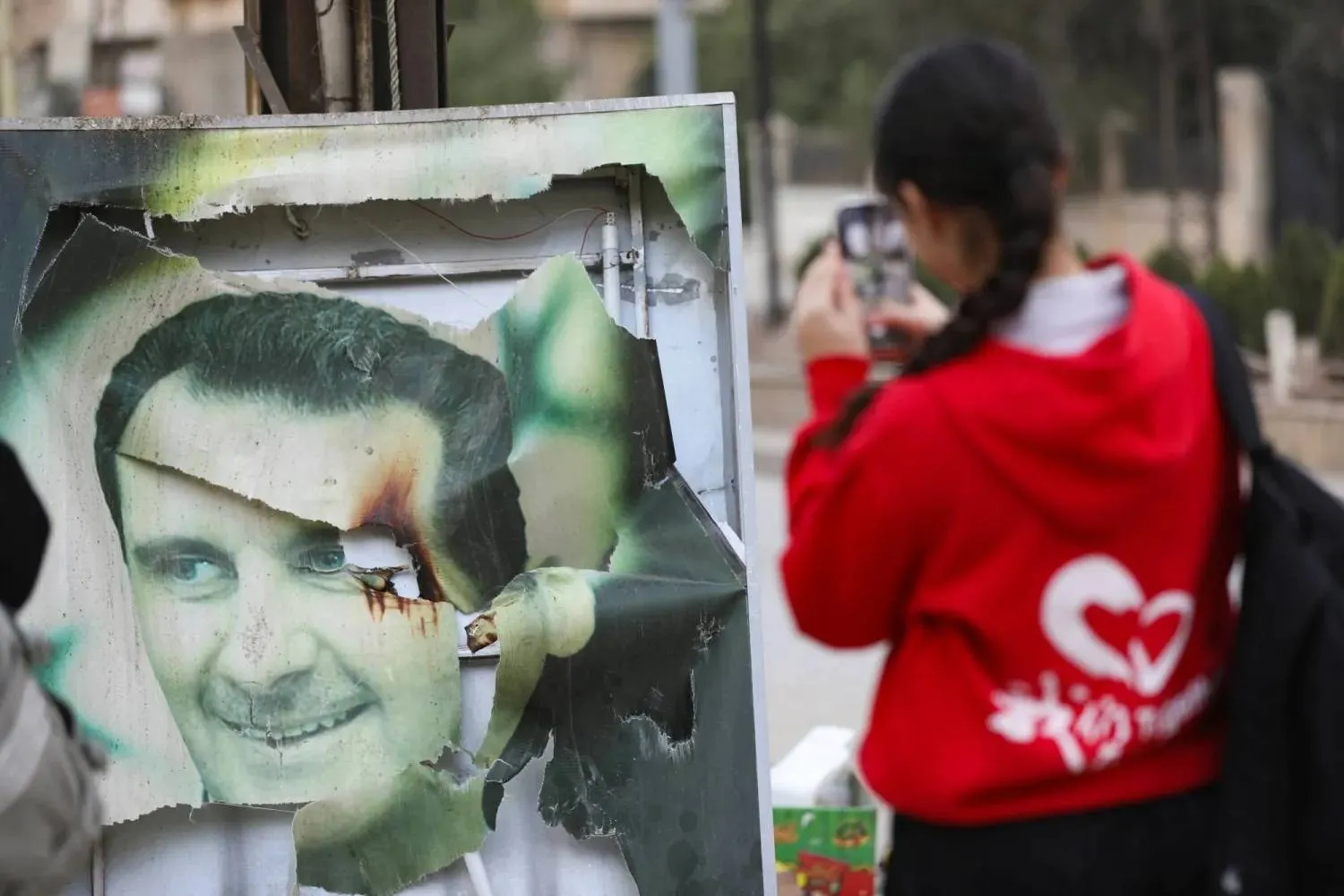
A woman uses her mobile phone near a damaged picture of ousted Syrian ruler Bashar al-Assad as people celebrate, after the Syrian opposition announced that they have ousted President Bashar al-Assad, in Qamishli, Syria December 8, 2024. REUTERS/Orhan Qereman
TT

Syria Sentences Bashar Al-Assad to Death in Absentia Over Atrocities

A woman uses her mobile phone near a damaged picture of ousted Syrian ruler Bashar al-Assad as people celebrate, after the Syrian opposition announced that they have ousted President Bashar al-Assad, in Qamishli, Syria December 8, 2024. REUTERS/Orhan Qereman

A Syrian court on Tuesday sentenced former ruler Bashar al-Assad to death after a trial in absentia, convicting him of atrocities committed during the country's nearly 14-year civil war. 

It is the first such ruling under Syria's transitional leaders who ousted Assad in December 2024, vowing to provide justice and accountability for crimes committed under his rule. 

Assad fled to Moscow as opposition forces closed in on Damascus after a lightning offensive. 

At a court in Damascus, Judge Fakhr al-Din al-Aryan convicted Assad for crimes including "premeditated murder, the intentional killing of more than one person, the intentional killing of children under 15 years... torture, torture leading to death, and deprivation of liberty on multiple occasions -- classified as crimes against humanity and war crimes". 

"He is therefore sentenced to death." 

Syria in April began proceedings against Assad and other officials accused in person and in absentia of atrocities during the country's civil war, which erupted with the former authorities' brutal repression of peaceful pro-democracy protesters. 

More than half a million people were killed and millions displaced, while tens of thousands of people disappeared, many into the country's brutal prison system. 

The court also sentenced six former military and security officials in absentia to death including Assad's brother Maher, who ran the army's elite Fourth Division and also fled the country. 

Those convicted included former defense minister Fahd al-Freij and Louay al-Ali, who headed military intelligence in Daraa province in 2011. 

- Torture - 

The court convicted the officials for crimes including murder, incitement to murder, torture leading to death and repeated deprivation of liberty, also considered "crimes against humanity" and "war crimes". 

Former security official Atif Najib -- the only one in the dock -- was also sentenced to death for "crimes against humanity" committed when he was head of political security in Daraa province, the cradle of the country's 2011 uprising. 

Najib, a cousin of Assad who was arrested in January last year, was convicted for crimes including murder, "the intentional killing of children under 15", and "torture leading to death". 

The acts attributed to him are "crimes against humanity", the court said as it handed down "the harshest punishment against him, which is the death penalty". 

Syria's uprising began in Daraa in March 2011, after 15 students were arrested for allegedly writing anti-government slogans on the city's walls. 

Residents said the students were tortured, leading to a protest to demand their release that ended in bloodshed. 

Security personnel suppressed peaceful demonstrations with force and fired live ammunition to disperse sit-ins at several locations. 

Najib was dismissed after the crackdown, as the protests spread to other provinces. 

Aryan said Najib had denied the charges against him and showed "no remorse". 

Some of Najib's victims were present at the courthouse, including two who were teenagers in 2011 and expressed their opinions to The Associated Press. 

“Today we reached a point where the blood was not wasted,” said Mouawiya Sayasneh, about those who died in the crackdown. Fifteen years later, “there is happiness that Atef Najib was sentenced to death,” he said. 

Another man, Nayef Abazeid, who was detained at the age of 13 in 2011, expressed his satisfaction with the sentence, adding that “our biggest happiness will be when Bashar Assad is executed.” 

Assad took the Syrian presidency in 2000 after the death of his father Hafez. 


Hospital Says 5 People Killed in Gaza

Palestinians walk amid war-damaged buildings in Gaza City, Wednesday, Sept. 23, 2026. (AP Photo/Jehad Alshrafi)
TT

Hospital Says 5 People Killed in Gaza

Palestinians walk amid war-damaged buildings in Gaza City, Wednesday, Sept. 23, 2026. (AP Photo/Jehad Alshrafi)

Israeli strikes overnight in Gaza killed five people, according to al-Shifa Hospital, where the casualties were taken. Four women were among the dead. A mother and daughter among them were Christians, a minority in Gaza, the hospital said,

A large fire burned at the site, where the strikes tore a gaping hole in the ground floor of a multistory building. The hospital said people were still reported missing beneath the debris.

Israel's military did not immediately comment, saying it was checking for information.

Israeli strikes have killed at least 1,439 Palestinians in Gaza since a ceasefire was reached with the Hamas militant group nearly a year ago, according to the territory’s Health Ministry. Its figures are seen as generally reliable by UN agencies and independent experts. It does not give a breakdown of civilians and militants.

Israel says it is targeting Hamas and other militants who pose a threat, and in response to ceasefire violations, including occasional attacks.


Aoun: Army, Security Forces Sole Authorities Responsible for Lebanese Security

Lebanese President Joseph Aoun meets with a delegation from the southern town of Deir Mimas (National News Agency). 
TT

Aoun: Army, Security Forces Sole Authorities Responsible for Lebanese Security

Lebanese President Joseph Aoun meets with a delegation from the southern town of Deir Mimas (National News Agency). 

Lebanese President Joseph Aoun said the army and state security forces alone were responsible for citizens’ security, as Israeli attacks continued across southern Lebanon and Maronite bishops called for all weapons to be brought under state control.

Aoun made the remarks during a meeting with a delegation from Deir Mimas, a predominantly Christian town south of the Litani River, where he reaffirmed the state’s commitment to residents facing Israeli attacks and displacement.

He described the determination of southern residents to remain on their land as the strongest response to Israeli displacement and intimidation, pledging continued support for those who stayed in their villages and those forced to flee.

Municipal chief Tania Bernaba welcomed Aoun’s insistence that weapons remain exclusively in state hands and that decisions on war and peace rest with its legitimate institutions, particularly the army and security forces.

She outlined the town’s difficult security, economic and humanitarian conditions, stressing that residents wanted to remain connected to state institutions and services rather than feel abandoned or isolated.

In response, Aoun expressed solidarity with residents affected by Israeli attacks and pledged that the state would provide protection and support wherever security conditions permitted.

“The Lebanese army and legitimate security forces will be the sole authorities responsible for citizens’ security,” he said, describing the state’s responsibility toward southern residents as a non-negotiable national priority.

He added that political, diplomatic and negotiating efforts were continuing to halt Israeli attacks, secure a complete withdrawal from occupied territory and deploy the army to the internationally recognized southern border.

Maronite bishops back negotiations

Aoun’s position was echoed by the Council of Maronite Bishops, which condemned continued Israeli attacks on southern Lebanon following its monthly meeting in Bkerke.

The bishops urged the international community to help displaced residents return to their homes, support ongoing negotiations and back efforts to place all weapons under state control.

Meanwhile, several residents of Nabatieh al-Fawqa entered their town on foot despite Israeli threats, coinciding with Prime Minister Nawaf Salam’s visit to Nabatieh.

Their return underscored the determination of southern residents to reclaim their homes, while highlighting the gap between government efforts to restore normal life and conditions on the ground, where Israeli threats and military operations continue.

Israeli attacks continue across southern Lebanon

The political statements came amid continued Israeli military operations across several southern towns, including artillery shelling, airstrikes and demolitions.

Field reports indicated that Israeli artillery targeted Mays al-Jabal, while troops fired machine guns toward the outskirts of Baraachit and carried out major demolitions in Beit Lif and Aitaroun, in the Bint Jbeil district.

Israeli aircraft also launched two rounds of strikes on Mansouri, south of Tyre, where a powerful explosion sent tremors through Tyre and neighboring towns.

In Majdal Zoun, Israeli forces carried out two successive demolitions after artillery struck Beit Yahoun, Mansouri, Wadi Zibqin and Wadi al-Slouqi at dawn. Machine-gun fire was also reported toward Hadatha and the outskirts of Baraachit.


Sudanese Army Expands Control in North Kordofan

Sudanese army soldiers take part in a military parade in Gedaref on August 17 (AFP). 
TT

Sudanese Army Expands Control in North Kordofan

Sudanese army soldiers take part in a military parade in Gedaref on August 17 (AFP). 

The Sudanese army said Friday it had recaptured the strategic town of Al-Mazroub in North Kordofan, a week after retaking Sodari, as a deadly drone strike on student housing in the state capital, El-Obeid, highlighted the growing use of unmanned aircraft in the conflict.

The developments come as the UN Security Council prepares for fresh negotiations over a US proposal to extend the arms embargo on Darfur to all of Sudan.

In a statement, the army’s General Command said its troops and allied forces had retaken Al-Mazroub after “fierce battles,” inflicting heavy casualties and vehicle losses on the paramilitary Rapid Support Forces (RSF).

The army pledged to continue operations on all fronts, protect civilians and secure property, urging residents of recaptured areas to resume their normal lives.

Mohamed Deidan, spokesman for the Special Operations Forces in North Kordofan, announced on Facebook that army troops had entered Al-Mazroub at 9 a.m. Friday, a development corroborated by field sources.

Located about 130 kilometers northwest of El-Obeid, Al-Mazroub is an important livestock market that has also served as a military supply route during the war. It had long been under RSF control.

Witnesses reported that RSF fighters withdrew from the town in September but returned after the army captured Sodari, before retreating again as government forces advanced Friday morning.

Holding Al-Mazroub strengthens the army’s ability to monitor movements west of Bara and restrict the town’s use as a transit and supply hub. Consolidating the gain, however, depends on securing surrounding roads and rural areas.

The advance follows recent army gains in Sodari, Um Sharo, Bara, Jabra al-Sheikh and Um Sayala. Field reports indicated that RSF units had retreated toward Um Badr, Hamrat al-Sheikh and the state’s far west, although their current positions remain independently unverified.

Kordofan’s strategic importance stems from its location linking central Sudan to Darfur, making control of its towns and roads critical to troop movements and supply lines.

Meanwhile, the Sudan Doctors Network reported that five people were killed and 47 wounded in a drone strike on University of Kordofan student housing in El-Obeid.

The network blamed the RSF, describing the attack as an escalation in strikes against civilian and educational facilities.

The paramilitary group made no immediate comment, and responsibility for the strike could not be independently established.

El-Obeid has faced repeated drone attacks in recent weeks, reflecting the weapon’s growing use alongside ground operations.

Burhan addresses military recruits

In Khartoum, Sudan’s Sovereignty Council chairman and army chief Abdel Fattah al-Burhan told newly admitted military academy recruits that the armed forces must safeguard the country’s security and unity, with loyalty transcending political, tribal and regional affiliations.

He described the army as a national institution serving all Sudanese and urged recruits to develop their military and technical skills to keep pace with advances in weaponry and equipment.

The Security Council is expected to revisit Sudan sanctions before the current temporary extension expires on October 9.

In September, disagreements over a US proposal to expand the Darfur arms embargo nationwide forced the council to extend the existing measures by just one month.

Washington also seeks tighter restrictions on weapons, drones, related technology and foreign fighters, while Russia and China have expressed reservations about widening the embargo.

Sudan’s government opposes a nationwide ban, arguing it could undermine the army’s ability to defend the country. Instead, it wants tougher measures to prevent weapons and foreign support from reaching the RSF.

The latest escalation in Kordofan adds significance to the Security Council debate, as military operations and drone warfare have spread beyond Darfur, for which the embargo was established more than two decades ago.
