
US ‘Veto’ Stalls Talks to Complete Zaidi Govt in Iraq

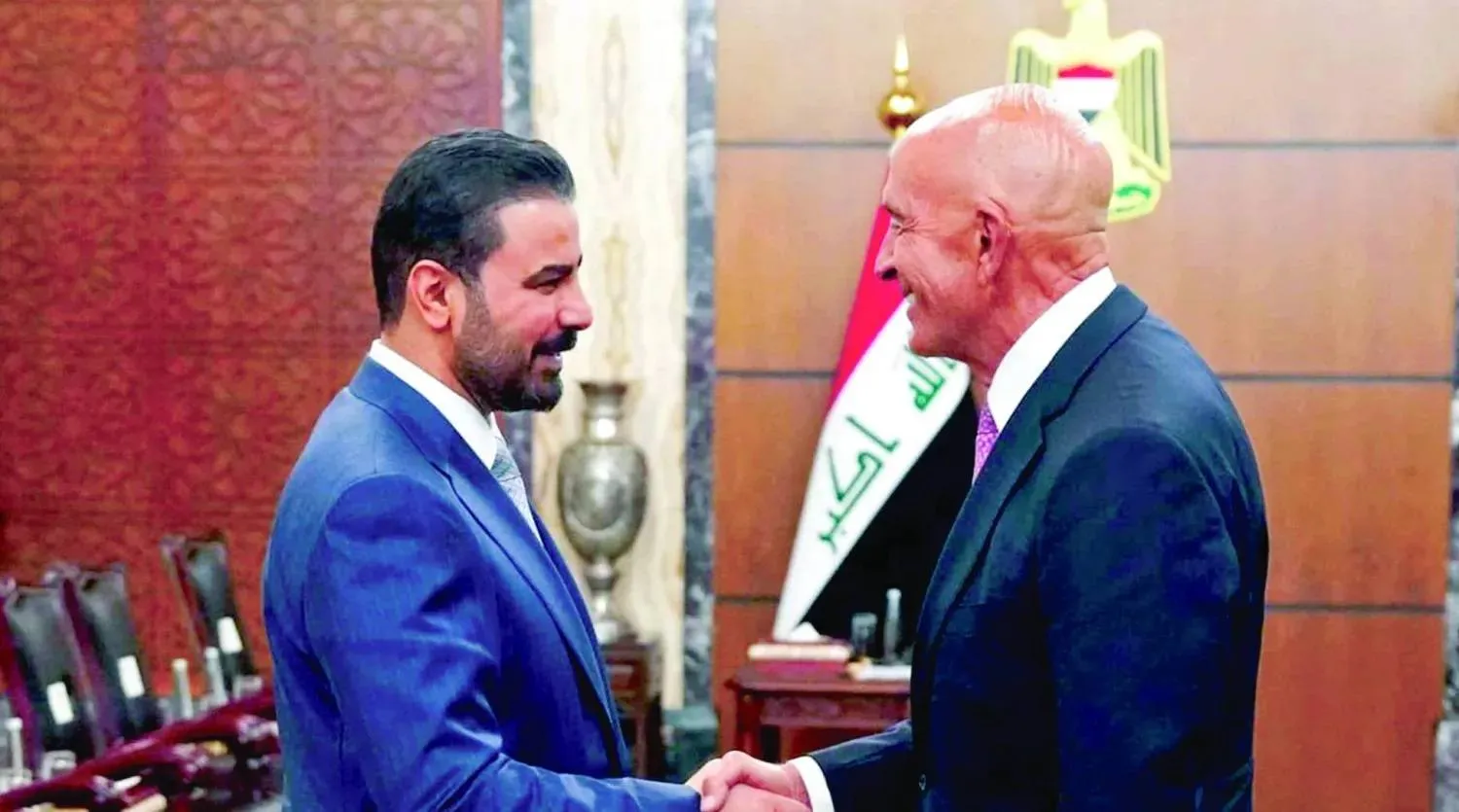
Iraqi Prime Minister Ali al-Zaidi meets US envoy Tom Barrack in Baghdad, June 16, 2026. (Government media)
TT

US ‘Veto’ Stalls Talks to Complete Zaidi Govt in Iraq

Iraqi Prime Minister Ali al-Zaidi meets US envoy Tom Barrack in Baghdad, June 16, 2026. (Government media)

A US “veto” has stalled talks to fill vacant posts in Iraqi Prime Minister Ali al-Zaidi’s government, political sources said, as Washington prioritizes a plan to bring armed factions’ weapons under state control despite Iranian objections.

Al-Zaidi told a meeting of the ruling Coordination Framework on Monday that he was close to completing his cabinet, which he announced in mid-May with 14 ministerial portfolios filled and nine posts vacant.

The vacancies include key ministries such as defense, interior, higher education and planning.

Iraq’s federal parliament has often approved incomplete governments in previous terms because of disputes among political parties and blocs over quotas and ministerial posts, with compromises reached later to fill the remaining portfolios.

But the formation of al-Zaidi’s government appears more complicated, and the remaining posts could stay vacant for months, according to a senior Framework official.

US ‘red lines’

The official told Asharq Al-Awsat that disputes over posts could delay completion of the government for a short period, but recent US intervention, particularly under al-Zaidi’s government, could hold it up for months.

The official said discussions within the Framework pointed to “a veto and red lines” imposed by the United States and US presidential envoy Tom Barrack on virtually all candidates nominated by the Framework.

“Some clearly believe Washington does not want the government completed at the moment,” the official said.

Several sources have previously said Washington categorically rejected representatives of armed factions taking ministerial posts and had raised the issue explicitly with al-Zaidi during his latest visit to Washington in July.

Framework uncertainty

Amid reports that Washington has rejected Laith al-Khazali for the post of deputy prime minister, the senior official said there was confusion within the Coordination Framework over the US position, saying Washington had placed red lines on most of its parties and factions.

“Take the State of Law coalition, for example. It has no factions or armed wings, but it too is under the weight of US anger and is not allowed to take ministerial posts,” the official said. “The same happened with its leader Nouri al-Maliki, whom the US president publicly rejected when he was nominated for prime minister.”

Maliki is the head of the State of Law coalition and Trump had vehemently opposed his nomination.

The official said the US priority appeared to be bringing weapons under state control and countering Tehran’s influence in Iraq, rather than completing the cabinet.

“Washington may prefer the defense and interior ministries to remain directly under Prime Minister al-Zaidi,” the official said.

Amid unconfirmed media reports that the head of Iran’s Quds Force is in Baghdad to counter moves to dissolve the armed factions, political sources said al-Zaidi’s announcement that the remaining cabinet posts would be filled was “a cover for the failure to reach an agreement with the Iranians over bringing weapons under state control, and for concerns about the fate of the government itself.”

After September

Kifah Mahmoud, political adviser to Kurdistan Democratic Party leader Masoud Barzani, said negotiations to fill the remaining government posts could take place in September at the earliest.

September 30 is the deadline set by the Baghdad government to resolve the issue of disarming the factions, he told Asharq Al-Awsat.

He added that Iraq’s federal constitution does not accept the presence of any armed faction outside the authority of the state and government.

Mahmoud agreed with the view that there was US resistance to completing the government, saying Washington had repeatedly opposed senior government posts going to figures close to armed factions.

“The two main parties in Kurdistan, the Democratic Party and the Patriotic Union, support al-Zaidi and his efforts to complete his cabinet,” he said.

“But the issue is tied to disputes among the leading forces within the Coordination Framework, as well as among Sunni parties.”

Still, Mahmoud said “serious US reservations over who holds government posts, and the red lines Washington has imposed, could obstruct al-Zaidi’s efforts to fill the remaining vacancies.”


Libya's NOC Reports Drone Attack Attempt at Fuel Depot

No casualties ‌were reported and the incident ‌did not impact supply operations. (EPA file)
TT

Libya's NOC Reports Drone Attack Attempt at Fuel Depot

No casualties ‌were reported and the incident ‌did not impact supply operations. (EPA file)

A remote-controlled drone attack targeted a fuel depot in Libya's capital Tripoli on Thursday, causing minor damage, the state-owned National Oil Corporation (NOC) said in a statement.

The NOC said that technical teams had begun drawing fuel from the tanks to reduce the fuel level as a ‌precaution.

There was ‌no immediate claim of ‌responsibility ⁠and authorities did not ⁠say who they believed was behind the attack.

The attack caused minor damage to some pipelines and tanks no. 213 and 220 due to falling shrapnel, said Ahmed Al-Masallati, ⁠spokesperson for Brega Petroleum ‌Marketing, which is ‌in charge of Libya's fuel supplies.

No casualties ‌were reported and the incident ‌did not impact supply operations.

Libyan oil facilities have been subject to repeated attacks and closures for various political and technical ‌reasons since the 2011 uprising that toppled Maammar al-Gaddafi and ⁠set ⁠off a prolonged period of chaos.

In August, fuel storage tanks at the nearby Zawiya oil complex, in western Tripoli, were targeted by several explosive-laden drone strikes that hit one of the tanks and completely burned it.

Attempts to target oil facilities represent "a direct threat to the supply system," the NOC said in the statement.


Houthis Escalate Attacks Across Taiz, Yemen’s Western Coast

 The navigation bridge of a sunken vessel is all that is seen at the surface of the water in the Port of Mokha the day after an attack by the Houthis on the city Mokha, held by Yemen's legitimate government on August 10, 2026. (AFP)
The navigation bridge of a sunken vessel is all that is seen at the surface of the water in the Port of Mokha the day after an attack by the Houthis on the city Mokha, held by Yemen's legitimate government on August 10, 2026. (AFP)
TT

Houthis Escalate Attacks Across Taiz, Yemen’s Western Coast

 The navigation bridge of a sunken vessel is all that is seen at the surface of the water in the Port of Mokha the day after an attack by the Houthis on the city Mokha, held by Yemen's legitimate government on August 10, 2026. (AFP)
The navigation bridge of a sunken vessel is all that is seen at the surface of the water in the Port of Mokha the day after an attack by the Houthis on the city Mokha, held by Yemen's legitimate government on August 10, 2026. (AFP)

The Iran-backed Houthi group stepped up military operations on several fronts west of Yemen’s Taiz governorate and along the Red Sea coast on Thursday.

Houthis fired more than 12 ballistic missiles at rural areas in Taiz and Hodeidah governorates as fierce clashes erupted with government forces and the National Resistance in Maqbanah, al-Kadha, al-Tuwair and Ghabari.

Military sources said the fighting began in the early hours of Thursday when the Houthis launched a broad assault on government and National Resistance positions across several sectors. The attack developed into direct clashes and artillery exchanges that lasted for hours.

The group fired hundreds of artillery and mortar rounds during the assault and deployed drones in combat operations, the sources said. The fighting spread to hills overlooking the al-Aqma area in Mawza district, where brigades affiliated with the National Resistance are stationed.

The Houthis seized several positions during the opening hours of the attack before government forces, fighters from Taiz and the National Resistance launched a counterattack and recaptured a number of them, according to military sources.

The sources said the ballistic missiles had no effect on government forces’ battlefield operations. Most of the Houthi missile strikes targeted areas around vital facilities and civilian and military supply routes, causing panic among residents.

Government forces suffered deaths and injuries, while the Houthis also sustained casualties, the sources said, without providing figures for either side. Four Houthi fighters were reportedly captured.

Reports from the Joint Operations Room said air-defense systems and military formations on the Red Sea coast were “maintaining a high level of vigilance in confronting these repeated missile threats, which have become the group’s most prominent means of trying to offset its successive battlefield losses.”

The reports said the attacks were also intended to send a message linked to regional developments around the Red Sea shipping corridor and strategic Bab al-Mandeb Strait.

The missile attacks coincided with an attempted infiltration and ground assault by Houthi fighters against government positions in al-Kadha, west of Taiz.

Three drones downed

Government forces said they shot down three Houthi drones flying over subdistricts in Jabal Habashi district as fighting continued on fronts west of Taiz.

Military sources said the drones were intercepted as the group continued using unmanned aircraft to attack government and National Resistance positions. Clashes persisted in several sectors as forces deployed reinforcements to combat positions.

The ground escalation coincided with a new wave of Houthi missile strikes on the Red Sea coast. The group fired more than 12 ballistic missiles toward several areas east and north of the city of Mokha, as well as areas in Hodeidah’s Khokha district.

Local sources said the missiles were launched from Houthi-held positions in Ibb governorate and from al-Hawban and Sharab, east and north of Taiz. One missile caused a fire on the northern outskirts of Mokha.

The National Resistance’s military media office said the Houthis fired eight ballistic missiles toward rural areas around Mokha, while a ninth landed south of Khokha district. Local sources said three more missiles were launched shortly afterward.

Red Sea coast targeted

The missile strikes coincided with fighting on the Maqbanah and al-Kadha fronts west of Taiz, while air defenses operated by the “Taiz Military Axis” responded to drones launched by the group during the assault.

The escalation came hours after the Houthis targeted residential areas, the vicinity of camps for displaced people and front-line positions in Taiz, where fighting has intensified steadily since August.

Government forces and the National Resistance have continued to repel Houthi attacks across western Taiz and the Red Sea coast as the group persists in using ballistic missiles, drones and artillery.

The simultaneous broad ground assault and missile strikes point to an expansion of the Houthi escalation in the region, which has seen repeated attacks on military positions and areas near residential communities and civilian facilities.

Government forces in Marib and al-Dhale governorates carried out strikes on Wednesday targeting Houthi positions, gatherings and vehicles, and released footage of the operations.


Syria Says Begun Destroying Assad-Era Chemical Weapon Materials

Syrian Ambassador to the United Nations Ibrahim Olabi addresses the Security Council during the meeting on the situation in the Middle East, at UN headquarters in New York City, US, February 18, 2026. (Reuters)
TT

Syria Says Begun Destroying Assad-Era Chemical Weapon Materials

Syrian Ambassador to the United Nations Ibrahim Olabi addresses the Security Council during the meeting on the situation in the Middle East, at UN headquarters in New York City, US, February 18, 2026. (Reuters)

Syria has begun the process of destroying chemical weapon materials identified by an international watchdog, the country's UN envoy said Thursday, signaling a major step forward since the 2024 ouster of autocratic leader Bashar al-Assad.

"This is the very first destruction process since we have been liberated from the previous regime," Ibrahim Olabi told the Security Council. "It's also the first of its kind to destroy chemical materials on Syrian territory for over a decade."

In 2021, the Organization for the Prohibition of Chemical Weapons (OPCW) took the unprecedented step of stripping Syria of its voting rights after finding its air force had used nerve agent sarin and chlorine gas on its own people.

But since Assad's overthrow, the new authorities in Damascus have vowed to cooperate with the OPCW to destroy the chemical weapons the former president was repeatedly accused of using during Syria's 13-year civil war.

"We aim at protecting the Syrian people so that such weapons will not fall into the wrong hands," Olabi said Thursday.

He added that his country was "also protecting the world and the region through such work. Every site that is secured, every ammunition that is identified, does not merely remove a danger to Syria, but the entire world."